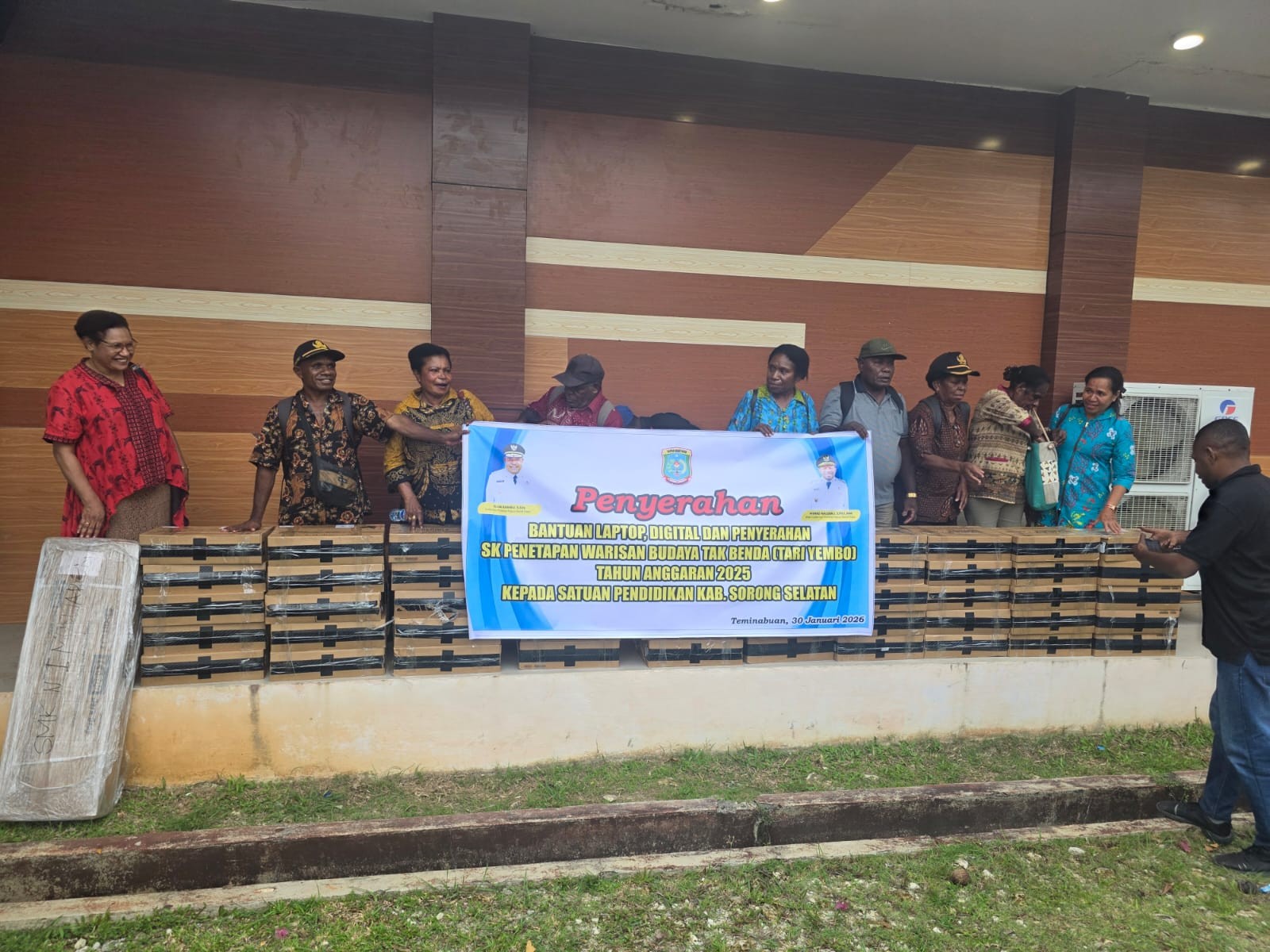
On January 31, 2026, teachers and students began arriving early at a public school in Sorong Selatan Regency, long before the first bell rang. Wooden desks were arranged neatly in the school yard, and a temporary tent had been set up to shield attendees from the tropical sun. At the center of the gathering stood several cardboard boxes, sealed and stacked carefully. Inside them were devices that symbolized something new for education in Papua.
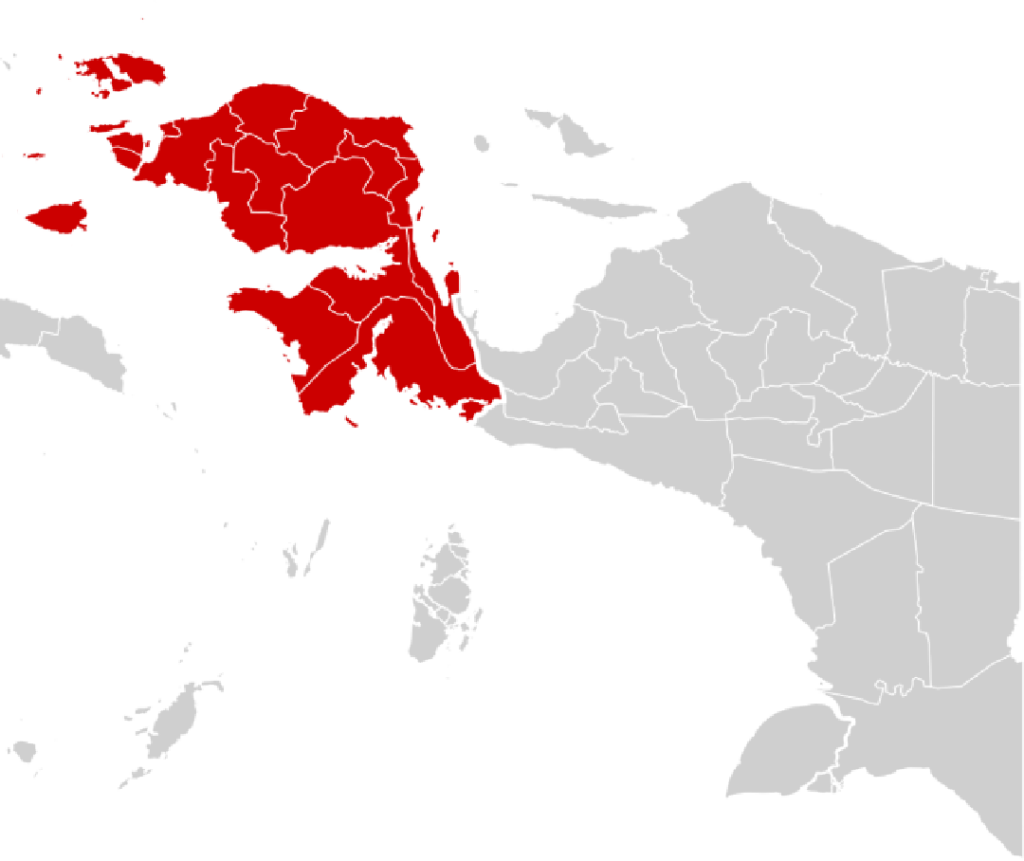
That morning, the Papua Barat Daya (Southwest Papua) Provincial Government officially distributed 50 laptop computers to 10 selected schools in Sorong Selatan. The assistance was part of a provincial program aimed at accelerating digital transformation in education, particularly in areas that have long faced limitations in access to technology and learning resources.
The event was attended by provincial officials, local education authorities, school principals, teachers, and students. For many of them, it was not simply a ceremonial handover, but a moment that marked a shift in how education might look in one of Indonesia’s most remote regions.
A Clear Time and Place for Change
The handover took place in Moswaren District, one of the educational hubs in Sorong Selatan, and was conducted as part of a provincial visit to monitor development programs across the regency. The timing was deliberate. With the new academic semester approaching, the provincial government wanted schools to begin integrating digital tools as early as possible.
Speaking during the event, Elisa Kambu emphasized that education reform in Papua cannot be postponed.
“Education in Papua must move forward at the same pace as other regions,” she said. “Technology is no longer optional. It is a basic tool for learning, and our children must not be left behind simply because of where they are born.”
Her remarks were met with applause from teachers who, for years, had relied on printed materials, handwritten exercises, and limited teaching aids to deliver lessons.
Schools Selected Across Sorong Selatan
According to provincial education officials, the laptops were distributed to 10 schools spread across different districts in Sorong Selatan. These included elementary and junior high schools that had demonstrated readiness to adopt digital learning.
Among the recipient schools were SD YPK Syalom Moswaren, SMP Negeri I Moswaren, and SMP Negeri I Kais. Each school received an average of five laptops, which will be used primarily for classroom learning, teacher preparation, and basic digital literacy programs.
The selection process was conducted through coordination between the provincial education office and the Sorong Selatan education department. Schools were assessed based on student numbers, availability of electricity, basic internet access, and the commitment of school leadership to integrate technology into daily learning activities.
“We want these laptops to be used actively, not stored in cabinets,” said a provincial education official. “That is why we chose schools that are ready to use them immediately.”
Teachers Preparing for a New Learning Environment
For teachers, the arrival of laptops brings both opportunity and responsibility. Many educators in Sorong Selatan have limited experience with digital teaching tools. While some are familiar with basic computer use, integrating technology into lesson plans requires training and adaptation.
At the handover event, several teachers expressed optimism mixed with determination. One junior high school teacher explained that the laptops would allow her to prepare digital presentations, access updated teaching materials, and introduce students to online learning platforms.
“In the past, we explained everything using the board and textbooks,” she said. “Now, students can see visual explanations, videos, and interactive exercises. It makes learning more engaging.”
Provincial officials acknowledged this challenge and stated that the laptop distribution would be followed by teacher training programs. These programs will focus on basic computer skills, digital classroom management, and the responsible use of online resources.
Students Encounter Technology Firsthand
For many students attending the event, it was the first time they had seen multiple laptops in one place. As the boxes were opened and devices displayed, students gathered closely, whispering among themselves and pointing at the screens.
One ninth-grade student from Moswaren said she had previously only seen laptops on television. She explained that learning to use one made her feel closer to the outside world.
“I want to be able to study like students in big cities,” she said. “With a laptop, I can learn more than what is written in our books.”
Her words reflect a broader reality in Papua, where educational inequality is often tied to geography. Access to digital tools can change how students perceive their own potential and future opportunities.
Digital Education as a Development Strategy
The laptop assistance program is part of a wider strategy by the Papua Barat Daya government to strengthen human capital development. Education officials argue that improving digital literacy among students is essential for long-term economic growth.
In Indonesia, digital skills are increasingly required in sectors such as administration, communication, entrepreneurship, and public services. By introducing technology at the school level, the provincial government hopes to prepare students for future demands that extend beyond traditional occupations.
Governor Elisa Kambu noted that education reform must start early. “If students are familiar with technology from school, they will not be intimidated by it later in life,” she said.
Beyond Hardware: Building a Digital Culture
Officials emphasized that providing laptops is only the first step. Sustainable digital education requires maintenance, electricity, internet connectivity, and consistent use. The provincial government has begun coordinating with local authorities to ensure that schools can support these needs.
In some areas, schools rely on limited electricity supply. As a result, schedules for laptop use will be adjusted to ensure devices can be charged and maintained properly. Discussions are also underway to improve internet access in selected districts, although officials admit this remains a long-term challenge.
Despite these obstacles, school principals expressed commitment to building a digital learning culture. Some plan to establish computer clubs, while others intend to rotate laptop use among classes to ensure all students benefit.
Parents and Community Response
Parents who attended the handover event expressed cautious optimism. For families in Sorong Selatan, education is seen as a pathway to a better future, yet access to quality resources has often been limited.
One parent said that while she does not fully understand how laptops work, she believes they will help her children learn more effectively. “We want our children to have the same chances as others,” she said.
Community leaders also welcomed the program, noting that education development contributes to broader social stability. When young people have skills and opportunities, they are less likely to be left behind.
Part of a Broader Education Transformation
The laptop distribution aligns with national education policies aimed at promoting digital learning across Indonesia. However, in Papua, these efforts carry additional significance due to historical disparities in education access.
By focusing on concrete assistance at the school level, the Papua Barat Daya government is attempting to translate policy into tangible impact. Officials stated that future programs may include additional devices, digital textbooks, and online teacher training platforms.
“This is not the end,” said a provincial official. “This is the beginning of a transformation process.”
Conclusion
As the event concluded and the laptops were officially handed over, teachers carefully carried the devices back to their schools. Students followed closely, eager to see how the new tools would be used in class.
In the coming months, the true impact of the program will depend on how effectively the laptops are integrated into daily learning. Challenges remain, from infrastructure to training, but the direction is clear.
For Sorong Selatan, the delivery of 50 laptops to 10 schools represents more than a donation. It is a statement that education in Papua matters, that digital transformation must reach even the most remote classrooms, and that the future of Papua’s children deserves investment today.