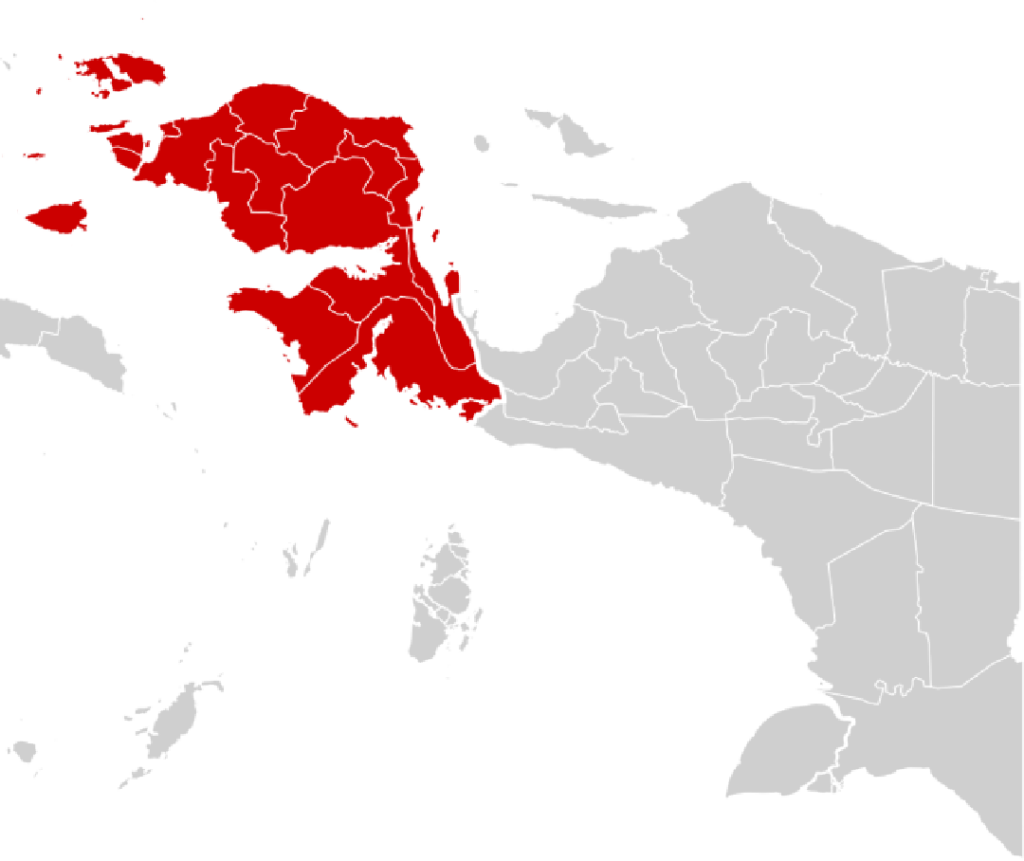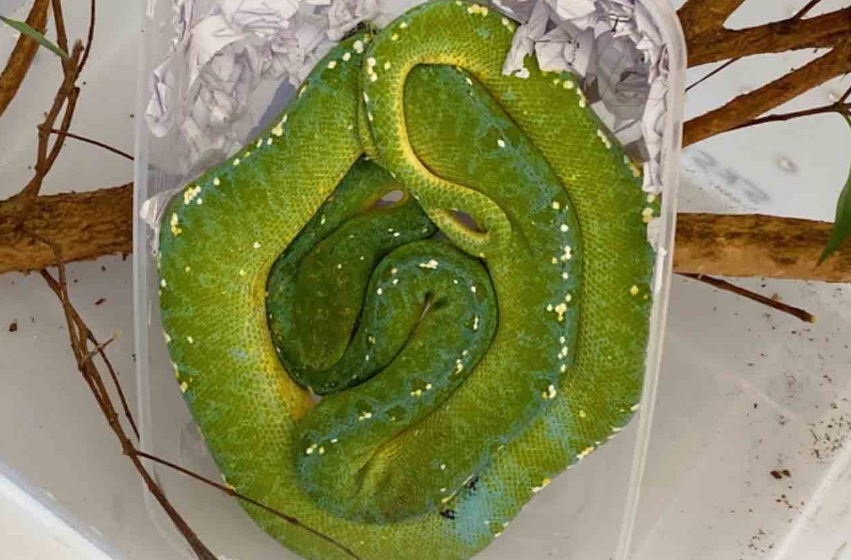
Authorities from the Papua Tengah Quarantine Office (Balai Karantina/Barantin Papua Tengah) have successfully prevented the illegal transportation of several Papuan green tree pythons through the cargo terminal of Mozes Kilangin Airport in Timika, reinforcing Indonesia’s ongoing efforts to combat wildlife trafficking and protect one of the world’s richest centers of biodiversity.
The reptiles, which are endemic to the forests of Papua and highly valued in the illegal exotic pet trade, were discovered during a routine inspection before being shipped to Bandung, West Java. According to officials, the shipment lacked the mandatory documentation required for the legal movement of protected wildlife, prompting quarantine officers to immediately halt the delivery and launch further investigations into the attempted smuggling operation.
Although the seizure involved only a limited number of animals, conservation experts note that every successful interception represents an important contribution to protecting Papua’s fragile ecosystems. Illegal wildlife trafficking remains one of the principal threats to biodiversity across the island, where many species are found nowhere else on Earth.
The latest operation also highlights the increasingly important role of Indonesia’s quarantine authorities in safeguarding not only agricultural and animal health but also the country’s irreplaceable natural heritage.
Routine Inspection Prevents Illegal Wildlife Shipment
The attempted shipment was uncovered during routine cargo inspections conducted by officers from the Papua Tengah Quarantine Office at Mozes Kilangin Airport, one of the busiest transportation hubs serving Papua’s mining and logistics sectors.
Officials reported that inspectors became suspicious after examining cargo destined for Bandung. Further inspection revealed live green tree pythons concealed inside the shipment without the official permits required for transporting wildlife between provinces.
Following the discovery, quarantine officers immediately secured the reptiles and coordinated with relevant authorities to determine the origin of the animals, identify those responsible for the shipment, and assess whether the case was connected to a wider wildlife trafficking network.
Authorities emphasized that Indonesia maintains strict regulations governing the transport of animals, particularly species originating from regions with exceptional biodiversity such as Papua. Quarantine inspections therefore serve not only to prevent the spread of diseases but also to detect illegal wildlife movements that threaten conservation efforts.
Officials praised the professionalism and vigilance of frontline officers, noting that routine inspections remain one of the most effective methods for disrupting illegal trafficking before protected wildlife reaches commercial markets.
Papua’s Green Tree Python Is an Ecological Treasure
The green tree python is widely recognized as one of Papua’s most distinctive reptiles.
Known for its vivid emerald coloration, arboreal lifestyle, and striking appearance, the species inhabits tropical rainforests throughout Papua and parts of neighboring Papua New Guinea, where it plays an important ecological role as a natural predator helping regulate populations of small mammals, birds, and reptiles.
Its unique appearance has also made the species highly sought after within segments of the international exotic pet market.
Conservation organizations have long warned that sustained illegal collection from the wild can place pressure on local populations, particularly when combined with habitat degradation and forest disturbance.
Wildlife biologists emphasize that reptiles such as the green tree python contribute to maintaining ecological balance within Papua’s rainforest ecosystems.
Removing significant numbers of predators from natural habitats may affect food chains and alter relationships among multiple species, potentially reducing ecosystem resilience over time.
Papua is internationally recognized as one of the world’s richest biodiversity hotspots.
Its rainforests contain thousands of plant and animal species, including birds of paradise, tree kangaroos, cassowaries, cuscuses, crocodiles, butterflies, orchids, and numerous reptiles found nowhere else on Earth.
Protecting these species therefore carries significance not only for Indonesia but also for global biodiversity conservation.
Illegal Wildlife Trade Remains a Global Challenge
The attempted smuggling case reflects a broader international challenge confronting many biodiversity rich countries.
According to conservation experts, illegal wildlife trafficking has become one of the world’s most profitable forms of transnational environmental crime, generating significant illicit revenues while threatening endangered species and fragile ecosystems.
Demand for exotic reptiles, rare birds, mammals, and ornamental plants continues to encourage illegal harvesting from forests across tropical regions.
Papua’s remarkable biodiversity unfortunately makes the region particularly attractive to wildlife traffickers seeking valuable species for domestic and international markets.
Experts explain that illegal wildlife trade often involves complex networks connecting collectors, intermediaries, transport operators, and buyers across multiple provinces or countries.
For this reason, successful enforcement depends upon cooperation among quarantine agencies, conservation authorities, police, customs officials, airport operators, and local communities.
Each interception therefore provides valuable intelligence that may help authorities identify broader trafficking patterns and strengthen future prevention efforts.
Strengthening Indonesia’s Conservation Commitment
The successful interception in Timika demonstrates Indonesia’s continued efforts to strengthen biodiversity protection through preventive enforcement.
In recent years, the government has increased coordination among the Barantin, the Ministry of Environment and Forestry, law enforcement institutions, airport authorities, and regional governments to improve monitoring of wildlife transportation routes.
Modern inspection procedures increasingly combine risk based screening, document verification, intelligence gathering, and interagency cooperation to detect suspicious shipments more effectively.
Officials emphasize that preventive inspections remain particularly important because wildlife trafficking is often easier to disrupt before animals leave their region of origin than after they enter broader commercial distribution networks.
Alongside enforcement activities, authorities also continue promoting public awareness regarding legal requirements governing wildlife transport and the ecological importance of conserving Papua’s endemic species.
Environmental educators frequently note that long term conservation depends not only on law enforcement but also on strengthening public understanding of biodiversity protection.
Communities, transportation companies, logistics providers, and wildlife enthusiasts all play important roles in ensuring that Papua’s natural heritage is preserved for future generations.
Conservation Supports Sustainable Development
Protecting wildlife is increasingly recognized as an important component of Papua’s broader sustainable development strategy.
Healthy forests, thriving wildlife populations, and intact ecosystems support ecological services that benefit local communities through clean water, climate regulation, traditional livelihoods, scientific research, and nature based tourism.
Papua’s exceptional biodiversity has also become an important attraction for ecotourism, drawing researchers, photographers, birdwatchers, and conservation organizations from around the world.
Maintaining healthy wildlife populations therefore contributes not only to environmental protection but also to future economic opportunities based on sustainable tourism and scientific collaboration.
Development specialists increasingly emphasize that biodiversity conservation and economic development should reinforce one another rather than compete.
Responsible environmental management helps preserve natural assets while creating opportunities for community based tourism, environmental education, and sustainable livelihoods that can generate long term benefits for Indigenous Papuan communities.
Local Communities Play a Vital Role in Wildlife Protection
The successful interception in Timika also highlights the importance of community participation in safeguarding Papua’s extraordinary biodiversity.
Across Papua, Indigenous communities have long maintained close relationships with their surrounding forests through customary knowledge that has been passed down over generations. Traditional practices governing the sustainable use of natural resources have contributed to preserving many ecosystems that today remain among the most intact tropical forests in the world.
Conservation experts increasingly recognize that protecting Papua’s wildlife cannot rely solely on law enforcement. Long term success depends upon meaningful partnerships between government agencies, Indigenous communities, conservation organizations, researchers, and local leaders.
Public awareness also plays an essential role.
Individuals involved in transportation, cargo handling, logistics, and commercial shipping are often among the first to encounter suspicious wildlife shipments. Strengthening understanding of wildlife protection regulations enables these stakeholders to become important partners in preventing illegal trafficking before endangered species leave their natural habitats.
Environmental education programs likewise encourage younger generations to appreciate Papua’s unique biodiversity while promoting sustainable stewardship of natural resources.
By combining traditional ecological knowledge with modern conservation practices, Papua possesses significant potential to become a model for community based biodiversity protection.
Stronger Coordination Improves Wildlife Enforcement
The Timika operation also demonstrates the growing effectiveness of interagency cooperation in combating environmental crime.
Indonesia’s wildlife protection framework increasingly relies on coordination among the Barantin, the Ministry of Environment and Forestry, customs authorities, airport operators, police, prosecutors, and regional governments.
Such collaboration enables authorities to respond more quickly when suspicious cargo is identified while strengthening investigations into the individuals or networks responsible.
Illegal wildlife trafficking often extends beyond a single shipment.
Conservation investigators note that traffickers commonly operate through organized distribution chains involving collectors, intermediaries, transport providers, and buyers across multiple regions. As a result, every successful interception provides valuable intelligence that may assist authorities in identifying broader trafficking patterns and preventing future offenses.
Officials have emphasized that investigations into the attempted shipment from Timika will continue in accordance with applicable regulations, including efforts to determine the origin of the reptiles and identify those responsible for arranging the illegal transport.
The case also demonstrates the importance of routine inspections at airports, ports, and cargo facilities, where frontline officers serve as the first line of defense against wildlife crime.
Protecting Papua’s Biodiversity Supports Sustainable Development
Papua is internationally recognized as one of the planet’s most biologically diverse regions.
Its rainforests, wetlands, mangrove ecosystems, rivers, and mountain landscapes provide habitat for thousands of endemic plant and animal species that contribute to global biodiversity.
Protecting these natural assets is therefore closely linked to Papua’s broader development agenda.
Healthy ecosystems support clean water, climate regulation, traditional livelihoods, scientific research, ecotourism, and sustainable economic opportunities for local communities.
Increasingly, policymakers view biodiversity conservation as an important pillar of sustainable development rather than an obstacle to economic progress.
Nature based tourism, wildlife research, environmental education, and responsible forest management all offer opportunities to diversify regional economies while preserving Papua’s globally significant ecosystems.
The successful prevention of illegal wildlife trafficking therefore contributes not only to species conservation but also to protecting the long term economic value of Papua’s natural heritage.
Conservation specialists frequently emphasize that preserving biodiversity today creates opportunities for future generations while maintaining ecological resilience in the face of environmental change.
Papua’s Natural Heritage Has Global Significance
The attempted smuggling of endemic green tree pythons also serves as a reminder that Papua’s biodiversity represents an international conservation responsibility.
Scientists estimate that New Guinea, including Indonesia’s Papua region, contains one of the highest concentrations of endemic species anywhere in the world. Many animals and plants found in Papua occur nowhere else, making their protection especially important from both national and global perspectives.
International cooperation in conservation, scientific research, environmental monitoring, and law enforcement has become increasingly important as wildlife trafficking evolves into a transnational challenge.
Indonesia’s continued investment in stronger quarantine systems, environmental governance, and biodiversity protection therefore contributes to broader international efforts to combat illegal wildlife trade while supporting commitments under global conservation agreements.
The Timika interception illustrates how local enforcement actions can have significance far beyond Papua itself by helping preserve species that form part of the world’s shared natural heritage.
Looking Ahead
Authorities are expected to continue investigating the attempted shipment while strengthening monitoring at cargo terminals and transportation hubs across Papua. Officials have indicated that preventive inspections, interagency coordination, and public awareness campaigns will remain central components of Indonesia’s strategy to combat illegal wildlife trafficking. At the same time, conservation programs involving Indigenous communities, environmental agencies, and research institutions are expected to continue supporting the protection of Papua’s exceptional biodiversity while encouraging sustainable development based on responsible natural resource management.
Conclusion
The successful interception of illegally transported green tree pythons at Timika’s cargo airport demonstrates Indonesia’s continuing commitment to protecting Papua’s extraordinary biodiversity from wildlife trafficking. Beyond preventing the unlawful movement of endemic reptiles, the operation highlights the growing effectiveness of quarantine inspections, interagency cooperation, and preventive enforcement in safeguarding one of the world’s richest ecological regions. As Papua continues balancing conservation with sustainable development, protecting its unique wildlife will remain essential not only for preserving fragile ecosystems but also for supporting scientific research, ecotourism, and the long term well-being of Indigenous communities whose cultural and economic futures are closely connected to the natural environment.