
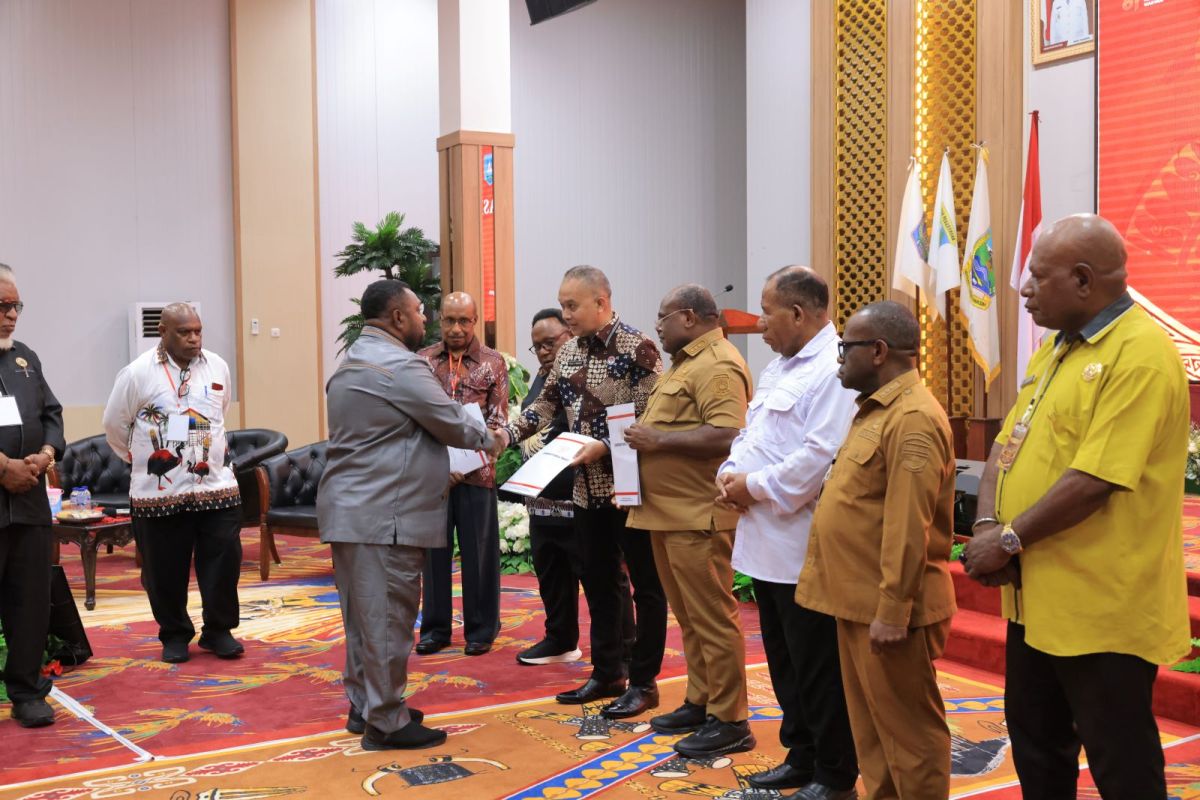
A landmark agreement reached in Nabire has brought a new direction to the debate over the definition of Indigenous Papuans, known locally as Orang Asli Papua (OAP). Regional leaders, the Papuan People’s Assemblies and other representative institutions across the Indonesian provinces of Papua have agreed on three genealogical criteria for determining OAP status, recognising individuals whose biological ancestry comes from either their father, their mother or both parents.
Known as the Nabire Agreement, the consensus was reached on November 24, 2026, following a two-day intergovernmental coordination meeting in Nabire, Papua Tengah (Central Papua). It also proposes removing the separate criterion of becoming an OAP through customary community recognition from the new three-part definition, placing greater emphasis on verifiable family lineage.
The agreement is intended to provide a consistent reference for the protection of Indigenous identity and the implementation of political, economic, social and cultural rights under Papua’s Special Autonomy framework. Its recommendations are expected to be followed up through institutional deliberations, regional special regulations known as Perdasus, and proposals for a limited revision of Indonesia’s Special Autonomy Law.
For Indonesia, the development represents an important effort to strengthen legal certainty in a region where Indigenous identity is closely connected to customary institutions, political representation and the distribution of affirmative development programmes.
The central challenge now is to translate the agreement into clear, legally sound and consistently implemented regulations while ensuring that the diversity of Papua’s customary systems remains properly recognised.
Nabire Agreement: A Collective Decision After 25 Years of Special Autonomy
The agreement emerged from a coordination meeting held on November 23 and 24 at the Papua Tengah Governor’s Office in Nabire.
The gathering brought together governors and regents from across the Papua region, representatives of the Papuan People’s Assemblies (MRP), special autonomy working groups within the provincial legislatures, the Papua Special Autonomy Development Acceleration Steering Agency (BP3OKP), and the Executive Committee for the Acceleration of Papua’s Special Autonomy Development.
The meeting was organised against the backdrop of more than 25 years of implementing Papua’s Special Autonomy policy, which began under Law No. 21 of 2001 and was subsequently amended by Law No. 2 of 2021.
During this period, the framework has provided special arrangements for Indigenous representation, regional governance, financial allocations and the protection of Papuan cultural identity.
However, differences in how provincial institutions interpret the definition of OAP have created challenges in implementing affirmative policies consistently.
The issue has become particularly important in determining eligibility for certain political positions, Indigenous representation and access to programmes specifically designed for OAP communities.
The Nabire meeting therefore sought to establish a common understanding that could be adopted across the six provinces of Papua.
Meki Nawipa: Clarity Is Essential for Papua’s Future
Papua Tengah Governor Meki Nawipa, who also chairs the Association of Regional Heads across Papua, described the agreement as a continuation of recommendations previously submitted by the MRPs.
He said the lack of a consistent definition had generated discussions in different parts of Papua and required a collective response from regional governments and representative institutions.
“We are proud to be Papuans, and we are proud to be part of this country. Today, many Papuans have become leaders, and we will continue moving forward to develop Papua,” Nawipa said following the signing of the Nabire Agreement, as reported by ANTARA on November 25.
His statement reflected the broader objective of the meeting: strengthening Indigenous participation while ensuring that Papua’s development continues within Indonesia’s constitutional and Special Autonomy framework.
Three Genealogical Criteria for Recognising OAP Status
The most significant outcome of the Nabire Agreement is the adoption of three proposed criteria based on biological descent from the Indigenous Melanesian Papuan population.
The formulation recognises that Indigenous identity can be inherited through either the paternal or maternal line, rather than requiring both parents to be Indigenous Papuans.
Under the agreed proposal, the three categories are:
First, individuals whose biological father and mother are both Indigenous Papuans from the Melanesian Papuan population.
Second, individuals whose biological father is an Indigenous Papuan from the Melanesian Papuan population, while their mother is not.
Third, individuals whose biological mother is an Indigenous Papuan from the Melanesian Papuan population, while their father is not.
The inclusion of both paternal and maternal descent is particularly important in a region where different communities maintain distinct kinship systems.
Some Papuan customary societies place strong emphasis on paternal lineage, including family names, clan affiliation and inheritance. Others recognise maternal descent as an important basis for family identity and social relationships.
By acknowledging both lines, the proposed framework seeks to provide a common standard without automatically privileging one customary inheritance system over another.
The agreement also addresses an issue that has generated considerable debate: whether long-term residence in Papua or recognition by a customary community should independently establish OAP status.
Under the three categories agreed upon in Nabire, biological ancestry becomes the principal basis for determining status.
The separate route based on customary recognition, which appears in the existing Special Autonomy Law, is not included as an independent fourth category in the new three-part formulation.
This is a significant policy change proposed by the participating institutions. However, it should be distinguished from a completed amendment to national law. The existing statutory definition remains applicable until the relevant legislative and regulatory processes are completed.
From Earlier MRP Recommendations to the Nabire Consensus
The agreement followed a series of discussions involving the MRPs across Papua.
On November 23, 2026, the Association of MRPs across Papua presented recommendations during a coordination meeting in Nabire.
Secretary of the Association of MRPs, Judson Fersinandus Waprak, explained that a uniform definition was necessary to prevent different interpretations of Indigenous identity between provincial administrations.
He stressed that the status of children born to parents from different ethnic backgrounds required more detailed regulation.
According to Waprak, the criteria should reflect both paternal and maternal kinship systems.
He initially presented three genealogical categories covering individuals whose two biological parents were Indigenous Papuans, those with an Indigenous Papuan father, and those with an Indigenous Papuan mother.
At that stage, the MRP recommendations also discussed the possibility of recognising individuals through customary community acceptance, provided that the process involved accountable verification and the participation of customary institutions.
Waprak emphasised that recognition through customary institutions should not depend solely on personal claims or administrative documents.
The process, he argued, needed to involve legitimate customary authorities to ensure that recognition could be properly justified.
The subsequent November 24 Nabire Agreement brought the discussion into a broader political and institutional consensus, with the three genealogical categories becoming the agreed-upon basis for the proposed common definition.
This progression is important because it demonstrates that the final formulation emerged from discussions involving different institutions rather than from a single administrative decision.
John NR Gobai Calls for a Genealogical Approach
The debate also received attention from John NR Gobai, Deputy Speaker IV of the Papua Tengah Provincial House of Representatives (DPRPT), who participated in the November 23 coordination meeting.
Gobai argued that the definition of Indigenous Papuans should be based on genealogical relationships rather than geographical residence or the length of time an individual has lived in Papua.
He explained that the Papua Tengah legislature had previously adopted Special Regional Regulation No. 14 of 2026 concerning OAP status. However, the regulation subsequently attracted criticism, particularly regarding provisions governing individuals who could be accepted and recognised as Indigenous Papuans.
Gobai acknowledged that the initial drafting process had generated different interpretations and that public feedback needed to be taken seriously.
He said the regulation should be withdrawn and revised, particularly in relation to its definition and eligibility criteria.
In his explanation, genealogical identity could be established through family lineage, clan affiliation, ancestral history, family records and connections to customary land.
“People may live in Papua for many years, even hundreds of years, but from a genealogical perspective, that does not necessarily make them Indigenous Papuans,” Gobai said, according to Salam Papua’s November 23 report.
He also highlighted the importance of recognising maternal lineage.
According to Gobai, children born to Indigenous Papuan mothers retain genealogical connections to Indigenous Papuan communities, including children born outside marriage.
His remarks added an anthropological dimension to the discussion, particularly concerning the different kinship systems found across Papua.
Gobai also proposed that verification should begin at the family level, with relatives and customary groups providing information about ancestry before the relevant institutions validate the claim.
The approach is intended to reduce uncertainty and strengthen the reliability of OAP population data.
Why the Customary Recognition Criterion Became Controversial
The debate over customary recognition is one of the most sensitive aspects of the proposed reform.
Under the existing definition in Article 1 of Law No. 21 of 2001, as amended by Law No. 2 of 2021, OAP includes people belonging to the Indigenous Melanesian population and individuals who have been accepted and recognised as Indigenous Papuans by Papuan customary communities.
This provision has provided a legal route for customary acceptance beyond direct biological descent.
However, discussions in 2026 highlighted concerns about how the provision should be implemented consistently.
Some regional lawmakers and representatives argued that an insufficiently clear recognition mechanism could create different interpretations between customary institutions and provincial administrations.
There were also concerns that claims of Indigenous status should be supported by reliable evidence rather than relying exclusively on individual statements or administrative documents.
Gobai was among those advocating a more clearly defined genealogical approach. He argued that family history, clan relationships and ancestral connections should provide a stronger foundation for verification.
The Nabire Agreement subsequently placed the three biological descent categories at the centre of its proposed definition.
This does not mean that customary institutions have become irrelevant. On the contrary, the proposed verification framework continues to assign important responsibilities to families, clans and customary structures in establishing genealogical information.
The distinction is between using customary institutions to verify ancestry and treating customary acceptance itself as an independent route to OAP status.
That distinction will need to be carefully addressed in the final legal drafting to avoid conflicting interpretations.
A Unified Verification System Across Six Provinces
Another important element of the agreement concerns the creation of a more transparent and accountable system for registering and verifying OAP status.
The meeting agreed that family genealogies should initially be established through families, clans, customary groups and traditional communities.
The MRP in each province would then undertake verification and validation.
Following validation, the information would be integrated by regional governments in cooperation with Statistics Indonesia (Badan Pusat Statistik or BPS).
The proposed arrangement is intended to create a more reliable population database that can support the implementation of Special Autonomy programmes.
Accurate data is particularly important because OAP status is closely connected to affirmative policies and the protection of Indigenous representation.
Without consistent verification, different institutions may use different criteria to determine eligibility for programmes or political opportunities.
A common system could help reduce administrative disputes, improve coordination and make public spending more accurately targeted.
At the same time, the collection of genealogical information must respect privacy, protect sensitive family records and provide a fair mechanism for resolving disputes.
Political Rights and Indigenous Representation
The Nabire Agreement goes beyond defining Indigenous identity.
One of its other important recommendations concerns political eligibility for regional leadership positions.
The participating institutions agreed to propose OAP status as a requirement for candidates seeking election as regents, deputy regents, mayors and deputy mayors throughout Papua.
The proposal is intended to strengthen Indigenous participation in regional political leadership under the Special Autonomy framework.
Supporters argue that local government leadership should reflect the purpose of Special Autonomy, which includes strengthening the role of Indigenous Papuans in governing their communities.
However, the proposed requirement will need to be formulated in accordance with Indonesia’s constitutional framework and relevant electoral legislation.
The agreement also emphasised the special legal character of Papua’s Special Autonomy arrangements.
Under the principle of lex specialis derogat legi generali, specific legal provisions governing special autonomy may take precedence over general legal provisions where the law permits.
This principle is important in determining how special arrangements concerning Indigenous representation, regional administration and natural resource management interact with national legislation.
The Next Stage: Perdasus and the Third Amendment to the Special Autonomy Law
Following the signing of the Nabire Agreement on November 24, the participating institutions agreed to establish a small working team to oversee its implementation.
The team is expected to involve BP3OKP, the MRP and the Executive Committee for the Acceleration of Papua’s Special Autonomy Development.
Its responsibilities will include coordinating the recommendations with relevant national institutions in Jakarta.
These include the Ministry of Home Affairs, the Regional Representative Council (DPD RI), the House of Representatives (DPR RI), the President and the Vice President.
Velix Wanggai, Chairman of the Executive Committee for the Acceleration of Papua’s Special Autonomy Development, described the Nabire Agreement as a collective understanding reached by Papuan leaders and institutions after 25 years of Special Autonomy implementation.
He said BP3OKP and the Executive Committee would communicate the recommendations to the central government, including through the presidential level.
Meanwhile, Judson Waprak said the Association of MRPs would continue the process through internal institutional meetings and plenary discussions in each province.
The agreed criteria are also expected to inform the preparation and harmonisation of Special Regional Regulations, or Perdasus, so that the same standards can be applied across Papua.
At the national level, the proposals will form part of discussions concerning the third amendment to the Special Autonomy Law.
These are complementary legal processes. Perdasus will provide more detailed regional implementation arrangements, while changes to the national Special Autonomy Law would require the appropriate legislative process involving the central government and parliament.
The Nabire Agreement itself does not automatically amend existing legislation or immediately change the legal status of individuals already recognised as OAP.
Conclusion
The Nabire Agreement marks an important stage in Papua’s continuing efforts to strengthen the implementation of Special Autonomy through clearer definitions, institutional coordination and more reliable population data.
By recognising paternal and maternal descent, the proposed three-part definition seeks to accommodate different family backgrounds while establishing a common genealogical standard across the region.
The proposed removal of customary acceptance as an independent eligibility category represents a substantial policy shift. Its eventual implementation will depend on careful legal drafting, consultation with customary communities and the completion of the relevant legislative procedures.
For Indonesia, the initiative provides an opportunity to strengthen the credibility of affirmative policies and ensure that programmes intended for Indigenous Papuans are administered with greater consistency and accountability.
For the people of Papua, the most important outcome should be greater certainty that Indigenous identity, political representation and development opportunities are protected through fair and transparent institutions.
Ultimately, the success of the Nabire Agreement will depend not simply on the wording of a new regulation but on whether it strengthens the position of Indigenous Papuans while respecting the cultural diversity and customary traditions that make Papua unique.
Read Also
Papua Leaders Seek Otsus Law Revision to Protect Indigenous Rights
Indonesia Pushes Faster Indigenous Papuan Census

