
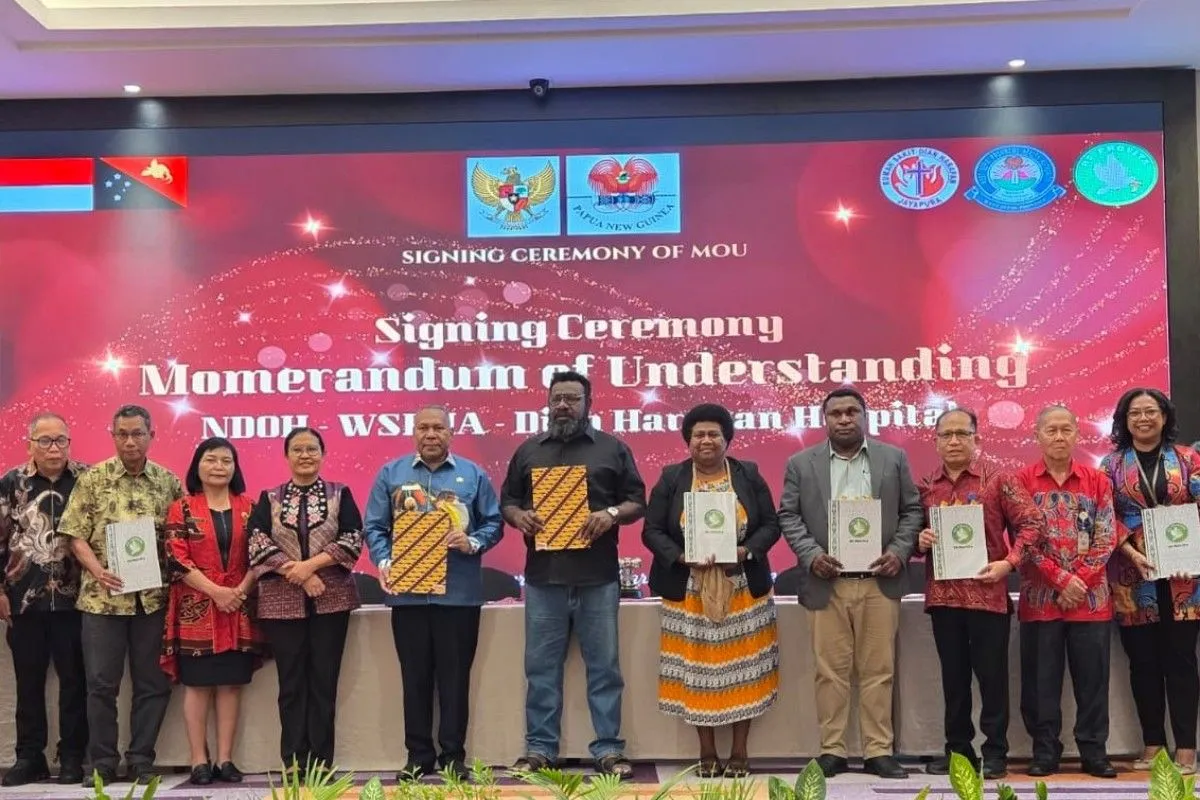
Papua-Papua New Guinea (PNG) healthcare cooperation has entered a new phase following the signing of a cross-border medical services agreement between two hospitals in Jayapura and health authorities in PNG. The partnership is intended to improve access to medical treatment for communities on both sides of the international border, particularly residents of PNG’s West Sepik Province who may require services not readily available in their home areas.
The agreement was signed in Jayapura on November 12, 2026, involving Dian Harapan Hospital and Provita Hospital, West Sepik Provincial Health Authority (WSPHA), and PNG’s National Department of Health (NDoH).
Papua Deputy Governor Aryoko Rumaropen said the cooperation was designed to respond to continuing limitations in healthcare facilities and specialist medical personnel in several border areas.
The agreement is expected to strengthen coordination in patient referrals, specialist medical services, diagnostic examinations, and treatment that may not be available in patients’ places of residence.
The development follows months of discussions and hospital visits by PNG health officials, beginning in May 2026. Subsequent discussions in June explored the possibility of developing Jayapura as a regional medical service center for patients from neighboring PNG communities.
For Papua, the initiative is significant beyond healthcare. It could also support economic activity in transportation, accommodation, food services, and other businesses that serve patients and accompanying family members. More importantly, it reflects the longstanding social and geographical connections between communities living along the Indonesia-PNG border.
From Initial Discussions to a Formal Agreement
The latest agreement is the result of a process that began with an exploratory visit by PNG health authorities to Jayapura in May 2026.
On 25 and 26 May, a delegation from PNG’s National Department of Health and West Sepik Provincial Health Authority travelled to Jayapura to examine medical facilities and explore possible cooperation with the Papua Provincial Government.
The delegation was led by Ambrose Kwaramb, Executive Manager of the Health Standards and Compliance Wing at the National Department of Health, and Stanley Masi, Chief Executive Officer of the West Sepik Provincial Health Authority.
During the visit, the delegation inspected a number of government and private hospitals to assess their facilities and the services available.
The hospitals included:
· Jayapura Central General Hospital (RSUP Jayapura), under Indonesia’s Ministry of Health.
· Jayapura Regional General Hospital, commonly known as RSUD Dok II.
· Jayapura Mental Hospital.
· Bhayangkara Hospital.
· Provita Hospital.
· Dian Harapan Hospital.
The delegation also visited companies supplying medical equipment and pharmaceutical products in Jayapura.
The inspections were intended to provide PNG officials with a clearer picture of the medical infrastructure and supporting industries available in the Indonesian border region.
The Indonesian consul in Vanimo Alexander Tangkuman said the visit was an important step towards establishing cooperation between the two sides.
He expressed hope that the discussions could lead to formal agreements covering both healthcare services and the export of medical equipment.
Tangkuman also pointed to the potential for increased Indonesian exports through the Skouw State Border Crossing Post (PLBN Skouw), which connects Jayapura with Vanimo, the capital of PNG’s West Sepik Province.
He said the proposed cooperation could increase the value of exports from Indonesia, particularly medical equipment and related products, while strengthening cross-border economic relations.
The May visit therefore addressed two connected opportunities: improving access to healthcare and developing trade in medical supplies.
June Discussions Highlight Medical Tourism Potential
The exploratory visit was followed by further discussions in June, when the Papua Provincial Government began examining the possibility of developing cross-border healthcare services into a broader medical tourism opportunity.
On June 8, Papua Regional Secretary’s Assistant for General Affairs Suzana Wanggai said the provincial government welcomed PNG’s interest in healthcare facilities in Jayapura.
She explained that PNG representatives had previously visited Jayapura Regional Hospital and Jayapura Central General Hospital to assess their facilities and services. The response from the visiting delegation was positive, creating opportunities for more extensive cooperation.
Suzana said the provincial government and relevant health institutions would continue improving hospital services and preparing the supporting arrangements needed to receive patients from abroad.
She identified the possibility of making Jayapura a referral center for PNG residents, particularly people living in Vanimo and neighboring provinces who need medical treatment that may not be available locally.
The discussion was not limited to the clinical aspects of healthcare. Suzana also highlighted the economic opportunities that could arise when patients travel with family members.
Patients and their accompanying relatives may require transport, accommodation, meals, and other services during their stay. These needs could create additional demand for local businesses, including small and medium-sized enterprises, hotels, restaurants, and transport operators.
“If managed properly, this cooperation will improve healthcare services and support economic growth among the people of Papua,” Suzana said in June, as reported by ANTARA.
Her remarks reflected the provincial government’s view that improved regional healthcare capacity could generate benefits across several sectors of the local economy.
On June 17, Suzana reiterated that the development of hospital tourism needed careful preparation. She said the positive response from PNG officials to Jayapura’s hospital facilities represented an opportunity that should be followed up through practical improvements.
She also emphasized that the government needed to ensure that hospitals were ready to serve patients from outside Indonesia, including through better service quality and supporting arrangements.
The June discussions thus helped establish the policy and economic context for the agreement signed in November.
November Agreement Establishes a Framework for Patient Referrals
The exploratory discussions culminated in the signing of a Memorandum of Agreement on November 12, 2026.
The agreement brought together Dian Harapan Hospital and Provita Hospital in Jayapura with West Sepik Provincial Health Authority and PNG’s National Department of Health.
Deputy Governor Aryoko Rumaropen said the partnership was intended to address gaps in healthcare facilities and specialist medical personnel in some border areas.
He explained that geographical proximity and longstanding social relationships between communities on both sides of the border made cooperation particularly relevant.
Residents of Indonesia in Papua and PNG have maintained social, family, and economic connections across the border for many years. For people living in West Sepik and nearby areas, Jayapura can be a geographically relevant destination when particular medical services are required.
Aryoko said cross-border coordination could help ensure that patients who need medical treatment receive services appropriate to their conditions.
He identified several areas that the agreement is expected to strengthen, including patient referral arrangements, specialist medical care, and diagnostic examinations and treatment that may not be available in the patient’s home area.
“We hope that through this cooperation, people who require medical treatment can obtain services in a more structured, coordinated, timely, and accountable manner,” Aryoko said.
His statement underlined the importance of having clear procedures rather than relying on informal arrangements between patients, hospitals, and health authorities.
A coordinated referral system can help clarify where patients should be treated, which facilities are appropriate for their conditions, and how medical information should be communicated between the referring and receiving institutions.
The agreement also provides an institutional basis for cooperation between the health authorities of the two countries and the participating hospitals.
However, the public announcement has not yet detailed specific patient quotas, treatment prices, insurance arrangements, referral eligibility rules, or the full operational schedule. These matters will need to be clarified by the participating institutions as implementation proceeds.
Why Jayapura Matters for PNG’s Border Communities
Jayapura’s location gives it a practical role in cross-border healthcare cooperation.
The city is connected by road to the Skouw border crossing, which provides access to Vanimo in West Sepik Province. This geographical connection creates opportunities for residents of nearby PNG communities to consider medical services in Jayapura when appropriate facilities are available.
For people living in border areas, access to specialist treatment can be affected by distance, transport availability, and the distribution of medical personnel.
A patient may need to travel beyond their immediate community to obtain diagnostic examinations, specialist consultations, or treatment. A referral arrangement with hospitals in Jayapura could provide another option, depending on medical needs and the procedures established by the two countries.
The partnership also has the potential to improve coordination between healthcare institutions rather than leaving patients and families to navigate cross-border treatment independently.
Nevertheless, geographical proximity alone does not guarantee access. The practical value of the agreement will depend on border-crossing procedures, medical documentation, referral protocols, payment arrangements, and the ability of hospitals to accommodate patients.
These operational matters are particularly important for patients requiring urgent treatment or ongoing specialist care.
Medical Tourism Could Generate Wider Economic Benefits
The provincial government sees potential economic benefits beyond the direct provision of medical services.
Suzana Wanggai has said that patients arriving from PNG are generally accompanied by family members. Their presence creates demand for a range of services, including transport, accommodation, meals, and other daily necessities.
This influx could provide opportunities for local businesses in Jayapura and surrounding areas.
Hotels and guesthouses may receive additional visitors, restaurants may serve more customers, and transport providers may benefit from journeys between the border, hospitals, and accommodation facilities.
Small businesses could also participate by supplying food, daily necessities, and other services required by patients and their families.
For Papua, this possibility connects healthcare development with a broader regional economic strategy. Medical services could become an additional source of economic activity while strengthening Jayapura’s role as a service center for communities in the Indonesia-PNG border region.
However, the development of medical tourism should be understood as a potential outcome rather than an established industry. Its success will depend on the quality of medical services, affordability, patient confidence, and the availability of supporting facilities.
The provincial government has therefore emphasized the need for continued improvements in hospital services before the opportunity can be developed on a larger scale.
Hospitals and Supporting Industries Need to Prepare
The May delegation’s visits to hospitals, medical equipment suppliers, and pharmaceutical companies suggest that the cooperation is not limited to patient referrals.
The availability of medicines, medical equipment, and supporting supplies is essential to maintaining reliable healthcare services.
Cooperation in these areas could also create opportunities for Indonesian suppliers to serve the PNG market, particularly through established border trade channels.
Alexander Tangkuman specifically highlighted the possibility of increasing exports of medical equipment through PLBN Skouw.
This aspect could complement the healthcare agreement by linking medical services with trade and logistics. However, any export arrangements would require the relevant regulatory approvals, product standards, and commercial agreements between the parties.
Hospitals also need to ensure that their clinical services are prepared for patients from another country. This includes appropriate communication, patient administration, medical records, billing procedures, and coordination with referring institutions.
Suzana has said that the provincial government would continue working with relevant agencies to improve hospital services and prepare the supporting requirements for international patients.
The agreement therefore creates a framework for cooperation, while implementation will require sustained coordination between government agencies, hospitals, and supporting businesses.
A Partnership Built on Neighbourly Relations
Healthcare cooperation also reflects the longstanding relationship between communities in Indonesian Papua and PNG.
People living along the border have family, social, and geographical connections that extend across the national boundary. These relationships create practical reasons for the two sides to cooperate on issues affecting daily life.
Aryoko Rumaropen said the longstanding social and family ties between border communities were an important consideration in developing the agreement.
He described cross-border healthcare cooperation as a shared response to the medical needs of people in both countries.
This approach places the partnership within the broader context of Indonesia-PNG relations. Beyond diplomacy and trade, cooperation in healthcare can deliver direct benefits to communities through access to medical services and closer institutional coordination.
It also demonstrates how regional governments can contribute to bilateral relations by addressing practical issues that affect people living near the international border.
For Papua, the partnership offers an opportunity to strengthen its role as a healthcare service center in the eastern part of Indonesia while supporting cooperation with its neighboring country.
Conclusion
The healthcare agreement between Papua and PNG marks an important development in efforts to improve access to medical services for communities along the international border. What began with hospital inspections and exploratory discussions in May has progressed through policy consultations in June to a formal agreement involving two Jayapura hospitals and PNG health authorities in November.
The next challenge is to turn that agreement into practical services. Clear referral procedures, affordable treatment, reliable medical coordination, and improvements in hospital capacity will be essential to ensure that patients receive appropriate care without unnecessary delays.
The potential benefits also extend beyond hospitals. If managed effectively, the partnership could generate economic opportunities for transport providers, accommodation businesses, restaurants, medical suppliers, and small enterprises in Papua.
Ultimately, the value of Papua PNG healthcare cooperation will be measured by its impact on patients and their families. By combining stronger medical services with cross-border coordination and responsible economic development, Papua and PNG have an opportunity to build a partnership that responds to the everyday needs of their neighboring communities.
Read Also
Damai Cartenz Task Force Brings Free Healthcare to Ilaga
Indonesian Hospital Ship Treats 1,213 in Papua New Guinea
Indonesian Navy Rescues 11 PNG Fishermen in Pacific

