
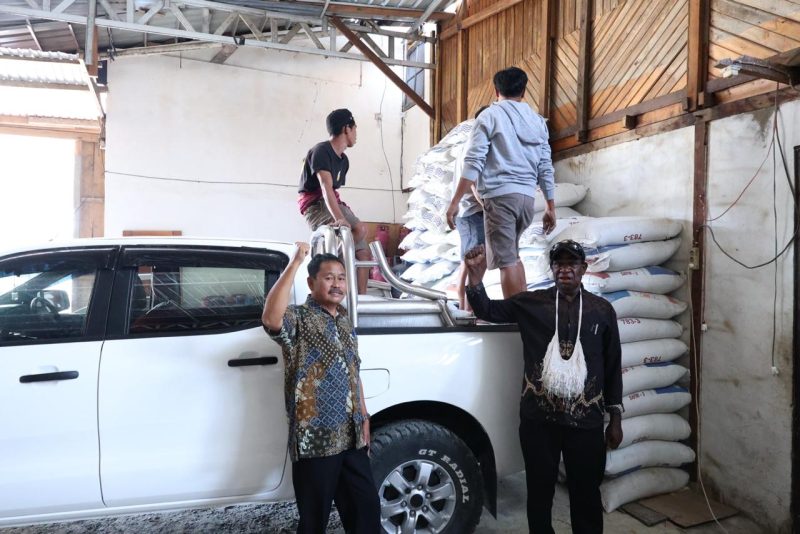
The Papua Pegunungan (Highland Papua) Provincial Government has begun distributing 25,000 fish fingerlings and 3.8 tonnes of fish feed to farming groups as part of an effort to strengthen food security and expand household economic opportunities through freshwater aquaculture.
The Papua Pegunungan programme for assisting fish farming is being implemented by the provincial Livestock and Fisheries Agency, with support directed towards communities in several regencies. The assistance consists of 15,000 tilapia fingerlings and 10,000 common carp fingerlings, alongside feed intended to help farmers establish and maintain productive fish ponds.
The distribution began in October 2026 and is being carried out in stages. Deliveries have to take account of flight availability because the fingerlings are transported from Jayapura to the highland region. The logistical challenge has made careful scheduling essential to ensure that the fish reach farming groups in suitable conditions.
In the initial phase, three farming groups received assistance comprising tilapia and carp fingerlings measuring approximately 13 to 15 centimetres, along with 1.5 tonnes of fish feed. The first distribution represented around 10 percent of the overall programme, according to the agency’s acting head, Paulus Arung Ramba.
A subsequent update published by ANTARA on November 9 detailed the allocation of the 3.8 tonnes of feed: three tonnes for freshwater aquaculture groups in Jayawijaya Regency and 800 kilograms for groups in Nduga Regency.
The initiative is intended to do more than provide fish farmers with immediate supplies. By supporting local aquaculture, the provincial administration hopes to increase fish production, improve access to nutritious food and create additional sources of income for households in Papua Pegunungan.
A Provincial Push to Develop Freshwater Aquaculture
The programme is part of the Papua Pegunungan Provincial Government’s wider effort to develop local economic activities and strengthen food security.
Agriculture and livestock production are important sources of livelihood in many communities across the highlands. Freshwater fish farming offers another opportunity for households and farmer groups to diversify their economic activities while contributing to local food supplies.
Through the Livestock and Fisheries Agency, the provincial government has chosen to support aquaculture groups with two essential inputs: fingerlings and feed.
The 25,000 fingerlings are divided into two species. Tilapia accounts for 15,000 fish, while the remaining 10,000 are common carp. Both are freshwater species included in the programme to support the development of fish cultivation.
The assistance is intended to help farming groups establish or expand their production capacity. Access to fingerlings provides farmers the opportunity to stock their ponds, while the provision of feed helps address one of the recurring requirements of fish cultivation.
For communities seeking to develop small-scale aquaculture, the combination of these inputs can provide a starting point for more organised production. The longer-term objective is to encourage farming groups to develop productive and sustainable businesses rather than rely solely on one-off assistance.
Distribution Begins in October Despite Transport Challenges
The first stage of distribution began in October 2026, with the provincial government arranging the movement of fingerlings and feed to selected farming groups.
In a report published by Potret Papua on October 22, Paulus Arung Ramba explained that deliveries were being organised according to flight conditions. The fingerlings were sourced from Jayapura, making air transport an important part of the distribution process.
Unlike the movement of ordinary agricultural supplies, transporting live fish requires attention to timing and handling. Delays or unsuitable transport conditions can affect the condition of the fingerlings before they reach their destinations.
Paulus said the first delivery covered three farming groups and included fingerlings measuring approximately 13 to 15 centimetres, as well as 1.5 tonnes of fish feed.
The initial phase represented around 10 percent of the overall assistance programme. Further deliveries were therefore planned in stages, depending on the availability of flights and the ability to reach farming groups in different regencies.
The approach reflected the practical difficulties of delivering agricultural inputs across a mountainous region. Transport availability, distance and local accessibility all influence how quickly assistance can reach its intended recipients.
Rather than distributing all the supplies at once, the agency adjusted its schedule to the conditions on the ground.
Meagama, Hubikosi and Napua Among the Initial Locations
The October distribution covered farming groups in several locations, beginning with communities in Jayawijaya Regency.
In Jayawijaya, the initial recipients included a farming group in Kampung Meagama, Hubikosi District, and another group in Napua District.
The provincial government also identified farming groups in Lanny Jaya and Tolikara as targets for the wider programme.
These locations formed part of the effort to extend aquaculture assistance beyond a single administrative area. The intention was to make support available to farming communities in different parts of Papua Pegunungan while allowing deliveries to proceed according to transport conditions.
Paulus said the agency hoped that the assistance would be used effectively to develop productive and sustainable fish farming activities.
He also stressed that the distribution was expected to continue during 2026 as long as flight conditions allowed. The government wanted farming groups across the province’s regencies to benefit from its efforts to develop the fisheries sector.
November Update Details Feed Allocation for Jayawijaya and Nduga
The programme’s progress was further outlined in an ANTARA report published on November 9, 2026.
Speaking in Wamena, Paulus confirmed that the provincial government had distributed a total of 3.8 tonnes of fish feed to freshwater aquaculture groups in Jayawijaya and Nduga.
The allocation consisted of three tonnes for farming groups in Jayawijaya and 800 kilograms for groups in Nduga.
Paulus said the distribution was determined according to the available budget and the agency’s records of freshwater aquaculture groups in the province.
He explained that the 2026 revised regional budget, known as the Anggaran Pendapatan dan Belanja Daerah Perubahan (APBD Perubahan), provided the funding framework for the programme.
“For this year, through the revised regional budget, we are focusing on supporting freshwater fish farming in Jayawijaya and Nduga. Next year, the assistance will be distributed to other areas that have not yet received it,” Paulus said, as quoted by ANTARA.
The November update also highlighted the reasons for selecting the two regencies for feed allocation.
According to Paulus, communities in Jayawijaya had shown considerable enthusiasm for developing freshwater fish ponds. Nduga, meanwhile, was also considered to have potential for freshwater aquaculture, with its geographical position near South Papua cited as part of the regional context.
He expressed hope that the feed assistance would encourage residents in both regencies to further develop their fish farming activities.
The November report provides a more specific breakdown of the feed allocation than the earlier October coverage. The October reports also identified Lanny Jaya and Tolikara as intended beneficiaries of the wider distribution programme. The available reports do not explain whether the allocation schedule or beneficiary coverage subsequently changed.
Strengthening Household Income Through Fish Farming
The provincial government expects the assistance to support the development of aquaculture as a source of household income.
For small farming groups, fish cultivation can create an additional economic activity alongside existing agricultural and livestock work. If production is managed consistently, harvested fish may be consumed by households or sold to local buyers.
The distribution of fingerlings and feed is intended to help farming groups take the first steps towards building that capacity.
Paulus said the government hoped the assistance would increase farmers’ incomes, encourage economic growth and strengthen food security across Papua Pegunungan.
He also linked the programme to the provincial governor’s development vision, particularly the objective of improving regional food security and supporting better nutrition among residents.
“We hope this fish assistance can increase farmers’ incomes, encourage community economic growth, strengthen food security and support the Governor’s vision and mission, particularly in achieving food security in Papua Pegunungan. In addition, this programme is expected to help meet the community’s nutritional needs,” he said, as quoted by Potret Papua.
The programme therefore connects two development priorities: strengthening local livelihoods and improving access to nutritious food.
Fish can provide an important source of protein. Increasing local production could provide households another source of food while potentially reducing their dependence on supplies brought from outside the region.
However, the extent of that contribution will depend on whether the farming groups can maintain their ponds, manage feed supplies and achieve successful harvests.
Food Security and the Importance of Local Production
Food security is not determined only by the availability of food at markets. It also depends on whether communities can produce sufficient supplies, maintain reliable distribution systems and afford the food they need.
In geographically challenging areas such as Papua Pegunungan, strengthening local production can form part of a broader effort to improve food availability.
Freshwater aquaculture offers one possible contribution. By encouraging communities to cultivate fish locally, the provincial government seeks to expand the range of food production activities available to households.
The programme’s combination of fingerlings and feed is designed to support the production process from the beginning. The fingerlings provide the initial stock, while feed supports their growth during cultivation.
The approach also creates an opportunity for farming groups to develop practical knowledge and experience. Successful fish farming requires attention to pond conditions, feeding schedules, water quality and the timing of harvests.
The programme’s success will depend on both the amount of aid given and the recipients’ ability to manage the resources.
The agency’s emphasis on productive and sustainable aquaculture indicates that the intended outcome is a continuing local economic activity, rather than a temporary distribution exercise.
The Next Challenge: Maintaining Production and Expanding Coverage
The staged distribution reflects the logistical conditions facing the provincial government. Since fingerlings are transported from Jayapura, flight availability remains an important factor in determining when additional deliveries can take place.
The November announcement also indicates that the government intends to extend assistance to other areas in the following year, particularly locations that have not yet received support.
That approach could give more farming groups an opportunity to participate, although the available reports do not specify the number of additional recipients, future quantities of fingerlings or feed, or a detailed distribution timetable for 2027.
For the current beneficiaries, the immediate priority will be to make effective use of the supplies already received. Maintaining fish health, managing feed consumption and ensuring suitable pond conditions will be essential to achieving productive harvests.
The provincial government will also need to maintain communication with farming groups to understand their needs and identify any obstacles that could affect production.
If local cultivation develops successfully, the benefits could extend beyond individual households. Increased production may create opportunities for local trading, strengthen links between farmers and markets, and contribute to a more diverse food supply in the highlands.
Conclusion
The distribution of 25,000 fish fingerlings and 3.8 tonnes of feed represents a practical step by the Papua Pegunungan Provincial Government to develop freshwater aquaculture as part of its food security and economic development agenda.
By supporting farming groups in Jayawijaya and other targeted regencies, the provincial government is seeking to expand local production, improve access to nutritious food and create additional income opportunities for rural households.
The programme has also demonstrated the importance of adapting public assistance to regional conditions. Transporting live fish from Jayapura requires careful coordination and flexibility, making staged distribution a practical response to the challenges of serving communities across the highlands.
The next measure of success will be the results achieved by the recipient farming groups. Consistent pond management, effective use of feed, and successful harvests will determine whether the initial assistance can evolve into a sustainable source of food and income.
For Papua Pegunungan, the wider objective is to build stronger local production capacity and provide communities more opportunities to participate in their own economic development. If supported by continued guidance, reliable distribution and access to markets, freshwater fish farming could become an increasingly useful part of that effort.
Read Also
Papua Tengah Seeks Major Boost for Fisheries Sector
Papua Fish Exports Target the US Market

