
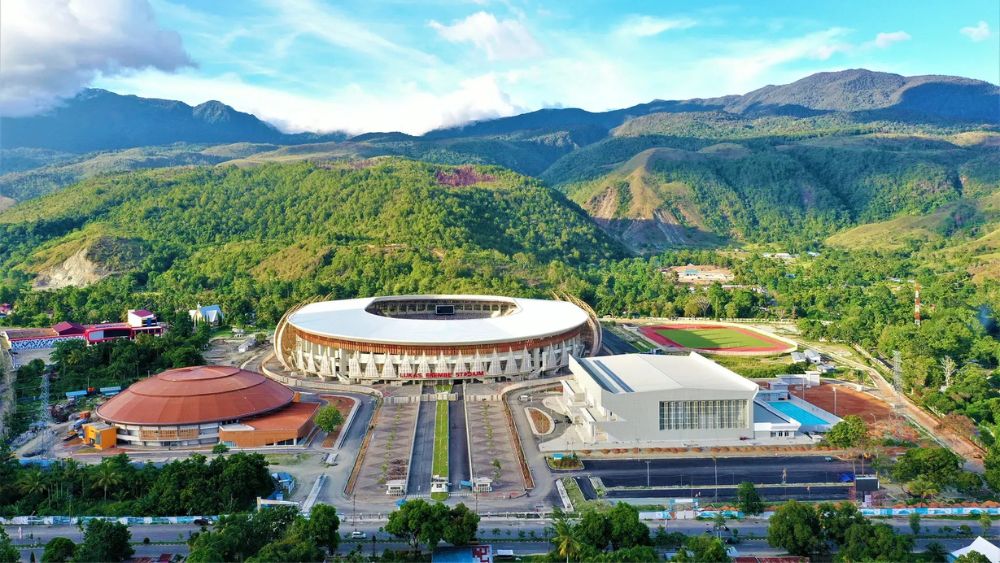
After nearly six months of restricted access, the reopening of Lukas Enembe Stadium in Kampung Harapan, Jayapura Regency, marks an important step in restoring Papua’s sporting activities. The provincial government has begun allowing residents to use the stadium and several other facilities again, while preparing the venue to host Persipura Jayapura’s home matches in November 2026.
The decision follows the unrest that erupted after Persipura’s promotion playoff against Adhyaksa FC on May 8, 2026. The incident resulted in damaged stadium facilities, burned vehicles, and the temporary closure of the sports complex. Since then, the Papua Provincial Government has undertaken damage assessments, repairs, and preparations for the facility’s gradual return to public use.
The reopening, announced through the Papua Provincial Youth and Sports Agency (Disorda) on November 4, is a limited return to operations. The government has introduced specific conditions for football matches, including limiting spectators to the north and south stands, enforcing official ticket requirements, and strengthening security arrangements.
For Papua, the development carries significance beyond football. Lukas Enembe Stadium is one of the region’s major sporting assets, serving as a venue for professional competitions, athlete development, and public sporting activities. Restoring its use is therefore an opportunity to rebuild confidence in the region’s sporting environment while ensuring that public facilities are protected and maintained.
From Football Unrest to the Stadium’s Closure
The events that led to the closure began on May 8, 2026, when Persipura Jayapura faced Adhyaksa FC in a promotion playoff for the 2025/2026 Championship competition, commonly known as Liga 2.
The match was particularly important for Persipura, a club with a long history in Indonesian football and a strong following in Papua. The team was seeking a return to the country’s top division, now known as the Super League, after competing outside the highest tier.
The match at Lukas Enembe Stadium began at approximately 5 p.m. local time. Adhyaksa FC took the lead through a goal by Adilson Silva shortly before half-time. The visitors maintained their 1-0 advantage until the final whistle, securing promotion to the Super League for the 2026/2027 season.
For Persipura supporters, the result was deeply disappointing. The home side’s failure to secure promotion brought an abrupt end to hopes of returning to the top division.
However, the disappointment surrounding the result soon escalated into violence.
How the unrest unfolded
According to police accounts reported by Indonesian media, shortly after the final whistle at around 7 p.m., several spectators left the stands and entered the pitch. Some pursued Adhyaksa FC players and match officials, forcing security personnel to prioritize the evacuation and protection of those involved in the match.
At approximately 7.16 p.m., the situation had developed into a serious disturbance, with spectators entering restricted areas and damage being reported inside the stadium.
The unrest subsequently spread beyond the pitch. By around 8 p.m., groups outside the stadium were reported to have damaged public facilities and set vehicles on fire in the surrounding area.
The police and joint security personnel from the Indonesian National Police and military moved to control the situation and prevent further escalation. Tear gas was reportedly used to disperse the crowd as the disturbance continued.
The consequences were substantial. Vehicles were burned or damaged, while parts of the stadium complex, including supporting facilities, sustained damage.
The Papua representative office of the National Commission on Human Rights (Komnas HAM) reported finding 30 burned vehicles, comprising 20 cars and 10 motorcycles. Other police and media reports provided different vehicle counts as the damage assessment continued.
The incident also raised concerns about the safety of players, officials, spectators, and people working around the stadium.
Provincial Government Moves to Assess the Damage
The following morning, May 9, Acting Papua Regional Secretary L. Christian Sohilait visited the stadium complex with representatives of several provincial government agencies.
The inspection was intended to establish the extent of the damage and identify facilities requiring immediate attention.
According to the Papua Provincial Government, the delegation received reports from security personnel about damaged cars and motorcycles. Officials also inspected several areas inside the stadium complex, including rooms and supporting equipment affected by the incident.
Sohilait instructed relevant government agencies to begin documenting the damage after the police had completed their crime-scene examination.
The government also coordinated with local authorities and security personnel to address the wider consequences of the unrest. Initial cleaning activities were carried out around the stadium, with assistance from military personnel.
Sohilait described the Kampung Harapan Sports Complex as a strategic provincial asset with an important role in developing sports in Papua.
He emphasized that the recovery process needed to be conducted carefully, systematically, and responsibly.
The inspection represented the beginning of a broader recovery effort. Rather than immediately reopening the venue, the provincial government first needed to establish which facilities had been damaged, assess the necessary repairs, and ensure that the area could be used safely.
Governor Fakhiri Orders Repairs and Asset Protection
On May 12, Governor Matius D. Fakhiri announced the temporary closure of Lukas Enembe Stadium and its surrounding facilities to allow repair work to proceed.
The decision was intended to prevent further disruption while damaged infrastructure was being restored.
Fakhiri said the stadium was a valuable public asset that needed to be protected and maintained for the benefit of the people of Papua, particularly those involved in sports.
He instructed the provincial asset management team and the Regional Financial and Asset Management Agency (BPKAD) to conduct a comprehensive assessment of the damage.
“We will record the losses to provincial government assets caused by yesterday’s incident. I have asked the asset team and the Regional Financial and Asset Management Agency to calculate the damage, including the large broken glass panels that need to be repaired,” Fakhiri said, according to the provincial government’s report.
He also directed the Head of the Youth and Sports Agency to calculate the repair requirements so that damaged facilities could be restored.
“I’ve tasked the Youth and Sports Office head with assessing the damage so we can replace it right away.” There is no need to blame one another,” he said.
The governor’s response focused on restoring the facilities and preventing a repeat of the incident rather than allowing the dispute surrounding the match to obstruct the recovery process.
During the inspection, Fakhiri also checked other venues in the Papua Bangkit sports complex, including the shooting venue, aquatic facility, and Istora Papua Bangkit.
The shooting venue was reported to be in safe condition, while the aquatic facility had sustained damage to parts of its glass structure that required repair.
Fakhiri stressed that similar incidents should not happen again.
His position reflected the government’s responsibility to protect public infrastructure while ensuring that facilities built for the community could continue to serve their intended purpose.
Gradual Reopening Begins in November
Following the period of closure and recovery, the Papua Provincial Government began reopening the sports facilities in early November 2026.
On November 3, the provincial government announced that Lukas Enembe Stadium would once again be accessible to the public through the Papua Provincial Youth and Sports Agency.
The announcement was followed by confirmation from Acting Head of Disorda Papua Laurens Wantik in a statement reported by ANTARA on November 4.
The reopening covers more than the main football stadium. The Istora indoor sports arena and the athletics track have also returned to public use.
Laurens said the government wanted the facilities to serve both organized sporting activities and everyday community needs.
“The reopening of these facilities is part of the government’s efforts to optimize the use of sports infrastructure that has been built so it can support athlete development as well as community activities,” he said.
The decision is intended to restore the wider sports complex as a productive public space rather than limiting its function to professional football matches.
Residents can once again use the facilities for physical activity, while athletes and sports organizations can benefit from improved access to training venues.
The reopening also represents a practical step towards ensuring that public investment in sports infrastructure continues to benefit the community.
Persipura Returns Under Strict Conditions
One of the most anticipated developments is the planned return of Persipura Jayapura to Lukas Enembe Stadium for its home matches in November 2026.
For the club and its supporters, returning to the venue offers an opportunity to reconnect with a stadium closely associated with Persipura’s identity and sporting history.
However, the provincial government has made clear that the return will take place under temporary restrictions.
Laurens Wantik said only the north and south stands would be opened to spectators during the scheduled matches.
The remaining stands will not be used for now. The restriction is intended to make crowd management more manageable and allow security personnel to monitor spectator movement more effectively.
Laurens called on supporters to accept the conditions and cooperate with the authorities.
“Persipura will play at Lukas Enembe Stadium in November, but this will be subject to certain restrictions.” Only the north and south stands will be used. People must be mature enough to accept these conditions. If they truly want Persipura to grow, they must follow the instructions and not resist,” he said in a statement published by the provincial government.
The message is particularly relevant given the events of May. The government is seeking to restore access to the stadium without overlooking the risks associated with large gatherings.
Ticket controls and stronger security
Disorda has also proposed restrictions on public viewing activities using large screens around the stadium.
The proposal is intended to prevent large crowds from gathering outside the designated spectator areas, where monitoring and crowd management may be more difficult.
Entry to the stadium will be limited to people holding official tickets. Once the allocated tickets have sold out, sales must stop. Additional tickets will not be issued beyond the approved spectator capacity.
Security arrangements around the venue will also be strengthened.
These measures are designed to provide a safer environment for players, match officials, spectators, and surrounding communities.
The restrictions may initially limit the number of supporters able to attend Persipura’s home matches. However, they also offer an opportunity to establish more disciplined spectator management before the stadium returns to full operational capacity.
Expanding the Sports Complex Beyond Football
The reopening of Lukas Enembe Stadium is also part of a wider plan to develop the Kampung Harapan complex as a center for different sporting activities.
According to the Papua Provincial Government, Disorda has been working with the Indonesian Motor Association (Ikatan Motor Indonesia, or IMI) to develop additional sporting activities in the area.
The cooperation is intended to introduce automotive sports activities that have not previously been held at the complex.
Such diversification could help the venue attract a wider range of participants and audiences. Instead of depending almost entirely on football matches, the complex could accommodate activities involving different sporting communities.
Laurens also said that Lukas Enembe Stadium was, in principle, ready to support preparations for the pre-national sports week competition, known as Prapon.
The reopening of the facilities could therefore contribute to broader athlete development and preparations for future sporting events.
For Papua, which has a strong sporting tradition and has produced prominent athletes in several disciplines, maintaining access to quality training facilities is particularly important.
The provincial government hopes that the Kampung Harapan complex can become a more active center for sports development and community participation.
A Shared Responsibility to Protect Public Facilities
The public’s behavior and cooperation, not just government decisions, will determine the return of sports.
Stadiums and sports venues are public assets. Their value lies in the opportunities they provide for athletes, clubs, spectators, and local residents.
Damage to these facilities can create financial costs for the government and interrupt activities for people who depend on them.
The events of May demonstrated how quickly a sporting disappointment can escalate into damage affecting a much wider community.
For that reason, the provincial government’s restrictions should be viewed as part of a broader effort to rebuild a safe sporting environment.
Supporters remain an important part of Persipura’s identity, but responsible conduct is essential to ensuring that football can be enjoyed without threatening public safety.
The reopening also presents an opportunity for clubs, supporters’ organizations, stadium managers, and security authorities to strengthen communication and develop clearer procedures for major matches.
If these efforts are sustained, Lukas Enembe Stadium can gradually regain its role as a shared space for sporting achievement and community life.
Conclusion
The reopening of Lukas Enembe Stadium marks an important stage in the Papua Provincial Government’s efforts to restore public access to sports infrastructure following the May 2026 unrest. By reopening the stadium and the athletics track while introducing stricter spectator controls, the government is seeking to balance the return of sporting activities with the need to protect public safety and valuable regional assets. Persipura Jayapura’s planned return to its home ground in November offers an opportunity to rebuild the connection between the club and its supporters, but the success of that return will depend on discipline, responsible crowd management, and cooperation from all parties. Beyond football, the renewed use of the Kampung Harapan complex could strengthen athlete development, encourage wider community participation, and support preparations for future sporting competitions. The stadium’s recovery should be judged by its ability to be a safe, productive, and inclusive sporting center for the people of Papua, not just by the resumption of matches.
Read Also
Persipura Jayapura Crush PSBS Biak 6-1 in Papua Derby
After the Riot, Papuans Return to Clean Lukas Enembe Stadium

