
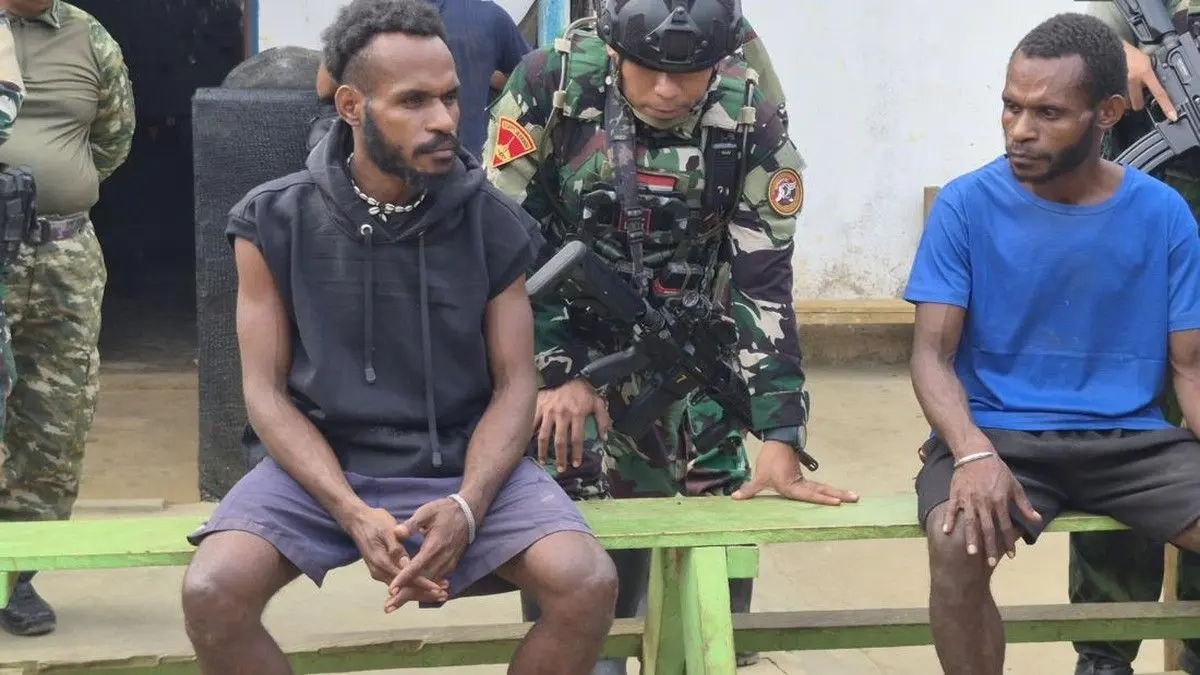
Anton Fatem and Yesias Fatem, two figures associated with the armed group known as the West Papua National Liberation Army-Free Papua Movement (TPNPB-OPM), have surrendered to Indonesian National Armed Force (TNI) personnel after surviving an earlier encounter with security forces. Their surrender was followed by the recovery of a Caracal assault rifle and 17 rounds of ammunition that had previously been seized by the armed group.
The developments, announced by Indonesia’s Habema Military Operations Command, mark a significant turn in a series of security operations in Maybrat, Papua Barat Daya (Southwest Papua). According to reports published on October 16 and 17, the two men surrendered on October 15, while a joint military team recovered the weapon and ammunition from a cave in Maybrat the following day. The firearm had reportedly been taken from personnel of the Indonesian Navy’s 9th Marine Infantry Battalion during an attack in the Sorya area on March 22, 2026.
The episode highlights the operational importance of information gathered through communication and questioning, as well as coordination among military units. It also brings renewed attention to the Indonesian military’s stated objective of reducing armed threats while encouraging individuals involved in armed groups to abandon violence and return to civilian life.
For communities in Papua, the central question is whether such developments can contribute to a more stable security environment in which residents can travel, work, attend school, and access public services without fear.
From Reports of Death to Confirmation That Two Men Survived
Confusion Following Earlier Military Operations
The latest development follows a series of encounters between Indonesian security forces and members of the TPNPB-OPM in Maybrat and surrounding areas.
In the days before the surrender announcement, reports concerning armed-group figures and military operations created uncertainty about the fate of several individuals. Subsequent reporting identified Anton Fatem and Yesias Fatem as men who had survived an earlier military encounter near the Kamundan River, despite having previously been reported as dead or believed to have been among those killed. The military later confirmed that the two were alive and had surrendered.
The distinction is important because separate encounters in the area were reported during the same period. On October 9, Indonesian military officials said three members of the armed group had died in a clash in a forested area north of Kampung Kamat, in Aifat Timur District. That incident was linked to operations against the group led by Manfret Fatem, who was also reported killed. Without additional confirmation, one should not conflate the identities of individuals involved in different encounters.
The later clarification concerning Anton and Yesias established that they had survived the encounter near the Kamundan River and subsequently surrendered. The sequence illustrates the difficulties of establishing accurate information during fast-moving security operations in remote and forested terrain, where immediate reports may not provide a complete picture of events.
Rather than treating early reports as the final account, the subsequent confirmation offers a reminder that information in conflict-affected areas needs to be updated as individuals are identified and circumstances become clearer.
Surrender in Maybrat on October 15
According to Habema Operations Command chief Brigadier General Riyanto, Anton Fatem and Yesias Fatem surrendered in Maybrat, Papua Barat Daya, on October 15. Military personnel followed their surrender with a process of communication and further questioning.
Riyanto said the information obtained during this process helped the joint team establish the location of a firearm previously taken by the armed group. The military subsequently organized a search operation that led to the recovery of the Caracal rifle and its ammunition.
The surrender was therefore followed by a practical security outcome. Instead of relying exclusively on patrols and searches, military personnel were able to use information obtained after the two men came under government control to identify where the missing weapon had been concealed.
The available reports do not provide a detailed public account of the surrender negotiations, the precise circumstances in which the two men decided to give themselves up, or whether any formal reintegration arrangements have been completed. Those details should not be assumed. What has been reported is that they surrendered, were questioned, and provided information that assisted the subsequent search.
TNI Recovers Caracal Rifle and 17 Rounds of Ammunition
A Weapon Taken during an Attack in March
On October 16, a joint team under Habema Operations Command recovered one Caracal rifle and 17 rounds of 5.56 mm ammunition in Maybrat, according to reports published the following day.
The weapon was reportedly taken by members of the armed group associated with TPNPB-OPM Regional War Command (Kodap) IV/Sorong Raya during an attack against personnel of the 9th Marine Infantry Battalion in the Sorya area on March 22, 2026. Its recovery therefore followed a period of nearly seven months during which the firearm had remained outside the control of the military.
The recovered items consisted of a Caracal long-barrel firearm and 17 rounds of 5.56 mm ammunition. Reports said the weapon had been hidden inside a cave in Maybrat. Its recovery removes one firearm and its associated ammunition from the group’s reported stock of weapons, although the wider security implications will depend on whether other weapons or ammunition remain unaccounted for.
The incident also demonstrates why the recovery of weapons taken from security personnel remains an operational priority. A firearm held by an armed group can pose a continuing risk to military personnel and civilians, particularly if it is moved between locations or used in further attacks.
For that reason, the operation was not simply about retrieving military property. It was also intended to reduce the possibility that the weapon could be used again in violence.

Cooperation Among Military Units
The recovery operation involved cooperation among several units under Habema Operations Command. Reports identified the RI-PNG Mobile Border Security Task Force of the 9th Marine Infantry Battalion, the Rajawali V detachment associated with the 411th/Pandawa Kostrad Infantry Battalion, and the territorial RI-PNG Border Security Task Force of the 764th Infantry Battalion.
The involvement of multiple units reflects the coordination required to conduct operations in a geographically challenging region. Maybrat includes forested and rugged areas where locating concealed weapons may require local information, careful planning, and cooperation between personnel operating under different task force structures.
In this case, the military said the recovery resulted from a combination of intelligence gathering, information obtained during questioning, and a subsequent search. The process underscores the role that accurate information can play alongside field operations.
TNI Stresses Professionalism and Public Safety
Riyanto praised the personnel involved, highlighting cooperation between units, the accuracy of information, and the professionalism of troops.
“The success demonstrates the importance of inter-unit synergy, information accuracy, and the professionalism of soldiers,” Riyanto said in a statement reported by Tirto. He added that recovering the firearm was part of an effort to prevent its misuse in ways that could endanger civilians and security personnel.
He also emphasized that security operations should remain selective, measured, and professional; comply with applicable law; and respect humanitarian values.
The emphasis on legal procedures and humanitarian considerations is significant in Papua, where security operations take place in communities that need access to essential services and opportunities for economic and social development. Maintaining public safety requires attention not only to armed threats but also to the protection of civilians and the continuation of everyday life.
Another Weapon Remains Unaccounted For
Although the recovery of the Caracal rifle represents a concrete outcome, the operation is not necessarily complete.
Habema Operations Command said it was continuing to gather information and search for another firearm, identified as a K3 Daewoo, which initial information suggested might still be hidden in Maybrat. As of the reports published on October 17, its recovery had not been confirmed.
The distinction matters. The recovery of one firearm does not resolve all security issues in the area. The search for the second weapon indicates that military personnel continue to assess whether other firearms remain concealed.
It also underlines the importance of verifying information before drawing conclusions about the scale of an operation’s success. The Caracal rifle and 17 rounds have been reported recovered; the location and status of the K3 Daewoo remain subject to further investigation.
For local residents, the continued search may be relevant to broader efforts to reduce the availability of weapons in areas affected by armed activity. However, long-term improvements in security will depend on more than individual recoveries. They will require sustained cooperation among security personnel, local authorities, and communities, together with measures that allow residents to pursue ordinary activities safely.
Why the Development Matters for Papua
Security and Everyday Life
Security incidents in Papua can have consequences that extend beyond the immediate location of a clash or search operation. In areas where armed activity is reported, residents may face anxiety over movement, disruptions to local economic activity, and concerns about whether schools, health facilities, and other public services can operate consistently.
The Indonesian military has presented its operations in Papua as part of an effort to maintain security and create conditions for development. Riyanto reiterated that security measures and a humanitarian approach should proceed together so that people can carry out daily activities safely and public services can continue.
That objective is particularly relevant to Maybrat and other districts where geographic isolation can make access to services more difficult even in the absence of violence. When insecurity disrupts transport or discourages movement, the consequences can affect farmers, traders, students, health workers, and small businesses.
The recovery of a firearm cannot by itself resolve these broader challenges. Nevertheless, removing weapons from circulation and reducing the potential for further attacks can form part of a wider effort to improve the security environment.
A lasting improvement would be reflected not only in operational statistics but also in whether residents feel safer travelling between communities, whether children can attend school regularly, and whether local economic activity can continue without interruption.
Surrender as an Alternative of Armed Violence
The surrender of Anton Fatem and Yesias Fatem also highlights the possibility of individuals leaving armed groups rather than continuing to participate in violence.
Riyanto’s public comments have stressed that military action should be carried out professionally and with respect for humanitarian values. His remarks on the latest operation also focused on preventing the misuse of weapons and maintaining conditions for peaceful daily life.
For surrender to contribute to lasting stability, however, the immediate security process is only one part of the picture. Any longer-term return to civilian life may require appropriate legal procedures, assessment of individual circumstances, and coordination with relevant authorities and communities. The available reports do not clarify whether Anton and Yesias have already completed such arrangements.
The general rule is that there should be a clear and legal way to leave armed activity. Security forces must protect the public and investigate possible offenses, while individuals who surrender should be treated according to applicable law.
Such an approach can help ensure that security measures are not treated as an end in themselves but as part of a broader effort to prevent further violence and support peaceful community life.
Conclusion
The confirmation that Anton Fatem and Yesias Fatem survived an earlier encounter and surrendered in Maybrat has clarified an important element of recent security operations in Papua Barat Daya. Their surrender on October 15 was followed by the recovery of a Caracal rifle and 17 rounds of ammunition on October 16, a weapon reportedly seized during an attack on Indonesian Navy personnel in March.
The operation demonstrates how communication, information gathering, and coordination between military units can contribute to recovering weapons that have remained outside state control for months. Riyanto’s emphasis on professionalism, legal compliance, and humanitarian values also reflects the stated importance of conducting security operations with attention to civilian safety.
Yet the wider test will be whether such developments help create conditions in which communities can live and work with greater confidence. The search for the K3 Daewoo firearm remains ongoing, and the available reporting does not establish that all security concerns in Maybrat have been resolved.
For Indonesia, sustainable progress in Papua will require security measures to work alongside reliable public services, economic opportunity, and community engagement. The recovery of a weapon is a tangible operational result. Its lasting significance will depend on whether it contributes to fewer threats, safer daily life, and greater space for peaceful development.
The events in Maybrat therefore represent both a security development and a reminder that durable peace is measured not only by weapons recovered but also by the ability of people to live without fear and build their futures in safety.
Read Also
Indonesian Marines Capture OPM Figure Zakarias Fatem in Papua
BIN Intelligence Supports TNI Operation in Maybrat
TNI Maybrat Operation Kills OPM Commander Manfret Fatem

