
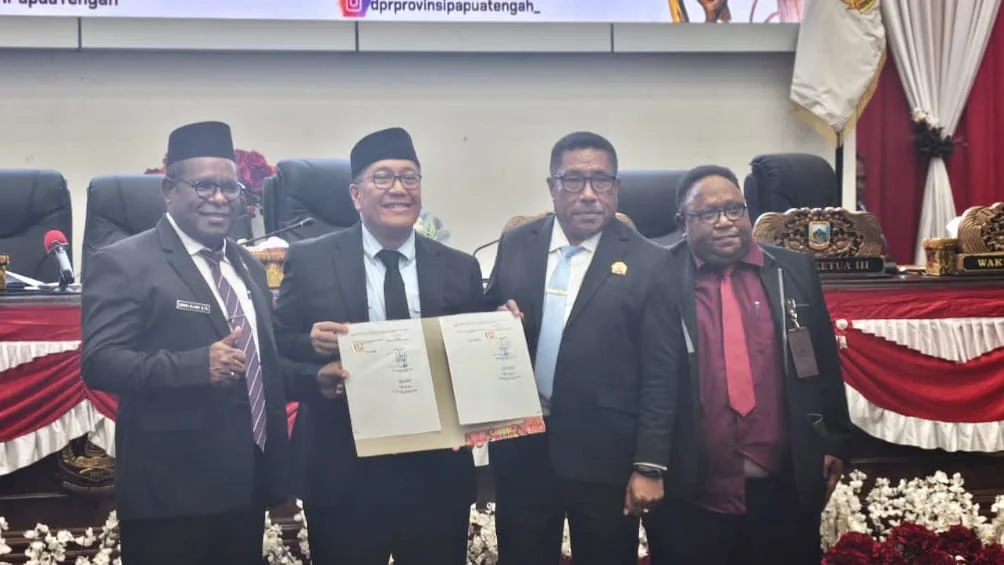
The Papua Tengah (Central Papua) government and provincial parliament have taken a significant step in strengthening their regional legal framework after they agreed on 10 non-budget regional regulations for 2026, covering issues ranging from Indigenous Papuan rights and customary justice to healthcare, natural resource management, public finance, and policing.
The agreement was reached during a plenary session of the Papua Tengah Provincial Parliament, or DPR Papua Tengah, in Nabire on October 6, 2026. The session was chaired by First Deputy Speaker Diben Elaby and attended by Acting Regional Secretary Silwanus Sumule, lawmakers, regional leaders, government agencies, and members of the provincial leadership forum.
The package is significant because the regulations are designed to establish a clearer legal foundation for a province that is still building its administrative institutions while facing the practical challenges of delivering services across a geographically difficult region.
The seven regulations within the main legislative program cover fisheries, customary natural resource compensation, customary justice, social conflict management, regional financial management, regional assets, and healthcare. Three additional draft regulations were discussed outside the formal Regional Regulation Formation Programme, or Propemperda: amendments to the special regulation on Indigenous Papuans, protection of Indigenous Papuan professionals, and the duties of the regional police.
Together, the 10 regulations provide a broad picture of how Papua Tengah is attempting to translate regional autonomy into practical rules for government and public services.
A Legislative Process That Took Months to Complete
The agreement did not come at the beginning of the legislative process.
Diben Elaby said the regulations had passed through several stages before reaching the final joint approval. The process included submission of the draft provincial and special regional regulations, general views from parliamentary factions, responses from the provincial government, a report from the DPR’s Legislation Formation Body, or Bapemperda, and final faction statements.
The final approval therefore represented the culmination of a legislative process rather than a single-session decision.
Diben described the agreement as more than an institutional formality. In his view, the regulations should provide a legal basis capable of responding to public needs while supporting government administration and development.
For a young province such as Papua Tengah, that distinction matters.
Regional institutions need rules that define responsibilities, establish standards, and provide legal certainty. Without such a framework, policies can become dependent on administrative discretion or change from one period of government to another.
The new regulations are intended to provide greater continuity.
Why the Seven Main Regulations Matter
The seven regulations within the main legislative agenda cover several areas that directly affect daily life.
Three are special regional regulations, or perdasus. They concern the protection and empowerment of Indigenous Papuan fish farmers and fishermen, compensation standards for timber and non-timber forest products involving customary communities, and customary justice.
Four are provincial regulations, or Perdasi, covering social conflict management, regional financial management, regional government assets, and healthcare.
The subjects may appear different, but they share a common purpose: establishing clearer rules for governance and public protection.
The fisheries regulation, for example, is intended to provide Indigenous Papuan communities with stronger space to manage and benefit from fisheries resources sustainably.
The regulation concerning forest products addresses another sensitive question: how customary communities can obtain fair and predictable compensation from natural resources located within customary territories.
Meanwhile, customary justice is intended to recognize local norms and traditions while remaining within Indonesia’s broader legal framework.
Diben said the customary justice regulation should strengthen recognition of local values, norms, and wisdom while continuing to observe applicable national legislation.
Protecting Indigenous Papuan Economic Interests
Among the most direct economic measures is the Perdasus for the protection and empowerment of Indigenous Papuan fish farmers and fishermen.
Papua Tengah has extensive coastal and marine areas, meaning fisheries can contribute to household income, food supply, and local economic activity.
Yet access to natural resources alone does not guarantee prosperity.
Small producers also need capital, equipment, skills, infrastructure, and markets. The DPR’s Special Committee, or Poksus, urged the provincial government to address these practical needs.
Donatus Mote, chairman of the DPR Papua Tengah Poksus, called for access to financing, capacity building, modern fishing and aquaculture infrastructure, and market protection for Indigenous Papuan fishermen.
The emphasis is therefore shifting from simply recognizing economic rights toward creating conditions in which local communities can actually participate in the regional economy.
That could become increasingly important as Papua Tengah seeks to diversify its economy and increase the role of local businesses and workers in development.
Forestry Rules Seek Greater Legal Certainty
The second resource-related regulation concerns compensation for timber and non-timber forest products involving customary communities.
Papua’s forests are economically, socially, and culturally important. For customary communities, forests can also provide food, materials, and income while forming part of longstanding relationships between communities and their territories.
The new regulation seeks to establish standards that provide greater certainty and fairness when communities benefit from resources in customary areas.
Diben said the regulation was expected to ensure that customary communities receive an appropriate share of the benefits from natural resources found in their customary territories.
The significance of such rules lies in predictability.
Clear standards can help reduce uncertainty between communities, government institutions, and economic actors. They can also provide a stronger basis for resolving disagreements when questions arise over compensation or resource use.
For development to be sustainable, economic activity needs to operate alongside clear legal protections and community participation.
Customary Justice Within the National Legal Framework
Another important element is the Perdasus on customary justice.
Customary law remains an important part of social life in many communities across Papua. Local mechanisms can play a role in resolving disputes, maintaining social relationships, and preserving cultural values.
The new regulation seeks to strengthen recognition of those mechanisms while keeping them aligned with Indonesian law.
This is not a simple choice between customary and formal justice.
Instead, the legislative approach described by DPR Papua Tengah seeks to recognize local norms while ensuring that the wider national legal framework remains applicable.
That balance is important in a province where traditional institutions continue to influence community life.
It also reflects a broader principle of Indonesian regional governance: local characteristics can be accommodated within the national legal system rather than treated as incompatible with it.
Conflict Management Takes a Preventive Approach
The Perdasi on social conflict management addresses another major governance requirement.
Rather than focusing only on what happens after a conflict has escalated, the regulation is expected to provide a framework for prevention, early response, and resolution.
Diben said the regulation should enable the regional government to prevent, handle, and resolve conflicts in a rapid, integrated, and fair manner, with an emphasis on humanitarian approaches and local wisdom.
The DPR Poksus also stressed early detection, prevention, mitigation, persuasion, and dialogue.
Mote said customary, women’s, religious, and youth leaders should be involved in conflict resolution.
That approach places community participation alongside government responsibility.
Early communication can be particularly valuable in Papua Tengah, where the geography makes government intervention difficult in remote areas. Local leaders often have a more profound understanding of tensions before they develop into larger disputes.
The regulation could therefore provide a legal structure for combining formal government mechanisms with community-based approaches.
Better Management of Public Money and Assets
Two of the seven principal regulations focus directly on government administration: regional financial management and regional government assets.
They may be less visible to the public than regulations concerning healthcare or fisheries, but they are crucial to how government operates.
Diben stated that the regulations aim to enhance governance by promoting transparency, accountability, effectiveness, efficiency, and responsibility.
The principle is straightforward.
Public budgets and government-owned assets need to be properly recorded, managed, and supervised. Strong administrative rules can reduce uncertainty and provide clearer standards for officials responsible for spending and managing public property.
For a province undertaking substantial development investment, proper management is particularly important.
Roads, health facilities, government buildings, equipment, and other public assets require not only initial funding but also proper management throughout their useful life.
Effective governance is therefore part of development infrastructure itself.
Healthcare Regulation Looks Beyond Urban Centers
Healthcare is another major pillar of the package.
The Perdasi on healthcare is intended to strengthen services for people throughout Papua Tengah, including communities living in areas that are difficult to reach.
The Poksus has pushed for the regulation to address the province’s shortage of specialist medical professionals.
Mote said the DPR had received information indicating that around 42 Indigenous Papuan doctors were working across eight regencies in Papua Tengah. He argued that some of these doctors should receive government support to pursue specialist training, with an obligation to return and serve in the province after completing their education.
The proposal reflects a practical problem faced by remote regions.
Training more doctors is important, but retaining them where they are needed can be equally challenging. A scholarship or training program without a clear service commitment may fail to produce a lasting improvement in local healthcare capacity.
Mote therefore called for Otsu’s funding to support specialist education while ensuring that recipients return to Papua Tengah.
Mote stated, “They must return to Papua Tengah to serve after receiving government funding.”
The proposal also addresses healthcare logistics.
According to Mote, medical personnel serving islands and coastal areas face difficulties obtaining fuel and travelling to patients. Patients travelling from islands can also reach a port by speedboat but encounter difficulties finding onward transportation to hospitals in Nabire.
He called for ambulances to remain available at ports so patients could continue their journey to hospitals without dangerous delays.
That concern illustrates why healthcare policy in Papua cannot focus solely on hospitals.
Transport, fuel, staffing, medicines, referral systems, and emergency vehicles can determine whether a patient actually receives timely care.
Three Additional Regulations Expand the Agenda
The remaining three regulations clarify why some reports describe the package as 10 regulations, while another report refers to it as seven.
The seven principal regulations formed part of the main legislative agenda. Three additional draft regulations were discussed outside the Propemperda.
They concern the amendment of Perdasus Papua Tengah No. 14 of 2026 on Indigenous Papuans, the duties of the Papua Tengah Regional Police, and the protection and empowerment of Indigenous Papuan professionals.
These additional regulations broaden the package from general governance into questions of representation, professional participation, and public security.
The Indigenous Papuan, or OAP amendment has attracted particular attention.
Revising the OAP Regulation
The DPR Papua Tengah Poksus considers revision of the OAP regulation a priority because some provisions have generated questions in the community.
Mote said the revision should clarify the definition, criteria, and classification of Indigenous Papuans and provide greater legal certainty in the administration of affirmative rights. He stated that the Ministry of Home Affairs, Bapemperda, and the Papua Tengah government had coordinated the process.
The issue is sensitive because the definition of OAP can affect access to affirmative policies and government programs.
The legislative objective, according to Diben, is to ensure that the regulation provides protection, empowerment, legal certainty, and appropriate affirmative treatment consistent with the province’s special characteristics and the needs of Indigenous Papuan communities.
The revision will therefore be closely watched because its practical effect could extend into employment, public programs, and other areas where OAP status is relevant.
Creating Space for Indigenous Professionals
Another proposed regulation focuses on Indigenous Papuan professionals.
Diben described it as a commitment to provide protection, opportunities, and space for Indigenous Papuan professionals to participate more fully in the development of Papua Tengah.
The broader principle of local participation closely aligns with this objective.
Infrastructure and government programs can generate significant economic activity, but their long-term value also depends on whether local residents have opportunities to develop skills and occupy professional roles.
For Papua Tengah, building a larger pool of Indigenous professionals could strengthen institutional capacity while allowing more local residents to contribute directly to regional development.
Police Regulation Links Security with Public Service
The tenth regulation concerns the duties of the Papua Tengah Regional Police.
Diben stated that the proposed regulation aims to uphold security, public order, and community services in line with Indonesian law.
The inclusion of police responsibilities in the legislative package reflects the relationship between security and development.
Businesses need a predictable environment. Schools and health facilities need to operate safely. Government personnel need access to remote communities. Infrastructure projects require an environment in which workers and assets can be protected.
Mote’s comments on conflict management demonstrate that the legislative approach extends beyond enforcement.
The Poksus have called for persuasive, humanitarian, and dialogue-based approaches, with customary, religious, women’s, and youth leaders participating in conflict prevention and resolution.
This creates a broader picture of security: maintaining public order while strengthening communication and community participation.
From Legal Text to Practical Results
The most important question now is implementation.
Passing a regulation creates a legal framework, but it does not automatically change conditions on the ground.
Mote explicitly warned against allowing the regulations to remain merely administrative or legal documents. He urged the provincial government to ensure that the rules are implemented after being approved and signed.
“Regional regulations are a political commitment at the regional level to implement government and development,” Mote said, calling for the approved regulations to be carried out in practice.
That concern applies across the entire package.
A fisheries regulation must eventually help fishermen. A health regulation must improve access to doctors and medical services. Financial management rules must improve accountability. Customary justice provisions must work for communities. Conflict regulations must help authorities prevent disputes from escalating.
Therefore, we will measure the package’s effectiveness not by the number of approved regulations, but by its ability to produce practical results.
Conclusion
The agreement between the Papua Tengah government and its provincial parliament on 10 non-budget regional regulations for 2026 represents an important stage in the province’s institutional development.
The seven principal regulations address fisheries, forest resource compensation, customary justice, conflict management, regional finances, government assets, and healthcare. Three additional proposals cover amendments to the OAP regulation, Indigenous Papuan professional empowerment, and the duties of the regional police.
Taken together, the package attempts to address several of Papua Tengah’s most important governance challenges at once.
It seeks to strengthen legal certainty for Indigenous Papuans, create greater opportunities for local economic participation, recognize customary institutions, improve public financial management, expand healthcare access, and establish clearer frameworks for security and conflict prevention.
The debate around implementation will now become more important than the approval ceremony itself.
For the Papua Tengah government and DPR, the next test is whether these regulations can move from the parliamentary chamber in Nabire into villages, coastal communities, hospitals, government offices, fisheries areas, and customary territories.
If implemented effectively, the regulations could provide a more stable legal foundation for development in the province while strengthening public services and the participation of Indigenous Papuans.
The legislative process has produced the framework. The people of Papua Tengah will measure the next chapter by what that framework delivers.
Read Also
APS III Conference Brings New Debate Over Papua’s Future
Papua Passes Seven Regional Laws to Strengthen Special Autonomy

