
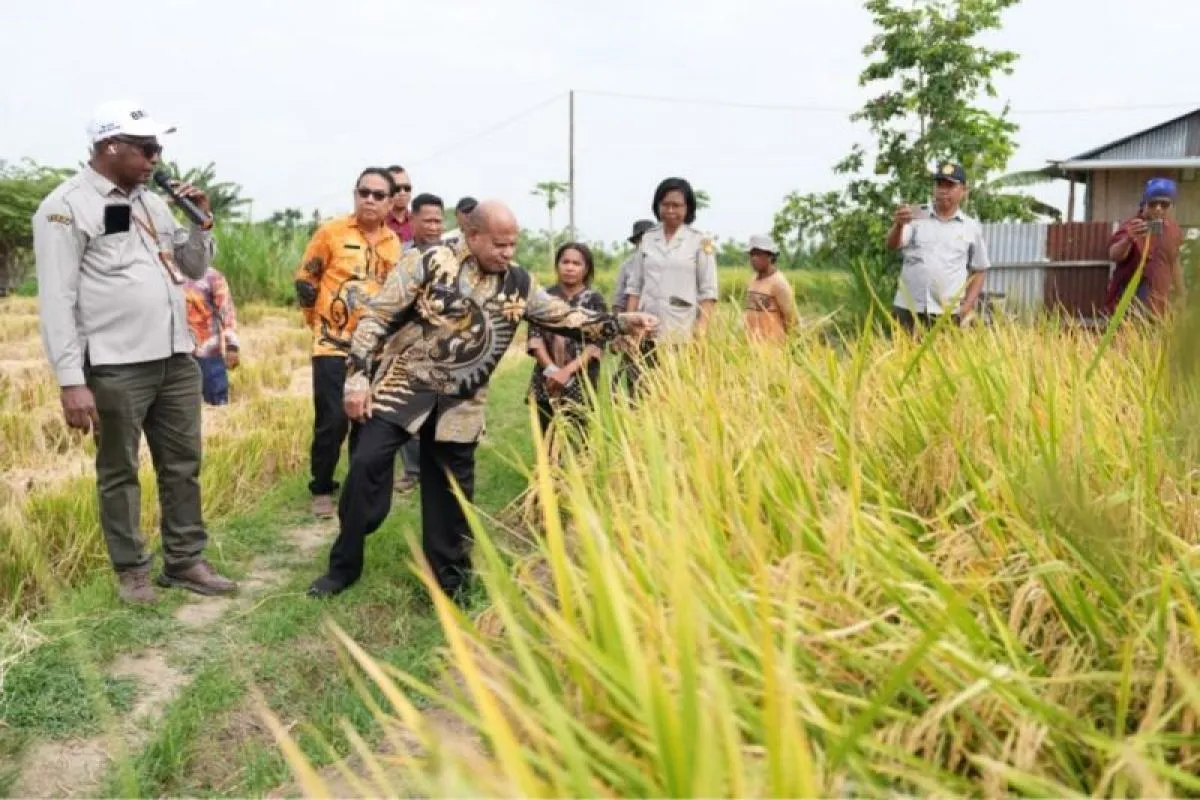
The Papua rice self-sufficiency programme is gaining momentum as the provincial government prepares about 6,500 hectares of new rice fields by the end of 2026, alongside the rehabilitation of previously unproductive farmland.
The programme represents one of Papua’s most significant recent efforts to strengthen local food production while reducing dependence on supplies brought from outside the region. It is also being positioned as part of a broader economic strategy under which agriculture and plantations can become stronger contributors to Papua’s economy.
Governor Matius D. Fakhiri announced the expansion after inspecting and harvesting rice in Koya Timur, Muara Tami District, Jayapura, on October 1, 2026. He said the new fields would be developed alongside efforts to bring “sleeping” or idle rice fields back into production.
“By the end of this year we will open 6,500 hectares of rice fields, in addition to rehabilitating several rice fields that have been idle,” Fakhiri said.
The target is ambitious. The provincial government wants Papua to achieve rice self-sufficiency by 2028, meaning that the programme has less than two years to move from land expansion and productivity improvements to a level of production capable of meeting the province’s needs.
For Papua, however, the strategy is not simply about planting more rice. It is about creating a stronger agricultural production system that combines land expansion, irrigation, water pumps, modern farming methods and better use of existing agricultural areas.
From New Fields to Higher Productivity
The first part of the strategy is straightforward: increase the amount of land available for rice cultivation.
The provincial government aims to establish around 6,500 hectares of new rice fields in 2026. At the same time, officials are rehabilitating farmland that has been left unused or has become less productive.
This combination is important because expanding agricultural land alone does not automatically guarantee higher production. Land must be supported by water infrastructure, farm inputs, appropriate seeds, machinery and farmers who can cultivate it effectively.
The government is therefore pairing the expansion programme with improvements in irrigation and the use of water pumps.
Fakhiri said the province was seeking to increase planting intensity so farmers could harvest rice three times a year rather than relying on a single annual harvest.
“We are not asking for four planting cycles, but three is enough so that Papua can harvest three times,” he said.
That approach could become one of the most important elements of the province’s food security strategy. If farmers can consistently produce three harvests annually on suitable land, the same agricultural area can generate significantly greater output without requiring an equivalent expansion of farmland.
The challenge, of course, is ensuring that irrigation systems and water pumps can support the planting calendar throughout the year.
Productivity is Already Showing Progress
The government’s confidence in its 2028 target is partly based on improvements already recorded in several farming areas.
According to Fakhiri, average rice yields in Papua have risen to more than eight tonnes per hectare. In parts of Keerom Regency, the reported yield has reached 12.8 tonnes per hectare.
“We are now at the forefront in Papua Province. We have already produced 12.8 tonnes,” Fakhiri said.
The figures provide important context for understanding the 6,500-hectare programme. The government is not relying solely on land expansion. It is also attempting to raise productivity on cultivated land.
That distinction is critical for long-term agricultural development. More land can increase production, but higher productivity can make farming more efficient and economically attractive.
A separate RRI report on the government’s agricultural strategy highlighted the role of modern farming technology. The Papua Agricultural Research and Modernisation Implementation Centre, or BRMP Papua, has been testing a modern agricultural approach known as the Advanced Agriculture System. The approach uses tighter planting arrangements, measured fertilisation, precision management and full mechanisation.
A two-hectare demonstration plot in Koya Timur reportedly produced around eight tonnes per hectare, above the province’s average of about five tonnes in the context cited by BRMP Papua. The institution said yields could potentially rise towards 10 to 12 tonnes per hectare if technology, improved seeds, fertilisation and mechanisation were applied effectively.
The combination of new fields and productivity improvements therefore forms the backbone of the 2028 strategy.
Koya Timur Becomes a Picture of Papua’s Agricultural Potential
The recent harvest in Koya Timur provides a useful snapshot of what the provincial administration hopes to achieve.
Located in Muara Tami District, the area has become one of the places where rice production and modern agricultural practices are being demonstrated.
It was here that Fakhiri reviewed rice quality and spoke about the province’s broader food production ambitions.
The harvest was more than a routine agricultural event. It provided the provincial government with an opportunity to assess productivity while promoting agriculture as an increasingly important component of Papua’s economic future.
The government wants agricultural development to serve two objectives at the same time.
The first is food security. More locally produced rice means a greater ability to meet the needs of Papua’s population through domestic production.
The second is economic diversification.
Fakhiri has argued that stronger agricultural and plantation production could help ensure that Papua’s economy is not overly dependent on the mining sector.
This point highlights the rice programme’s importance beyond just food production.
Papua has substantial natural resources and a long history of mineral production, but agricultural development offers another path for creating economic activity that is more closely connected to rural communities.
Feeding Both Coastal and Highland Communities
One of the practical objectives of increased rice production is to improve the supply of food within Papua.
Fakhiri said higher production should initially help meet the needs of communities in coastal areas while also creating opportunities to supply rice to Papua’s mountainous regions.
This could become particularly important because the geography of Papua creates logistical challenges for food distribution.
The province encompasses large areas with different landscapes, transportation conditions and patterns of settlement. Transporting food within the region is much harder than in areas with denser road networks and shorter distances between production centres and markets.
A stronger local rice production base could therefore reduce some of the pressure associated with bringing supplies into Papua from elsewhere.
It could also create a more integrated internal food market, linking agricultural production zones with urban consumers and communities in more remote areas.
From Self Sufficiency to Regional Markets
The provincial government’s ambitions extend beyond simply producing enough rice for Papua.
As production increases, officials have begun exploring potential markets outside the province.
Fakhiri said the Papua government had started communicating with the Government of Papua New Guinea to examine opportunities for rice market development, including the possibility of exports once domestic requirements had been met.
The sequence is important.
The government is prioritising domestic food security first. Only after local demand can be adequately supplied would exports become a realistic option.
If that happens, Papua’s geographical position could become commercially significant. The province is Indonesia’s easternmost major territory and lies directly adjacent to Papua New Guinea.
A future surplus could therefore potentially create new agricultural trade links across the border.
For now, however, the immediate priority remains achieving self-sufficiency.
“By 2028, our target is to achieve self-sufficiency,” Fakhiri said.
Supporting the National Food Security Agenda
The national government’s strategic agricultural agenda under President Prabowo Subianto also includes the Papua programme.
Fakhiri said the expansion of agricultural land and increased rice production represented support for national strategic programmes aimed at strengthening food security and self-reliance.
This places Papua’s agricultural expansion within a much wider Indonesian policy objective.
Food security has become increasingly important in Indonesia as the government seeks to strengthen domestic production, improve farmer productivity and reduce vulnerabilities associated with dependence on external supplies.
For Papua, the national agenda intersects with a very local question: how to make better use of agricultural land while ensuring that communities have reliable access to food.
The provincial government’s approach therefore combines national policy priorities with Papua’s own geographical and economic circumstances.
The Role of Technology and Infrastructure
The 6,500 hectare target will ultimately depend on more than land availability.
Irrigation is one of the central requirements.
Fakhiri has specifically stressed the necessity of irrigation infrastructure and water pumps to support multiple planting cycles.
Mechanisation is another component.
BRMP Papua has reported that modern agricultural systems can increase plant populations, improve precision in fertilisation and maintenance, and reduce dependence on manual labour. The institution has also emphasised the importance of collaboration among agricultural agencies, local governments, statistics authorities, Bulog and other stakeholders.
That suggests the 2028 target will require coordination across several layers of government and the agricultural supply chain.
Farmers need access to land, water, seeds, fertilisers and machinery. Harvested rice then needs storage, transportation and markets.
Without those links, higher production could create new bottlenecks rather than automatically producing greater food security.
A Possible Shift in Papua’s Rural Economy
The government’s agricultural strategy could have consequences well beyond rice.
If new rice fields become productive and farmers can achieve multiple harvests, supporting industries could also expand.
Farm machinery services, seed supply, fertiliser distribution, transportation, storage and rice milling could all benefit from greater agricultural activity.
In rural communities, increased production can also create opportunities for household income and local commerce.
This is why Fakhiri has linked agricultural development with Papua’s broader economic transformation.
The goal is not to replace mining overnight. Rather, the strategy seeks to build additional economic pillars so that agriculture and plantations can contribute more significantly to regional growth.
The 6,500 hectare programme is therefore both a food policy and an economic development initiative.
The Challenge between Ambition and Implementation
The 2028 target is substantial, and its success will ultimately depend on implementation.
The government must ensure that newly opened fields become productive rather than remaining underused. Rehabilitated fields must remain operational. Irrigation and pumps must function reliably. Farmers must have access to modern inputs and equipment.
Most importantly, increased production must be sustainable.
The figures from Koya Timur and Keerom provide encouraging evidence that Papua can achieve high rice productivity under favourable conditions. But those results should not automatically be interpreted as a guaranteed yield across every new hectare.
Different soils, water availability, weather patterns, farming practices and infrastructure conditions can produce different outcomes.
For that reason, the most credible measure of the programme will be consistent production over several planting cycles.
A 2028 Test for Papua’s Food Strategy
Papua now has a clear agricultural timeline.
By the end of 2026, the provincial government aims to establish approximately 6,500 hectares of new rice fields while rehabilitating idle farmland.
The next stage is to improve productivity through irrigation, water pumps, modern farming practices, mechanisation and more intensive planting.
The government wants farmers to reach three harvests annually while maintaining sufficient production to supply both coastal communities and Papua’s mountainous areas.
If production eventually exceeds domestic requirements, the province could explore wider markets, including Papua New Guinea.
The strategy is ambitious, but the logic is straightforward: expand productive land, increase yields, improve planting intensity and build the infrastructure needed to move agricultural products from farms to consumers.
For Papua, achieving rice self-sufficiency by 2028 would represent more than a food production milestone. It would demonstrate that the province can strengthen its agricultural base while creating a more diversified regional economy.
The next two years will determine whether the 6,500 hectare target can be converted into sustained production.
For Governor Matius D. Fakhiri, the direction is already clear. Papua wants agriculture to become a stronger foundation of its economic future while ensuring that the province can increasingly feed its population.
In that sense, the new rice fields are not simply hectares on a government plan. They are part of a larger attempt to build a more resilient food system, strengthen rural economic activity and connect Papua’s agricultural potential with both national food security and future regional trade.
The 2028 deadline will provide the ultimate test. But the work has already begun, with land expansion, rehabilitation, irrigation, mechanisation and productivity improvements moving together towards the same objective: a more self-reliant Papua.
Conclusion
Papua’s plan to develop 6,500 hectares of new rice fields represents more than an agricultural expansion. It is part of a broader strategy to strengthen food security, reduce dependence on supplies from outside the region, increase rural economic activity and support Papua’s long-term development.
The target of achieving rice self-sufficiency by 2028 is ambitious, but the provincial government’s approach combines several important elements: opening new farmland, rehabilitating idle fields, improving irrigation, introducing modern farming technology and encouraging farmers to achieve up to three harvests a year. The reported productivity gains in areas such as Keerom and Koya Timur provide an encouraging foundation, although maintaining those results across a much larger area will require sustained investment and effective implementation.
Ultimately, the success of the programme will be measured not by the number of hectares opened, but by whether those fields can consistently produce enough rice for Papua’s population. If the government succeeds in connecting land development with reliable irrigation, modern agricultural practices, farmer support, storage, transportation and markets, Papua could emerge as a stronger agricultural centre in eastern Indonesia.
By 2028, the province’s rice self-sufficiency target could therefore become an important milestone in Papua’s economic transformation, demonstrating how food security can also become a foundation for greater rural prosperity and future regional trade.
Read Also
Siam Madu Rice Seed Brings New Hope for Papua’s Food Security
Papua’s New Rice Fields Aim to Feed Communities

