
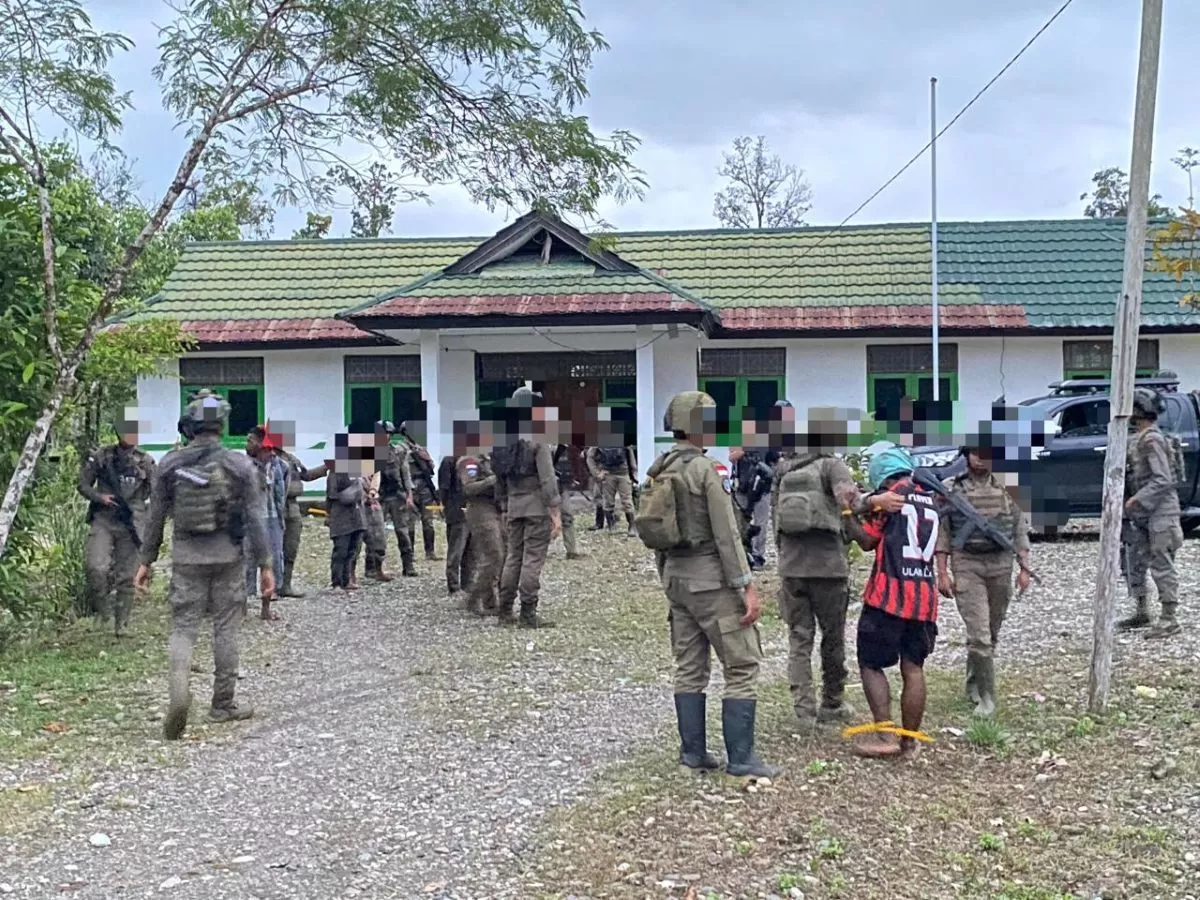
The Cartenz Task Force Operation in Yahukimo ended in a deadly exchange of fire on September 1, 2026, after a joint security team moved to intercept members of the Eden Sawi Battalion, which authorities identify as part of the West Papua National Liberation Army from the Free Papua Movement (TPNPB OPM) Regional War Command (Kodap) XVI Yahukimo. Four suspected members of the group were killed, six others were detained, and a homemade long-barrel firearm, 11 rounds of 5.56 millimeter ammunition, and three mobile phones were recovered.
The confrontation took place near the former KPU office on Jalan Miyaro in Dekai District, Yahukimo Regency, Papua Pegunungan (Highland Papua) Province. According to the Cartenz Task Force Operation’s public information chief, Commissioner Yusuf Sutejo, the operation followed intelligence and investigative information indicating that members of the Eden Sawi Battalion, led by deputy battalion commander Habis Nare, were gathering at a temporary house in the area.
Authorities said the joint team arrived at approximately 4:35 p.m. local time. Police reported that the group opened fire, prompting officers to issue warning shots before returning fire when the shooting allegedly continued. Four people believed to belong to the armed group subsequently died at the scene.
The incident has again placed Yahukimo at the center of Papua’s security challenge, but its significance extends beyond the immediate firefight. The operation raises questions about the protection of civilians, the security of government facilities and economic activity, and the ability of law enforcement to contain armed violence while maintaining due process for those detained.
An Operation Based on Investigative Information
The operation did not begin with the exchange of fire.
According to the authorities, investigators had received information about a planned gathering or consolidation of the Eden Sawi Battalion at a house used as a temporary meeting location near the former KPU office in Dekai. The joint team from the Cartenz Taks Force Operation and Yahukimo Police was subsequently deployed to conduct an arrest operation.
That distinction is important.
The authorities’ account describes the operation as an attempt to apprehend members of an armed group rather than an operation initially designed as a firefight. The subsequent shooting, according to police, transformed the arrest attempt into an armed confrontation.
Commissioner Yusuf Sutejo said officers gave warning shots after receiving fire from the group. The armed men allegedly continued shooting while some attempted to flee toward a forested area. Security personnel then responded with what officials described as firm and measured action.
Independent verification of the precise sequence of shots is not available in the reports reviewed for this article. The account of the confrontation therefore remains principally based on statements from the security authorities.
That distinction is important when reporting a deadly security incident.
Four Bodies Taken to Dekai Hospital
After the confrontation ended, four bodies were recovered and evacuated to Dekai Regional General Hospital for examination and identification.
Three of the deceased have initially been identified by the initials EH, also known as E, YK, also known as LY, and M. Authorities said the fourth person had not yet been definitively identified as of September 2. Investigators were using facial registration and other identification procedures to establish the person’s identity.
The identification process matters both legally and socially.
In a conflict affected by competing narratives, correctly establishing who died is essential. It allows families to receive accurate information and enables authorities to establish a reliable record of the incident.
The bodies were therefore not immediately treated simply as evidence of an operational success. They were taken to a medical facility for examination and further identification.
That process also underscores the importance of maintaining accurate documentation after armed confrontations.
Six People Remain Under Investigation
Six other people were detained during the operation.
They were identified by the initials BK, PM, DH, NJK, PA, and AS. Authorities said they were found in the vicinity and were suspected of having connections with the Eden Sawi Battalion.
However, officials have emphasized that their status is still being examined.
The six individuals were taken to Yahukimo Police headquarters for questioning. Investigators are examining their identities, activities, roles, and possible links to the armed group.
Yusuf Sutejo said authorities would not rush to determine their legal status before the examination was completed.
That is a significant point in assessing the operation.
Being detained near an alleged armed-group gathering does not by itself establish criminal responsibility. The investigation must determine the individual circumstances of each person.
A careful distinction between suspects, witnesses, and confirmed members of an armed organization is essential for maintaining public confidence in law enforcement.
Weapons and Ammunition Recovered
The security operation also produced several pieces of evidence.
Authorities recovered one homemade long-barrel firearm, 11 rounds of 5.56 millimeter ammunition, and three mobile phones from the area.
The discovery of ammunition compatible with military-style firearms is particularly relevant to the security investigation because it can help investigators determine the nature of the weapons available to the group and potentially establish connections with other cases.
The three mobile phones could also become important evidence.
Digital devices may contain information about communications, contacts, and movements. Any examination, however, should be conducted according to applicable legal procedures and evidentiary standards.
For investigators, the immediate task is therefore not simply to catalog the seized items but to establish what they reveal about the organization, its activities, and the circumstances surrounding the confrontation.
Why Yahukimo Remains a Security Concern
Yahukimo occupies an important position in Papua Pegunungan.
Dekai serves as the regency capital and an important administrative and economic center. Maintaining security there has consequences for government services, transportation, education, health care, and local commerce.
When armed violence occurs around an urban center, the consequences can extend beyond those directly involved.
Residents may become reluctant to travel. Government employees may face additional security concerns. Businesses can experience disruptions. Transport operators may adjust schedules or routes. Development projects can also become more difficult to implement.
That is why security operations in Yahukimo have a direct relationship with development.
The central government’s approach in Papua has increasingly emphasized the need to maintain security while continuing public services and economic development. In remote regions, those two objectives cannot easily be separated.
A road, school, health center, or government office is difficult to operate effectively if people do not feel safe reaching it.
Security and Development Are Closely Linked
The Yahukimo operation comes against the background of wider development efforts across Papua Pegunungan.
The Indonesian government has continued to allocate resources to infrastructure, education, health services, and connectivity in the region. Local governments are simultaneously trying to expand economic opportunities and improve access to basic services.
Security is one of the conditions supporting those efforts.
This does not mean that every security challenge can be solved through enforcement alone. Experience in remote areas suggests that law enforcement works most effectively when combined with community engagement, reliable public services, and opportunities for legitimate economic activity.
For that reason, the longer-term significance of the Cartenz task force operation should not be measured only by the number of arrests or weapons recovered.
The more important question is whether it contributes to a sustained reduction in armed violence and creates greater space for normal civic and economic activity.
Protecting Civilians Must Remain Central
Yahukimo’s civilian population remains at the heart of the security question.
People living in areas affected by armed confrontations face risks regardless of which side is involved. They may be exposed to stray fire, disrupted transportation, or fear of future incidents.
This makes civilian protection an essential part of security policy.
The authorities’ stated objective in the September 1 operation was to apprehend members of an armed group. The fact that the operation ended in fatalities illustrates how quickly an arrest operation can become dangerous when firearms are involved.
For future operations, accurate intelligence, clear rules of engagement, communication, and careful planning remain essential.
These principles are important not only from a legal perspective but also because they influence public trust.
A community is more likely to cooperate with law enforcement when residents believe that operations are targeted, professional, and conducted according to established procedures.
Intelligence Has Become Increasingly Important
One of the clearest lessons from the Dekai incident is the importance of intelligence.
The operation was reportedly initiated after investigators obtained information about a planned consolidation of the Eden Sawi Battalion. That suggests the authorities were able to identify a potential gathering before it developed into a larger security incident.
Effective intelligence can provide several advantages.
It can allow authorities to identify suspected armed-group movements, understand the structure of organizations, and determine where preventive intervention may be possible.
At the same time, intelligence must be tested carefully.
Information that is incomplete or inaccurate can lead to unnecessary confrontation or the detention of people who have no role in criminal activity.
The decision to continue examining the six detainees rather than immediately assigning them a definitive status is therefore consistent with the need for evidence-based investigation.
The Role of the Cartenz Task Force Operation
The Cartenz Task Force Operation has become one of the Indonesian government’s principal security mechanisms for addressing armed violence in Papua.
Its approach combines police and military capabilities in areas where armed groups continue to operate. The Yahukimo operation involved personnel from the Cartenz task force and the Yahukimo Police.
The operational challenge is complicated by geography.
Yahukimo includes large mountainous and forested areas. Moving personnel, equipment, and humanitarian supplies can be difficult. Some locations are more efficiently accessible by air than by road, and weather can further complicate operations.
Armed groups can potentially exploit this terrain to move between settlements and remote areas.
For state security institutions, the situation makes local intelligence and cooperation with communities particularly valuable.
The ability to understand local geography and social conditions can determine whether a security response is precise or unnecessarily broad.
What the Incident Means for Local Stability
The immediate consequence of the September 1 operation is a disruption to the organization targeted by the security forces.
Four suspected members of the Eden Sawi Battalion are dead, six others are being investigated, and a firearm and ammunition have been removed from circulation.
But the longer-term effect remains uncertain.
Armed groups can lose personnel and equipment yet remain capable of reorganizing. Conversely, a successful law enforcement operation can disrupt planned activities and deter further attacks if it is followed by sustained policing and community engagement.
The next steps will be crucial.
Authorities will need to determine the legal status of the six detainees, complete the identification of the fourth deceased person, and investigate the seized weapons and digital devices.
At the same time, security agencies will need to maintain protection around government facilities and civilian areas in Dekai.
A Need for Proportionate and Lawful Enforcement
The September 1 incident also highlights a difficult balance faced by security forces.
The government has a responsibility to protect citizens and public institutions from armed violence. At the same time, enforcement must remain grounded in law, evidence, and proportionality.
These principles are not contradictory.
Professional security operations can be firm while still maintaining procedural safeguards. Arresting suspects where possible, documenting evidence, investigating detainees individually, and accurately identifying the deceased all contribute to that standard.
Such practices are especially important in conflict-affected environments, where misinformation can spread rapidly and public perceptions can be shaped by incomplete accounts.
For Indonesia, maintaining confidence in its security institutions in Papua requires both operational effectiveness and credible accountability.
Economic Stability Depends on Security
The connection between security and the local economy is often overlooked.
Yahukimo’s economy depends on the movement of people and goods. Farmers need access to markets. Traders need transportation. Government employees need to reach their workplaces. Construction projects require workers and supplies.
When security deteriorates, these activities can become pricier and less predictable.
A reduction in armed violence can therefore have an economic dividend.
Businesses can operate with greater confidence, transportation can become more reliable, and public services can function more consistently.
The government faces the challenge of ensuring that security improvements are followed by economic opportunities.
Otherwise, a reduction in immediate violence may not automatically translate into improved living standards.
Community Confidence Will Be the Longer Test
For residents of Dekai and surrounding areas, the success of the operation will ultimately be judged through everyday life.
Can people travel safely?
Can schools operate normally?
Can health workers reach patients?
Can markets function without fear?
Can government offices provide services without disruption?
Those questions matter more to ordinary residents than the tactical details of a single operation.
This is why security policy in Papua needs to remain connected to public service delivery.
Law enforcement can create the necessary security space, while local and central government programs can use that space to strengthen education, health, infrastructure, and economic opportunity.
The two processes reinforce each other.
Conclusion
The September 1 confrontation in Dekai represents another significant episode in the continuing security challenge in Yahukimo.
According to the authorities, the joint Cartenz Operation and Yahukimo Police team went to the former KPU office area following investigative information about a planned gathering of the Eden Sawi Battalion. A subsequent exchange of fire left four suspected members dead. Three have been initially identified as EH alias E, YK alias LY, and M, while the identity of the fourth remains under examination.
Six other people, identified by the initials BK, PM, DH, NJK, PA, and AS, were detained for further investigation. One homemade long-barrel firearm, 11 rounds of 5.56-millimeter ammunition, and three mobile phones were also recovered.
The operation demonstrates the importance of intelligence-led policing in dealing with armed groups in difficult terrain. It also illustrates the risks inherent in attempting to arrest armed suspects.
For the Indonesian government, the broader challenge is now to translate operational gains into lasting stability.
That means maintaining effective security while ensuring that investigations remain evidence-based, detainees receive due process, and civilian protection remains central to future operations.
Yahukimo needs more than temporary calm. It needs an environment in which schools, health services, markets, transportation, and government institutions can operate normally.
The most meaningful measure of security will therefore not be the number of weapons seized or suspects detained. It will be whether residents can return to ordinary life with greater confidence.
In that sense, the Cartenz task force is only one part of a much larger task: creating the security conditions in which peace, public services, and development can take root in Yahukimo.

