
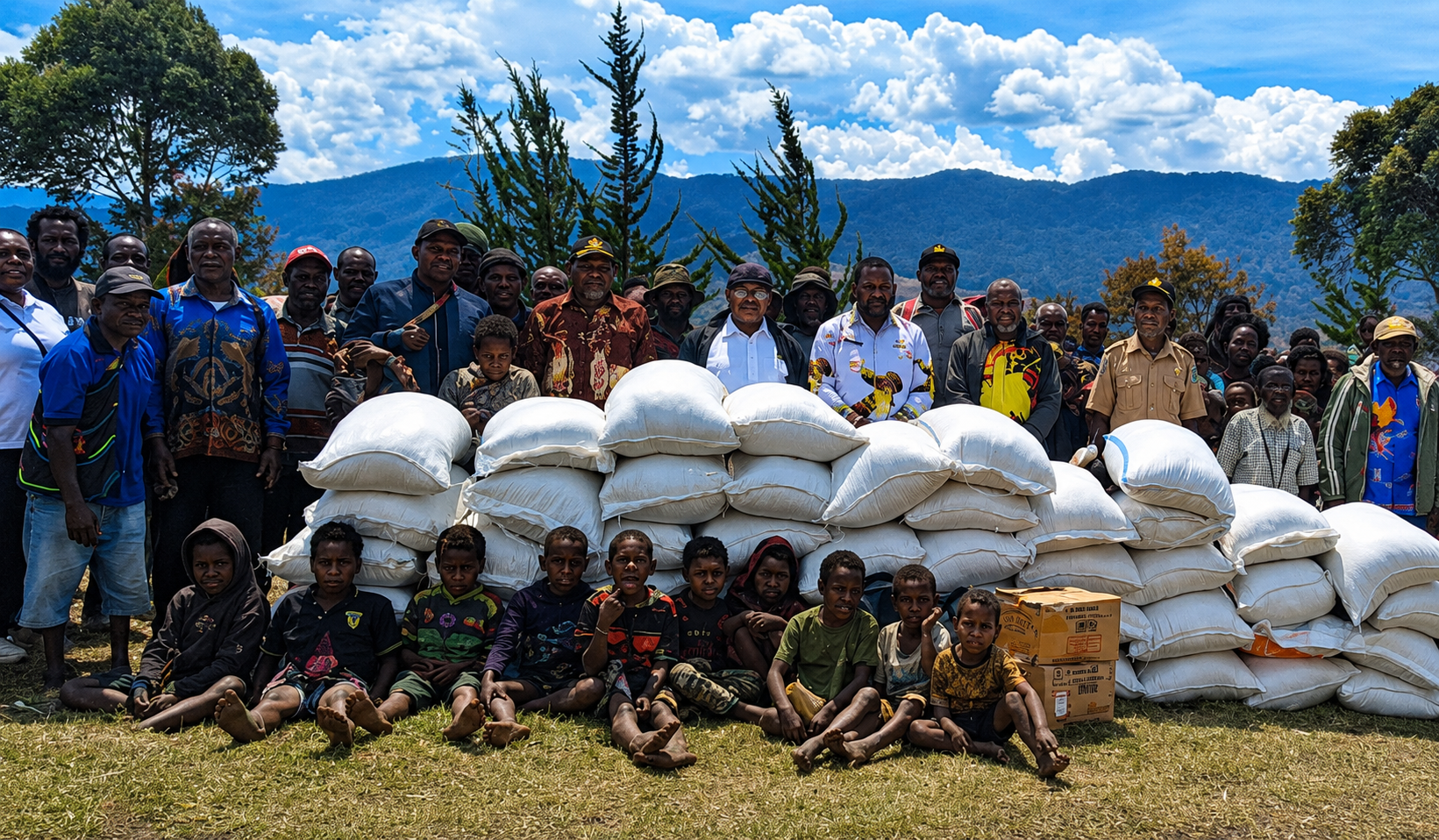
In the highlands of Papua, where distance and difficult terrain can quickly turn a shortage into a crisis, the Nduga drought response is taking shape around two immediate needs: food and water. The Nduga regency government has distributed 50 tons of rice to communities affected by prolonged dry conditions and begun building water storage tanks as the region faces the effects of an extended dry season and what local authorities describe as the impact of El Niño.
The response covers communities spread across 32 districts, according to the Nduga administration. At the same time, the local government has established a coordination center for climate change emergencies in Kenyam, the regency capital, to monitor conditions and organize assistance.
The measures reflect a challenge that extends beyond the immediate availability of food. In parts of Nduga, declining water supplies have affected transportation, agriculture, and access to basic commodities. The local government has consequently combined food distribution with clean water delivery, construction of water storage facilities, and efforts to keep logistical routes open.
The response is also being carried out against the backdrop of a formal three-month emergency response period from August through December 2026, declared by the Nduga government because of the prolonged dry season.
Drought Puts Pressure on Food and Water Supplies
A Prolonged Dry Season Reaches Remote Communities
According to ANTARA, Nduga has experienced drought conditions since approximately April, with the dry season continuing into August. Some areas have also experienced snowfall, contributing to difficult conditions in several highland communities. The government says the combination has contributed to crop failures and disrupted access to basic necessities.
The situation is particularly challenging because Nduga’s geography makes the movement of people and goods highly dependent on limited transport corridors.
For residents of remote communities, a disruption to local water sources can quickly become a food security problem. Farmers may struggle to maintain crops, while traders face higher transportation expenses when conventional routes become difficult to use.
The government has identified Mumugu, in Krepkuri District, as one particularly challenging location. The area is Nduga’s only coastal region and borders Asmat Regency in South Papua. During the dry season, river levels that normally support transportation can fall significantly, making the movement of basic commodities more difficult.
Local authorities say the situation has contributed to higher prices for basic necessities and construction materials in Mumugu.
That makes emergency assistance more than a matter of distributing supplies. It also requires maintaining the physical routes through which those supplies can reach communities.
Food Assistance Reaches 32 Districts
The distribution of 50 tons of rice is therefore a central element of the emergency response.
Nduga Regent Yoas Beon said the rice was prepared for residents across 32 districts. The assistance is intended to prevent prolonged drought from developing into a broader food security problem.
The local government has also sent rice directly to communities experiencing particularly severe conditions.
ANTARA reported that 10 tons of rice were delivered to communities in Wutpage and Nenggeagin, areas that have experienced prolonged drought and snowfall.
The government has emphasized that food assistance must be accompanied by continued monitoring. Rather than treating the 50-ton distribution as a one-time intervention, authorities say conditions in individual districts will continue to be evaluated and assistance adjusted according to local needs.
That approach is important in a geographically diverse regency. The severity of drought is not necessarily identical from one district to another, while transportation constraints can make the delivery of supplies considerably more complicated in remote areas.
Water Becomes the Second Front of the Response
Six Water Storage Tanks Constructed
Food assistance can address immediate hunger, but water shortages require a different response.
The Nduga administration has begun constructing water storage facilities in several locations in and around Kenyam. Six water tanks have been established at strategic points, including near the former regent’s office, Jerusalem Church, Yigi village near the Yosoma post, Nogolait, Yehuda Church, and Krobotak.
The facilities are being developed with community involvement.
The government is also transporting water from Kali Bening to the newly established storage points before distributing it to residents. Water is additionally being delivered to household profile tanks in affected areas.
The administration planned to construct another four water storage tanks on August 28, expanding the network available to communities facing the most acute shortages.
For local authorities, this infrastructure has a purpose beyond the current emergency. Water storage enables communities to accumulate supplies closer to residential areas, minimizing the need for repeated long-distance transportation.
Why Water Matters for Public Health
The Nduga government has identified clean water as a priority because prolonged shortages can have direct consequences for public health.
Yoas Beon said the water crisis needed particular attention because of its connection with community health and made clean water distribution an important part of the El Niño response.
The connection is straightforward. When reliable water sources become scarce, households face difficulties maintaining basic hygiene, preparing food, and meeting everyday needs.
For remote highland communities, the problem can be compounded by the limited availability of health services and the difficulty of transporting supplies.
The presence of health officials and medical personnel in the government’s field visits is therefore significant. During a visit to Wutpaga Nenggeagin in Kuyawagi, the regent was accompanied by officials from the social affairs and health agencies as well as medical personnel.
The response consequently combines food, water, and health considerations rather than treating the drought purely as an agricultural problem.
Keeping the Logistics Network Open
Roads Become Critical During the Emergency
Nduga’s response also highlights an issue that often receives less attention during climate emergencies: transportation.
The local government and communities have been cleaning and maintaining roads to improve access between Mumugu and Kenyam. The objective is to keep logistical routes functioning so food, water, and other essential supplies can continue moving into affected areas.
This is particularly important because conventional river transportation has been affected by declining water levels.
In Mumugu, the drying of rivers has reduced a transportation option that residents normally depend on. The government is therefore seeking to improve the road connection from Kenyam to Mumugu to help communities access food and clean water.
The episode illustrates how climate conditions can create secondary economic effects.
A drought does not only reduce water availability. It can disrupt transportation, increase the price of goods, reduce agricultural production, and place additional pressure on household incomes.
In a remote region such as Nduga, where logistical costs are already high, these effects can reinforce one another.
Emergency Response Extended Through December
Nduga Establishes A Three-Month Emergency Period
Recognizing the potential for the situation to continue, the Nduga government declared an emergency response period lasting from August through December 2026.
The declaration provides a framework for continuing government intervention as dry conditions persist.
The administration has divided teams according to the principal needs of affected communities. Some teams focus on clean water in Kenya, while others handle food distribution and logistics. The regent has also led field teams involving health and social officials and district heads in areas such as Kuyawagi, Wutpage, and Nenggeagin.
The creation of the Posko Induk Penanggulangan Perubahan Iklim, or central climate change response post, in Kenyam is intended to strengthen coordination.
According to ANTARA, the post is responsible for monitoring developments in affected areas and coordinating assistance. The administration says the initiative is necessary because drought can produce interconnected problems, beginning with water shortages and eventually affecting food supplies and livelihoods.
This coordination mechanism could prove particularly important if weather conditions remain unfavorable in the final months of the year.
The Broader Climate Challenge in Papua
Beyond Emergency Aid
The Nduga experience also points to a broader question for Papua: how should remote communities prepare for increasingly difficult climate conditions?
Emergency assistance is essential when people face immediate shortages. Yet rice distributions and water deliveries cannot alone provide a permanent solution.
Longer-term resilience requires reliable water infrastructure, agricultural adaptation, improved roads, better storage capacity, and effective early warning systems.
The government’s current response provides several building blocks for that approach. Water tanks increase local storage capacity. Road maintenance supports logistical resilience. The coordination post creates a mechanism for monitoring conditions. Food assistance protects households while agricultural production is disrupted.
The challenge will be maintaining those systems after the emergency period ends.
Nduga’s geography makes the situation particularly important. The region’s mountainous terrain and dispersed settlements mean that infrastructure investments can have an outsized impact on the reliability of basic services.
Community Participation Matters
Another feature of the response is the involvement of local communities.
The government and residents are jointly constructing the water storage facilities, and community members are also participating in road cleaning and maintenance.
That participation can make emergency infrastructure more sustainable.
Residents are familiar with local terrain, water sources, and transportation routes. Their involvement can therefore help authorities determine where facilities are most useful and how they should be maintained.
It also creates a stronger sense of shared responsibility during a crisis.
The Nduga government has encouraged residents to protect water sources and use distributed assistance appropriately.
Government Presence in Remote Communities
The response also carries an important social dimension.
During his field visit to Wutpaga Nenggeagin and Kuyawagi, Regent Yoas Beon personally observed conditions and distributed assistance alongside government officials and medical personnel.
The administration has told affected residents that they should remain in their communities rather than leave because of the drought, while promising continued government assistance.
This approach reflects an effort to manage the crisis close to where it occurs.
At the same time, the regent has acknowledged that Nduga faces limitations in responding to the emergency and has called for support from the Papua Pegunungan provincial government and the central government.
That request is significant because the scale and geography of the problem can exceed the capacity of a district administration acting alone.
A coordinated response involving district, provincial, and national authorities could help ensure that emergency food and water supplies reach communities consistently throughout the three-month response period.
What Happens Next?
The immediate priority is clear: maintain access to food and clean water while the dry conditions continue.
But the coming months will test whether the emergency response can evolve into a longer-term resilience strategy.
The Nduga government has already established a mechanism for monitoring conditions and coordinating assistance. Basic water infrastructure and the upkeep of logistical routes have also begun to receive investment.
The next step will be to determine whether these measures can be expanded to areas outside the immediate centers of response, particularly communities that remain difficult to reach.
The administration’s decision to continue evaluating conditions in each district provides a useful basis for targeted intervention.
For Papua more broadly, Nduga’s experience offers a reminder that climate resilience is closely connected to infrastructure, food security, and public health.
The issue is not simply whether rain falls or temperatures rise. It is whether communities have enough storage, transportation access, food reserves, and institutional capacity to absorb the effects of changing weather patterns.
Conclusion
The Nduga drought response represents a multilayered effort to protect communities from the immediate effects of a prolonged dry spell. The distribution of 50 tons of rice across 32 districts, the construction of water storage tanks, and the transportation of clean water from Kali Bening address some of the most urgent needs identified by local authorities.
The declaration of a three-month emergency response from August through December shows that the Nduga government is preparing for the possibility that difficult conditions will continue.
The longer-term measure of success, however, will be whether emergency action can strengthen resilience beyond the current crisis.
For Nduga, that means maintaining reliable food supplies, expanding clean water infrastructure, protecting transportation links, and strengthening cooperation between local communities and government institutions.
In a region where geography can magnify the effects of a climate shock, those investments are not merely emergency measures. They are part of the foundation for more secure and resilient communities in Papua’s highlands.

