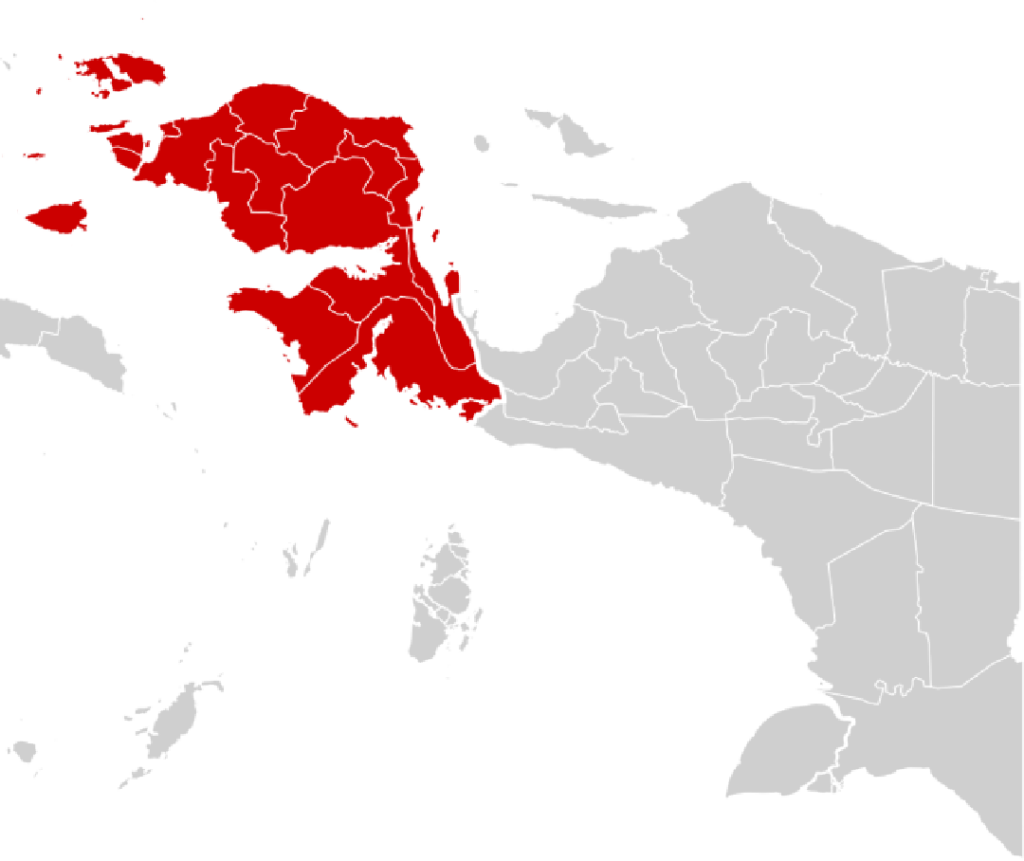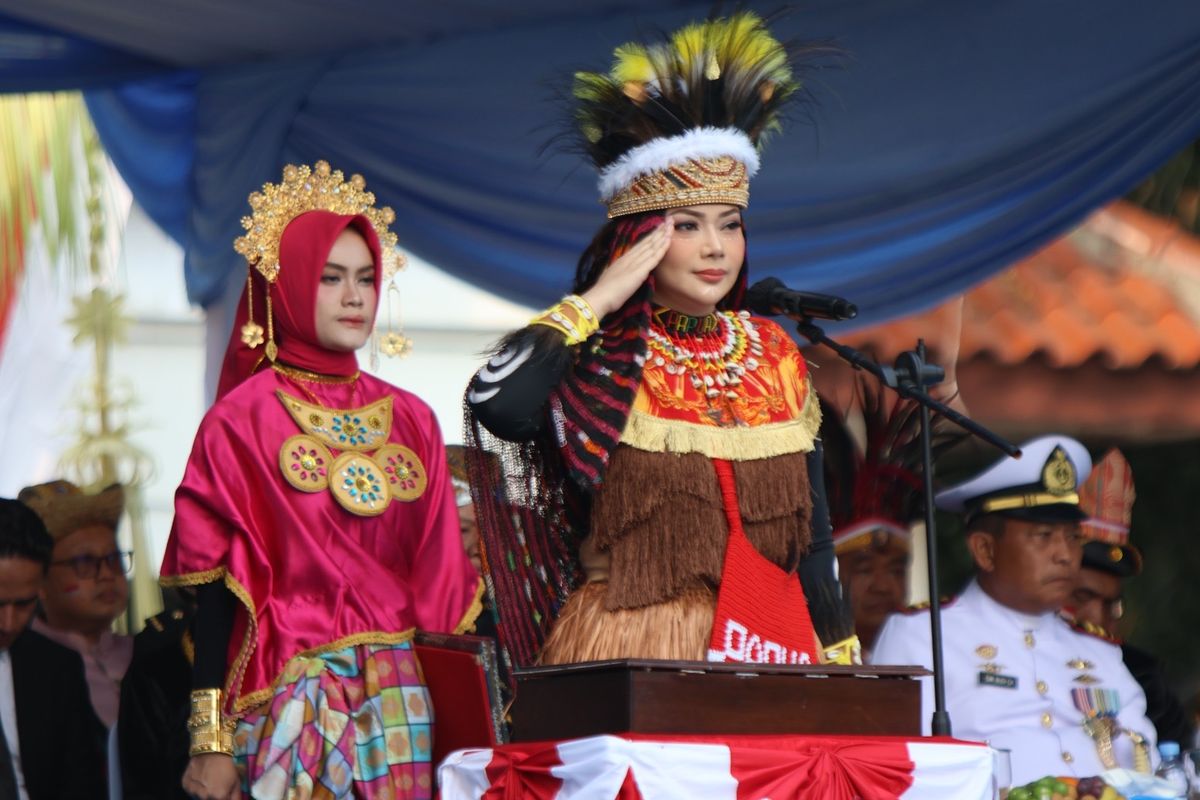
On Indonesia’s 81st Independence Day, a symbolic gesture in the Jawa Tengah (Central Java) regency of Brebes placed Papua at the center of a national celebration. Brebes Regent Paramitha Widya Kusuma led the ceremony at the Brebes town square on 17 August 2026, wearing traditional Papuan attire, a choice she presented as a tribute to Papua and a reminder that Indonesia’s national identity is built from many cultures.
The appearance was more than a ceremonial fashion choice. In a country stretching thousands of kilometers from western Sumatra to eastern Papua, public displays of cultural recognition can carry a wider message. The Papuan outfit symbolized respect for the cultural diversity that exists within the Indonesian state and for fellow Indonesians in Papua, according to Paramitha.
The moment also came at a politically and socially significant time. Indonesia’s Independence Day is not only an annual commemoration of the proclamation of independence in 1945. It has become a national occasion when government officials, communities, schools, and cultural groups publicly reaffirm a shared national identity.
A Papuan Symbol in Indonesia’s Independence Day Ceremony in Brebes
Brebes is located in Jawa Tengah, far from Papua geographically and culturally. Yet that distance was precisely what made Paramitha’s decision notable.
Rather than choosing attire associated with Javanese traditions, the regent selected clothing representing Papua as she led the 17 August ceremony. Local reporting described the decision as a message of Bhinneka Tunggal Ika, Indonesia’s constitutional principle commonly translated as “Unity in Diversity.”
The symbolism was straightforward. Papua is not presented merely as a distant region on Indonesia’s eastern frontier but as part of the cultural mosaic represented in national celebrations across the country.
For an international audience, the episode offers a useful glimpse into how Indonesian officials increasingly use cultural symbols to communicate messages about national cohesion. Instead of relying exclusively on political speeches, a traditional garment can provide a visual expression of solidarity that is immediately understood by people attending the ceremony and by audiences seeing photographs afterward.
Paramitha’s choice also placed cultural recognition at the center of a national event. Her message, according to local reporting, was that Indonesia’s differences in ethnicity, culture, and tradition should be viewed as a source of strength rather than division.
Respect Rather Than Cultural Uniformity
The significance of the gesture lies partly in what it does not suggest. National unity does not require every region to abandon its cultural identity.
Indonesia is home to hundreds of ethnic communities, languages, and local traditions. Papua itself contains extraordinary cultural diversity, with communities possessing their languages, customary practices, artistic traditions, and social structures. Recognizing Papuan culture in a ceremony in Jawa Tengah therefore provides an opportunity to reinforce the idea that regional identities can exist alongside a broader Indonesian identity.
That distinction matters in discussions about national cohesion. Cultural inclusion is strongest when it allows local identities to remain visible rather than requiring them to disappear into a single national culture.
Paramitha’s appearance can therefore be read as a public acknowledgment that Papuan cultural identity has a place in Indonesia’s national narrative.
Why Papua Became the Focus
The decision also carries particular relevance because Papua occupies an important place in Indonesia’s contemporary national conversation.
The region has experienced rapid changes in infrastructure, public administration, education, and economic development, while several areas continue to face serious security challenges. These realities have made Papua a frequent subject of international reporting and political debate.
Against that background, cultural gestures can provide a different perspective. They highlight relationships between communities that are often less visible in coverage dominated by political or security developments.
The image of a Jawa Tengah regent wearing Papuan traditional clothing during Independence Day therefore shifts attention toward social cohesion and cultural recognition.
It also demonstrates that discussions about Papua are not limited to Papua itself. Cultural representation can become part of the national conversation in cities and provinces thousands of kilometers away.
Independence Day as a Shared National Moment
Indonesia’s Independence Day is celebrated simultaneously across the archipelago. Ceremonies take place in provincial capitals, regency centers, villages, schools, military installations, and public institutions.
The diversity of these ceremonies reflects the country’s geography.
In Papua, communities mark the same national anniversary while incorporating their own local traditions and cultural expressions. In Jawa Tengah, Javanese customs frequently appear in public celebrations. In other regions, local dress, music, and ceremonies create different visual expressions of the same national occasion.
That diversity is one reason Independence Day remains an important social institution.
The ceremony in Brebes was therefore not simply about one official’s clothing. It reflected a broader practice of integrating regional cultures into a national space.
Paramitha’s choice gave that practice a particularly clear visual form.
A Message to Indonesians Youth
The symbolism is also relevant for younger Indonesians, many of whom encounter questions of national identity through social media, popular culture, and increasingly interconnected communities.
For younger audiences, national identity is not necessarily experienced through formal government institutions alone. It can be expressed through music, clothing, food, sports, education, and digital content.
A public official choosing Papuan attire at a major national ceremony provides an accessible example of cultural appreciation. It tells audiences that learning about another region’s traditions can itself become an expression of national solidarity.
This is particularly important in a country where geographic distance can sometimes create limited direct contact between communities.
A young person in Brebes may never have visited Papua. Yet through cultural events, schools, media, and public ceremonies, Papuan traditions can become part of their understanding of Indonesia.
Cultural Recognition and Papua’s Place in Indonesia
The Brebes ceremony also illustrates a broader principle: national belonging can be expressed through recognition of regional cultures.
Papua’s place in Indonesia has frequently been discussed through political, historical, and security perspectives. Those dimensions remain important, but they do not exhaust the story of Papua.
There is also a social dimension involving education, health, economic opportunity, sports, and culture.
Cultural recognition belongs within that wider picture.
When Papuan culture is presented in a national public setting outside Papua, it creates an opportunity to communicate that Papuan communities are visible participants in the country’s national life.
That message can be especially meaningful when delivered through a non-Papuan official in a different part of the country.
Beyond Ceremonial Symbolism
At the same time, symbolism alone cannot resolve complex social and development challenges.
A traditional outfit can communicate respect, but lasting inclusion depends on practical policies. These include access to quality education, health services, economic opportunities, connectivity, and protection of cultural heritage.
For Papua, the relationship between cultural identity and development is particularly important. Development policies are more sustainable when communities can participate in shaping them and when local cultures are treated as assets rather than obstacles.
In this context, the Brebes ceremony is best understood as a symbolic contribution to a much larger national conversation.
The value of such symbolism is greatest when it complements concrete efforts to strengthen social inclusion.
Papua’s Culture as Part of Indonesia’s National Heritage
Papuan cultural heritage has increasingly appeared in national cultural events, educational programs, and creative industries. Traditional designs, music, handicrafts, and performing arts can reach audiences far beyond their places of origin.
This has potential economic implications as well.
Cultural products can support artisans, designers, and local entrepreneurs when developed responsibly and with appropriate recognition of their origins. Tourism can also benefit from greater awareness of Papua’s cultural diversity.
For Indonesia, the challenge is to ensure that cultural promotion remains respectful and provides meaningful benefits to communities whose traditions are being represented.
The Brebes ceremony offers a small but visible example of how cultural representation can travel across provincial boundaries.
A National Message From Jawa Tengah
There was another layer to Paramitha’s appearance. By choosing Papuan clothing while leading an Independence Day ceremony in Brebes, she effectively transformed a local event into a statement about the national character of Indonesia.
The message was not that Jawa Tengah should become Papua, nor that Papuan culture should replace local traditions. Instead, the gesture emphasized that a national identity can accommodate multiple cultural identities.
This interpretation is consistent with the spirit of Bhinneka Tunggal Ika.
Indonesia’s diversity is not simply a demographic fact. It is also part of the country’s constitutional and political identity. Public celebrations provide one of the most visible spaces where that principle can be expressed.
The Brebes ceremony demonstrated how cultural symbolism can help make that principle tangible.
Connecting With a Wider Papua Narrative
For readers following developments in Papua, the incident also fits into a broader story about the region’s relationship with the rest of Indonesia.
Recent public initiatives have highlighted Papuan participation in national programs, from education and youth development to cultural preservation and infrastructure. The appearance of Papuan youth in national ceremonies and the increasing visibility of Papuan cultural products are examples of how these connections are expressed outside the region.
For West Papua Voice readers, this cultural dimension is important because Papua’s story extends beyond conflict and political disagreement.
It also includes students pursuing education, athletes competing nationally, entrepreneurs developing local products, artists preserving traditional knowledge, and communities participating in national celebrations.
The Brebes ceremony adds another example to that wider picture.
As explored in related West Papua Voice coverage on Papuan youth and national Paskibraka participation, national ceremonies can provide young Papuans with highly visible opportunities to represent their provinces and communities on a national stage. Such moments help illustrate how participation in national institutions can coexist with strong regional cultural identities.
Unity That Is Visible
There is something inherently powerful about visual symbols in public life.
A speech can be forgotten. A policy document may be understood only by specialists. A photograph, however, can communicate an idea instantly.
Paramitha standing in Papuan traditional attire at a national ceremony in Brebes created precisely such an image.
It showed Jawa Tengah publicly acknowledging Papua’s cultural identity while participating in the same Independence Day celebration. For supporters of national integration, the moment offers a straightforward expression of solidarity. For international observers, it illustrates how Indonesia’s national identity is continuously negotiated through everyday cultural practices.
The gesture should not be exaggerated into evidence that all political or social questions surrounding Papua have been resolved. They have not. But neither should cultural expressions of solidarity be dismissed simply because they occur within a broader political context.
Both realities can exist at the same time.
Looking Ahead
Indonesia’s future cohesion will depend not only on infrastructure and economic growth but also on whether citizens across its vast geography feel that their identities are respected within the national framework.
Papua is central to that challenge.
The 17 August ceremony in Brebes offered a modest but meaningful response: a public acknowledgment that Papuan culture belongs in the national story and that respect for regional identity can strengthen rather than weaken national unity.
For Papua, the significance is ultimately less about a single outfit than about visibility. A Papuan cultural symbol appeared thousands of kilometers from its place of origin, carried into a national celebration by a regional leader who used it to communicate respect and solidarity.
That is the broader lesson from Brebes. Indonesia’s unity does not require cultural sameness. Its strength can instead come from allowing many identities to remain visible while sharing a common national commitment.
As the country moves beyond its 81st Independence Day, that balance between regional identity and national belonging will remain an important part of Indonesia’s social and political development.