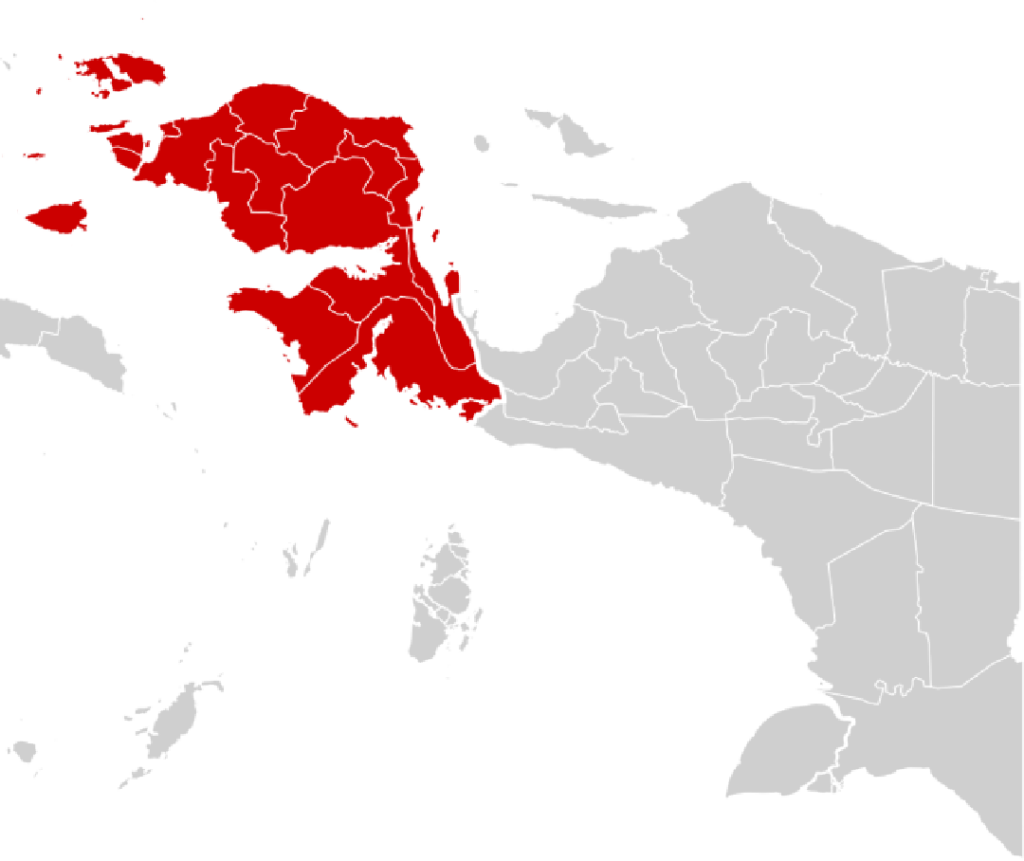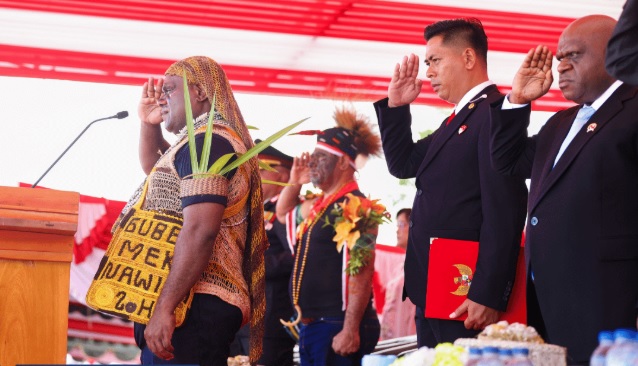
In Nabire, Papua Tengah (Central Papua) province, Indonesia’s 81st Independence Day carried a message that went beyond the ceremonial raising of the national flag. Natalius Pigai in Papua Tengah used his presence at the 17 August commemoration to emphasize that the meaning of independence should be felt by Indonesians across the country, including communities living in areas affected by conflict.
Pigai, Indonesia’s Minister of Human Rights and a Papuan figure himself, attended the Indonesia’s Independence Day commemoration in Nabire which was led by Governor Meki Fritz Nawipa, bringing the national government’s message directly to one of Papua’s most strategically important provincial capitals. His visit came amid continuing efforts by the central and provincial governments to strengthen stability, public services, and development across Papua Tengah.
The minister’s presence was also significant because the province continues to face complex challenges involving security, governance, development, and human rights. Earlier in 2026, Pigai had argued that resolving conflict in Papua requires a comprehensive national approach involving multiple branches of government and stakeholders rather than isolated responses to individual incidents.
Independence as a Message for All Indonesians
For Pigai, the 17 August celebration was not simply an annual state ceremony. It provided an opportunity to reinforce the idea that independence should have practical meaning in people’s daily lives.
His message, as reported by Antara Papua Tengah, was that the spirit of independence must be felt even in conflict-affected areas. That framing places security and human rights within a broader national objective: ensuring that citizens can experience the benefits of independence through peace, access to government services, and opportunities for a better life.
The significance of that message is particularly strong in Papua Tengah.
The province is home to communities spread across difficult terrain, including urban centers such as Nabire and more remote highland districts. Differences in geography, infrastructure, and security conditions mean that the experience of government services can vary considerably from one community to another.
A national Independence Day message delivered from Nabire, therefore, carries a practical dimension. It reinforces the principle that geographical distance should not determine whether citizens feel connected to the state.
A Minister with a Personal Connection to Papua
Pigai’s appearance also attracted attention because he is himself from Papua. His position as minister of human rights gives his public statements an additional dimension when he discusses the relationship between national policy, human rights, and conditions in Papua.
Earlier this year, Pigai repeatedly called for a peaceful and comprehensive approach to the region’s security challenges. In April, he encouraged all sides to work together to create peace in Papua, arguing that responsibility for resolving the conflict should not rest exclusively with the executive branch.
In May, he said the resolution of the Papua conflict required a national political decision and a comprehensive approach involving the executive, legislative, and judicial branches, political parties, and national figures.
Those statements provide useful context for his appearance in Nabire on Independence Day.
The message is not simply about celebrating the national holiday. It also reflects an effort to connect the principles of human rights, peace, and national development with the everyday experience of Papuan communities.
Nabire’s Strategic Role in Papua Tengah
Nabire has become an increasingly important administrative and economic center in Papua Tengah.
As the provincial capital, the city serves as a hub for government administration, transportation, education, health services, and economic activity. Its position also makes it a natural meeting point for national and regional officials working on the province’s development agenda.
The presence of a national minister during the Independence Day ceremony consequently carried symbolic and institutional importance.
It demonstrated coordination between Jakarta and the provincial government while giving local leaders an opportunity to discuss issues extending beyond the ceremony itself.
Reports surrounding Pigai’s visit indicate that discussions also touched on institutional development and regional stability, including the issue of establishing a high prosecutor’s office in Papua Tengah. Such institutions are important as the province continues to strengthen its capacity to manage government, law enforcement, and public services from within the region.
Strengthening Institutions Closer to Communities
The development of regional institutions can have a direct impact on public confidence.
For a rapidly developing province, effective governance requires more than physical infrastructure. It requires courts, prosecutors, police, health services, schools, and administrative institutions capable of operating efficiently and providing predictable services.
The establishment and strengthening of provincial institutions can reduce dependence on offices located outside the region and potentially make government services more accessible.
This is particularly relevant in Papua, where distance and terrain have historically presented significant logistical challenges.
A stronger institutional framework in Papua Tengah can therefore complement infrastructure development and economic investment.
Stability as a Foundation for Development
Pigai’s Independence Day message also needs to be understood against the security challenges facing parts of Papua Tengah.
The province has experienced armed violence in several districts. According to previous reporting, Papua Tengah recorded 17 of 42 armed violence incidents in Papua during the first half of 2026, based on data cited from Komnas HAM.
The consequences of insecurity extend beyond immediate casualties.
When violence occurs, communities can experience disruptions to education, healthcare, transportation, trade, and agricultural activity. In some cases, residents have been displaced from their homes and moved toward safer urban areas or neighboring districts.
That is why the language of “independence” used during the Nabire ceremony has significance beyond patriotism.
For communities affected by insecurity, the ability to live safely, send children to school, access healthcare, travel freely, and earn a livelihood is a tangible expression of stability.
The challenge for government is therefore to ensure that national celebrations are matched by practical improvements in people’s lives.
Human Rights and Security Cannot be Separated
Pigai’s position as human rights minister gives his Independence Day message an additional layer.
His earlier statements on Papua have emphasized that civilian protection must remain central to the government’s approach. In April, following a deadly armed confrontation in Puncak, Pigai called for those responsible for attacks against civilians to take responsibility and face legal proceedings. He also said children injured in the incident had received government-supported medical treatment.
His position illustrates a broader principle: maintaining national security and protecting human rights are not necessarily competing objectives.
A stable environment is necessary for government services and economic activity to function. At the same time, security operations must be conducted within the framework of Indonesian law and respect for civilian protection.
This balance will remain important in Papua Tengah.
Dialogue Remains Part of the Broader Approach
The provincial government has also emphasized peaceful approaches to regional challenges.
In July, Papua Tengah Governor Meki Frits Nawipa called on all elements of society to reject violence and prioritize dialogue. He described Papua Tengah as a shared home for people from different ethnic, religious, and cultural backgrounds and argued that development could not proceed optimally without peace and security.
That message complements the broader national emphasis on stability.
For international observers, it is important to recognize that the Papua policy debate involves several dimensions at once. Security is one component, but so are human rights, development, local governance, education, healthcare, economic opportunity, and social cohesion.
The government’s challenge is to make these elements work together rather than treating them as separate policy areas.
Development Gives Independence a Practical Meaning
One of the strongest themes emerging from Papua Tengah’s development agenda is the connection between social welfare and human capital.
In July, the provincial government launched the BANGKIT program, aimed at strengthening family and child development, improving nutrition, and addressing challenges including stunting and poverty. The program was presented as part of a broader investment in the quality of human resources among Indigenous Papuan communities.
Such programs demonstrate how the meaning of independence can be translated into public policy.
A child who receives adequate nutrition has better prospects for learning. A young person who gains access to quality education has greater opportunities to participate in the economy. A family with reliable healthcare and income opportunities is more resilient to economic shocks.
These are not abstract measures of national unity. They are tangible indicators of whether citizens feel that the state is delivering on its responsibilities.
A Broader National Connection
The participation of a national minister in the Independence Day ceremony in Nabire also sends a message about Papua’s place within Indonesia’s national development framework.
Papua is geographically distant from Jakarta, but its development is increasingly linked to national infrastructure, connectivity, investment, and public service strategies.
The creation of new provinces, expansion of transport networks, and development of local institutions are intended to bring administration and public services closer to communities.
That process will inevitably take time. Papua’s geography is among the most challenging in Indonesia, and development projects often face high logistical costs and difficult terrain.
But the strategic direction is clear: improving connectivity and strengthening local government capacity are central to integrating remote communities into broader economic and administrative networks.
Independence Day and the Next Generation
The 17 August celebration also carries particular significance for young Papuans.
For a younger generation growing up in Papua Tengah, national identity is shaped not only by political debates but also by education, sport, cultural activities, social media, employment opportunities, and interaction with people from other parts of Indonesia.
Government programs that expand these opportunities can create a more direct connection between young people and the national development process.
This is particularly important because young people are among the groups most affected when insecurity interrupts schooling or limits economic opportunities.
A peaceful and functioning environment provides them the opportunity to participate in Indonesia’s future rather than simply observe national development from a distance.
A Message that Extends Beyond the Ceremony
The significance of Pigai’s visit ultimately depends on what follows the ceremony.
An Independence Day speech can provide inspiration, but the more difficult task is converting that message into policies that communities can experience.
In Papua Tengah, this means continuing efforts to improve infrastructure, healthcare, education, and economic opportunities while strengthening public institutions and maintaining security.
It also means ensuring that human rights remain part of the development conversation.
The provincial government has already emphasized the importance of peace as a prerequisite for development. The central government’s challenge is to translate national commitments into consistent programs that reach communities across the province, including those in areas facing security difficulties.
For Papua, this may be one of the most meaningful ways to interpret the spirit of independence.
Looking Ahead
Natalius Pigai’s presence in Nabire on Indonesia’s 81st Independence Day placed Papua Tengah at the center of a national message about freedom, unity, and public responsibility. His call for the spirit of independence to be felt in conflict-affected areas reflects a broader challenge facing Indonesia: ensuring that national development and protection of citizens reach communities regardless of geography or security conditions.
The road ahead will not be simple. Papua Tengah still faces security concerns, geographical obstacles, and significant development needs. Yet the combination of stronger local institutions, infrastructure investment, human capital programs, and dialogue can provide a foundation for gradual progress.
For Nabire and Papua Tengah, the real measure of independence will ultimately be found not only in ceremonies held each August but also in whether people can live safely, educate their children, access public services, and build livelihoods with confidence.
That is where the symbolism of 17 August becomes a practical national commitment.
Conclusion
Minister Natalius Pigai’s participation in Indonesia’s 81st Independence Day celebrations in Nabire carried a message that extended beyond the ceremony itself. By marking the national anniversary in Papua Tengah, the government sought to underline that the meaning of independence, public services, human rights protection, and development should be felt across the country, including areas facing security and development challenges. His engagement with regional leaders also highlighted the importance of maintaining stability while ensuring that development remains connected to the needs of local communities. For Papua Tengah, the significance of the visit will ultimately be measured not only by the symbolism of the celebration but also by whether the message of inclusion is translated into stronger institutions, better public services, economic opportunities, and lasting peace.