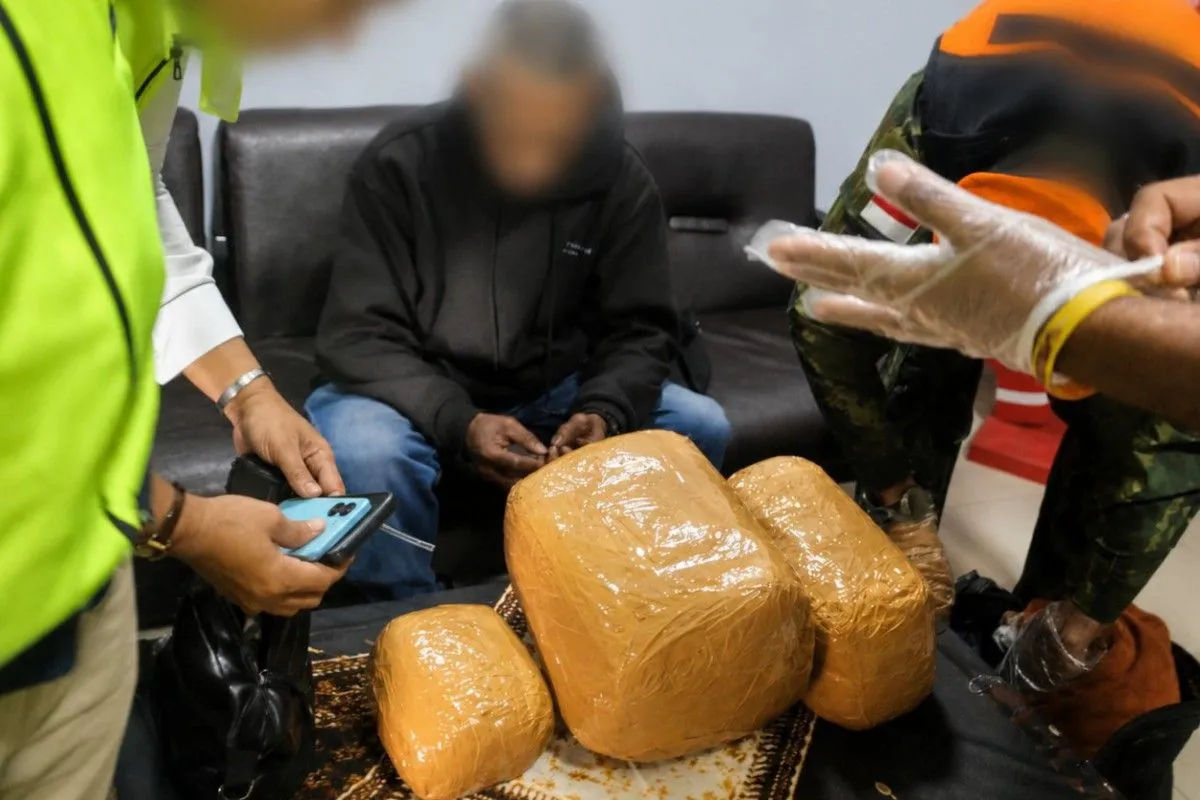
In a region where air transport is essential for connecting communities separated by mountains, forests, and long distances, Sentani Airport cannabis smuggling has become an increasingly important security concern. On 12 August 2026, airport security officers in Jayapura have once again intercepted an attempt to move dried cannabis through the airport, this time seizing approximately 3.7 kilograms of the drug, reportedly destined for Sorong.
The latest interception adds to a much larger pattern. According to reports from local media, security officers at Sentani Airport prevented attempts to move approximately 145 kilograms of dried cannabis between April and August 2026. The repeated seizures have highlighted the role of Papua’s aviation network in efforts to prevent narcotics from reaching other parts of the region.
The latest case began when airport security officers became suspicious of a yellow suitcase belonging to a passenger. A subsequent inspection reportedly uncovered 188 packages of dried cannabis, with the total weight estimated at 3.7 kilograms. The passenger, identified in reports by the initials HH, was subsequently handed over to law enforcement for further investigation.
The incident is significant not only because of the quantity seized but also because it illustrates the continuing challenge faced by security authorities in protecting Papua’s transportation system from narcotics trafficking.
A Suspicious Suitcase Draws Attention
According to reports surrounding the case, the discovery was made during routine security procedures at Sentani International Airport.
The passenger was preparing to travel aboard Lion Air flight JT 799, with Sorong reportedly listed as the destination. During the inspection process, officers noticed something unusual about a yellow suitcase.
Further examination led to the discovery of numerous packages containing dried cannabis. Local reports said the shipment consisted of 188 individual packages, collectively weighing approximately 3.7 kilograms.
The discovery demonstrates why airport security screening remains an important component of Papua’s broader fight against narcotics trafficking.
Unlike major road networks, aviation provides a rapid connection between geographically distant parts of Papua and other Indonesian regions. That connectivity is essential for legitimate travel, trade, healthcare, and education. At the same time, the same network can be exploited by criminal networks attempting to move illegal goods.
For authorities, the challenge is therefore to maintain efficient transportation while preventing legitimate infrastructure from being abused for criminal purposes.
From Detection to Law Enforcement
Once the suspected narcotics were discovered, the case was reportedly transferred to law enforcement authorities for further examination.
The next stage of the investigation is particularly important because the person carrying the packages may represent only one part of a wider distribution chain.
Questions surrounding the origin of the cannabis, its intended recipients, and the financing behind the shipment will be central to determining the scope of the case.
It is also important to distinguish between what has been established and what remains under investigation. The seizure itself confirms that cannabis was intercepted at the airport. Any conclusions about a wider trafficking network require evidence from the police investigation.
That distinction matters when reporting narcotics cases. A seizure can reveal a trafficking route, but investigators still need to establish who organized the shipment, who financed it, and where the drugs were ultimately intended to go.
145 Kilograms Stopped in Five Months
The latest seizure becomes more significant when placed against the wider figures reported from Sentani Airport.
From April through August 2026, officers reportedly prevented the movement of approximately 145 kilograms of dried cannabis through the airport. The latest 3.7-kilogram seizure represents another addition to that enforcement record.
The volume suggests that authorities are facing more than isolated individual incidents.
It points to persistent attempts to move cannabis through Papua’s transportation infrastructure, with air travel forming one of the routes that traffickers may attempt to exploit.
The figure also demonstrates the importance of sustained airport security operations rather than occasional enforcement campaigns.
Sentani is one of the principal aviation gateways serving Papua. It connects Jayapura with destinations across the region and provides access to communities where road transportation remains limited.
That makes the airport strategically important for the local economy. It also means that security procedures have implications beyond aviation itself.
Papua’s Geography Creates a Complicated Security Environment
Papua’s geography is one reason narcotics enforcement presents a particularly complex challenge.
Large areas are covered by forests and mountainous terrain, while some communities remain difficult to reach by road. In several parts of the region, small aircraft provide an essential link between communities and larger urban centers.
The geography can make law enforcement difficult, particularly when illicit cultivation or trafficking occurs in remote areas.
At the same time, improved connectivity has become an important part of the Indonesian government’s development strategy for Papua. New roads, bridges, and air routes are intended to reduce isolation and improve access to markets and public services.
The security challenge is to ensure that these connections remain primarily instruments of development rather than channels for criminal activity.
The latest seizure at Sentani Airport illustrates this dual reality.
The airport enables people to travel, businesses to operate, and goods to reach remote communities. Security officers must therefore protect the network without undermining the legitimate mobility that Papua needs for its economic and social development.
Cannabis trafficking is not Simply a Law Enforcement Issue
The scale of the seizures also raises a broader question about the economics of illegal narcotics.
Cannabis cultivation and trafficking can provide income in places where legitimate economic opportunities are limited. That does not make the activity legal or harmless. Rather, it shows why enforcement needs to be accompanied by economic alternatives.
In rural and remote areas, government investment in agriculture, infrastructure, education, and small businesses can help reduce the economic incentives associated with illicit activities.
This is particularly relevant in Papua, where agricultural communities possess significant potential in legitimate sectors, including coffee, cocoa, horticulture, and other local products.
The objective should therefore be twofold: disrupt criminal networks while expanding lawful opportunities for communities.
That approach can make counter-narcotics efforts more sustainable.
Protecting Papua’s Transportation Network
The repeated discoveries at Sentani Airport also demonstrate the importance of cooperation between aviation security personnel and law enforcement agencies.
Airport security officers are often the first line of defense. Their role begins with screening passengers and baggage, identifying suspicious objects and escalating cases when prohibited substances are detected.
Police investigators then have the responsibility of determining how the drugs were obtained, where they came from, and who was supposed to receive them.
The two functions are complementary.
A security officer who detects a suspicious package prevents the immediate movement of the narcotics. An investigation that follows can potentially identify the people behind the shipment.
This second stage is crucial because removing one shipment does not necessarily eliminate the network responsible for it.
The effectiveness of Papua’s narcotics enforcement will therefore depend partly on whether individual airport seizures can generate intelligence that leads investigators toward larger trafficking structures.
The Wider Narcotics Challenge in Papua
The Sentani case is not an isolated example of drug enforcement in Papua.
Earlier in 2026, ANTARA reported that the aviation security team at Sentani Airport had also intercepted approximately 2.6 kilograms of cannabis.
Previous cases have similarly involved passengers attempting to conceal cannabis in luggage. In June 2025, for example, airport security officers detected 93 packages of cannabis weighing about 745 grams during an X-ray inspection of a passenger’s backpack. The packages had been hidden among clothing.
These cases show how concealment techniques can vary, while the underlying challenge remains the same.
For airport security personnel, modern screening technology is therefore only one part of the solution. Officer awareness and careful follow-up remain equally important.
A Security Issue with Economic Consequences
Narcotics trafficking also carries an economic cost.
Illegal drug markets can generate criminal income, encourage corruption, and expose communities to health and social problems. They can also undermine the legitimate economy by creating parallel markets that operate outside taxation and regulation.
For Papua, maintaining a secure transportation environment is therefore relevant to economic development.
Investors, travelers, and businesses need confidence that airports and other transport facilities are secure.
The relationship between security and development is especially visible in a region where improved connectivity is being used to expand economic opportunities.
A secure airport supports tourism, commerce, and public services. An airport that becomes associated with trafficking would face a very different challenge.
The work of aviation security officers is therefore part of a broader effort to ensure that Papua’s infrastructure serves legitimate economic and social purposes.
What the Latest Seizure Tells Authorities
The 3.7 kilogram seizure provides investigators with another opportunity to map the movement of narcotics through Papua.
The most important questions now extend beyond the suitcase itself.
Where did the cannabis originate? Who prepared the 188 packages? Who financed the shipment? Who was expected to receive it in Sorong? Were there other people involved in arranging the passenger’s journey?
Answers to these questions could determine whether the incident represents an isolated attempt or a component of a wider distribution network.
Authorities also need to continue monitoring transportation routes beyond Sentani.
Papua’s geography means that narcotics can potentially move through several channels, including airports, roads, maritime routes, and informal crossings.
A comprehensive strategy, therefore, requires coordination between airport authorities, police, customs officials, local governments, and other relevant agencies.
Security and Development Must Move Together
The fight against narcotics should not be separated from Papua’s wider development agenda.
The region needs better connectivity, stronger local economies, and improved access to education and healthcare. At the same time, we must protect those same networks from exploitation by criminal groups.
This is particularly important as Indonesia continues investing in infrastructure across Papua.
Recent projects such as the Trans Papua road network and the construction of bridges in remote communities are intended to improve mobility and economic integration. Greater connectivity can create opportunities, but it also requires stronger institutional capacity to manage security risks.
The answer is not to restrict mobility.
Rather, the challenge is to make mobility safer.
That means maintaining effective screening at airports while ensuring that legitimate passengers and businesses can continue to use Papua’s transportation infrastructure efficiently.
Conclusion
The interception of 3.7 kilograms of dried cannabis at Sentani Airport is another reminder that Papua’s growing transportation connectivity also creates responsibilities for security authorities. The reported seizure of 188 packages destined for Sorong adds to approximately 145 kilograms of dried cannabis that authorities reportedly prevented from being moved through Sentani Airport between April and August 2026.
The figures point to a persistent narcotics trafficking challenge, but they also demonstrate the importance of effective security screening and cooperation between aviation personnel and law enforcement agencies.
For Papua, the issue extends beyond individual arrests or seizures. A secure transportation system is essential to the region’s wider economic development. Airports connect communities to markets, schools, healthcare, and employment opportunities, and we must protect those connections from criminal exploitation.
The next step should be to use each seizure not only to remove drugs from circulation but also to identify the networks behind them. At the same time, stronger legal economic opportunities in remote communities can help address some of the conditions that allow illicit markets to take root.
Sentani Airport’s latest interception therefore represents both an enforcement success and a warning. Papua’s connectivity is expanding, and protecting that connectivity will be increasingly important to ensuring that infrastructure and mobility contribute to legitimate development rather than become channels for organized crime.