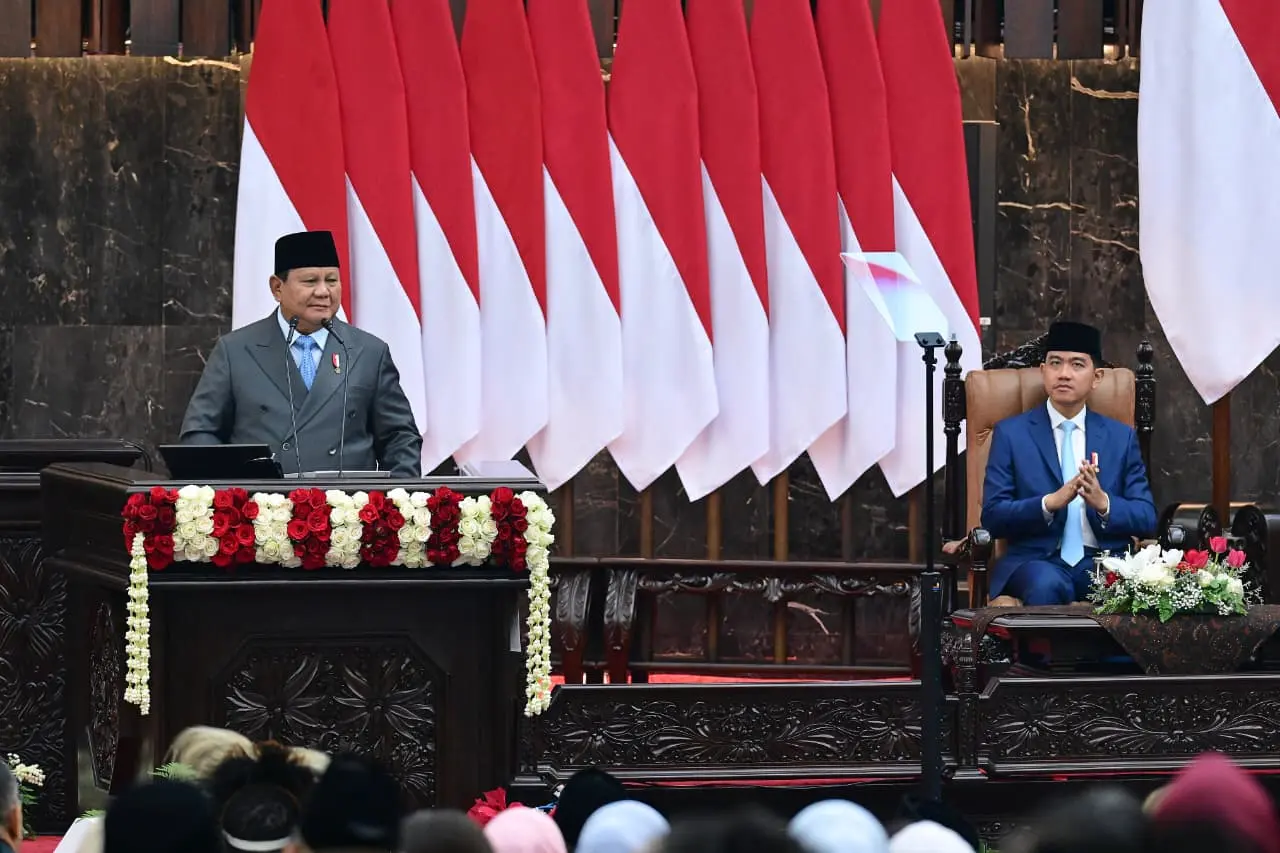
When President Prabowo Subianto delivered his state address at the annual session of the People’s Consultative Assembly, or MPR, on Friday, 14 August 2026, one of the most personal moments came from far beyond Jakarta.
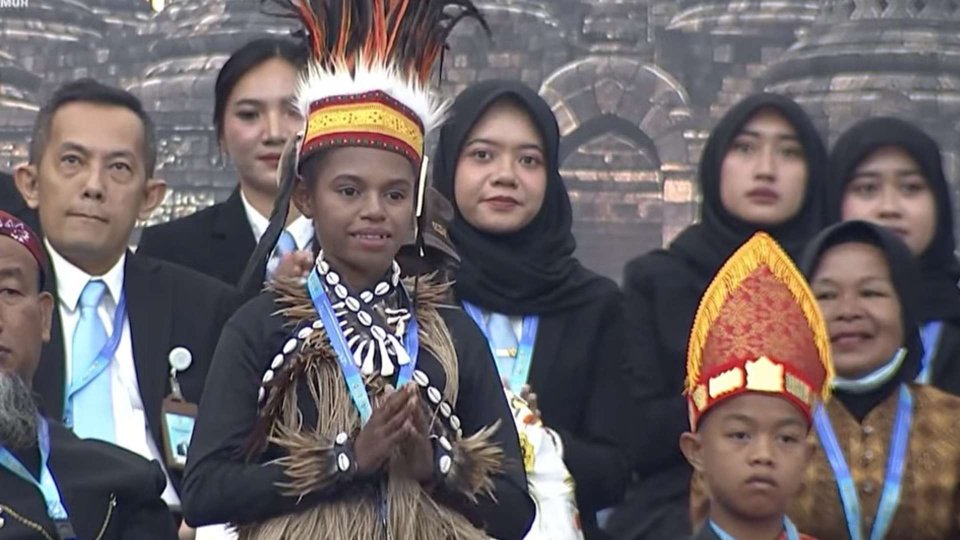
Standing among special guests invited to the parliamentary complex was Kristina Beno, a sixth-grade elementary school student from Merauke, Papua Selatan (South Papua). Her presence gave a human face to one of the administration’s flagship social programs, the Free Nutritious Meals initiative, widely known by its Indonesian acronym, MBG.
Prabowo used Kristina’s experience to illustrate what the government believes the program can achieve when nutrition policy reaches children in regions far from Indonesia’s political and economic centers.
The president said MBG had helped Kristina become fitter, more focused in class, and more consistent in attending school. Metro TV reported that Prabowo described nutritious food as an investment in children’s future, linking adequate nutrition with the physical and cognitive development needed for learning.
For Papua, the symbolism was significant. Kristina was not presented simply as a recipient of government assistance. She was introduced as part of a wider national conversation about education, nutrition, and the opportunities available to children from Indonesia’s easternmost regions.
Why Kristina’s Story Matters for Papua
Papua’s geography presents a particular challenge for public service delivery. Communities are spread across a vast territory, with some areas separated by mountains, forests, rivers, and long distances between population centers.
Against that backdrop, education and nutrition programs can have consequences beyond the immediate benefit of providing a meal.
For a child such as Kristina, being physically healthier can affect how she participates in lessons. Better concentration can influence her ability to absorb material. Regular school attendance can provide greater continuity in education.
These are modest changes at the individual level, but they become more important when viewed across generations.
Kristina’s story therefore fits into a broader development question facing Papua: how can government investment in children translate into stronger human capital over the long term?
From Food Assistance to Human Capital
The Prabowo administration has promoted the MBG program as more than just a food distribution scheme. Its stated objective is connected to improving nutritional intake while supporting children’s ability to learn and develop.
In his parliamentary address, Prabowo emphasized the importance of providing children with adequate energy and nutrients. Metro TV reported his argument that nutritious meals provide the energy needed for education as well as protein supporting the development of the brain, bones, and muscles.
That approach places nutrition within the wider framework of human capital development.
For Papua, the argument matters because economic development is not determined only by roads, ports, electricity, or investment. It also depends on the quality of the people who will eventually manage schools, hospitals, businesses, public institutions, and local industries.
A child who attends school regularly and has enough energy to learn is, in that sense, part of a much longer development process.
Prabowo’s Message to Papua’s Younger Generation
The president’s interaction with Kristina went beyond MBG.
According to detikEdu, Prabowo told Kristina that she could one day occupy a position in the country’s leadership, pointing to the presence of Papuan figures in the national government.
The message was deliberately forward-looking.
For decades, debates surrounding Papua have frequently focused on infrastructure gaps, political tensions, security challenges, and disparities in development. Education provides another way to approach the issue: preparing young Papuans to participate in the country’s future.
Prabowo’s remarks suggested that the government wants children from Papua to see national institutions not as distant places reserved for people from Indonesia’s major cities, but as institutions they themselves could eventually enter.
Kristina’s appearance in the MPR complex was therefore more than ceremonial. It placed a schoolchild from Merauke in the center of the country’s annual constitutional and political gathering.
The president also referred to Bahlil Lahadalia, who is from Papua, as an example of a Papuan who has reached a senior national leadership position. Metro TV reported that Prabowo used this example to encourage Kristina and other Papuan children to imagine themselves taking part in national leadership in the future.
MBG and the Broader Development Agenda
The significance of MBG becomes clearer when considered alongside other government programs in Papua.
The region’s development agenda increasingly combines infrastructure, education, health, agriculture, local economic development, and social protection. The challenge is ensuring that these programs do not operate as isolated initiatives.
A school meal, for example, has limited long-term impact if a child cannot reach school safely. Likewise, improved school attendance needs to be accompanied by competent teachers, adequate facilities, and access to continued education.
This makes MBG one component of a broader policy ecosystem.
The program also has an economic dimension. A large-scale food program creates demand for agricultural and food products, potentially connecting schools and public institutions with local farmers, producers, and small businesses.
In Papua, where strengthening local economies remains a major policy priority, the potential connection between public food procurement and local production deserves particular attention.
If local supply chains can participate effectively, government spending on nutrition could have secondary effects for farmers, traders, food processors, and small enterprises.
The result could be a cycle in which better nutrition supports education, education strengthens human capital, and public procurement creates opportunities for local economic activity.
A National Program With a Papua Perspective
The decision to highlight Kristina also reflects the geographic reach that the government wants MBG to demonstrate.
The annual MPR session is one of Indonesia’s most important political events. It is watched nationally as a moment when the president explains the government’s priorities and presents a broader picture of the country’s direction.
The 2026 session was formally opened after 629 of 732 MPR members were recorded as present. The agenda included reports from state institutions and the president’s state address ahead of Indonesia’s 81st Independence Day.
Against that formal political setting, Kristina’s presence introduced a different perspective.
Instead of statistics alone, the government presented one student’s experience.
This can make national policy more understandable to the public. At the same time, individual experiences should not be treated as conclusive evidence of the overall effectiveness of a nationwide program.
That distinction is important.
Kristina’s experience provides an example of the intended benefits of MBG. Measuring the program’s broader success requires larger datasets covering nutritional status, attendance, academic performance, food quality, distribution reliability, and the program’s impact across different regions.
Such evaluation will be particularly important in Papua, where geography and infrastructure can make implementation more complicated than in densely populated parts of western Indonesia.
The Importance of Consistent Implementation
The government’s challenge now is to turn individual success stories into sustainable outcomes.
A program as large as MBG requires reliable food supplies, appropriate menus, quality control, trained personnel, and effective distribution systems. Papua adds another layer of complexity because transportation expenses and logistical distances can be substantial.
The policy therefore needs to be judged not only by how many meals are distributed, but also by whether children consistently receive safe and nutritious food.
This is where local government, schools, health workers, communities, and local producers can become important partners.
The strongest model would be one in which national funding is combined with local knowledge. Papua’s communities understand local food availability, dietary habits, and geographic conditions. Incorporating that knowledge could help make the program more efficient and culturally appropriate.
At the same time, transparent monitoring remains essential. Public confidence in a major social program depends on accountability, particularly when large public resources are involved.
Recent public discussions have also raised questions about MBG’s budget management and implementation. Those debates are part of the normal process of evaluating a major public policy and should be addressed through transparent data and measurable outcomes.
Education as a Long-Term Investment in Papua
There was another important message in Prabowo’s interaction with Kristina: the connection between nutrition and opportunity.
For a sixth-grade student, the immediate goal may simply be to remain healthy enough to attend class and learn. But the government’s larger objective is to create conditions in which children can continue their education and eventually contribute to their communities.
That is particularly relevant for Papua.
The region’s future economic prospects depend heavily on developing local human resources capable of managing growing opportunities in agriculture, fisheries, tourism, services, technology, public administration, and other sectors.
Education can help create that capacity.
Nutrition is one of the foundations.
A hungry child may struggle to concentrate. A child who repeatedly misses school may fall behind. A child who has adequate nutrition and regular access to education has a stronger starting point.
This approach does not guarantee success, but it improves the conditions in which success becomes possible.
Papua’s Development Story Through a Child’s Experience
The appearance of Kristina Beno at the MPR session also carries a wider social message.
Papua is often discussed internationally through the language of politics, security, and geopolitics. Those issues remain important, but they do not represent the entirety of everyday life in the region.
There are also children going to school, families working to improve their livelihoods, teachers preparing lessons, and communities seeking better access to public services.
Kristina’s story brings one of those everyday experiences into the national spotlight.
It also demonstrates how government policy can be communicated through personal stories. Rather than presenting MBG only through budget figures or administrative targets, Prabowo pointed to a student whose reported experience could be easily understood by parents and educators.
For international audiences, that perspective provides a useful reminder that development policy is ultimately measured by its effect on people’s daily lives.
Looking Ahead
The appearance of Kristina Beno in President Prabowo’s 2026 state address placed Papua at the center of a national discussion about nutrition, education, and the future of Indonesia’s young generation.
Her story illustrates the government’s intended impact from MBG: children who are healthier, more attentive, and more consistently present at school.
The next challenge is ensuring that such experiences are not isolated examples.
For Papua, the real measure of success will be whether programs such as MBG can be implemented consistently across urban centers, remote districts, and geographically difficult communities. It will also depend on whether improved nutrition is matched by quality education, healthcare, infrastructure, and opportunities for local economic participation.
If those elements advance together, a school meal can become more than a daily intervention. It can form part of a longer investment in human capital.
Kristina’s journey from Merauke to the national parliament offered a simple but powerful image of that ambition: a child from Papua being encouraged to imagine a future in which she can play a role in shaping Indonesia itself.
Conclusion
Kristina Beno’s appearance at the MPR annual session gave Indonesia’s MBG program a human face while highlighting the importance of nutrition in supporting education and child development in Papua. Her reported improvement in fitness, concentration, and school attendance reflects the program’s intended benefits. The broader challenge now is to ensure that such outcomes are sustained and reached by children across Papua, including those in remote communities, through consistent nutrition, quality education, and reliable public services.