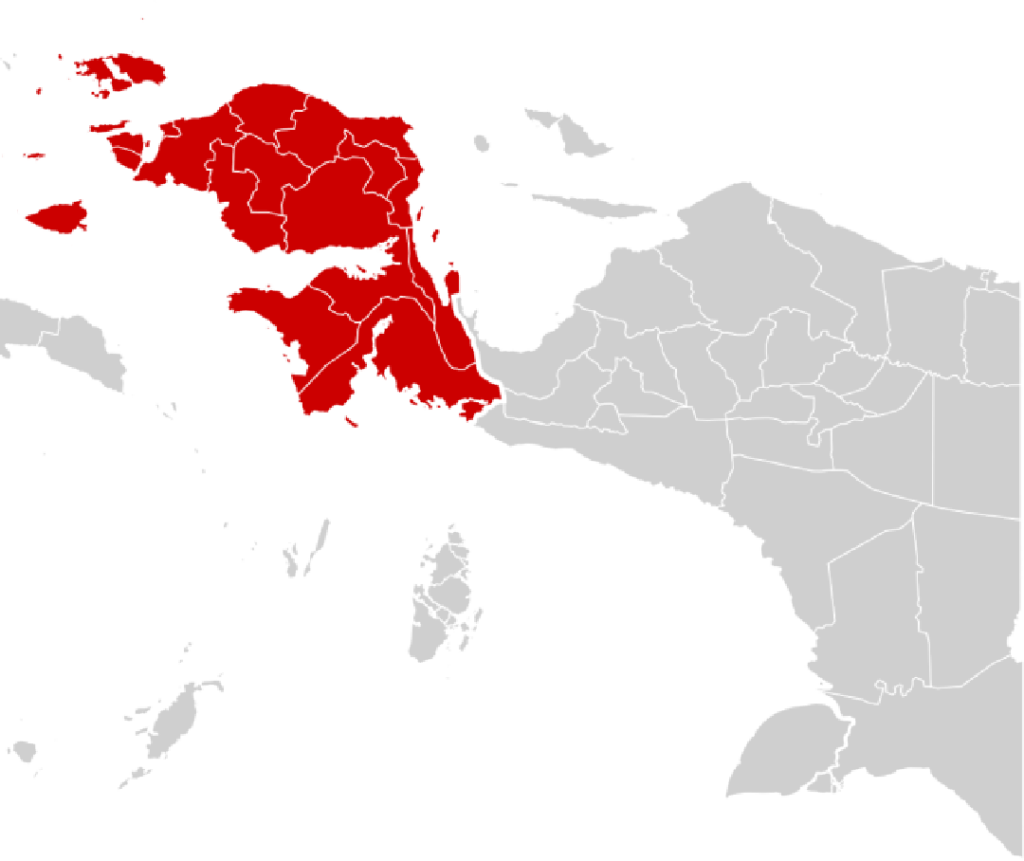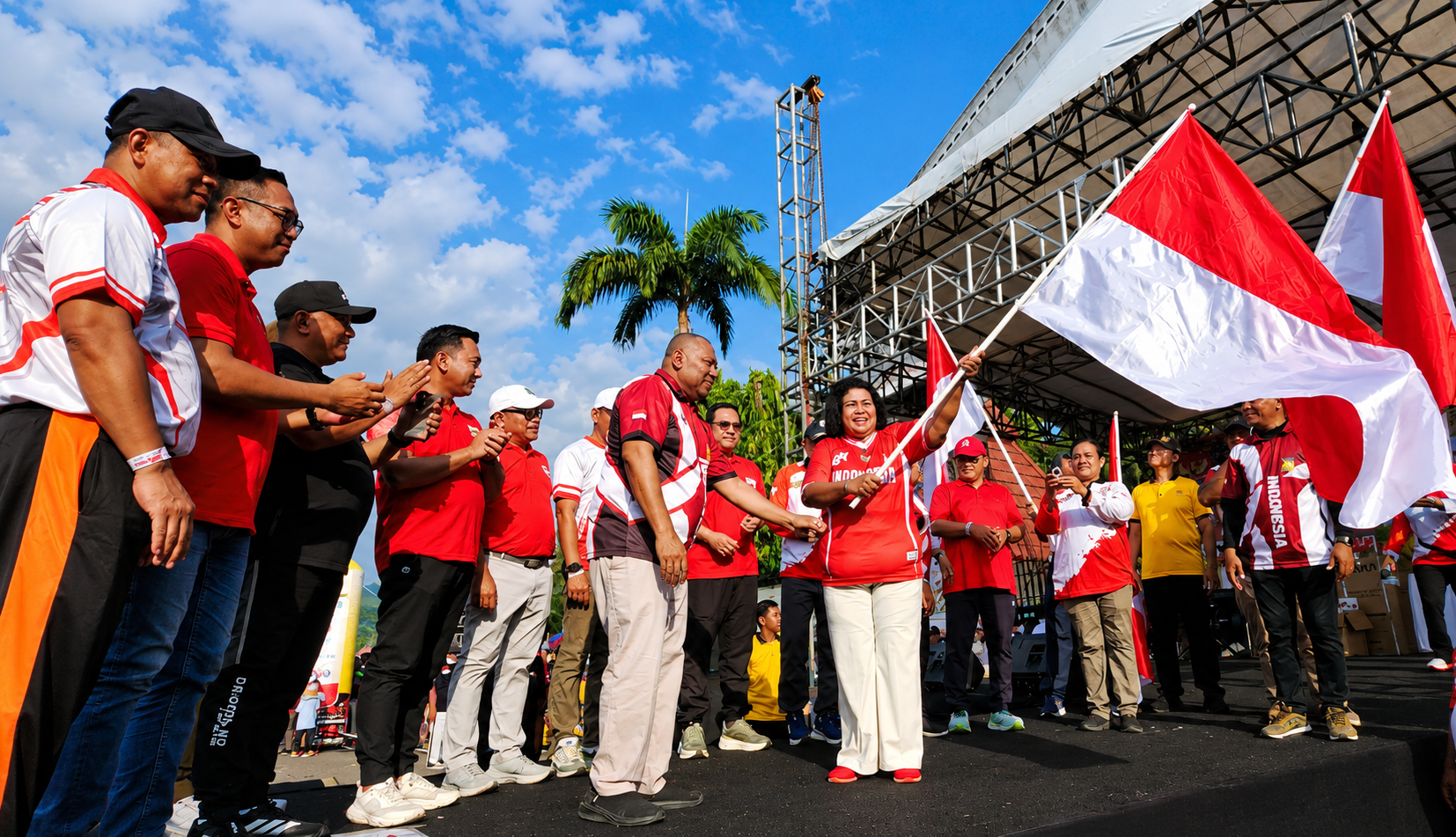
Indonesia’s Independence Day 2026 celebrations are beginning to take visible shape in Jayapura, where the Papua provincial government has distributed 2,000 red and white flags to residents ahead of Indonesia’s 81st Independence Day on 17 August.
The flags were handed to motorists, pedestrians, business owners, and other residents at several locations across Jayapura. Provincial officials said the initiative was intended to encourage people to display the national flag during August and strengthen public participation in the Independence Day celebrations.
At first glance, the campaign may appear modest. A flag handed to a passerby is a simple gesture. Yet in a province as geographically and culturally diverse as Papua, the act carries a wider public message.
For the provincial government, the campaign is part of a national Red and White Flag Distribution Movement designed to encourage participation in Independence Day activities. Papua officials have framed the initiative around nationalism, unity, togetherness, and respect for the country’s historical struggle.
The campaign also comes as Jayapura prepares for a broader series of August activities. Those events are expected to combine public entertainment with services and economic activities, giving the Independence Day period a community focus rather than limiting it to a formal ceremony.
Why the Flag Campaign Matters
The red and white flag, Indonesia’s national flag, is one of the most recognizable symbols of the country’s independence.
In Jayapura, its presence during August is being encouraged across homes, businesses, and community spaces.
Papua’s assistant for general and administrative affairs, Suzana Wanggai, said the distribution was intended to encourage residents to fly the flag in their respective neighborhoods throughout the Independence Month as a way of honoring the country’s heroes.
The provincial government’s message is therefore broader than simply decorating the city.
Officials want Independence Day to become a moment for residents to participate in shared public activities and express a sense of belonging to a larger national community.
That message was reinforced by Deputy Governor Aryoko A.F. Rumaropen, who encouraged residents to take part in programs organized throughout August.
He said Independence Day should not be viewed merely as a ceremonial occasion but as an opportunity to strengthen nationalism, deepen unity, and reaffirm a collective commitment to the aspirations of the country’s founders.
A Month of Activities Beyond the Ceremony
The flag distribution is only one element of Papua’s 81st Independence Day program.
According to reports, the provincial government has prepared a range of activities throughout August, including a car-free day, MSME markets, affordable markets, a community walk, entertainment programs, blood donation, free health services, vehicle registration services, banking services, and immigration services.
The variety is significant.
Rather than concentrating all activities around 17 August itself, the provincial government has structured the celebration as a month-long program.
That approach gives more residents an opportunity to participate.
It also allows government services and community activities to become part of the celebration.
For an international audience, this is an important aspect of understanding how national celebrations can function at the local level in Indonesia.
Independence Day is not limited to a flag-raising ceremony. Across the country, August is traditionally associated with neighborhood events, sporting activities, community gatherings, and public celebrations.
In Jayapura, the provincial government is adding public services and economic activities to that familiar pattern.
Linking National Celebration to Local Economy
One of the more practical elements of Papua’s Independence Day program is its focus on local businesses and farmers.
The provincial government has included MSMEs and local farmer markets in the August agenda.
Deputy Governor Aryoko said the activities were expected to strengthen togetherness while also supporting economic growth through the participation of MSMEs and local farmers.
That creates a direct connection between a national celebration and household economic activity.
An MSME market can give small entrepreneurs a temporary increase in visibility and customer traffic. Local farmers can use the opportunity to introduce their products to consumers in Jayapura.
The effect of such events should not be overstated. A single market cannot transform the provincial economy.
But repeated opportunities to sell products, meet customers, and build networks can be useful for small businesses.
The approach also reflects a broader trend in Papua, where local economic development is increasingly linked to community participation.
Agriculture, tourism, creative industries, and MSMEs can complement government programs by creating income opportunities at the community level.
Public Services Become Part of the Celebration
The inclusion of free health services, banking assistance, immigration services, and vehicle registration services gives the Independence Day program another dimension.
Residents can participate in celebrations while also accessing services that might otherwise require separate visits to government offices.
This is particularly relevant from a public administration perspective.
A national anniversary provides an opportunity for government institutions to meet residents in a less formal environment.
For citizens, the benefit is practical.
For government agencies, it creates another channel for public engagement.
The provincial government has emphasized that Independence Day activities should provide tangible benefits rather than remain purely ceremonial.
That principle can help make public celebrations more meaningful.
National identity is often expressed through symbols and ceremonies, but it can also be strengthened through everyday interactions between citizens and public institutions.
Jayapura Prepares for a Livelier August
The flag campaign is also expected to contribute to a more festive atmosphere in Jayapura.
DetikTravel reported that a variety of entertainment and community activities would be held during the August celebrations, with residents and visitors able to participate in public events.
For Jayapura’s tourism and hospitality sectors, public events can create additional activity.
Restaurants, cafés, transportation providers, market sellers, and other businesses may benefit from increased movement around celebration venues.
Again, the economic impact should be viewed realistically.
The principal purpose of the program is public participation and commemoration. Yet when well organized, public events can generate secondary economic activity.
That is particularly relevant as Papua continues to develop its tourism potential.
A lively and welcoming city environment can contribute to the experience of domestic and international visitors.
National Identity in a Diverse Papua
Papua is home to many Indigenous communities, languages, cultures, and religious traditions.
That diversity is an important part of the province’s identity.
The provincial government’s Independence Day campaign is being presented as a way to bring that diversity together through shared public activities.
Suzana Wanggai said the celebration should strengthen unity, togetherness, and love of country amid the diversity of Papuan society.
This framing is important because national identity does not necessarily require cultural uniformity.
Papuan communities retain distinctive traditions while participating in the wider civic life of Indonesia.
Public celebrations can provide a space where those different identities appear together.
The flag, in this context, functions as a common national symbol while local communities continue to express their own cultural characteristics through food, music, art, traditional dress, and community activities.
That combination can make national celebrations more locally relevant.
A Public Message of Participation
The decision to distribute flags directly to residents also changes the character of the campaign.
Instead of relying entirely on institutions to decorate public spaces, the government is asking residents to participate themselves.
A flag displayed outside a house, shop, or workplace becomes a visible expression of individual participation in the national celebration.
The government has encouraged public institutions, businesses, community organizations, and residents to display the red and white flag in accordance with applicable regulations.
The campaign therefore relies on participation from different parts of society.
That includes people who may have very different occupations, backgrounds, and experiences.
For the provincial administration, broad participation can help create a shared atmosphere across the city during August.
The Wider Meaning of 17 August in Papua
Indonesia’s Independence Day is celebrated annually on 17 August, commemorating the proclamation of independence in 1945.
The 2026 anniversary is the country’s 81st.
For Papua, the celebration takes place alongside a broader development agenda involving infrastructure, healthcare, education, agriculture, tourism, and local economic development.
The provincial government is therefore presenting the anniversary not only as a historical occasion but also as an opportunity to reflect on future development.
Deputy Governor Aryoko has described the celebration as a moment to strengthen national spirit and reaffirm commitment to the country’s founding aspirations.
That perspective connects historical commemoration with contemporary public policy.
The question becomes not simply how to celebrate independence, but how public institutions can use the occasion to encourage participation and deliver practical benefits.
A Celebration With a Community Focus
The 2,000 flags provide the most visible element of the campaign, but the broader program may ultimately be more important.
The combination of markets, health services, public administration, entertainment, and community activities creates several ways for residents to participate.
A family might attend a public event.
A small business owner might sell products at an MSME market.
A resident might use a free health service.
A farmer might find new customers.
Another resident might simply display the national flag outside a home or business.
Each activity is small in isolation.
Together, however, they create a public environment in which the Independence Day anniversary becomes part of everyday community life.
What the Campaign Says About Papua’s Development
The initiative also reflects a broader idea about development in Papua.
Economic and social development is not only about large infrastructure projects or government spending.
It also involves building participation, strengthening local businesses, and making public services more accessible.
The August program brings those elements together.
The inclusion of MSMEs and farmers points toward local economic empowerment. Public services address immediate community needs. Cultural and entertainment activities provide opportunities for social interaction.
The result is a more comprehensive approach to a national anniversary.
For Papua, that can be useful because development outcomes are often strongest when communities are active participants rather than passive recipients.
Looking Ahead
The 2,000 flags distributed across Jayapura are likely to become increasingly visible as August 17 approaches.
The provincial government is encouraging residents to display them throughout the Independence Month, while government institutions, businesses, community organizations, and other groups prepare their own activities.
The immediate objective is to create a lively and participatory anniversary.
The longer-term objective is more intangible: strengthening civic participation and a shared sense of national belonging.
Whether that goal is achieved will depend less on the number of flags distributed than on how many residents choose to participate in the wider program.
That is why the combination of symbolism and practical public services is significant.
A flag can represent national identity.
A health service, local market, or community event can demonstrate how public institutions engage with citizens in everyday life.
Conclusion
The Papua provincial government’s distribution of 2,000 red and white flags in Jayapura is giving Indonesia’s 81st Independence Day a visible presence across the provincial capital.
The initiative encourages residents, business owners, pedestrians, and motorists to display the national flag during August, while provincial officials describe the campaign as an effort to strengthen nationalism, unity, and appreciation for the country’s historical struggle.
But the campaign extends beyond flags.
Jayapura’s August program includes MSME and farmer markets, affordable markets, car-free day activities, community walks, entertainment, blood donation, and a range of public services. Officials say the objective is to make the anniversary meaningful to residents and provide practical benefits alongside the celebrations.
For Papua, this creates an opportunity to connect national commemoration with local community life.
The red and white flag remains the central symbol, but the broader message is participation.
Residents can celebrate, businesses can promote local products, farmers can reach consumers, and public institutions can bring services closer to communities.
As 17 August approaches, the streets of Jayapura are expected to become increasingly decorated in red and white.
More importantly, the provincial government hopes the celebration will reinforce a sense of unity and shared purpose across Papua’s diverse communities.