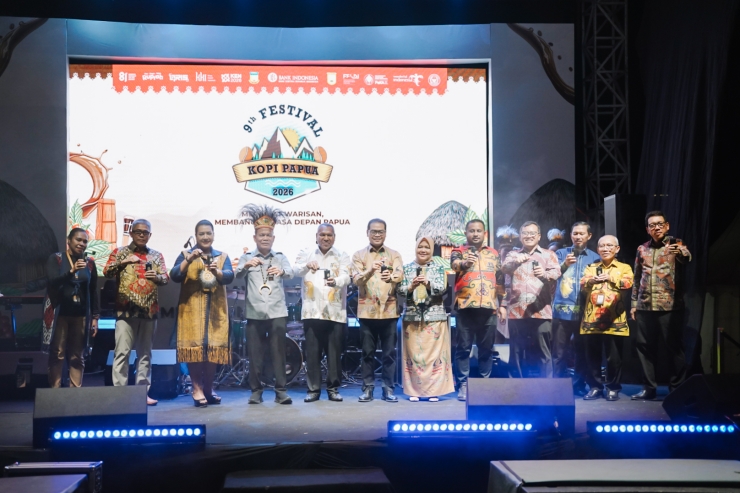
The Papua Coffee Festival 2026 is putting one of the province’s most promising agricultural products at the center of an economic conversation. Held from August 7 to 9 at the grounds of the Papua Governor’s Office in Jayapura, the ninth edition is designed to introduce coffee from across Papua to a wider audience while creating stronger opportunities for farmers, small businesses and exporters.
The event comes as the provincial government seeks to position coffee as one of Papua’s leading commodities. Official tourism information describes the festival as a major coffee event in the Sulawesi, Maluku and Papua region, bringing together coffee producers, baristas, businesses and communities through competitions, educational workshops, Micro, Small, and Medium Enterprises (MSMEs) exhibitions, cultural performances and industry training.
For Papua, that combination matters.
Coffee is grown in several highland areas, including Lanny Jaya, Yalimo, Pegunungan Bintang, Wamena, Paniai and Tolikara, while production also exists in other parts of the province. The provincial government has argued that the commodity can become more than an agricultural product. It can be part of Papua’s economic identity and a source of income for farming communities.
That ambition is not entirely new. Bank Indonesia Papua has supported the Festival Kopi Papua since its early editions, with the stated objectives of promoting Papua coffee nationally and internationally, improving post harvest quality, encouraging downstream processing and increasing farmer welfare.
The ninth festival therefore represents a continuation of a longer effort to move Papua coffee from farms and local markets toward higher value markets.
From Highland Farms to the Global Market
Papua’s coffee story begins in the highlands.
The province’s geography provides diverse growing environments, particularly for Arabica coffee. Different elevations, soils and local farming practices contribute to variations in flavor and quality, giving producers an opportunity to develop distinctive regional identities.
Government officials have increasingly focused on this diversity as a potential competitive advantage.
In 2025, Papua’s provincial government said coffee from areas including Lanny Jaya, Yalimo, Pegunungan Bintang, Wamena, Paniai and Tolikara had the potential to reach international consumers. Officials argued that better management, quality standards and market development were necessary if the product was to appear more consistently in global markets.
The challenge is that producing good coffee is only one part of building a successful coffee industry.
Farmers also need access to appropriate seedlings, technical assistance, financing, reliable post harvest facilities, quality certification and dependable distribution networks.
A recent assessment of Jayawijaya’s coffee potential similarly highlighted productivity, financing, post harvest processing, certification and marketing as important areas for strengthening the competitiveness of Papua coffee.
That is where a festival can serve a practical purpose.
A public event creates a meeting point between producers and buyers. Farmers can see how their product is evaluated, consumers can learn about different origins, and small businesses can build relationships with potential partners.
The ultimate objective is not simply to sell more cups during three days in Jayapura. It is to create stronger commercial connections that continue after the festival closes.
Why Farmers Are Central to the Strategy
Behind every premium coffee is a farming community.
For Papua’s coffee strategy to succeed, higher visibility and stronger exports must translate into tangible benefits for producers.
This is one reason the government and Bank Indonesia have increasingly linked coffee promotion with MSMEs development and farmer empowerment.
The provincial government has previously described coffee as a potential source of welfare for farmers, while Bank Indonesia has supported capacity building and market access initiatives.
The economic impact can extend beyond the farm itself.
When coffee production expands, demand can increase for processing, packaging, transportation, warehousing, roasting, cafés and other services. Young people can find opportunities in barista work, product design, digital marketing and hospitality, creating a broader economic ecosystem around the commodity.
The 2026 festival reflects that wider approach.
Its program includes not only coffee displays but also MSMEs exhibitions, training and educational workshops. Indonesia’s official tourism platform says the festival is intended to support MSMEs development, digital transactions and improvements in coffee quality so that Papua’s products can compete in global markets.
This is particularly relevant for a province seeking to diversify its economy.
Agricultural commodities with strong local identities can provide additional income streams while allowing communities to participate directly in value creation.
Bank Indonesia and the Push for Stronger MSMEs
Bank Indonesia’s role is important because the development of coffee involves more than agricultural production.
The central bank’s Papua office has positioned MSMEs as an important part of regional economic growth and has promoted digital payment adoption alongside business development.
Its Festival Kopi Papua program is part of this broader effort.
RRI reported that Bank Indonesia’s support for the coffee festival is intended to promote Papua coffee to national and international markets, improve post harvest practices, develop downstream industries and raise the welfare of farmers.
Digitalization is another part of the equation.
For small businesses, digital payments can make transactions easier to record and potentially expand their customer base. The growing use of QRIS, Indonesia’s national QR payment standard, has also become associated with the festival’s development.
A recent review of the festival’s evolution noted that since its establishment in 2018, the event has developed from a gathering of coffee enthusiasts and businesses into a platform connected with MSMEs growth and digital payment adoption in Papua.
That transition illustrates how a cultural event can gradually become part of a wider economic policy.
Building a Papua Coffee Brand
For Papua coffee to compete internationally, production alone will not be enough.
Branding matters.
International consumers increasingly want to know where coffee comes from, who produced it and what makes its origin distinctive. Papua has a potentially powerful story because its coffee is connected to highland landscapes, local farming traditions and the cultural diversity of communities across the province.
Provincial officials have previously described coffee as both an economic commodity and part of Papua’s identity. They have called for stronger branding and international standards to help the product compete beyond Indonesia.
There are already indications that Papua coffee can attract international buyers.
The Vice President’s office reported in early 2026 that members of the Association of Coffee Farmers and Enthusiasts of Papua Pegunungan had received international recognition and that their coffee was being exported to markets including the Netherlands, Italy, Australia and Canada. The association represents farmers and coffee enthusiasts from eight districts in Papua Pegunungan.
Those examples provide an encouraging signal, but they also show the scale of the opportunity.
If individual producers can reach international markets, a stronger regional ecosystem could potentially make such access more systematic.
Exports Require More Than Production
Papua’s export ambitions also depend on infrastructure.
Coffee must move from remote highland farms to processing facilities, then to domestic distribution centers and ultimately to international ports or airports.
The provincial government has previously identified improved port and airport infrastructure as important for expanding direct exports from Papua. It has specifically cited coffee alongside other commodities as a product with export potential once logistics are strengthened.
This creates a direct connection between agricultural development and infrastructure policy.
Better roads can reduce transportation difficulties for farmers. Improved processing facilities can help maintain quality. Reliable logistics can make delivery more predictable for international buyers.
The result is a value chain in which improvements at one point can benefit the entire system.
For coffee farmers, the difference can be significant.
A product that previously moved through several intermediaries in a relatively raw form can potentially gain additional value through sorting, processing, roasting, packaging and branding closer to its source.
That is the logic behind the government’s growing emphasis on downstream development.
A Cultural Event With an Economic Purpose
Although the economic agenda is central, the festival is also a cultural event.
Coffee is closely connected with everyday life in many communities, and the festival gives producers an opportunity to present not only their beans but also the stories and traditions behind them.
The official tourism description combines coffee competitions and workshops with cultural performances, making the event part of Papua’s broader tourism and creative economy strategy.
That combination is increasingly important for international tourism.
Visitors are often interested in more than a product. They want to understand its origins, meet producers and experience the culture associated with it.
A coffee festival can therefore function as a gateway to other tourism activities in Papua.
A visitor attracted by specialty coffee may also become interested in the province’s mountains, Indigenous cultures, natural landscapes, culinary traditions and other destinations.
This creates the possibility of linking agricultural promotion with tourism development.
What Comes After the Festival?
The real measure of the ninth Papua Coffee Festival will not be the number of visitors during the three day event.
Its longer term impact will depend on what happens afterward.
Will farmers receive more consistent access to buyers? Will more coffee businesses achieve quality certification? Can processing capacity expand? Can Papua maintain reliable export volumes? And will a larger share of the value created by international sales reach farming communities?
These questions are important because global specialty coffee markets are competitive.
Quality must be consistent. Supply must be reliable. Buyers need clear information about origin and processing. Exporters need dependable logistics. Producers need financing and technical assistance.
The festival cannot solve all of those challenges by itself.
It can, however, create the relationships and visibility needed to address them.
That makes continued cooperation between the provincial government, Bank Indonesia, farmers, cooperatives, MSMEs, exporters and other stakeholders particularly important.
Looking Ahead
Papua’s coffee sector is entering an important stage.
The ninth Festival Kopi Papua demonstrates that the province increasingly sees coffee not simply as a plantation crop but as part of a broader economic ecosystem involving farmers, entrepreneurs, tourism, finance, digital commerce and international trade.
The opportunity is substantial, but it will require patient investment.
Improving farm productivity, strengthening post harvest handling, expanding processing facilities, developing credible regional brands and improving logistics will be essential if Papua wants to turn international interest into sustainable export growth.
The most important measure of success, however, should remain the communities at the beginning of the supply chain.
If Papua coffee becomes more recognized in Jakarta, Tokyo, Amsterdam, Sydney or New York, the benefits should ultimately reach the farmers who cultivate it.
That is what could transform a coffee festival from a promotional event into a genuine economic development platform.
Conclusion
The Papua Coffee Festival 2026 offers Jayapura a chance to showcase the province’s distinctive coffee while advancing a larger economic objective.
By bringing together farmers, MSMEs, government institutions, coffee communities and potential buyers, the ninth edition provides a platform for strengthening the value chain from Papua’s highlands to international markets.
The Indonesian government and Papua provincial authorities have increasingly identified coffee as a promising local commodity, while Bank Indonesia has supported promotion, capacity building, digitalization and market access. Existing examples of Papua coffee reaching international markets suggest that the opportunity is already real, although expanding it will require improvements in quality, processing, logistics and market consistency.
For Papua’s farmers, the ambition is straightforward: better recognition should lead to better opportunities.
And for Papua itself, the humble coffee bean could become part of a broader story about rural enterprise, cultural identity, MSMEs growth and participation in the global economy.