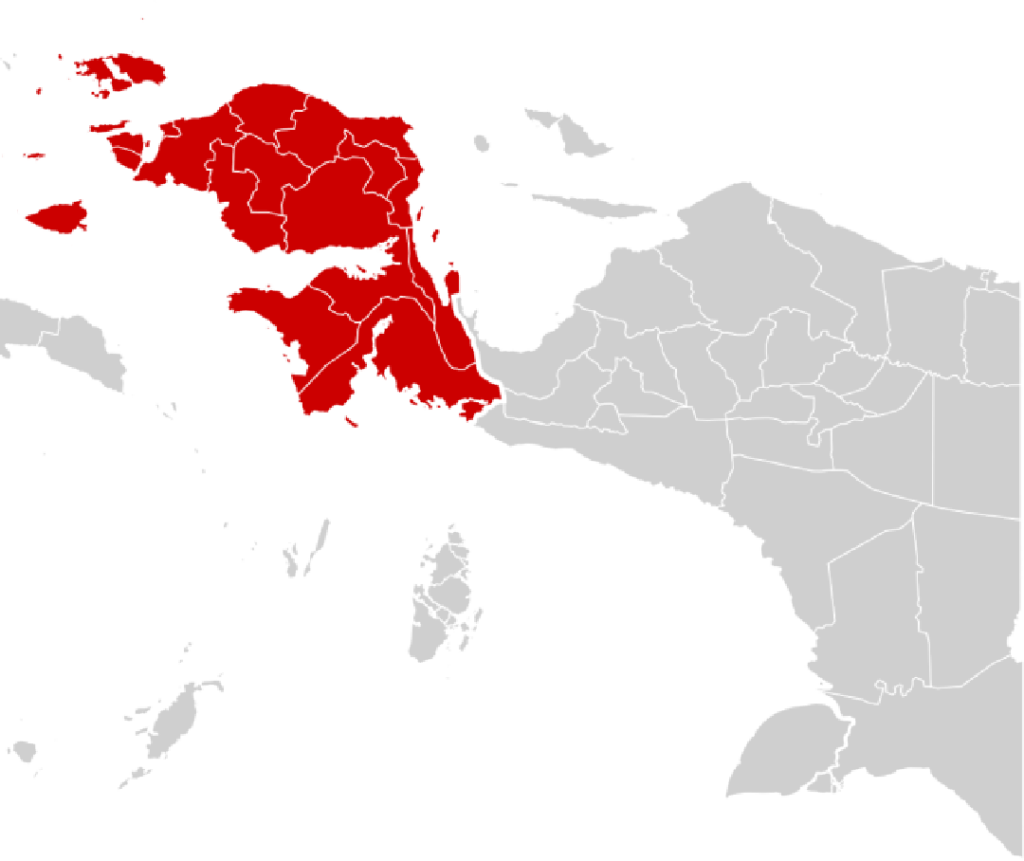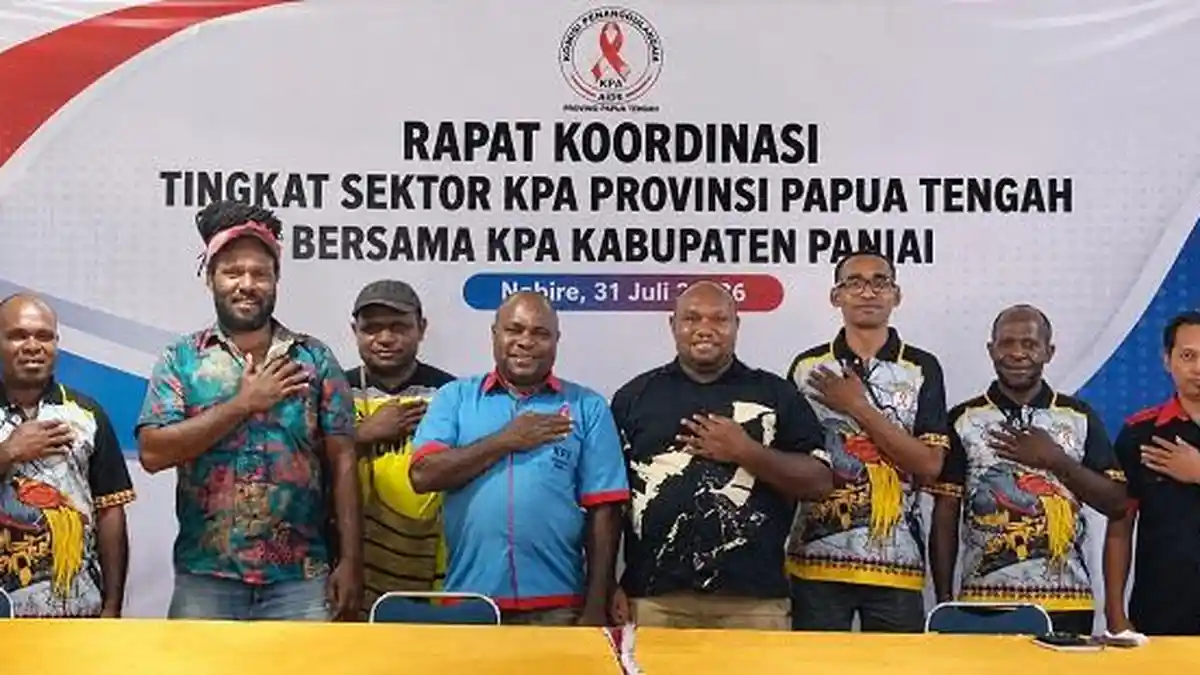
The Government of Papua Tengah (Central Papua) Province has intensified its Papua Tengah HIV response by strengthening cooperation among government agencies, healthcare institutions, community organizations, and local leaders to improve prevention, early detection, and treatment services. During a cross sector coordination meeting chaired by Freny Anouw, Chairperson of the Provincial AIDS Commission (KPA), officials reviewed the province’s HIV situation while identifying practical strategies to improve public awareness and expand access to healthcare.
According to data presented during the meeting, 24,777 HIV and AIDS cases have been recorded in Papua Tengah. While the figures underscore the scale of the public health challenge, provincial officials emphasized that increasing case detection also reflects broader testing coverage and improved community willingness to seek medical examinations. Health authorities stressed that stronger surveillance and earlier diagnosis remain essential for ensuring timely treatment and preventing further transmission.
The meeting highlighted the importance of collaboration across sectors rather than relying solely on healthcare providers. Provincial leaders noted that HIV prevention requires active participation from education institutions, religious organizations, community leaders, law enforcement, civil society groups, and local governments to build sustained public awareness and reduce stigma surrounding testing and treatment.
Papua Tengah Expands a Comprehensive HIV Strategy
Officials attending the coordination meeting agreed that HIV prevention must combine medical interventions with community engagement, education, and continuous public communication.
Chairperson Freny Anouw explained that effective HIV control depends upon coordinated action rather than isolated institutional efforts. Health facilities can provide testing and treatment, but long term success also requires stronger public understanding of prevention measures, increased awareness of available health services, and greater willingness among communities to participate in voluntary testing.
Provincial authorities therefore continue encouraging district governments to strengthen local coordination while adapting prevention strategies to the specific needs of individual communities.
Healthcare officials also emphasized that early diagnosis significantly improves treatment outcomes. Individuals who receive timely testing and begin antiretroviral therapy are more likely to maintain healthier lives while reducing the risk of onward transmission.
For this reason, expanding voluntary testing services remains one of the province’s central priorities.
At the same time, authorities acknowledged that stigma continues to discourage some people from accessing healthcare. Public education campaigns therefore aim not only to increase awareness of HIV prevention but also to encourage supportive attitudes toward individuals living with HIV.
Officials stressed that reducing discrimination is an important component of strengthening public health because communities are more likely to participate in testing programs when healthcare services are trusted, confidential, and accessible.
Cross Sector Coordination Strengthens Public Health
One of the key outcomes of the coordination meeting was renewed commitment to stronger cooperation among government institutions.
Participants agreed that HIV prevention cannot be addressed exclusively through provincial health offices.
Education agencies can support awareness programs among students and young adults.
Religious leaders often play important roles in promoting healthy behavior and encouraging compassion toward affected individuals.
Community organizations help extend public education into villages where formal healthcare information may be less accessible.
Law enforcement institutions contribute by addressing activities that increase vulnerability to disease transmission while supporting broader public safety initiatives.
By bringing these institutions together, the Provincial AIDS Commission aims to create a more integrated public health response capable of addressing both medical and social dimensions of HIV prevention.
Officials noted that coordination also improves data sharing, program planning, resource allocation, and monitoring of prevention initiatives throughout the province.
Such collaboration becomes increasingly important as Papua Tengah continues expanding healthcare services into remote districts where logistical challenges often complicate routine medical outreach.
Better Data Supports Better Policy
During the meeting, officials discussed how improvements in surveillance and reporting have contributed to a clearer understanding of HIV trends across Papua Tengah.
Health experts explained that increasing numbers should not automatically be interpreted solely as evidence of rising transmission.
Expanded testing programs frequently identify cases that previously remained undiagnosed, providing authorities with more accurate information regarding the actual scale of the epidemic.
This improved data enables provincial governments to allocate healthcare resources more effectively while targeting prevention programs toward communities with greater needs.
Officials emphasized that evidence based policymaking remains essential for ensuring that limited healthcare resources produce the greatest possible public health impact.
Accurate epidemiological information also allows healthcare providers to monitor treatment outcomes, evaluate prevention strategies, and identify areas requiring additional intervention.
Provincial leaders therefore encouraged continued strengthening of data collection systems alongside expanded community outreach.
Reliable information, they noted, forms the foundation of effective public health planning and long term disease control.
Building Public Trust Through Community Engagement
Beyond medical treatment, provincial authorities recognize that successful HIV prevention depends upon strong community participation.
Healthcare professionals cannot work alone without the support of families, educators, traditional leaders, religious institutions, youth organizations, and civil society.
Community engagement helps ensure that health messages are communicated in culturally appropriate ways while encouraging individuals to seek testing without fear of discrimination.
Officials emphasized that public trust is one of the most valuable assets in disease prevention.
Communities that trust healthcare institutions are generally more willing to participate in voluntary counseling, routine screening, and ongoing treatment programs.
For this reason, the Provincial AIDS Commission continues encouraging dialogue between healthcare providers and community leaders to strengthen mutual understanding and improve access to services throughout Papua Tengah.
These efforts complement broader healthcare reforms already underway in the province, including improvements in clinical mentoring programs for healthcare workers, expanded medical outreach, and stronger cooperation between provincial and district health authorities.
Paniai Becomes a Model for HIV Prevention
One of the clearest examples discussed during Papua Tengah’s efforts to strengthen its HIV response has come from Paniai Regency, where the local AIDS Commission has pursued a more proactive approach to detection and prevention.
Rather than waiting for residents to visit healthcare facilities after developing symptoms or becoming concerned about possible exposure, the Paniai AIDS Commission has sought to bring testing and education closer to the population. The approach reflects a simple public health principle: HIV is easier to manage when infections are identified early and people are connected with appropriate healthcare services without unnecessary delay.
Among the initiatives highlighted by provincial officials was HIV testing involving civil servants, or ASN, accompanied by broader community education intended to improve understanding about prevention.
The initiative is significant because government employees can help normalize voluntary testing within the wider community. When people see testing presented as a routine health measure rather than something associated with shame or judgment, health authorities hope that hesitation about seeking services can gradually decline.
Papua Tengah officials have consequently pointed to Paniai as an example of how district administrations can take greater ownership of HIV prevention while adapting provincial priorities to local conditions.
The lesson is not that one campaign can solve a complex public health problem. Rather, Paniai demonstrates the potential value of moving prevention beyond meetings and policy documents and bringing it directly into workplaces and communities.
That distinction matters in Papua Tengah, where settlements are spread across geographically diverse areas and access to health facilities varies considerably.
A strategy that depends entirely on residents independently reaching hospitals or clinics risks leaving some infections undetected. Active outreach provides another route for identifying people who may benefit from testing, counseling, or treatment.
## Mass Testing Helps Bring HIV Into the Open
Testing among ASN in Paniai carries another important message: knowing one’s HIV status should be treated as part of responsible healthcare rather than as a source of stigma.
For years, stigma has complicated HIV responses in communities around the world. Fear of being judged can discourage people from undergoing testing, discussing risk factors with healthcare professionals, or seeking treatment.
Papua Tengah’s strategy seeks to counter that barrier by making testing more visible and accessible.
The approach is particularly relevant to what health officials sometimes describe as the “iceberg phenomenon.” Recorded cases represent infections that have been detected, while an unknown number may remain outside official statistics because individuals have not yet been tested.
From that perspective, finding additional cases through expanded screening does not necessarily mean prevention programs are failing.
In some circumstances, higher detection can indicate that healthcare services are becoming better at finding infections that previously remained hidden.
This distinction is important when interpreting the reported 24,777 HIV and AIDS cases in Papua Tengah. The number represents a serious public health challenge requiring sustained intervention, but authorities are also using improved detection to build a clearer picture of where services and prevention resources are most urgently required.
The objective is ultimately to shorten the distance between infection, diagnosis, and treatment.
When people learn their status earlier, healthcare professionals have greater opportunities to provide appropriate counseling and connect patients with treatment services. At the population level, wider awareness can also strengthen prevention by encouraging informed decisions about health.
Turning Testing Into a Community Habit
Paniai’s experience suggests that effective screening programs work best when accompanied by education.
Testing without explanation can generate anxiety. Education without accessible testing, meanwhile, may leave residents informed but unable to act easily on what they have learned.
Combining the two provides a more practical pathway.
Community education can explain transmission risks, prevention, the importance of testing, and the availability of treatment. At the same time, accessible screening gives residents an immediate opportunity to take responsibility for their health.
The approach also allows healthcare workers to correct misinformation directly.
This is especially important because misconceptions about HIV can contribute to discrimination against people living with the virus. Such discrimination can itself become an obstacle to prevention if individuals avoid healthcare facilities because they fear being identified or socially excluded.
For Papua Tengah, therefore, the battle against HIV is partly medical and partly social.
Testing identifies cases. Treatment protects health. Education addresses misconceptions. Community participation builds trust.
The stronger those elements work together, the greater the opportunity to produce sustainable improvements.
From Provincial Policy to District Level Action
Paniai’s experience also provides an example of the role district governments can play within the provincial strategy advocated by Freny Anouw and the Papua Tengah AIDS Commission.
Papua Tengah covers communities with different geographical, demographic, and social conditions. A prevention model that works in an urban center cannot simply be copied unchanged into every highland or rural community.
Local institutions therefore become critical.
District administrations understand their communities more closely and can identify which institutions have the greatest ability to reach residents, whether through healthcare facilities, government workplaces, schools, churches, traditional networks, youth organizations, or village structures.
The provincial government’s role is consequently not limited to issuing instructions. Coordination can help districts exchange successful approaches, identify weaknesses, and adapt effective programs from one location to another.
Making Paniai a reference point serves this purpose.
If elements of its testing and education strategy produce measurable improvements, similar approaches could be adapted by other districts while accounting for their own circumstances.
That process represents a shift from a reactive model toward a more preventive one.
Instead of focusing resources primarily on people who have already entered the healthcare system, authorities can actively identify populations requiring services and bring those services closer to them.
Addressing New Risks in a Changing Social Environment
Papua Tengah’s HIV strategy is also confronting changes in how social interactions take place.
Provincial AIDS Commission officials have raised concerns about online facilitated prostitution as one area requiring greater attention within prevention programs.
The emergence of digital platforms has changed how individuals connect and communicate, including interactions that may carry health risks. Unlike conventional locations that can be more readily identified by outreach workers, activities arranged through online channels can be dispersed and difficult for conventional prevention programs to reach.
This development creates a new challenge for public health authorities.
It does not mean digital technology itself is responsible for HIV transmission. Rather, changing patterns of interaction require prevention programs to evolve instead of relying exclusively on strategies developed for an earlier social environment.
Papua Tengah authorities are consequently considering how outreach, education, and prevention can respond to behavior increasingly mediated through digital channels.
Any response also requires care.
Effective HIV prevention depends on public trust, confidentiality, accurate information, and access to healthcare. Measures that drive vulnerable populations further away from healthcare services could make detection more difficult rather than easier.
For that reason, prevention efforts must balance awareness of emerging risk factors with approaches that encourage individuals to use healthcare services voluntarily and without fear of stigma.
Prevention Must Keep Pace With Social Change
This challenge demonstrates why the cross sector coordination meeting is significant.
Healthcare agencies possess medical expertise, but they cannot independently address every social factor influencing HIV transmission.
Digital behavior involves communications and technology. Public awareness involves education. Community acceptance involves social and religious institutions. Effective outreach requires trusted local networks.
Bringing these different actors together creates an opportunity to develop responses capable of adapting to changing circumstances.
It also helps move the discussion away from treating people living with HIV as the problem.
The public health objective is preventing transmission, finding infections earlier, connecting patients with appropriate treatment, and ensuring that people can live healthier lives.
Papua Tengah’s response will ultimately be judged by its ability to translate those objectives into accessible services across communities.
Connecting Prevention With Better HIV Care
The renewed prevention campaign also complements Papua Tengah’s recent efforts to improve the quality of HIV healthcare itself.
As discussed in the related WestPapuaVoice article, “Papua Tengah Strengthens HIV Care Services Through Clinical Mentoring,” the provincial health authorities have been working to strengthen the capabilities of healthcare personnel through clinical mentoring and evaluation.
The two approaches reinforce each other.
Expanding testing without strengthening treatment capacity would leave the healthcare system facing more diagnosed patients without necessarily improving their outcomes. Conversely, improving clinical services has limited reach if people living with HIV remain undiagnosed and never enter treatment.
Papua Tengah is therefore increasingly treating detection and care as parts of the same continuum.
A resident may first encounter HIV information through community education, proceed to testing through an outreach initiative, and, if necessary, enter healthcare services where trained personnel can provide further management and treatment.
The effectiveness of the system depends on ensuring those steps remain connected.
Paniai’s proactive testing program provides one possible entry point. Provincial clinical mentoring strengthens another part of the chain. Cross sector coordination attempts to ensure that the different components operate toward the same objective.
Taken together, these measures suggest that Papua Tengah is moving toward a more systematic HIV response based on early detection, stronger healthcare capacity, community education, reduced stigma, and shared responsibility across government and society.
The reported 24,777 cases make clear that the challenge remains substantial. Yet acknowledging the scale of the problem and actively searching for previously undetected cases can also provide the information required to confront it more effectively.
For Papua Tengah, progress will depend not on hiding difficult statistics, but on turning those numbers into action at clinics, workplaces, villages, schools, families, and communities throughout the province.
Strengthening Healthcare Through Multi Sector Collaboration
One of the strongest messages emerging from the Provincial AIDS Commission’s coordination meeting was that HIV prevention can only succeed through sustained collaboration across multiple sectors. While healthcare institutions remain at the center of diagnosis and treatment, officials acknowledged that lasting progress depends equally on the active participation of government agencies, educational institutions, religious organizations, community leaders, civil society, and families.
Chairperson Freny Anouw emphasized that HIV is not solely a medical issue but also a social and developmental challenge. Reducing new infections requires consistent public education, accessible healthcare services, early testing, and supportive communities that encourage individuals to seek medical assistance without fear of discrimination.
The provincial government therefore continues promoting an integrated strategy in which prevention, education, treatment, and community empowerment reinforce one another. District governments are encouraged to strengthen local partnerships while adapting provincial policies to their own demographic and cultural conditions.
This collaborative approach also supports more efficient use of healthcare resources. By sharing information, coordinating outreach activities, and evaluating program implementation together, institutions can identify service gaps more quickly while directing interventions toward communities with the greatest need.
Health experts note that sustained cooperation is particularly important in geographically diverse provinces such as Papua Tengah, where remote communities often face logistical barriers in accessing healthcare services. Coordinated outreach enables healthcare providers to reach populations that might otherwise remain underserved.
Building a Sustainable Public Health Strategy in Papua Tengah
Beyond responding to current case numbers, the Provincial AIDS Commission is increasingly focused on building a long term public health strategy capable of reducing HIV transmission over many years.
Officials explained that sustainable progress depends on strengthening several interconnected areas simultaneously. Healthcare workers require continuous professional development. Communities need reliable access to voluntary counseling and testing services. Public education campaigns must provide accurate, culturally appropriate information. Local governments require strong monitoring systems to evaluate the effectiveness of prevention programs.
Recent efforts to improve clinical mentoring for healthcare personnel, as previously reported by WestPapuaVoice, complement these objectives by strengthening the quality of HIV care available throughout Papua Tengah.
Similarly, proactive initiatives such as Paniai’s community education and mass testing demonstrate how local innovation can strengthen provincial policy implementation.
Authorities also highlighted the importance of protecting patient confidentiality while maintaining high standards of healthcare professionalism. Trust remains fundamental to successful HIV prevention because individuals are more likely to undergo testing and continue treatment when healthcare services are perceived as respectful, confidential, and accessible.
The provincial government therefore continues encouraging healthcare providers to combine medical expertise with compassionate patient care, recognizing that reducing stigma remains an essential component of improving long term health outcomes.
Looking Ahead
The cross sector coordination meeting represents another important step in Papua Tengah’s continuing effort to strengthen its response to HIV and AIDS through evidence based policymaking and broad institutional cooperation.
Going forward, provincial authorities are expected to continue expanding voluntary testing services, strengthening healthcare capacity, improving community education, and supporting district level innovations similar to those implemented in Paniai Regency.
Officials also intend to improve monitoring systems that allow programs to be evaluated more effectively over time. Better epidemiological data will help determine where additional healthcare resources, educational campaigns, and community outreach initiatives are most needed.
As social conditions continue evolving, prevention strategies are also expected to adapt accordingly. Emerging challenges, including digital platforms that may facilitate higher risk behavior, require prevention programs capable of reaching communities through modern communication channels while maintaining accurate health messaging.
Ultimately, provincial leaders believe that reducing HIV transmission requires sustained commitment rather than short term interventions. Building public trust, strengthening healthcare services, expanding early detection, and encouraging community participation will remain central components of Papua Tengah’s long term public health agenda.
Conclusion
Papua Tengah’s recent cross sector coordination meeting demonstrates a comprehensive approach to addressing one of the province’s most significant public health challenges. Led by Provincial AIDS Commission Chairperson Freny Anouw, the meeting reinforced the importance of cooperation among healthcare providers, government institutions, educators, community organizations, and local leaders in strengthening HIV prevention and treatment.
Although 24,777 reported HIV and AIDS cases underscore the seriousness of the challenge, provincial officials emphasized that expanded testing and improved surveillance also provide a clearer understanding of healthcare needs. Earlier diagnosis enables patients to begin treatment sooner while supporting broader prevention efforts.
The experience of Paniai Regency, particularly its proactive HIV testing among civil servants and community education programs, offers a practical example of how district level initiatives can complement provincial strategies. Combined with strengthened clinical mentoring, improved healthcare capacity, and continuous public awareness campaigns, these initiatives illustrate a more integrated response to HIV.
Looking ahead, Papua Tengah’s emphasis on collaboration, early detection, public education, and accessible healthcare provides an encouraging foundation for improving public health outcomes. Continued investment in community engagement and healthcare quality will remain essential to reducing HIV transmission while supporting healthier and more resilient communities throughout the province.