
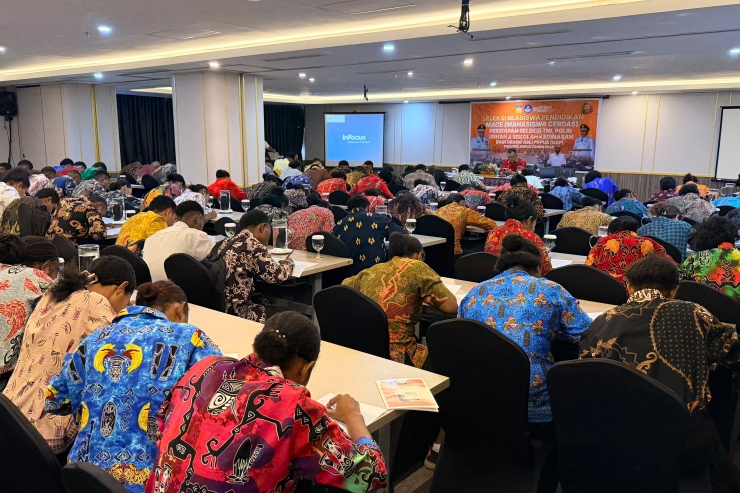
The Government of Papua Province officially launched the selection process for 1,000 recipients of the Mahasiswa Cerdas (MACE) Scholarship Program, reaffirming its commitment to increase access to higher education and to invest in the long-term development of Papua’s human capital.
The initiative is part of the provincial government’s larger PACE and MACE education program, aimed at improving access to education for Indigenous Papuans (Orang Asli Papua) through affirmative policies based on academic achievement and socioeconomic background.
The scholarship program is intended to give gifted students from different economic backgrounds equal opportunities to continue higher education and prepare themselves to work in the public and private sectors, the Papua Provincial Education Office said.
‘Education is still one of the most effective tools to accelerate sustainable development and for young Papuans to play more active roles in governing the region, economic growth, technological innovation, and public service,’ the officials said.
The provincial government’s target is to close the gap in education by increasing the number of scholarships while building the foundation of Papua’s future competitiveness.
MACE Scholarship Expands Educational Opportunities
The Mahasiswa Cerdas (MACE) Scholarship is one of Papua’s largest education support programs aimed specifically at university students.
The provincial government has allocated 1,000 scholarship quotas for the 2026 academic year, a giant investment to increase the number of Indigenous Papuans in higher education.
As opposed to conventional financial aid programs, MACE combines academic achievement and social inclusion by considering the students’ achievements and their families’ economic conditions in the selection process.
Officials said this two-pronged approach allows students with academic ability from financially disadvantaged homes to continue their education without the restrictions of economic barriers.
The scholarship program also reflects Indonesia’s broader commitment to improving educational equality throughout eastern Indonesia while supporting the implementation of special autonomy policies to improve human resource development in Papua.
Education experts frequently note that increasing access to higher education is beneficial not only for the individual but also for the broader economy, through gains in regional productivity, innovation, and institutional capacity.
Merit and Economic Need Guide Selection
The Papua provincial government said the selection of applicants will be carried out online in a fair, accountable, and open manner to all qualified applicants.
There will be two important criteria for selection.
The first is academic achievement, which acknowledges students who have demonstrated sound educational achievement and the capacity to succeed in higher education.
The second is economic background, ensuring that financial hardship does not prevent talented young Papuans from attending university.
This combination is representative of an increasingly popular approach internationally whereby scholarship programs are intended to reward excellence at the same time as promoting educational equity.
Education opportunities should be based on talent and determination, not only economic conditions, government officials stressed.
By combining both standards, the MACE Scholarship hopes to create a system that is more just and inclusive and can reach students from various communities across Papua.
Preparing Future Professionals for Strategic Sectors
Besides providing financial assistance, the MACE Scholarship is also intended to produce new generations of skilled professionals who can contribute to the long-term development of Papua.
The provincial government has released details that scholarship recipients will have opportunities to study in a range of academic disciplines and career pathways.
The program also prepares students for admission to state universities, official government academies, the Indonesian Defense University (Universitas Pertahanan/Unhan), and the recruitment route leading to careers in institutions such as the Indonesian National Armed Forces (TNI) and the Indonesian National Police (Polri) according to the admission requirements of each institution.
Officials said the scholarship is both an investment in leadership development and financial assistance.
Papua’s future progress will depend on highly qualified teachers, engineers, health professionals, public administrators, researchers, legal experts, entrepreneurs, information technology specialists, and other professionals who can respond to increasingly complex development challenges.
Therefore, improving access to education is an important strategy for enhancing long-term institutional capacity in Papua.
Investing in Papua’s Young Generation
The development of human capital has become one of the main priorities of the regional development strategy of Papua.
Recently, provincial and national governments have boosted investment in schools, vocational education, teacher training, digital learning infrastructure, scholarships, and educational assistance programs across Papua.
The MACE scholarship is part of these larger efforts to extend educational opportunity beyond secondary school to higher education.
Development economists always mention education as one of the most productive long-term investments that governments can make.
Higher educational attainment is positively correlated with higher productivity and innovation capacity, better governance, better health outcomes, higher household income, and higher social mobility.
Improved access to higher education also helps Papua’s efforts to increase local participation in strategic sectors and reduce dependence on external expertise in the long term.
The provincial government’s decision to expand scholarship opportunities, then, is an investment in people, not just infrastructure.
Policymakers believe education can empower young Papuans and develop future leaders who can take the lead in sustainable development across the province.
Education Supports Inclusive Development
The introduction of the MACE Scholarship also reflects the growing importance of education in Papua’s wider development agenda.
Improving access to education is critical to promoting inclusive and equitable growth, alongside investments in health care, transportation infrastructure, digital connectivity, food security, and economic diversification.
Communities with well-educated human resources are better able to benefit from the expanding opportunities generated by infrastructure projects, technological innovation, reform of public administration, and private sector investment.
With Papua’s ongoing integration into Indonesia’s fast-growing digital and knowledge-based economy, enhancing educational attainment will be increasingly important for sustaining regional competitiveness.
Thus, scholarship programs are seen by government officials as strategic investments, the benefits of which extend far beyond the individual recipients to society as a whole.
Education as the Foundation of Sustainable Development
Education is widely accepted as one of the most powerful forces for long-term economic and social progress. International development institutions have long pointed out that investment in human capital is a key determinant of productivity, innovation, institutional quality, and economic resilience.
“In the case of Papua, the wider access to higher education is an opportunity to give birth to a stronger generation of professionals who can lead development in various sectors.
MACE Scholarship graduates and other similar programs are expected to contribute to the fields of education, health care, engineering, agriculture, environmental management, information technology, entrepreneurship, and public administration.
As Papua continues the pace of their infrastructure projects, digital transformation, healthcare improvements, and economic diversification programs, their expertise will become more and more valuable.
Rather than just seeing scholarships as educational assistance, policymakers are increasingly looking at them as long-term investments in regional capacity building.
Strengthening Human Capital for Regional Competitiveness
The experience of the world is that regions that invest in education over time tend to have stronger economic growth.
Highly educated labor forces boost institutional performance, stimulate creativity, raise labor productivity, and attract more investment.
Papua’s expanding scholarship programs are therefore part of wider government efforts to upgrade roads, airports, hospitals, schools, telecommunications infrastructure, and public services.
Officials say that physical infrastructure alone can’t deliver sustainable development without equally strong investment in people.
Increasing the number of university graduates from the Papuan indigenous communities aims to strengthen local leadership while creating wider opportunities for participation in regional and national development.
The approach also supports Indonesia’s long-term objective to reduce the disparity of regional development through inclusive human resource policies.
Building Equal Opportunities Through Education
The MACE Scholarship is distinguished by its foundation in the principle of equal opportunity.
Students from remote regions often face a number of challenges in accessing higher education, including financial constraints, geographical isolation, and unequal educational facilities.
The goal of the scholarship program is to reduce these barriers through the use of merit-based assessment and socioeconomic considerations while ensuring that talented students receive opportunities based both on merit and need.
Inclusive scholarship programs, said educational experts, promote educational equality and help build stronger social cohesion by creating opportunities for diverse communities.
This inclusive approach is especially important for a geographically scattered population, such as the one in Papua.
This allows gifted students from different districts to play a more active role in shaping the province’s future, irrespective of their economic situation.
Looking Ahead
The Papua Provincial Government hopes that the 2026 MACE Scholarship Program will be an important milestone in strengthening the province’s long-term human resource development strategy. Policy makers anticipate that as scholarship recipients continue with their higher education and professional training, they will return with the knowledge, skills, and leadership to contribute to education, healthcare, public administration, business, technology, and community development throughout Papua. Ongoing investment in educational access will likely remain a core plank of Papua’s sustainable development agenda.
Conclusion
The launch of 1,000 MACE scholarships is a reflection of Papua’s growing commitment to invest in its greatest long-term asset, its people. The provincial government is increasing access to education while promoting fairness, inclusion, and social mobility through the selection of recipients based on academic achievement and socioeconomic need. Along with wider investments in schools, digital connectivity, healthcare, and economic development, the scholarship program is an important step toward building a highly skilled generation of Indigenous Papuans who can lead the province’s future. These students will become professionals, educators, entrepreneurs, researchers, and public servants, and their role in advancing sustainable development in Papua and enhancing its contribution to the national progress of Indonesia will become increasingly significant.

