
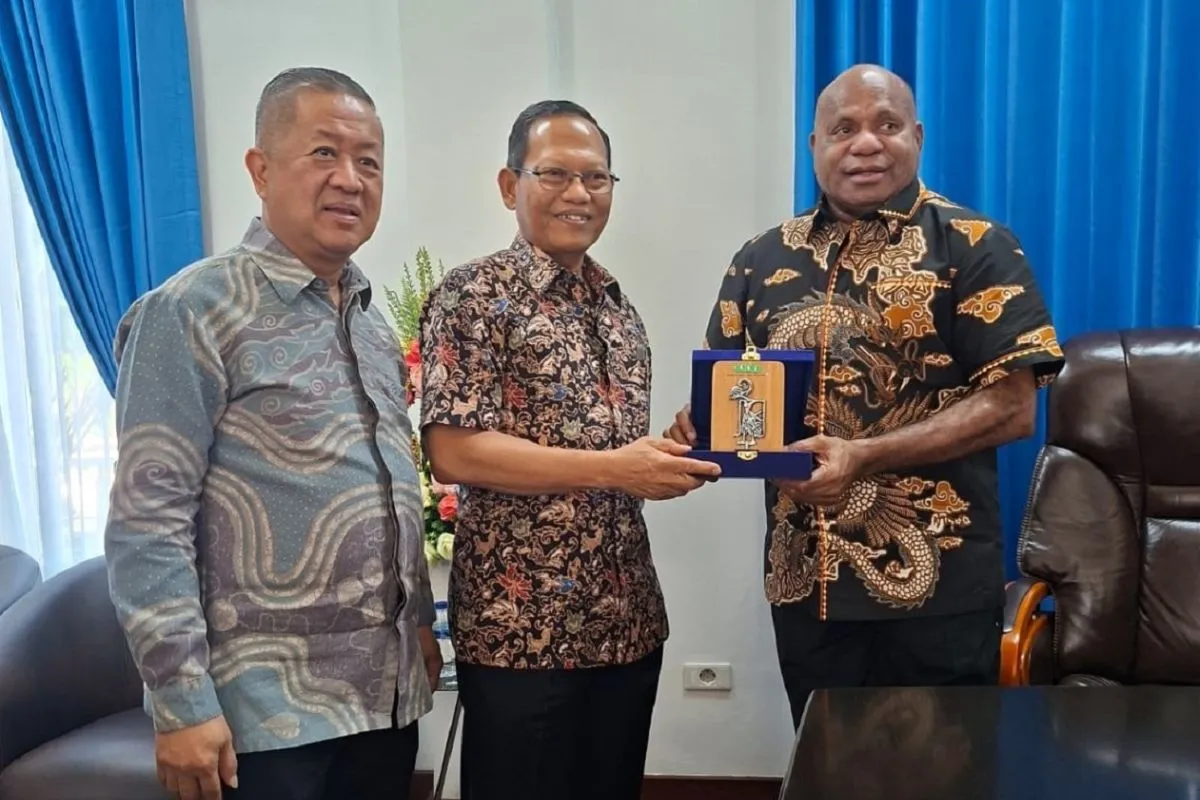
Papua Province has reiterated its commitment to sustainable development by supporting the Indonesian Forest Concession Holders Association (APHI) to prepare a long-term roadmap for the forestry sector. The initiative will help guide the development of Papua’s forest industry over the next decade, balancing economic growth, environmental conservation, and the interests of Indigenous Papuan communities.
The commitment was made during a meeting between Governor Mathius Fakhiri and APHI representatives, in which both sides agreed that Papua has one of Indonesia’s greatest forestry assets. Rather than only targeting conventional timber production, the roadmap seeks to enhance the entire forest value chain, beginning with responsible forest management and including downstream processing industries that can generate greater economic value.
The discussion took place as Indonesia continues to encourage areas rich in natural resources to develop industries that create jobs, increase local income, and improve community welfare without compromising environmental sustainability.
A Shared Vision for Papua’s Forest Future
Governor Mathius Fakhiri welcomed APHI’s proposal to prepare a comprehensive forestry roadmap covering the next ten years. According to him, Papua requires a clear long-term strategy that protects forests and enables local communities to benefit from their sustainable use. He emphasized that forests should no longer be viewed merely as a source of raw materials. Instead, they should become a strategic asset capable of supporting regional economic transformation through better planning, innovation, and investment. Fakhiri said the provincial government appreciates APHI’s initiative because sustainable forestry development requires collaboration between government institutions, businesses, academics, and Indigenous communities. He also stressed that every stage of future development should respect customary land rights while ensuring environmental protection remains a central principle. “The provincial government fully supports APHI’s initiative to formulate a sustainable forestry roadmap because Papua needs a clear direction for the future,” he said. According to the governor, cooperation among all stakeholders will determine whether Papua can maximize its forest resources responsibly while improving community welfare.
APHI Sees Vast Potential Beyond Timber
APHI Chairman Soewarso said Papua has enormous potential to develop what is now called multi-business forestry in Indonesia.
“The forestry sector has developed remarkably in the past decade,” he said. Sustainable forestry is not only about extracting timber anymore but also about ecosystem restoration, environmental services, ecotourism, carbon initiatives, non-timber forest products, and community-based enterprises.
Papua has a large forest landscape, Soesilo said, and thus offers an opportunity to combine conservation with economic development.
APHI wants the roadmap to be a practical guide for turning forest management from upstream activities to downstream industries that can produce more added value,” he said. Soesilo said Papua had a giant potential to develop multi-business forestry. “We are working on a roadmap that links upstream and downstream industries so that forests can contribute more significantly to economic growth while being sustainable.”
He said a long-term strategy would give more certainty to investors while encouraging innovation in environmentally responsible forest management.
Developing Industries From Upstream to Downstream
One of the main objectives of the roadmap is to boost Papua’s downstream forest industry.
Historically, many forest-producing regions exported raw materials, and processing took place elsewhere. That pattern kept local economic benefits down, even with abundant natural resources.
The proposed roadmap recommends increased investment in wood processing, furniture manufacturing, engineered timber products, non-timber forest products, and other value-added industries that can be located closer to the production areas.
Officials believe the strategy could create more employment opportunities and boost regional revenues, as well as promote the development of supporting sectors such as transportation, logistics, vocational education, and research.
More processed products in Papua could mean more economic value for local businesses instead of exporting mainly raw commodities.
Indigenous Communities Remain Central
APHI and the provincial government also stressed that Indigenous Papuans should continue to be the key players in future forestry development.
A large part of the forest in Papua is tied to customary territories where local communities have managed natural resources based on traditional knowledge for generations.
Governor Fakhiri said sustainable forestry policies should increase, not decrease, community participation.
He believes Indigenous communities should be beneficiaries as workers, entrepreneurs, partners, and decision-makers in forest-based businesses.
Such an approach, he said, would ensure economic development to help directly improve the level of living while protecting the cultural heritage of Papua.
Conservation and Economic Growth Can Advance Together
Both APHI and the provincial government emphasized the importance of ensuring indigenous Papuans remain central players in any future forestry development.
Much of Papua’s forest is intrinsically linked to customary land, where indigenous communities have used traditional knowledge to manage nature for centuries.
“Sustainable forestry policies should enhance community participation rather than undermine it,” Governor Fakhiri said.
He says Indigenous communities should benefit not just as workers but as entrepreneurs, partners, and decision-makers in forest-based businesses.
That approach is important to ensure economic development directly contributes to improving living standards while preserving Papua’s cultural heritage.
Supporting Local Economic Transformation
Provincial officials believe that in the next decade forestry could be one of the most important economic drivers for Papua.
Sustainable forest industries could also stimulate the growth of small and medium enterprises producing furniture, handicrafts, processed forest products, essential oils, natural fibers, and other value-added commodities in addition to creating jobs.
The roadmap is also expected to boost partnerships between businesses and educational institutions to improve workforce skills and promote research into sustainable forest management.
The changes could open up more career opportunities for Papua’s younger generation in forestry, environmental science, engineering, business management, and conservation.
It would help reduce dependence on a narrow band of economic sectors and encourage more balanced regional development.
Collaboration Will Shape the Next Decade
The participants in the discussion agreed that the implementation of the roadmap will need close cooperation between central and provincial governments, the private sector, universities, traditional institutions, and local communities.
Each stakeholder has a different role to play, whether it is policy-making, investment, scientific research, or community engagement.
Officials believe that collaborative governance will increase transparency, consistency of policy, and public confidence in sustainable forestry programs.
The province also hopes the roadmap can serve as a reference for future investment while maintaining strict environmental safeguards.
Looking Ahead
Papua’s support of APHI’s ten-year forestry roadmap is part of a broader effort to position the province’s vast forest resources as a platform for sustainable development, rather than short-term exploitation.
Many of the details will be worked out with stakeholders, but the initiative sends a message of a shared commitment to balancing economic opportunity with environmental stewardship and respect for Indigenous communities.
If well implemented, the roadmap could help to develop value-added forest industries, create new jobs, increase community participation, and strengthen Papua as one of the leading regions in Indonesia in sustainable forest management.
We have previously reported on West Papua Voice about community-based sago conservation and sustainable agricultural initiatives. Increasingly, the province pursues development strategies that seek to combine economic progress with the preservation of its rich natural heritage. The forestry roadmap represents a significant advancement in the broader context of sustainable development.
Conclusion
The support of APHI for Papua’s forestry roadmap is a sign of the efforts of the province to make its huge forest resources a long-term engine of sustainable development. The initiative is a joint commitment to grow value-added industries, protect one of the world’s richest tropical forest ecosystems, and increase opportunities for Indigenous Papuan communities. As the roadmap moves from planning to implementation, sustained collaboration among government institutions, businesses, customary communities, academics, and civil society will be critical to ensure that economic progress and environmental stewardship can move forward together.

