
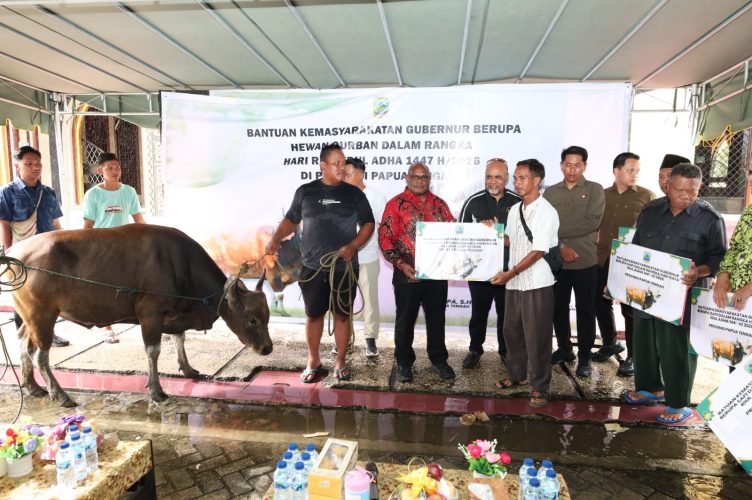
In the afternoons this week, trucks carrying sacrificial cattle slowly entered mosque courtyards across several parts of Papua.
Children gathered near the roadside to watch. Mosque volunteers checked distribution lists under temporary tents. In some neighborhoods, Christian residents helped unload cattle alongside Muslim families preparing for Eid al Adha.
For many Indonesians, scenes like these are familiar every year.
But in Papua, where ethnic, religious, and cultural diversity shape daily life in unique ways, the approach to Eid often carries a more personal meaning.
This year, regional governments across Papua have accelerated preparations for Eid al-Adha 2026 through large-scale sacrificial cattle distribution programs, while local residents continue maintaining long-standing traditions of sharing food and helping neighbors regardless of religious background.
On May 22, the government of Papua Tengah (Central Papua) officially distributed 11 sacrificial cattle donated through assistance from President Prabowo Subianto to eight regencies across the province ahead of Eid celebrations.
Around the same period, Governor Meki Nawipa and Mimika Regent Johannes Rettob also handed over dozens of additional cattle intended for Muslim communities in Nabire and Mimika.
Meanwhile, preparations were also underway in Manokwari, where local authorities confirmed the distribution of more than 140 sacrificial cattle to mosques and residents ahead of the holiday.
But beyond official ceremonies and livestock numbers, many Papuans say the real meaning of Eid in the region still comes from the atmosphere between neighbors.
“In Papua, we celebrate together,” a local resident in Jayapura told regional media while helping prepare Eid logistics this week.
Regional Governments Begin Large-Scale Eid Preparations
Papua Tengah Distributes Presidential Assistance
Preparations intensified after local governments across Papua began distributing sacrificial cattle during the third week of May.
According to reports published between May 22 and May 24, the government of Papua Tengah distributed 11 cattle donated through presidential assistance programs to eight regencies ahead of Eid al-Adha 2026.
The handover process involved coordination between provincial authorities, local religious leaders, and mosque committees responsible for distribution during the holiday.
Governor Meki Nawipa said the assistance reflected the spirit of sharing during Eid while also helping communities prepare properly for the celebration.
“This is part of togetherness and concern for society,” he said during a handover event quoted by regional media outlets.
On the same occasion, regional authorities also distributed additional sacrificial cattle for Nabire and Mimika.
The provincial government prepared 26 cattle for Eid distribution programs in several districts, according to reports from Nabire.
In Mimika, Governor Nawipa and Regent Johannes Rettob later handed over a total of 64 cattle during another public ceremony linked to Eid preparations.
Manokwari and Papua Barat (West Papua) Increase Distribution
Preparations were equally visible in western parts of Papua.
In Manokwari, the local government announced the distribution of 92 sacrificial cattle ahead of Eid al Adha. Shortly afterward, regional media reported the distribution of 143 cattle to 23 mosques across the regency.
Officials said the distribution targeted both urban communities and surrounding areas where residents might have limited economic access during the holiday season.
In Papua Barat Daya (Southwest Papua), President Prabowo Subianto also provided sacrificial cattle assistance for several districts in the province.
Meanwhile, the government of Papua Province announced the distribution of 75 sacrificial animals to regencies and municipalities across the province.
Several officials emphasized that the programs served not only as ceremonial events but also as forms of social support during an important religious celebration.
Eid al-Adha in Papua Often Becomes a Shared Celebration
Neighbors Help One Another Regardless of Religion
Although Muslims form minority populations in several parts of Papua, Eid al Adha preparations frequently involve broader community participation.
In Jayapura this week, one local story that attracted public attention centered around a sacrificial cow named “Roby” in the coastal settlement of Abepantai.
According to local reports, residents from different religious backgrounds helped care for and prepare the animal before Eid distribution activities.
The story quickly became symbolic for many residents because it reflected something deeply familiar in Papua: neighbors helping each other during religious celebrations regardless of faith.
In many Papuan communities, Christians often assist Muslims during Eid, while Muslim families later participate in Christmas preparations or church celebrations in return.
Those interactions rarely attract national headlines, but they remain common across many neighborhoods.
A resident interviewed by local media in Jayapura said the spirit of cooperation had existed for generations.
“We already know each other like family,” the resident said.
Sharing Meat Still Carries Social Meaning
For many lower-income residents, Eid al-Adha also has important humanitarian meaning.
Sacrificial meat distribution programs often reach families who rarely consume beef outside major celebrations.
In several districts, mosque committees confirmed that meat distribution would include non-Muslim residents and economically vulnerable households.
Community leaders said the practice helps strengthen relationships between neighbors while ensuring the celebration benefits wider society.
That social aspect explains why local governments across Papua continue allocating budget support and logistical assistance for Eid preparation programs every year.
Papua’s Diversity Becomes Visible During Religious Holidays
Religious Tolerance Remains Part of Daily Life
Papua is one of Indonesia’s most culturally diverse regions, home to hundreds of ethnic groups and communities with different religious backgrounds.
However, in many places, local traditions of kinship and cooperation shape daily interactions between communities more than religious divisions do.
Major religious celebrations often highlight the visibility of this social culture.
Residents help organize security, transportation, food preparation, and public events together.
In some villages, church youth groups assist mosque committees during Eid preparations. In other places, Muslim communities later help Christians organize Christmas activities.
Local sociologists say this culture of practical coexistence has helped preserve stability in many parts of Papua despite broader political and social challenges.
Officials Hope Holiday Strengthens Social Cohesion
Several regional officials expressed hope that Eid al Adha 2026 would continue strengthening social harmony across Papua.
Authorities also emphasized the importance of maintaining peaceful community relations during religious celebrations.
Security personnel, local governments, and community organizations have coordinated in several districts to ensure smooth Eid activities, particularly in urban centers expected to host large prayer gatherings.
For many residents, however, the holiday remains less about politics and more about ordinary human connection.
Families prepare meals together. Children gather around mosque courtyards. Neighbors exchange food.
And in many places across Papua, people of different backgrounds continue showing up for each other quietly, without needing formal ceremonies to explain why.
Conclusion
As Eid al Adha 2026 approaches, preparations across Papua are revealing a familiar picture of community life in Indonesia’s easternmost region.
Regional governments have distributed hundreds of sacrificial cattle through programs involving provincial administrations, local leaders, and assistance from President Prabowo Subianto.
From Papua Tengah and Mimika to Manokwari and Jayapura, mosque committees and residents have spent the past week organizing livestock distribution, preparing prayer locations, and arranging community celebrations.
Yet beyond the official programs, many Papuans say the real spirit of Eid remains visible in smaller moments.
Neighbors helping unload cattle.
Families sharing meat with nearby households.
Communities from various religious backgrounds collaborate closely.
In Papua, those traditions continue quietly every year, often away from national attention, but deeply rooted in everyday life.

