The discussions inside the meeting hall in Timika stretched late into the evening on May 12, 2026.
Officials moved in and out of conference rooms carrying documents, phones, and cups of coffee while aides quietly updated schedules near the entrance. Outside, traffic in Timika continued as usual. But inside the forum, governors and regional leaders from across Papua were trying to finalize something they hoped could outlast the meeting itself.
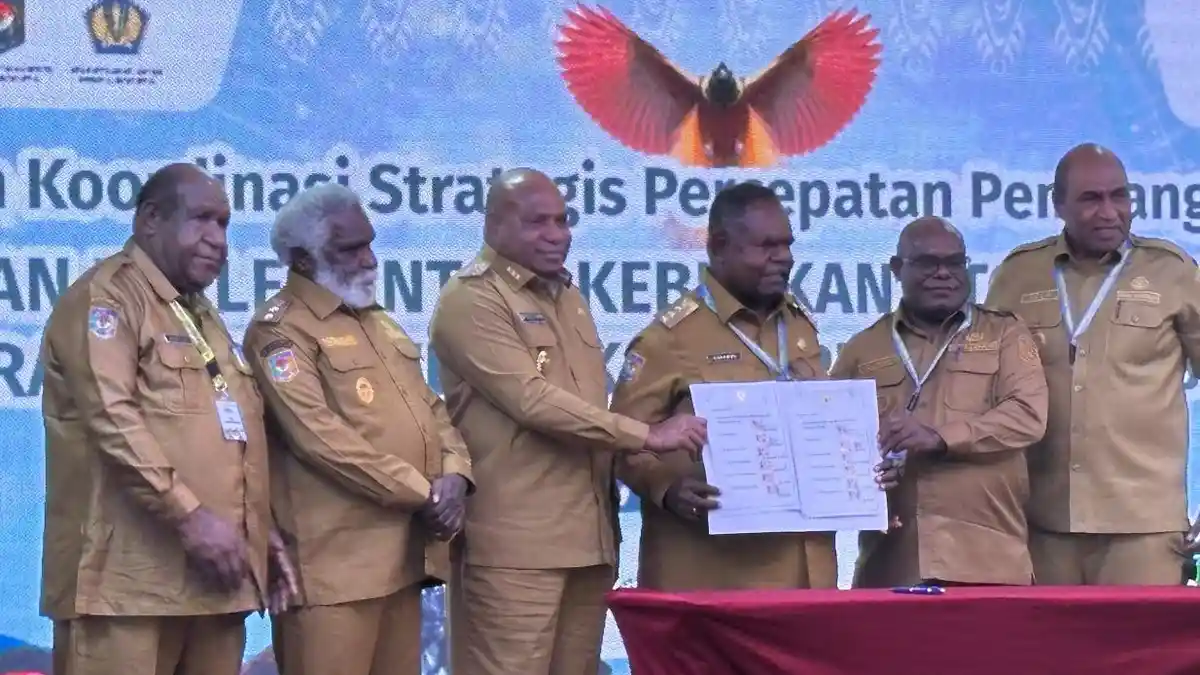
By the end of the two-day forum, six governors from across Papua, along with regents, mayors, and government officials, agreed on 12 points related to development priorities and implementation of Papua’s special autonomy program, widely known as Otsus.
The agreements were announced following the Strategic Coordination Forum for the Acceleration of Papua Development held on May 11 and 12.
Participants described the forum as an attempt to strengthen coordination between Papua’s provinces at a time when the region is undergoing major administrative and political changes.
Governors From Six Papuan Provinces Attend
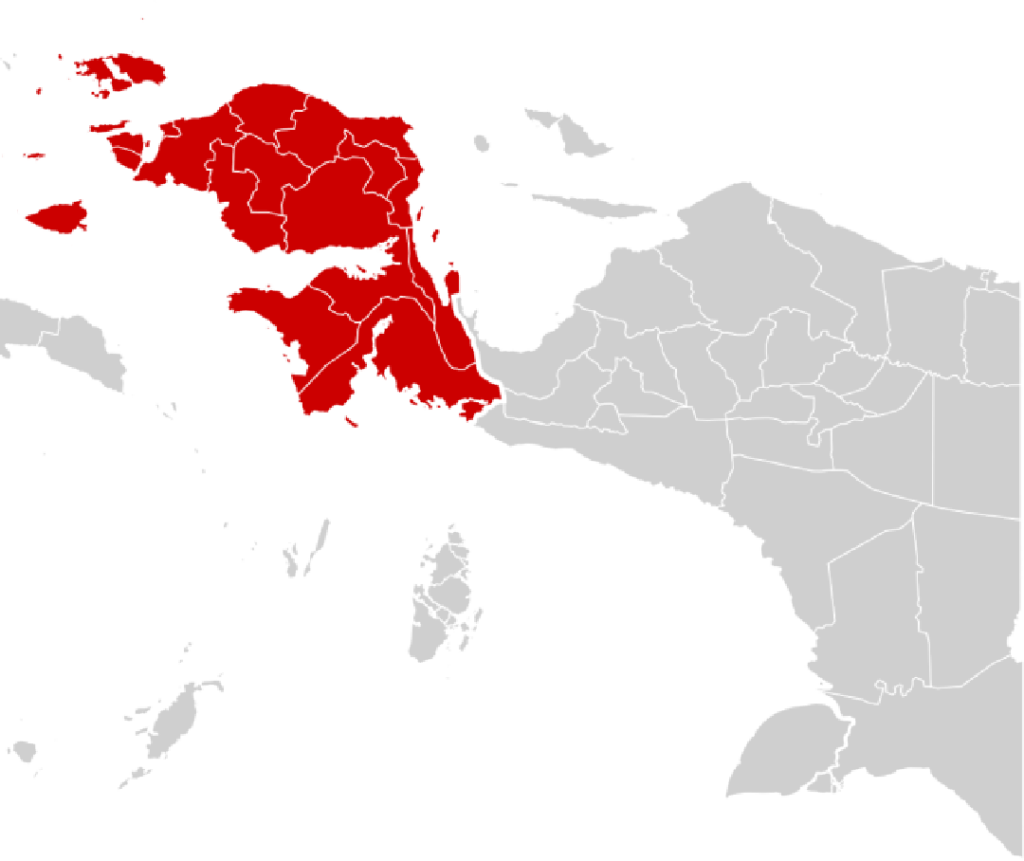
The gathering brought together leaders from Papua, Papua Tengah (Central Papua), Papua Pegunungan (Highland Papua), Papua Selatan (South Papua), Papua Barat (Southwest Papua), and West Papua.
Representatives from Indonesia’s central government also joined several sessions, including officials connected to Otsus implementation and regional development planning.
Much of the discussion focused on how special autonomy funds should be managed more effectively and how provincial governments could coordinate development programs more closely.
The atmosphere during parts of the meeting was formal and technical.
At other moments, discussions became more direct, especially when regional leaders spoke about development gaps still affecting remote communities.
Velix Wanggai Calls the Agreement “One for Six.”
One of the most closely watched remarks came from Chairman of the Executive Committee for the Acceleration of Special Autonomy Development in Papua, Velix Vernando Wanggai, after the forum concluded on May 12.
Speaking to reporters, Wanggai said the Timika agreements reflected “the spirit of one for six and six for one” in accelerating development across Papua.
The phrase quickly circulated among participants after the meeting ended.
Several officials repeated it while speaking informally outside the venue.
The statement appeared intended to emphasize cooperation between Papua’s six provincial governments following years of administrative restructuring in the region.
Otsus Funding Dominates the Discussions.
Accountability and Public Trust Become Main Issues
Special autonomy funding remained at the center of nearly every major discussion during the forum.
Officials acknowledged that Otsus has financed roads, healthcare programs, schools, scholarships, and public infrastructure across Papua over the years. But participants also admitted that expectations from communities continue to rise.
Representatives from Indonesia’s Ministry of Home Affairs reportedly reminded regional administrations that Otsus funding must directly reach communities and remain accountable.
That point surfaced repeatedly during discussions on May 11 and 12.
Several regional leaders said people increasingly want to see practical results rather than only budget figures or development announcements.
Infrastructure and Healthcare Still Become Priorities
According to reports from the meeting, the 12 agreements included commitments related to infrastructure development, healthcare access, education improvement, and economic empowerment programs.
Leaders from several provinces raised concerns about transportation difficulties in mountainous and remote areas where public services remain limited.
Some participants described logistics as one of Papua’s biggest continuing obstacles.
Moving medical supplies, teachers, construction materials, and food into isolated districts still requires high costs and long travel times.
Local languages also become part of the agreement.
One issue receiving unexpected attention during the forum involved local language preservation.
Reports connected to the meeting noted support for programs encouraging schools to introduce designated local language days to help preserve Indigenous Papuan languages.
The discussion reflected growing concern among educators and cultural figures that younger generations are increasingly using Indonesian more frequently while local languages become less common in daily life.
Papua remains one of the most linguistically diverse regions in the world.
For several participants, preserving local languages was described as part of protecting Papuan identity itself.
National and Regional Figures Respond Positively
Papuan People’s Assembly (MRP) Welcomes the Agreements
The outcome of the Timika forum received support from several regional figures after the meeting ended.
MRP Papua Barat Daya Chairman Yoas Dowansiba publicly appreciated the 12-point agreement reached by the governors and regional leaders.
According to local reports published on May 13, he said the agreements could strengthen coordination between Papuan regions and help align development priorities more clearly.
His comments reflected wider support from local institutions hoping regional governments can cooperate more consistently on issues affecting Indigenous communities.
Leaders Emphasize Cooperation
Throughout the forum, several officials stressed the importance of reducing fragmentation between Papua’s provinces.
Since Indonesia established new provinces in Papua, regional administrations have operated under increasingly complex governance structures.
While supporters argued the expansion would improve services and bring government closer to communities, the changes also increased the need for coordination.
That issue shaped much of the conversation in Timika.
One participant privately described the atmosphere as “serious, but constructive.”
Timika Becomes Center of Papua Discussions
For two days, Timika became one of the busiest political meeting points in Papua.
Government vehicles moved steadily in and out of the venue while delegations held discussions inside conference rooms throughout May 11 and 12.
Hotel lobbies nearby filled with officials, assistants, journalists, and security personnel.
Some delegates stayed talking in small groups after sessions ended late at night.
Others quietly reviewed documents before returning to meetings the next morning.
Although the forum focused heavily on policy and coordination, there was also recognition that public expectations remain high across Papua.
Communities continue expecting improvements in healthcare, education, infrastructure, and employment opportunities.
Challenges Remain Beyond the Meeting
Even participants who support the agreements acknowledged that implementing them will be challenging.
Papua’s geography alone creates major logistical complications. Development conditions differ sharply between urban coastal areas, highland districts, and isolated villages.
Some regions continue facing infrastructure limitations despite years of government investment.
Others struggle with shortages of healthcare workers and teachers.
During the forum, several leaders reportedly reached an agreement that coordination between provinces would become increasingly important for the faster progression of development programs.
Conclusion
The Strategic Coordination Forum for the Acceleration of Papua Development ended on May 12 with handshakes, group photographs, and a document containing 12 agreed-upon priorities for the region.
The agreements touched on special autonomy, infrastructure, healthcare, education, Indigenous welfare, and cultural preservation.
No one at the forum suggested Papua’s challenges would disappear quickly.
But for two days in Timika, governors, regents, mayors, and officials from across the island sat together trying to build a more coordinated direction for Papua’s future.
As delegations departed Timika on the evening of May 12, the discussions inside the forum rooms were over.
What matters now is whether the agreements signed there eventually produce changes visible far beyond the conference tables where they began.