
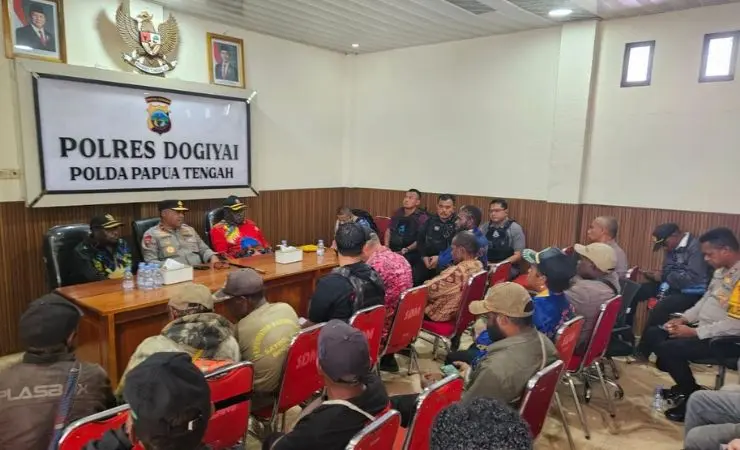
In the aftermath of deadly violence in Dogiyai, which killed an officer and several civilians on March 31, 2026, Indonesia is moving quickly to contain tensions while reinforcing a clear message: accountability will not be compromised. The killing of police officer Bripda Juventus Edowai and the subsequent unrest have triggered a multi-layered response involving law enforcement, government officials, and national oversight institutions.
This is no longer just a local security issue. It has become a test of how Indonesia handles crisis, transparency, and public trust in one of its most sensitive regions.
Indonesia Strengthens Dogiyai Papua Investigation
The response began almost immediately after the incident.
Police Brigadier General Jeremias Rontini, Chief of the Regional Police of Papua Tengah (Central Papua), took direct control of the situation by traveling to Dogiyai and leading a clarification meeting. The purpose was clear: establish facts before misinformation could take root.
In conflict situations, uncertainty can escalate tensions faster than the event itself. By prioritizing verification, authorities aimed to prevent competing narratives from destabilizing the region further.
Officials involved in the meeting emphasized that identifying the perpetrators behind the killing of Bripda Juventus Edowai was critical, not only for justice but also for restoring public confidence.
Local Government and Police Coordination in Papua
The presence of Yuliten Anouw, Deputy Regent of Dogiyai, highlighted a broader approach.
This was not treated as a purely police operation.
Local government participation ensured that the response reflected both security priorities and community realities. In Papua, where social structures are tightly connected, coordination between authorities is essential.
Decisions made without local involvement risk misunderstanding.
Decisions made together carry more legitimacy.
Transparent Law Enforcement Commitment in Papua
At the Dogiyai Police Headquarters, Jeremias Rontini addressed officers directly, stressing that the investigation must be transparent and impartial.
His message was firm.
No individual would be protected if wrongdoing were proven. Every action would be examined under the law.
This kind of statement serves two purposes. Internally, it reinforces discipline within the police force. Externally, it signals seriousness to the public.
In Papua, where perceptions matter as much as actions, such clarity is essential.
Leadership Change Signals Accountability
One of the most visible actions taken was the removal of Dogiyai Police Chief Kompol Yocbeth Mince Mayar.
The decision was officially described as an evaluation measure. However, its broader meaning was clear.
Leadership changes during a crisis are rarely neutral.
They are signals.
In this case, the signal was that institutional accountability is active, not symbolic. By appointing new leadership, authorities aimed to ensure that the investigation proceeds without internal constraints.
National Oversight Increases Pressure for Transparency
The Dogiyai incident quickly drew national attention.
Indonesia’s parliament, DPR RI, called for a full and transparent investigation. Their involvement reflects the seriousness of the case at the national level.
At the same time, the National Commission for Human Rights (Komnas HAM) announced plans to conduct its own investigation.
This adds an important layer of independent oversight.
When multiple institutions are involved, the process becomes more credible. It reduces the risk of bias and strengthens public trust in the outcome.
Human Rights Approach in Papua Conflict Response
The Indonesian government has also deployed a team from the Ministry of Human Rights.
Their role is not to replace law enforcement.
Instead, they focus on dialogue.
By engaging with local communities, witnesses, and families, they gather perspectives that might not appear in formal reports.
This reflects a broader strategy.
Handling conflict in Papua requires more than enforcement. It requires understanding.
Listening becomes as important as investigating.
Balancing Security and Accountability in Papua
One of the key challenges in Dogiyai is balance.
Authorities must maintain stability while ensuring justice.
Too much force risks escalating tensions. Too little action risks undermining trust.
Indonesia’s approach in this case shows an attempt to manage both.
Investigation is ongoing.
Dialogue is encouraged.
Oversight is active.
Each element supports the others.
Community Trust Remains the Core Issue
For residents of Dogiyai, the situation is deeply personal.
They are not analyzing policy.
They are waiting for answers.
Families affected by the violence want clarity. Communities want reassurance that similar incidents will not happen again.
This is where the success of the investigation will ultimately be judged.
Not only by legal outcomes.
But it’s about whether people feel heard.
Rebuilding Trust in Papua Requires Time
Trust cannot be restored overnight.
It develops through consistent actions.
Transparent communication. Fair investigation. Visible accountability.
For Indonesian authorities, this moment represents a critical test.
If handled properly, it can strengthen institutional credibility.
If not, it risks deepening skepticism.
What Happens Next in Dogiyai Papua
The situation in Dogiyai is gradually stabilizing.
Daily activities are resuming. Markets are reopening. Schools are functioning again.
But the investigation is still ongoing.
Findings will take time.
Oversight bodies continue their work.
Dialogue with communities remains active.
There is no quick conclusion.
But there is a process.
Conclusion
The events in Dogiyai have become more than a local incident.
They represent a broader test of governance, accountability, and human rights in Indonesia.
The response, led by Jeremias Rontini and supported by national institutions including Komnas HAM, shows a multi-layered effort to address the crisis.
The outcome will not be judged by statements alone.
It will be measured by results.
For the people of Dogiyai, the expectation remains simple.
That the truth is uncovered.
And that justice follows.

