
When the roar of the crowd echoed across Thailand’s competition venues during the 2025 Southeast Asian Games, it carried with it the hopes of millions of Indonesians. Among the athletes who stepped onto the international stage were men and women from Papua, a region often defined by its distance from the country’s political center but rich in resilience, discipline, and sporting talent. At the SEA Games in Thailand, Papuan athletes did more than compete. They delivered performances that spoke of perseverance, national pride, and the quiet strength born from years of dedication far from the spotlight.
From the calm waters of canoeing arenas to the tense silence of weightlifting platforms, Papuan athletes stood tall among Southeast Asia’s best. Their achievements were not accidental moments of brilliance but the result of long journeys marked by sacrifice, community support, and unyielding belief. As medals were lifted and flags raised, Papua’s contribution to Indonesia’s sporting success became impossible to ignore.
Rising With the Tide: Papua’s Canoe Athletes Make History
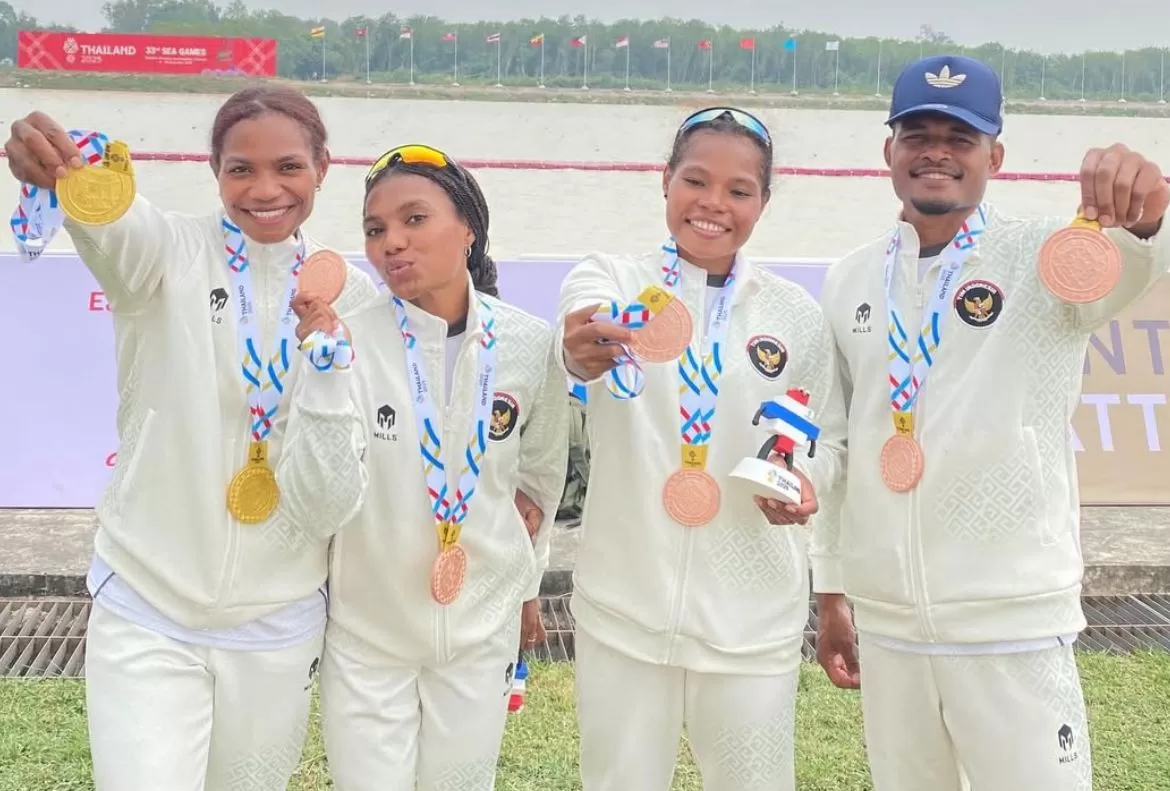
One of the most striking chapters of Papua’s SEA Games story unfolded on the water. In Thailand, canoeing competitions became a stage where Papuan athletes demonstrated not only physical strength but also synchronization, mental endurance, and tactical intelligence. Four canoe athletes from Papua emerged as central figures in Indonesia’s medal success, claiming gold and bronze medals in multiple events and leaving a lasting impression on spectators and rivals alike.
At the heart of this achievement was Stevani Maysche Ibo, a name that has become synonymous with Indonesian canoeing excellence. Calm, focused, and powerful in her strokes, Stevani delivered performances that reflected years of disciplined training. Her first gold medal came in the Mixed Kayak Four 500 meter event, where precise coordination and unwavering rhythm carried the Indonesian team across the finish line ahead of strong regional competitors. The victory was celebrated not only as a personal achievement but as proof of Indonesia’s growing strength in canoeing at the regional level.
Stevani did not stop there. She returned to the water in the Mixed Kayak Double 200 meter event and once again demonstrated her elite ability. The race was fast and unforgiving, demanding explosive speed and flawless timing. Together with her partner, she surged forward with confidence and crossed the line in first place. As the Indonesian flag rose and the national anthem played, the gold medal symbolized more than a win. It represented years of perseverance by an athlete who had trained through limitations, distance, and minimal attention compared to athletes from more established sporting hubs.
Alongside Stevani, fellow Papuan athletes Sella Monim and Herlin Lali added depth to Indonesia’s canoeing success. Competing in the Women’s Canoe Double 500 meter and 200 meter events, they secured bronze medals through consistent and determined performances. Their races were marked by strong starts, controlled pacing, and resilience against pressure from seasoned opponents. Standing on the podium, they embodied the collective strength of Papua’s canoeing program, proving that excellence was not confined to a single athlete.
In the men’s events, Evans Monim contributed further to the medal tally by earning bronze medals in the Men’s Canoe Double 200 meter and Men’s Canoe Four 200 meter races. His performances reflected teamwork and tactical awareness, qualities that are essential in high speed canoeing events where margins are measured in fractions of seconds. Together, these Papuan athletes transformed canoeing into one of Indonesia’s most successful disciplines at the 2025 SEA Games.
Strength Forged in Silence: Natasya Beteyob’s Weightlifting Triumph
While cheers echoed across the water venues, another powerful story was unfolding indoors under the unforgiving lights of the weightlifting arena. Natasya Beteyob, a lifter from Papua, stepped onto the platform with quiet confidence. In weightlifting, there is no room for distraction. The barbell waits, the room falls silent, and years of preparation are tested in seconds.
Competing in the women’s 58 kilogram category, Natasya delivered a performance that combined technical precision with raw strength. She completed her snatch lifts cleanly, showing control and balance that reflected mature technique. In the clean and jerk segment, she maintained composure under pressure, successfully lifting weights that placed her firmly among Southeast Asia’s elite lifters.
By the end of the competition, Natasya recorded a total lift of 218 kilograms, earning a silver medal for Indonesia. Though narrowly behind Thailand’s gold medalist, her achievement carried deep significance. It marked an improvement over her previous SEA Games appearance and demonstrated her progression as an athlete who continues to refine her skill and physical capacity.
For Natasya, the silver medal was not just a personal milestone. It was a symbol of Papua’s presence in strength sports traditionally dominated by athletes from countries with longer weightlifting traditions. Her performance resonated deeply back home, where young athletes saw in her success a reflection of what is possible through discipline and perseverance.
More Than Medals: What Papua’s Success Represents
The achievements of Papuan athletes at the 2025 SEA Games cannot be measured solely by gold, silver, and bronze. They represent something far broader. For decades, Papua has produced exceptional athletic talent, particularly in sports that demand physical endurance, coordination, and mental toughness. Yet athletes from the region have often faced structural challenges, including limited access to facilities, geographic isolation, and fewer competitive opportunities.
What unfolded in Thailand was evidence that those barriers, while real, are not insurmountable. The performances of Papuan canoeists and weightlifters demonstrated the results of sustained investment, effective coaching, and the unwavering support of families and local communities. Each medal was a testament to long training sessions conducted far from international arenas and often with limited resources.
These athletes carried with them not only personal ambition but also the hopes of communities that see sport as a path to dignity, recognition, and unity. Their success reinforced the idea that national achievement is strongest when talent from all regions is nurtured and celebrated.
A Source of National Pride
Papua’s contributions played an important role in Indonesia’s overall performance at the SEA Games 2025. As Indonesia competed fiercely against regional rivals such as Thailand and Vietnam, medals from canoeing and weightlifting added crucial points to the national tally. The success highlighted Indonesia’s growing competitiveness across a wide range of sports, supported by athletes from diverse backgrounds and regions.
For Indonesian sports fans, the rise of Papuan athletes offered a powerful reminder of the country’s diversity. The stories of Stevani Ibo and Natasya Beteyob resonated because they reflected determination shaped by unique journeys. Their victories became shared moments of pride, uniting audiences from Papua to Java and beyond.
Echoes Back Home in Papua
In Papua, the news of these achievements spread quickly. Communities gathered around television screens, schools shared highlights with students, and families spoke with pride about athletes who had carried the Papuan name onto the international stage. For many young people, these medalists became living proof that global recognition is attainable, regardless of geographic distance or background.
Local leaders and sports officials expressed hope that these successes would encourage greater investment in sports development across Papua. Training centers, youth programs, and competitions are seen as essential steps toward sustaining momentum and ensuring that future generations have even greater opportunities to excel.
Parents spoke of children who now dream of becoming canoeists or weightlifters, inspired by athletes who once trained under similar conditions. In this way, the impact of the SEA Games extended far beyond Thailand, planting seeds of aspiration across Papua’s towns and villages.
Looking Ahead: Building on Momentum
As the SEA Games concluded and athletes prepared to return home, attention turned to the future. For Papuan athletes, the journey does not end with medals. The experience gained in Thailand will serve as a foundation for higher level competitions, including Asian championships and potentially global events.
Stevani Ibo and her canoeing teammates are expected to remain key figures in Indonesia’s regional and international campaigns. Meanwhile, Natasya Beteyob’s steady progression positions her as a strong contender for future multi sport events. Their continued development will depend on sustained support, structured training, and opportunities to compete at the highest levels.
Conclusion
The story of Papua at the 2025 SEA Games is ultimately a story of belief. Belief in talent that grows far from the spotlight. Belief in the power of sport to unite a nation. Belief that excellence can emerge from any corner of Indonesia when opportunity meets determination.
As Indonesia reflects on its performance in Thailand, the achievements of Papuan athletes stand as a reminder that national success is built collectively. Each stroke on the water and every lift on the platform carried with it the spirit of Papua, contributing to a broader narrative of resilience, pride, and possibility.
Their medals shine brightly, not only as symbols of victory, but as beacons pointing toward a future where every region has a place on the podium.

