
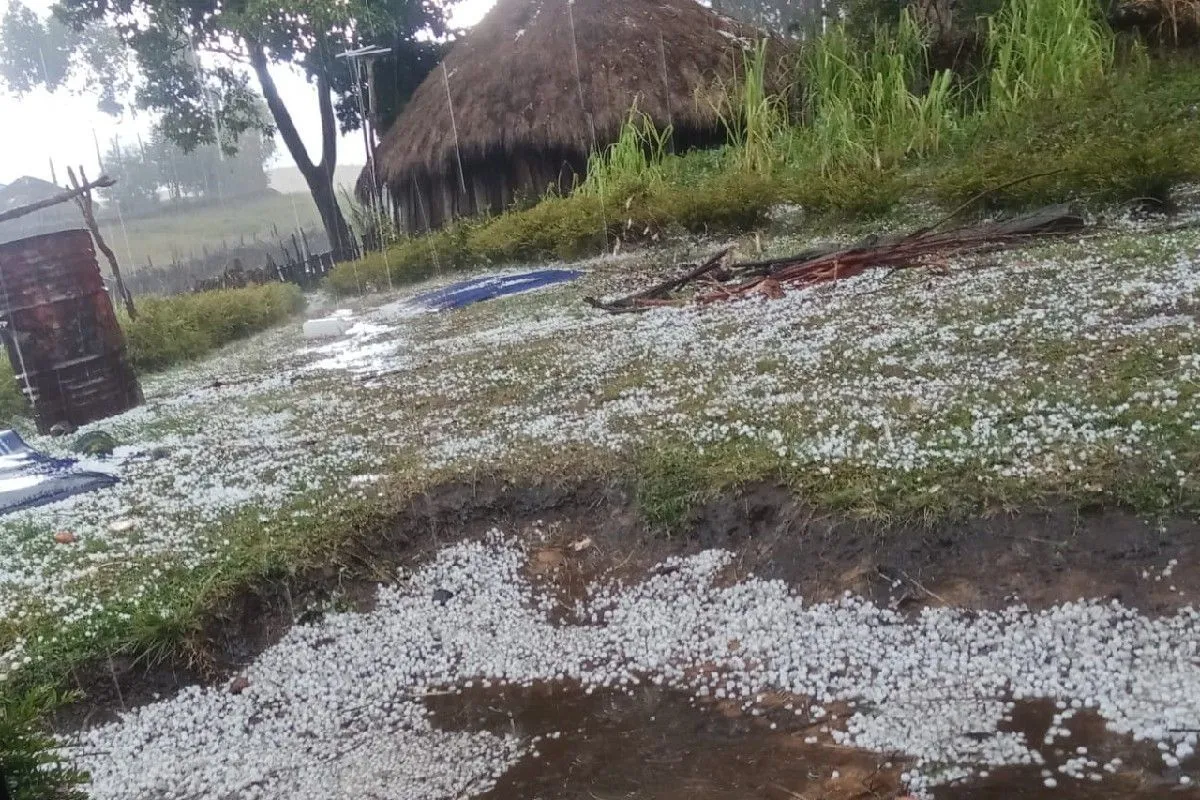
The Papua hailstorm that struck highland communities in Puncak and Lanny Jaya has turned an unusual weather phenomenon into a serious humanitarian and food security concern. What briefly made villages appear white like snow has left damaged crops, disrupted livelihoods, and raised concerns about how families will obtain food if agricultural production does not recover quickly.
In Lanny Jaya, the local government has identified three affected districts, Kuyawage, Wano Barat, and Goa Baliem, and has distributed 82 tons of rice to residents. The assistance came from the central government through a food security program. Medical teams are also being prepared to provide basic health services during the emergency and recovery period.
In neighboring Puncak Regency, Papua Tengah Province, authorities have taken a separate emergency approach. The Puncak administration declared a 14-day emergency response beginning August 24 after prolonged drought, forest and land fires, and hail affected several areas. A joint team involving local government, the TNI, and Polri was formed to coordinate the response.
The two cases reveal a wider challenge facing Indonesia’s central and highland Papua: extreme weather can simultaneously threaten food production, water supplies, health, and access to remote communities.
A White Landscape with Serious Consequences
The hailstorm in Lanny Jaya was reported on the night of August 16, with damage concentrated in three districts.
According to Lanny Jaya Regent Aletinus Yigibalom, the latest event was more damaging than previous incidents because crops were not merely exposed to cold conditions. Some agricultural plants were destroyed to the point that they could no longer be harvested. Local officials warned that the resulting damage could threaten household food supplies.
For communities in the highlands, that distinction matters.
Agriculture is not simply an economic activity. It is closely tied to household food security and daily survival. When crops fail, families can quickly become dependent on food deliveries, particularly in locations where markets are distant and transport is expensive.
RRI reported that residents’ intercropped agricultural fields were damaged by the combination of drought and hail. Some affected residents also faced difficulties reaching distribution points because of long distances, physical weakness, and illness.
The disaster therefore has two dimensions. There is the visible damage to crops, and there is the less visible problem of maintaining access to food for families while the agricultural system recovers.
BMKG Explains Why Hail Can Fall During a Dry Season
The unusual timing of the phenomenon has attracted attention because hail is generally associated in the public imagination with colder climates or winter storms.
But Indonesia’s meteorological authorities have offered a different explanation.
The Meteorology, Climatology, and Geophysics Agency, or BMKG, said the Lanny Jaya hailstorm was associated with the strong development of Cumulonimbus clouds, commonly known as Cb clouds.
According to BMKG Region V Jayapura forecaster Arif Setiawan, powerful convective clouds can carry water droplets upward into frigid portions of the atmosphere. The droplets freeze into ice particles, which can subsequently fall toward the ground.
The high elevation of Lanny Jaya is an important part of the process.
Because temperatures generally decrease with altitude, the ice particles have a greater chance of remaining frozen as they descend. In lower and warmer areas, they are more likely to melt before reaching the surface.
BMKG also explained that dry-season conditions can contribute to strong daytime heating of the surface. Warm air rises and, when atmospheric conditions are favorable, can support the development of powerful convective clouds.
That means the appearance of hail during a dry period is not necessarily contradictory.
The key factor is not simply whether it is the dry season. Rather, it is the combination of atmospheric instability, strong cumulonimbus development, temperature, and the mountainous environment.
This distinction is important for disaster preparedness because communities cannot rely solely on seasonal expectations. A dry period can still produce damaging short-duration weather events.
Lanny Jaya Moves from Assessment to Assistance
The response in Lanny Jaya began with local authorities trying to establish the actual scale of damage.
After receiving official reports from residents, Regent Aletinus ordered the creation of an emergency response team involving the regional disaster management agency and relevant government agencies. The team was deployed to the three affected districts to collect field data.
That approach is significant because emergency assistance depends on accurate information.
The government must identify the communities that have lost crops, assess the extent of agricultural land damage, and determine which households are most vulnerable. In mountainous areas, where access can be difficult, field verification becomes particularly important.
The Lanny Jaya administration estimated that agricultural damage could affect residents for up to a year if recovery is not addressed quickly.
That is why the response has moved beyond emergency food distribution.
The local government has also prepared health teams to provide basic medical services and monitor residents during the emergency and recovery phases.
The combination of food and health measures reflects the interconnected nature of disasters. A damaged harvest can reduce food availability. Poor nutrition can increase vulnerability to illness. At the same time, remote communities may face difficulties accessing medical facilities.
Central Government Assistance Reaches Remote Communities
The central government’s role has become particularly visible through the Ministry of Social Affairs, or Kemensos.
On August 21, the Papua Pegunungan Provincial Social Affairs Office accompanied the distribution of Kemensos logistical assistance to communities affected by drought and hail in Lanny Jaya and Nduga.
The assistance included 14.035 tonnes of rice, 219 kilograms of sugar, 219 cartons of coffee, and 700 cartons of instant noodles. The aid was distributed to residents in Wanobarat and Kuyawage in Lanny Jaya, as well as Nengeyagin and Wutpaga in Nduga.
Kemensos representative Roberto Koibur said the assistance was intended to ease the burden on communities directly affected by the disaster. The provincial Social Affairs Office said the distribution followed reports submitted through government channels from the district and provincial levels to the central government.
The process also illustrates one of the practical difficulties of disaster response in the Papua highlands.
Some residents were able to reach distribution points, while others could not because of distance and health conditions. Local officials therefore emphasized the need to ensure that aid reaches people who remain in their settlements rather than only those who can travel to collection points.
For remote communities, the last kilometer of humanitarian assistance can be as important as the initial decision to provide it.
Puncak Declares Its Emergency Response
The situation in Puncak, Papua Tengah, has developed along a parallel but somewhat broader path.
On August 24, the Puncak Regency Government declared a 14-day emergency response covering the impacts of prolonged drought, forest and land fires, and hail.
The decision followed a coordination meeting involving the local government, regional leadership forum, TNI, and Polri. A joint team was established to conduct field response, monitoring, and prevention efforts.
The emergency status is crucial due to the challenges in Puncak, which extend beyond hail.
The region has also been dealing with prolonged dry conditions and food supply pressures. Earlier in August, the TNI’s Koops Habema distributed two tons of humanitarian assistance to Agandugume, Oneri, and Lambewi districts.
The distribution itself demonstrated the geographical challenge. According to RRI, the operation involved difficult mountainous terrain, changing weather, and limited access. In another report, the two tons of assistance reached the destination after personnel spent 12 days walking through difficult terrain.
Eight TNI helicopters were also deployed in an operation to deliver humanitarian assistance to three districts in Puncak affected by prolonged drought and food shortages.
These operations demonstrate the need for emergency management in Papua to go beyond conventional road-based logistics.
Air transport, military and civil coordination, local government networks, and community-level distribution can all become necessary when mountainous terrain limits access.
Agriculture Becomes a National Response Priority
The Indonesian government’s response has increasingly moved toward protecting agricultural production rather than relying solely on emergency food distribution.
On August 26, Agriculture Minister Andi Amran Sulaiman prepared agricultural equipment assistance for farmers in all 25 districts of Puncak Regency.
The initial equipment included basic agricultural tools such as crowbars, hoes, shovels, and machetes. Some assistance was being considered for air transportation because of the limited transport infrastructure in Puncak. The Ministry of Agriculture also planned to strengthen agricultural extension support for farmers.
This is an important shift in the response.
Emergency rice can prevent immediate hunger, but it does not restore damaged agricultural capacity. Farmers need tools, seeds, technical assistance, and access to markets if they are to recover their livelihoods.
The Puncak administration has also proposed strengthening coffee and livestock development as economic sectors for local communities, suggesting that recovery can be linked with longer-term economic development rather than treated only as disaster relief.
Food Security Is the Central Concern
The hailstorms have arrived during a period when Papua’s highlands are already experiencing significant dry-season pressure.
BMKG’s climatology station in Papua previously forecast that the dry season would peak in August across Papua, Papua Tengah, and Papua Pegunungan. The agency linked the seasonal conditions to a strong El Niño, with the index reported at +1.59 in the period monitored.
This does not mean that El Niño directly caused every individual hailstorm.
BMKG’s explanation for Lanny Jaya specifically points to strong Cumulonimbus development and highland atmospheric conditions. The broader dry-season environment, however, has created additional stress for agriculture and water availability.
That distinction matters when considering future preparedness.
Authorities need to monitor both seasonal climate patterns and short-term severe weather. A prolonged dry period can coexist with sudden, intense storms.
For communities dependent on agriculture, that combination can be especially disruptive.
Why Government Coordination Matters
The response across Puncak and Lanny Jaya also illustrates the importance of coordination between different levels of government.
At the district level, officials are responsible for identifying damage and reaching communities. Provincial administrations coordinate resources and technical support. Central ministries can provide food, agricultural equipment, and disaster assistance. TNI and other institutions can help overcome logistical barriers in remote terrain.
The Lanny Jaya government has explicitly requested support from the provincial and central governments, including the National Disaster Management Agency and Ministry of Social Affairs.
In Puncak, the emergency response similarly brings together local government, TNI, and Polri.
This multi-level structure is particularly important in Papua, where geography can turn a relatively straightforward relief operation into a complex logistical undertaking.
It also provides an opportunity to improve disaster preparedness beyond the immediate crisis.
From Emergency Relief to Climate Resilience
The most important question now is what happens after the ice melts.
Emergency assistance can stabilize households for days or weeks. But damaged agricultural land may take months to recover, and the consequences of a failed harvest can continue long after the weather event has ended.
Lanny Jaya’s administration has already warned that agricultural damage could affect food security for up to a year if the recovery is not handled properly.
That makes recovery planning essential.
The next stage should involve continued crop assessments, agricultural assistance, health monitoring, and food distribution where necessary. It should also involve strengthening local early-warning mechanisms so communities can receive information about severe weather before it arrives.
The BMKG explanation provides an important foundation for that effort. Understanding that powerful Cumulonimbus clouds can generate hail even during a dry season provides authorities and communities a clearer basis for weather preparedness.
A Wider Lesson for Highland Papua
The events in Puncak and Lanny Jaya highlight a broader reality about development in Papua.
Infrastructure, food security, agriculture, and disaster resilience closely connect.
A community may have productive farmland, but if roads and air links are limited, agricultural recovery becomes more difficult. A government may have food reserves, but distribution can remain challenging when settlements are separated by mountains and valleys.
For this reason, disaster response should increasingly be integrated with long-term development planning.
Improving transportation links, strengthening local agricultural services, maintaining emergency stocks, and expanding meteorological information can reduce the impact of future extreme weather.
The government’s recent actions in Puncak and Lanny Jaya provide elements of such an approach, although the effectiveness of the response will ultimately depend on whether assistance continues after the initial emergency period.
Conclusion
The Papua hailstorm in Puncak and Lanny Jaya has exposed the vulnerability of highland communities to an unusual combination of extreme weather, drought, and agricultural disruption.
In Lanny Jaya, three districts have suffered significant crop damage, prompting the local government to establish an emergency response team, distribute 82 tonnes of rice, and prepare medical assistance.
In Puncak, Papua Tengah, the government has imposed a 14-day emergency response while coordinating with TNI and Polri to address drought, forest and land fires, and hail. Central government institutions have also provided humanitarian assistance, while the Ministry of Agriculture has prepared agricultural tools for farmers across the regency.
The immediate priority is clear: protect food supplies and vulnerable households.
But the longer-term objective should be more ambitious. Papua’s highland communities need stronger agricultural resilience, reliable emergency logistics, better access to meteorological information, and infrastructure capable of supporting rapid response.
The hail may have lasted only a short time. Its consequences could last much longer.
How effectively government institutions respond during the recovery period will determine whether the 2026 extreme-weather events become simply another difficult chapter for highland Papua or a catalyst for stronger disaster preparedness and food security in the years ahead.

