
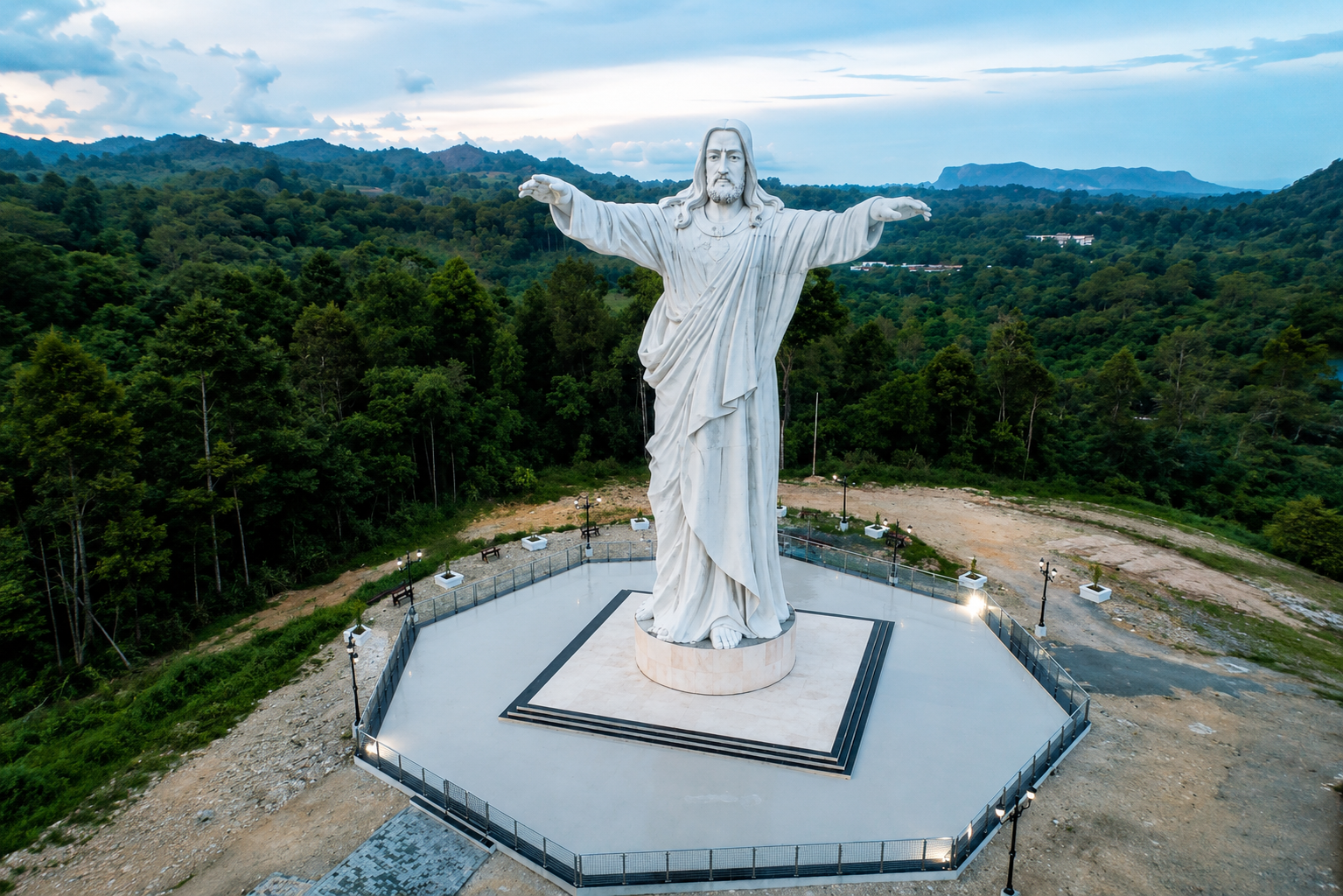
In the hills and green landscape of Kampung Yowong, Arso Barat District, Keerom Regency, Papua, a large religious monument is steadily taking shape. The Keerom Jesus Statue, standing 25 meters tall, is approaching completion and is expected to become a new landmark for religious tourism in Indonesia’s border region with Papua New Guinea.
Recent photographs published by ANTARA showed workers continuing construction at the site on August 18, 2026. The monument is now in its final construction phase and is scheduled to be inaugurated in November 2026. Local authorities and stakeholders hope it will develop into a distinctive religious tourism destination while adding a new attraction to the wider border area.
The project carries significance beyond the physical size of the statue. In a region where Indonesia’s border with Papua New Guinea is increasingly being connected with infrastructure, economic activity, and tourism, the monument offers another way to introduce visitors to Papua’s cultural and religious landscape.
For Keerom, the project could eventually bring together several interests at once: religious pilgrimage, cultural tourism, local economic activity, and the promotion of the border region as a destination.
A New Landmark Takes Shape in Keerom
The 25-meter statue is being built in Kampung Yowong, Arso Barat District, Keerom Regency. According to ANTARA Foto, construction had reached the finishing stage by August 18, with the inauguration planned for November 2026.
Its location is particularly important.
Keerom is part of Papua’s northeastern borderland, an area that connects Indonesia geographically and socially with Papua New Guinea. The border has long carried strategic importance for Indonesia, but it is also home to communities whose daily lives are shaped by agriculture, local trade, culture, and movement between settlements.
A prominent religious monument in such an environment can serve a different function from conventional infrastructure. It can become a recognizable visual marker for the district while providing a destination for pilgrims and visitors.
The project also coincides with the growing connection between tourism development in Papua and local economic opportunities. Rather than relying exclusively on large-scale attractions, regional destinations can be developed around cultural identity, natural landscapes, and community-based experiences.
From Construction Site to Tourism Destination
The immediate objective is to complete the monument itself. The longer-term challenge will be turning the site into a functioning tourism destination.
A statue alone does not automatically create a successful tourist attraction. Visitors need access, safety, parking, accommodation, food services, sanitation, information facilities, and reliable transportation. Local residents also need opportunities to participate in the economic activity generated by visitors.
If these elements are developed alongside the monument, the Keerom Jesus Statue could become more than a large structure visible from a distance.
It could become an entry point for visitors exploring the wider border region.
That could include religious pilgrims, domestic tourists, visitors from other parts of Papua and, potentially, international travelers interested in Papua’s culture and Indonesia’s border landscape.
Faith and Cultural Identity
Religious monuments have a particular place in Papua’s social landscape. Christianity has played a significant role in the history and cultural development of many Papuan communities, with churches and religious institutions often functioning not only as places of worship but also as centers of education and community life.
The construction of the Keerom monument therefore carries a cultural dimension alongside its religious meaning.
For Christian communities, a statue of Jesus with outstretched hands can represent blessing, peace, hope, and spiritual protection. The Indonesia Travel tourism platform notes that Jesus monuments across Indonesia commonly function as symbols of Christian faith while also becoming cultural and religious tourism attractions.
In Papua, where local community traditions closely intertwine with religious identity, that combination can be particularly relevant.
At the same time, presenting the monument as a tourism destination rather than solely as a religious structure creates an opportunity for broader cultural engagement. Visitors can learn about local traditions, history, and the communities living around the border.
A Monument With a Local Meaning
The significance of the Keerom project should ultimately be measured by how local communities experience its presence.
If tourism grows, residents could benefit through food businesses, transportation services, homestays, handicrafts, guides, and other small enterprises. Farmers and local producers could potentially supply food to visitors. Young people could discover opportunities in hospitality and tourism-related services.
This is one reason tourism infrastructure can matter to remote and border communities.
A successful destination creates a chain of economic activity rather than relying on ticket sales alone.
For Keerom, that economic potential could complement other development efforts in the border region.
The Third Jesus Monument in Papua?
The Keerom project is being discussed as another major Jesus monument in Papua, following prominent monuments already associated with Papua’s Christian heritage.
The comparison supplied for this project identifies the 25-meter Keerom monument alongside the 30-meter Jesus the King monument on Mansinam Island in Manokwari, Papua Barat, and the 2-meter Kasih Tanjung Abori monument in Serui Laut, Yapen Islands.
However, Indonesia’s official tourism portal lists several Jesus monuments in Papua and elsewhere, including the approximately 12-meter Hati Kudus Yesus monument in Merauke, Papua Selatan. It describes such monuments as religious and cultural destinations that can serve as places for prayer and pilgrimage.
This broader context is important because Papua’s religious tourism landscape is not limited to one monument.
Instead, the Keerom project could become part of a wider network of Christian heritage and pilgrimage destinations across the region.
Mansinam and the History of Christianity
Mansinam Island in Manokwari has particular historical significance in discussions of Christianity in Papua. The island is associated with the arrival of Christian missionaries and has become an important religious destination.
The Jesus monument on Mansinam is considerably taller than the planned Keerom statue, at around 30 meters according to the comparison provided for this article.
Keerom’s monument, however, has a different geographical character.
Its attraction lies partly in its proximity to the international border with Papua New Guinea. This gives it the potential to connect religious tourism with the experience of visiting one of Indonesia’s frontier regions.
Border Tourism Could Bring Wider Benefits
The location of the monument presents an opportunity for Keerom to broaden its tourism profile.
People often view border regions primarily through the lens of national security and administration. Yet they can also function as gateways for economic exchange, cultural interaction, and tourism.
The development of the Keerom Jesus statue offers another dimension to that role.
A visitor arriving in Keerom could potentially combine a religious visit with other local experiences, including nature tourism, culinary exploration, and cultural activities. With careful planning, the initiative could create a more complete tourism ecosystem.
The border itself can become part of the experience.
For international visitors, particularly those traveling through Papua New Guinea or Indonesia’s eastern provinces, a religious landmark near the frontier could offer an unusual combination of faith, landscape, and geopolitics.
The potential is there, but realizing it will require coordination.
Infrastructure Will Determine the Impact
The construction of the monument is only the first step.
Road access, telecommunications, electricity, clean water, and tourism facilities will influence whether the destination can attract visitors consistently. The availability of nearby accommodation will also matter, particularly if the site becomes a pilgrimage destination during religious holidays.
Digital promotion will be equally important.
International travelers increasingly discover destinations through photographs, social media, travel platforms, and online maps. A distinctive 25-meter monument overlooking the Papua landscape could have strong visual appeal.
But effective promotion should be accompanied by accurate information about how to reach the site, opening arrangements, local customs, and appropriate visitor behavior.
That would help transform online attention into meaningful visits and local economic benefits.
Tourism and Community Participation
One of the most important questions surrounding any new tourism destination is who benefits from it.
Keerom’s local communities should be positioned not merely as observers but as participants in the tourism economy.
Small businesses could provide food and refreshments. Local residents could operate homestays. Young people could work as guides or tourism workers. Local artists and craftspeople could introduce visitors to regional products.
Such participation would make the monument more closely connected to the community around it.
Tourism’s economic impact can be small at first, but it can grow as multiple businesses benefit from the same visitors.
For a border district such as Keerom, that diversification can be valuable.
A Symbol of Peace and Welcome
There is also a softer dimension to the project.
A statue of Jesus with open arms can naturally be interpreted as a symbol of welcome, blessing, and peace. In a border area, those themes can resonate beyond religious devotion.
Indonesia and Papua New Guinea share a geographical frontier and long-standing connections among communities living on either side of the border. Tourism can serve as an additional avenue for interaction, focusing on culture and shared human experiences rather than political differences.
This does not remove the strategic importance of the border. Instead, it adds a civilian and cultural dimension to it.
A tourism destination can help present a border not simply as a line separating two countries but also as a place where people, cultures, and economic activities meet.
For Keerom, that could become one of the monument’s most valuable long-term contributions.
What Comes After the Monument?
The November 2026 inauguration will likely mark the beginning of the project’s public life rather than its conclusion.
The next phase will determine whether the Keerom Jesus Statue becomes a genuine destination or remains primarily a landmark.
Successful tourism development requires maintenance. The statue must be protected from weather and environmental damage. Surrounding facilities need to remain clean and accessible. Visitor management must be organized. Religious activities and tourism should be balanced respectfully.
Local government will also need to consider how tourism growth affects the surrounding environment.
Keerom’s natural landscape is itself an important asset. Tourism planning should therefore avoid treating the monument as an isolated structure and instead develop the area in a way that protects the surrounding environment and respects local community interests.
That balance will be especially important if visitor numbers increase.
A New Chapter for Keerom’s Border Tourism
The construction of the 25-meter Jesus statue represents a visible investment in the identity and tourism potential of Keerom. Its location near the Indonesia-Papua New Guinea border gives the project an additional strategic and geographic dimension.
The monument will not solve every development challenge facing the region. Nor should a single tourism project be expected to transform the local economy overnight.
Its value lies in what can grow around it.
If the monument is supported by reliable infrastructure, community participation, and thoughtful tourism management, it could create new opportunities for local businesses while giving visitors another reason to explore Papua’s borderlands.
It could also become a place where religious devotion, cultural heritage, and tourism intersect.
Conclusion
The Keerom Jesus statue is nearing completion at a moment when Papua’s border regions are increasingly being viewed not only through security and connectivity but also through their economic and cultural potential.
At 25 meters, the monument will become a prominent feature of Kampung Yowong and is expected to be inaugurated in November 2026. Its significance, however, will ultimately depend on what happens around it.
For local residents, the greatest opportunity is economic participation. For pilgrims, it can become a place of prayer and reflection. For tourists, it can offer a distinctive window into Papua’s Christian heritage and border landscape. For Keerom itself, it can provide a recognizable identity within Papua’s growing tourism map.
The most promising future would involve the monument being part of a larger destination.
Instead, it could become the centerpiece of a broader destination supported by local businesses, cultural activities, infrastructure, and environmental stewardship. In that form, the Jesus statue could represent more than an imposing structure on the Papua landscape. It could become a symbol of welcome, faith, and the continuing effort to connect Indonesia’s eastern border communities with wider opportunities for tourism and development.

