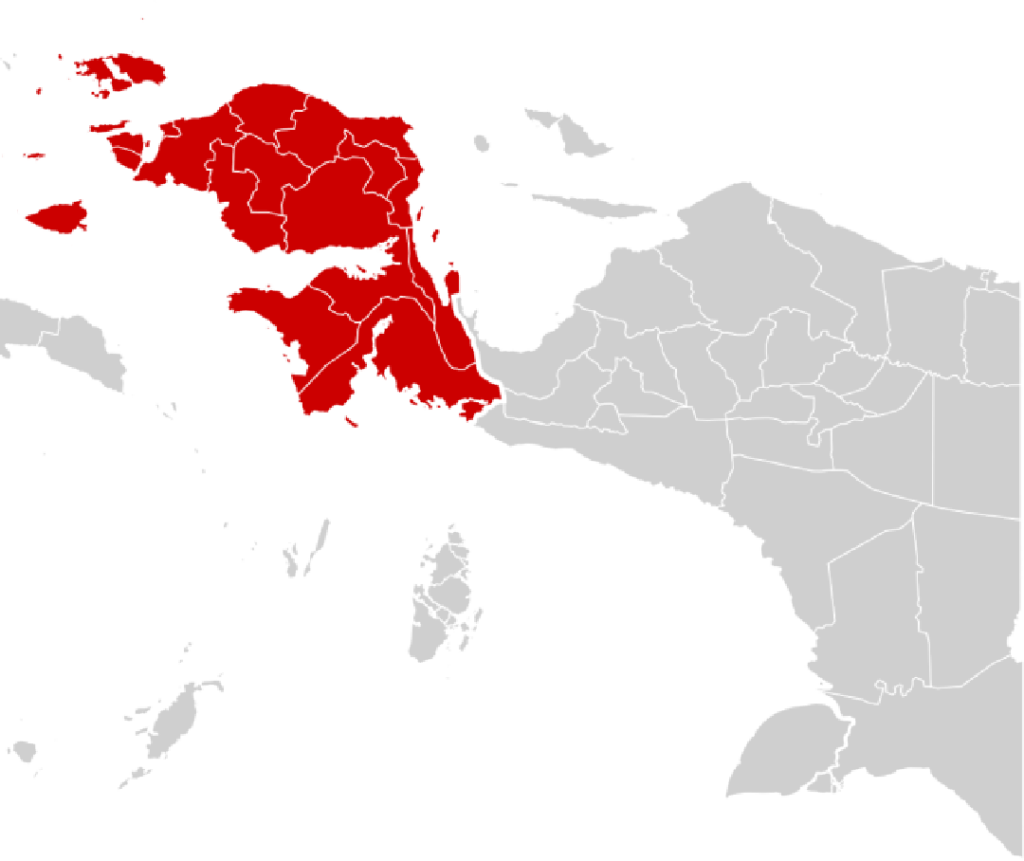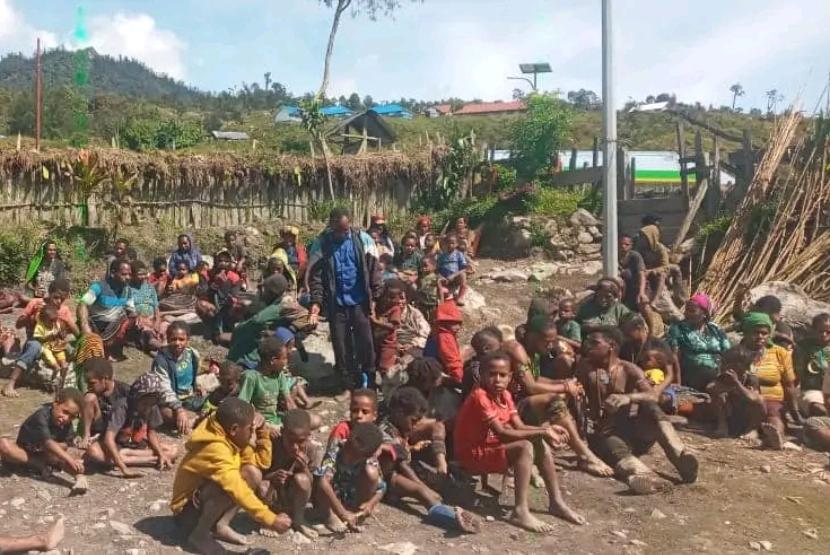
The Indonesian government is strengthening its humanitarian response in Papua Tengah (Central Papua) after the National Human Rights Commission, or Komnas HAM, estimated that 124,931 people had been displaced by ongoing conflict. The figure has prompted the Ministry of Human Rights to coordinate with the Coordinating Ministry for Human Development and Cultural Affairs and other government institutions to ensure that civilians receive essential services and protection.
The government says the response cannot be measured only by whether violence decreases. It must also be judged by whether displaced families have food, healthcare, education, and protection and whether they can eventually return to their homes safely and voluntarily.
The scale of the situation presents a major humanitarian and administrative challenge. It also puts greater emphasis on a more integrated approach in which security measures are accompanied by civilian protection, social assistance, and recovery programs.
A Large Displacement Crisis in Papua Tengah
Komnas HAM has described the situation in Papua Tengah as a dynamically developing emergency. According to Commissioner Saurlin P. Siagian, conflict and shooting incidents have resulted in deaths and forced thousands of people to leave their homes and move to different locations.
Komnas HAM estimates that 124,931 people require assistance, including food, clothing, and healthcare. The commission has called for stronger coordination among government institutions because the scale of the displacement is too large to be addressed by a single agency.
The commission also reported that 12 people had died as a result of shootings in the conflict situation. The figures underline the vulnerability of civilians living in areas affected by continuing insecurity.
For families who have left their homes, the immediate concern is often much more basic than the political questions surrounding the conflict. They need somewhere safe to stay, food for their children, medical treatment, access to schooling, and certainty that their families will not be forgotten.
That humanitarian dimension is now becoming a central element of the government’s response.
Human Rights Ministry Calls for a Coordinated Response
Deputy Minister of Human Rights Mugiyanto has stressed that the government cannot handle the situation through one ministry or one level of government alone.
The Ministry of Human Rights plans to coordinate with Coordinating Minister for Human Development and Cultural Affairs Pratikno to assess the situation more comprehensively. The discussion is expected to examine urgent needs, assistance already delivered, gaps in the current response, and responsibilities that should be shared between central and regional governments.
Mugiyanto’s position reflects an important shift in how the government frames the challenge.
Rather than treating the situation solely as a security issue, the Ministry of Human Rights says civilian welfare must remain a central indicator of government performance.
“Security and humanitarian approaches must go together,” Mugiyanto said, stressing that civilians should remain protected and their rights should not disappear because they have been caught up in conflict.
That approach places humanitarian considerations alongside efforts to restore security.
Why Accurate Data Matters
One of the immediate challenges is determining precisely where displaced people are and what they need.
Komnas HAM’s estimate of 124,931 people provides an important picture of the scale of the problem, but the Ministry of Human Rights says the underlying data needs to be continuously strengthened.
Mugiyanto said authorities must determine how many people are affected, where they are, what their circumstances are, and which needs should be prioritized. Without reliable information, some displaced families could potentially remain outside the reach of government assistance.
This may appear to be an administrative issue, but in a humanitarian emergency it can determine whether assistance reaches the right people.
Accurate data can help authorities identify children who have lost access to education, patients requiring medical attention, elderly people living without adequate support, and other vulnerable groups.
It can also help prevent duplication of assistance in some locations while other communities remain underserved.
For a displacement crisis spread across multiple locations, a common information system between the central government, regional authorities, and humanitarian institutions can therefore become an important part of the response.
Beyond Food and Temporary Shelter
The government’s stated approach goes beyond emergency relief.
Mugiyanto has emphasized that assistance cannot stop at food and temporary accommodation. Sick people must be able to obtain healthcare, children need to return to school, and vulnerable groups require additional protection.
This is significant because prolonged displacement can create problems that extend well beyond the initial security emergency.
Children who remain away from school for long periods risk falling behind academically. Families who lose access to farms, markets, or employment can experience a sharp decline in household income. People with health conditions may encounter treatment difficult to obtain if they are far from their usual medical facilities.
The longer displacement continues, the more difficult recovery can become.
For this reason, the government’s humanitarian response needs to operate on several levels at once. Immediate relief is necessary, but it must be accompanied by health, education, livelihood, and social protection measures.
Early Assistance Has Already Been Ddelivered
The response is not starting from zero.
According to Republika, the Ministry of Social Affairs has previously delivered emergency assistance to 1,013 displaced people in Puncak Regency, consisting of staple goods and clothing with a total value of Rp150 million. The ministry has also provided compensation for people who died or were injured.
Further assistance, however, depends partly on proposals from regional governments supported by reliable information about displaced residents.
This illustrates why the coordination between ministries is important. The Ministry of Social Affairs can provide social assistance, while the Ministry of Human Rights can focus on rights protection and monitoring. The Coordinating Ministry for Human Development and Cultural Affairs can potentially help align the work of different technical ministries.
Such division of responsibilities can make the response more systematic.
The Role of the Coordinating Ministry
The proposed involvement of the Coordinating Ministry for Human Development and Cultural Affairs is particularly important because the humanitarian needs of displaced communities cross institutional boundaries.
Food assistance involves social protection. Healthcare requires the health authorities. Education requires coordination with the education sector. Civilian protection involves security institutions and human rights mechanisms. Returning communities to their homes involves local governments and broader recovery planning.
No single institution controls all of these areas.
Komnas HAM has therefore encouraged broader cooperation, while the Ministry of Social Affairs has suggested involving the Coordinating Ministry for Human Development and Cultural Affairs to help coordinate relevant ministries.
This structure could help turn individual government programs into a more coherent humanitarian response.
Civilian protection as a central principle
The government’s current position places civilian protection at the heart of the response.
For the Ministry of Human Rights, the question is not simply whether fighting has declined. Authorities also need to examine whether people are safe, whether patients can access healthcare, whether children can attend school, and whether displaced families can meet their daily needs.
Mugiyanto has described these as important indicators of success.
This perspective is particularly relevant in areas where communities have experienced prolonged insecurity.
A reduction in violent incidents is obviously essential. But a family that remains unable to return home, send its children to school, or access healthcare cannot be considered fully recovered because the immediate security situation has improved.
Human security therefore becomes a broader measure of stability.
Creating Conditions for Safe and Voluntary Return
For many displaced families, returning home remains an important long-term objective.
The Ministry of Human Rights says the government should work toward conditions that allow people to return to their communities safely and voluntarily.
That distinction matters.
A sustainable return requires more than simply opening access to an area. Families need confidence that they can live safely, rebuild their homes, restore livelihoods, and access essential services.
In practical terms, this means that security, infrastructure, healthcare, education, and economic recovery must eventually work together.
The return process should also take account of the individual circumstances of displaced families. Some may be ready to return sooner than others. Others may need additional assistance before they can resume their lives.
A carefully managed approach can reduce the risk of people returning before conditions are sufficiently stable.
A Test of Indonesia’s Humanitarian Approach
The Papua Tengah displacement crisis represents a significant test for Indonesia’s broader approach to conflict-affected communities.
The government’s decision to involve the Ministry of Human Rights, the Coordinating Ministry for Human Development and Cultural Affairs, Komnas HAM, the Ministry of Social Affairs, and regional authorities reflects an understanding that the problem has multiple dimensions.
It also provides an opportunity to demonstrate that civilian welfare remains a priority even amid difficult security conditions.
For international observers, the effectiveness of this approach will ultimately depend on what happens on the ground.
Numbers of meetings and coordination agreements matter, but displaced families will judge the response through more immediate experiences: whether food arrives, whether medical services are available, whether their children can study, and whether they can eventually return home without fear.
Development and Recovery Closely Intertwine
Humanitarian assistance is also closely linked to Papua’s longer-term development.
When families are displaced, economic activity is disrupted. Farmers can lose access to agricultural land. Small businesses can lose customers and supply networks. Children can lose months or years of education. Public services can become harder to deliver.
Restoring stability therefore has an economic dimension.
A community that can safely return and resume farming, trade, education, and other economic activities is better positioned to recover than one that remains displaced indefinitely.
This makes humanitarian protection part of the wider development agenda.
The government’s approach can therefore be understood not simply as emergency assistance but as an effort to create the conditions necessary for social recovery.
A More Integrated Path Forward
The next phase will require sustained coordination.
The Ministry of Human Rights needs reliable data. Regional governments need the capacity to identify displaced communities and submit accurate assistance requests. Social agencies need to maintain emergency support. Health and education services need to reach vulnerable families. Security institutions need to maintain conditions that allow humanitarian and development activities to operate safely.
Komnas HAM can continue providing monitoring and human rights perspectives, while the Coordinating Ministry for Human Development and Cultural Affairs can help bring different government programs into a common framework.
This approach does not eliminate the underlying conflict, but it can reduce its humanitarian consequences.
That distinction is important.
A government can work simultaneously to restore security and protect civilians. In fact, the two objectives can reinforce each other. Communities are more likely to regain confidence when their safety and basic needs are treated as priorities.
Looking Ahead
The estimated 124,931 people affected by displacement in Papua Tengah represent more than a statistic. Behind the figure are families who have lost access to their homes, livelihoods, schools, and familiar surroundings.
The Indonesian government’s decision to strengthen coordination between the Ministry of Human Rights, the Coordinating Ministry for Human Development and Cultural Affairs, Komnas HAM, the Ministry of Social Affairs, and regional authorities signals a more integrated response to the humanitarian dimension of the crisis.
The central challenge now is implementation.
Reliable data must translate into targeted assistance. Emergency relief must connect with healthcare, education, and social protection. Security measures must create space for humanitarian work. And eventually, conditions must allow displaced families to make informed and voluntary decisions about returning home.
For Indonesia, this is an opportunity to demonstrate that addressing conflict in Papua involves more than restoring order. It also means protecting people, preserving access to essential services, and helping communities rebuild their lives.
That human-centered approach will be crucial to any sustainable recovery in Papua Tengah.
Conclusion
The Indonesian government’s decision to strengthen coordination between the Ministry of Human Rights, the Coordinating Ministry for Human Development and Cultural Affairs, Komnas HAM, and other agencies marks an important step toward a more humane response to the Papua Tanah conflict. With 124,931 people affected, the priority now is to ensure that humanitarian assistance reaches vulnerable communities, essential services remain accessible, and displaced families can eventually return safely and voluntarily. The effectiveness of this approach will depend on sustained coordination, accurate data, civilian protection, and long-term recovery efforts.