
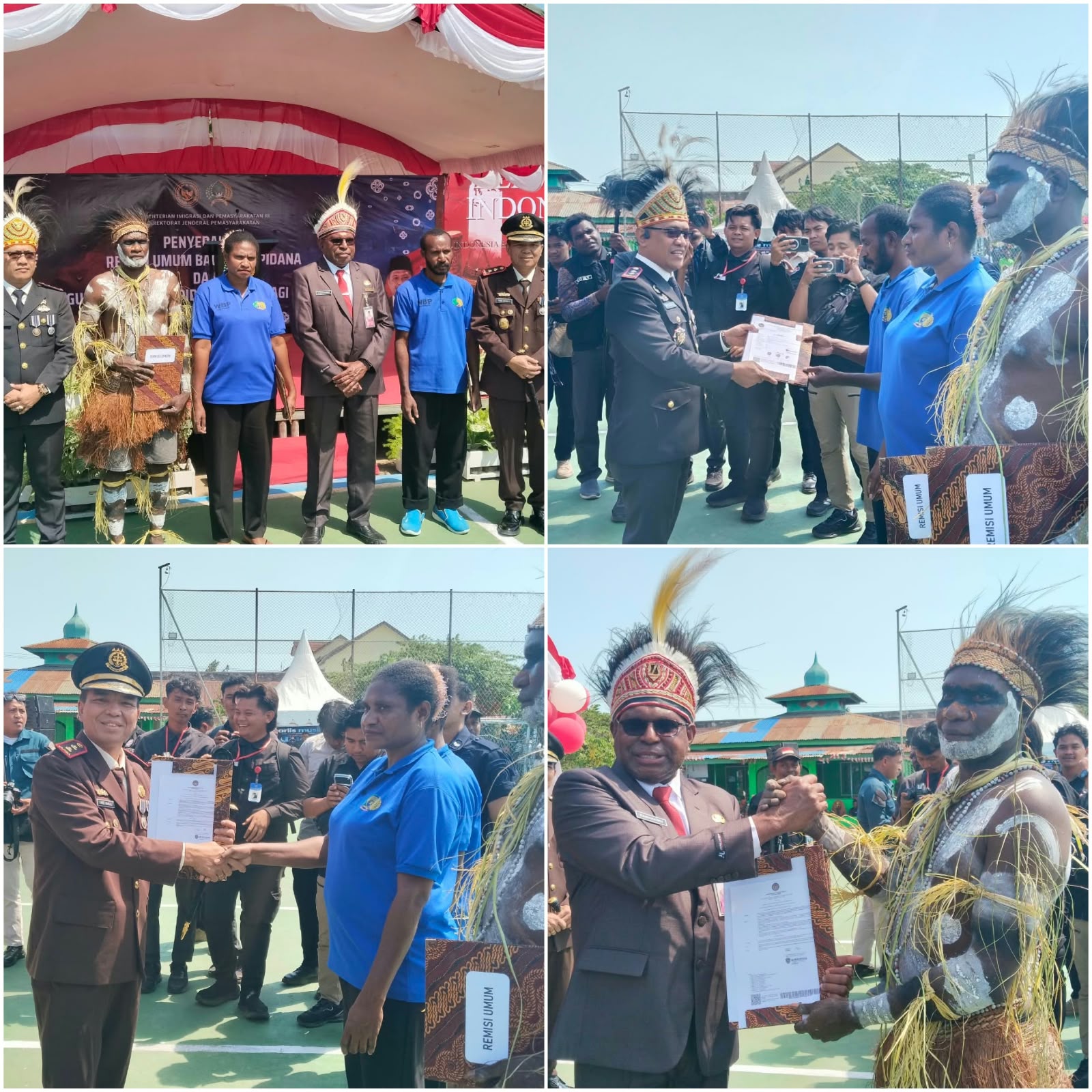
For 418 inmates at Merauke Penitentiary, Indonesia’s 81st Independence Day carried a meaning that extended beyond the flag ceremonies and national celebrations taking place across the country. This year, Papua Selatan (South Papua) inmate remission gave hundreds of prisoners an opportunity to reduce their sentences as part of Indonesia’s annual Independence Day remission program.
The remission was formally handed to inmates at the Merauke Penitentiary in Papua Selatan, reflecting a correctional policy that places rehabilitation and social reintegration alongside punishment. Reports from Antara, Indonesia’s National Police Information Network, InfoPublik, and Jubi confirmed that 418 inmates at the facility received general remission in connection with the 81st anniversary of Indonesia’s independence.
For Papua Selatan, where Merauke serves as an important administrative and economic center, the event also carries a broader message. Correctional institutions are not simply places where people serve sentences. They are increasingly expected to prepare inmates to return to their families and communities with better prospects of living productive and lawful lives.
Remission as Part of Indonesia’s Correctional Policy
Indonesia’s remission system is linked to the country’s correctional approach, in which inmates who meet established requirements may receive reductions in their sentences.
The annual Independence Day remission is among the most visible examples of this policy. Rather than treating imprisonment solely as a mechanism of retribution, the system recognizes behavioral improvement and participation in correctional programs as important elements of the rehabilitation process.
At Merauke Penitentiary, the granting of remission to 418 inmates therefore represents more than a ceremonial event. It demonstrates how national correctional policies are implemented at the regional level in one of Indonesia’s easternmost provinces.
The timing is also significant. Indonesia’s Independence Day is traditionally marked by ceremonies emphasizing national unity, citizenship, and public responsibility. In a correctional facility, those themes take on a different meaning. For inmates, independence can be understood in more personal terms: the possibility of rebuilding relationships, preparing for employment, and eventually returning to society.
A Policy Focused on Rehabilitation
The concept of remission is closely connected to rehabilitation. Prisoners are expected to use their time inside correctional institutions to develop discipline, acquire skills, and demonstrate behavioral improvement.
That process matters particularly when inmates eventually return to communities where employment and family relationships will determine much of their ability to rebuild their lives.
A sentence reduction does not erase the underlying offense or remove the responsibility of the individual. Instead, it creates an incentive for inmates to participate constructively in the correctional system.
This distinction is important when discussing remission internationally. The policy is not simply about shortening prison sentences. It is part of a broader attempt to encourage behavioral change while reducing the risk that former inmates will return to criminal activity after release.
Why the Merauke Event Matters for Papua Selatan
Merauke occupies a distinctive position in Papua. The city is a gateway for trade, agriculture, transportation, and public services across the southern part of the island.
Its geographical position also means that the quality of public institutions matters greatly for the region’s long-term development. Correctional institutions are one part of that institutional landscape.
The 418 inmates who received remission came from different personal and legal circumstances. Behind the official figure are families waiting for loved ones, children growing up with parents in prison, and individuals hoping to rebuild their lives after completing their sentences.
That human dimension is easily overlooked when correctional policy is discussed primarily through statistics.
A remission can shorten the period of separation between an inmate and their family. It can also provide prisoners a clearer incentive to prepare for life after incarceration.
For communities in Papua Selatan, successful reintegration can have practical consequences. Former inmates who find legitimate employment, reconnect with their families, and avoid reoffending become contributors to their communities rather than continuing to place pressure on the criminal justice system.
Independence Day and the Idea of a Second Chance
The symbolism of 17 August is particularly relevant to the remission program.
Every year, Indonesia’s Independence Day provides an opportunity for citizens to reflect on the country’s journey and the responsibilities associated with citizenship. Inside prisons, that national moment intersects with a very personal experience.
For inmates, the celebration can become a reminder that their lives are not necessarily defined permanently by their past mistakes.
This does not diminish the importance of accountability. On the contrary, rehabilitation requires inmates to acknowledge the consequences of their actions and demonstrate a willingness to change.
The remission system attempts to connect those two principles: accountability for wrongdoing and the possibility of rehabilitation.
That balance is increasingly important in modern correctional policy. Excessively punitive systems can leave prisoners with few opportunities to develop the skills and social relationships needed after release. Conversely, rehabilitation without accountability risks weakening public confidence in the justice system.
The Indonesian model seeks to place both considerations within the same framework.
The Role of Families in Rehabilitation
Behind every prison sentence is a network of family relationships.
In Papua, where communities can be geographically dispersed and transportation between districts can be difficult, maintaining those relationships may be particularly challenging. For families in and around Merauke, a shorter sentence can mean an earlier reunion with a husband, wife, parent, or child.
Family support is widely regarded as an important factor in successful social reintegration. A former inmate who returns to a stable family environment may have a stronger foundation from which to seek employment and avoid situations associated with previous offending.
This is why correctional policy cannot be separated entirely from broader social policy.
A prison can provide training and rehabilitation, but communities ultimately determine whether former inmates have opportunities to rebuild their lives. Families, employers, local governments, and community organizations all play important roles.
Merauke’s Correctional Challenge Goes Beyond Remission
The remission of 418 inmates is significant, but it doesn’t end the correctional process.
The more difficult question begins after an inmate leaves prison.
Will the individual find employment? Can they rebuild trust with their family? Will they have access to education and vocational training? Can local communities accept them without permanently defining them by their criminal history?
These questions are relevant not only to Merauke but also to correctional systems around the world.
For Papua Selatan, the answer will depend partly on the ability of government institutions to connect correctional programs with wider economic and social development.
The province has significant agricultural, fisheries, and natural-resource potential. Expanding opportunities in legitimate sectors could provide pathways for people returning from correctional facilities.
Vocational education inside prisons can therefore become more meaningful when it corresponds to actual employment opportunities outside them.
A Broader Development Perspective
The story of the 418 inmates also fits into a larger discussion about human development in Papua.
Public investment is often measured through roads, airports, schools, hospitals, and other physical infrastructure. Yet institutional development is equally important.
A functioning justice and correctional system contributes to public confidence in government. Rehabilitation programs can reduce repeat offending. Social reintegration can strengthen families. Employment can reduce economic vulnerability.
In that sense, correctional policy is not isolated from development policy.
For a rapidly changing region such as Papua Selatan, the ability to reintegrate former inmates into productive economic and social life can become part of a broader effort to strengthen communities.
The challenge is ensuring that remission remains tied to measurable rehabilitation rather than being viewed merely as a symbolic annual benefit.
A More Balanced View of Remission
There is also room for careful public discussion about how remission policies are implemented.
A credible system requires transparent eligibility criteria, consistent application of regulations, and proper documentation of inmate behavior. Public confidence depends on the perception that remission is granted according to established rules rather than personal influence.
This is particularly important because criminal justice decisions affect not only inmates but also victims and the wider community.
A balanced correctional policy must therefore recognize the rights and dignity of prisoners while maintaining accountability toward victims and society.
The Merauke event offers an opportunity to discuss that balance. The 418 inmates who received remission are being given an incentive and, for some, an earlier route back into society. The responsibility that comes with that opportunity remains significant.
Connecting With Wider Stories from Papua
The issue of rehabilitation also connects with broader developments across Papua, where questions of human development, social inclusion, and public services remain central to the region’s future.
For international readers seeking a wider understanding of Papua’s social development, West Papua Voice has previously examined initiatives involving youth, education, health, and community development. These stories provide useful context for understanding the growing emphasis on human capital and social participation in public policy.
The Merauke remission program should therefore be viewed as one element within a much larger institutional and social landscape.
What Comes After the Remission?
The immediate significance of the 418 remissions is clear: eligible inmates have received a reduction in their sentences as part of the 81st Independence Day commemoration.
The longer-term significance, however, will depend on what happens next.
For those eventually released, successful reintegration will require more than a formal end to imprisonment. It will require family support, employment opportunities, social acceptance, and continued commitment to lawful behavior.
For correctional authorities, the task is to ensure that rehabilitation programs produce practical outcomes rather than remaining administrative exercises.
For local governments, the challenge is to create an environment where people who have completed their sentences can return to productive economic and social life.
And for communities, there is a difficult but necessary balance between remembering the harm caused by crime and allowing individuals who have demonstrated genuine change to move forward.
Conclusion
The granting of remission to 418 inmates at Merauke Penitentiary during Indonesia’s 81st Independence Day is ultimately about more than reduced prison sentences. It is a test of whether the correctional system can turn punishment into rehabilitation and rehabilitation into genuine social reintegration.
For Papua Selatan, the policy carries particular significance because the region’s development depends not only on infrastructure and economic growth but also on the strength of its social institutions and communities.
The real measure of the remission will not be the ceremony itself. It will be seen months and years later, when former inmates return to their families, enter the workforce, support their communities, and avoid returning to crime.
This is where the concept of a second chance gains significance.
Indonesia’s Independence Day traditionally celebrates freedom and national renewal. Inside Merauke Penitentiary, the remission granted to 418 inmates offers a more personal version of that message: responsibility remains essential, but rehabilitation can open a path toward a different future.
If that opportunity is supported by effective correctional programs, family involvement, and meaningful economic opportunities, the policy can contribute not only to individual rehabilitation but also to safer, more resilient communities across Papua Selatan.

