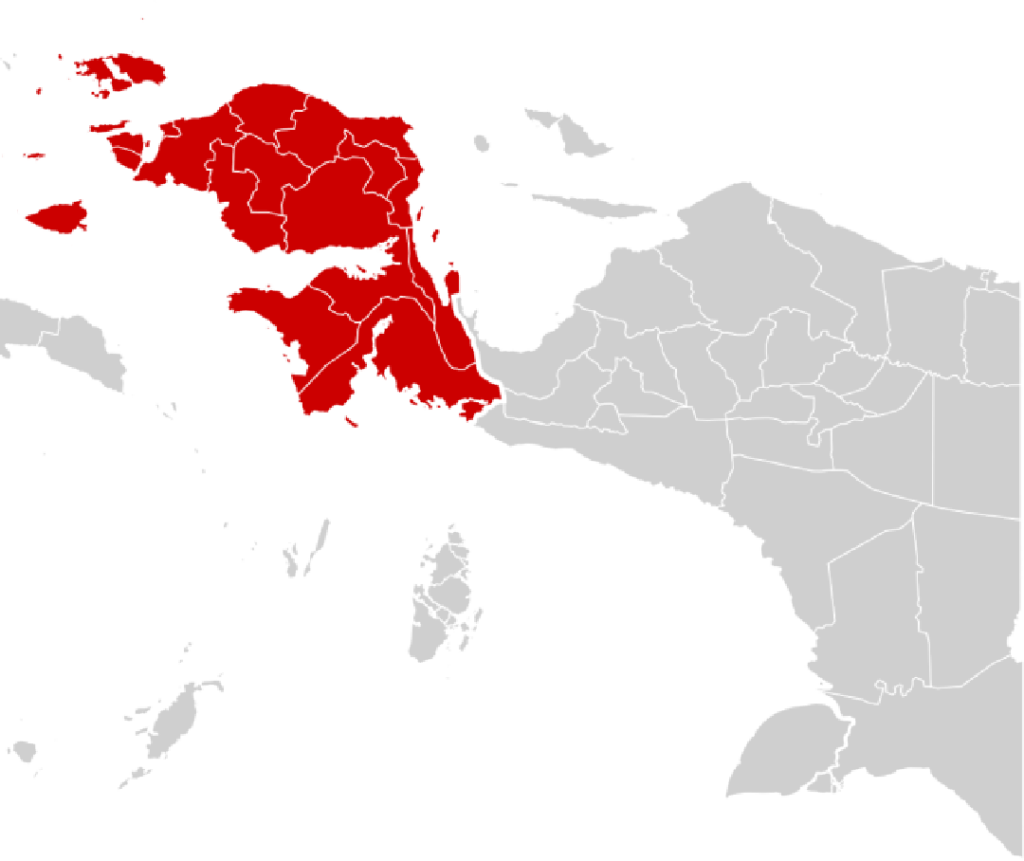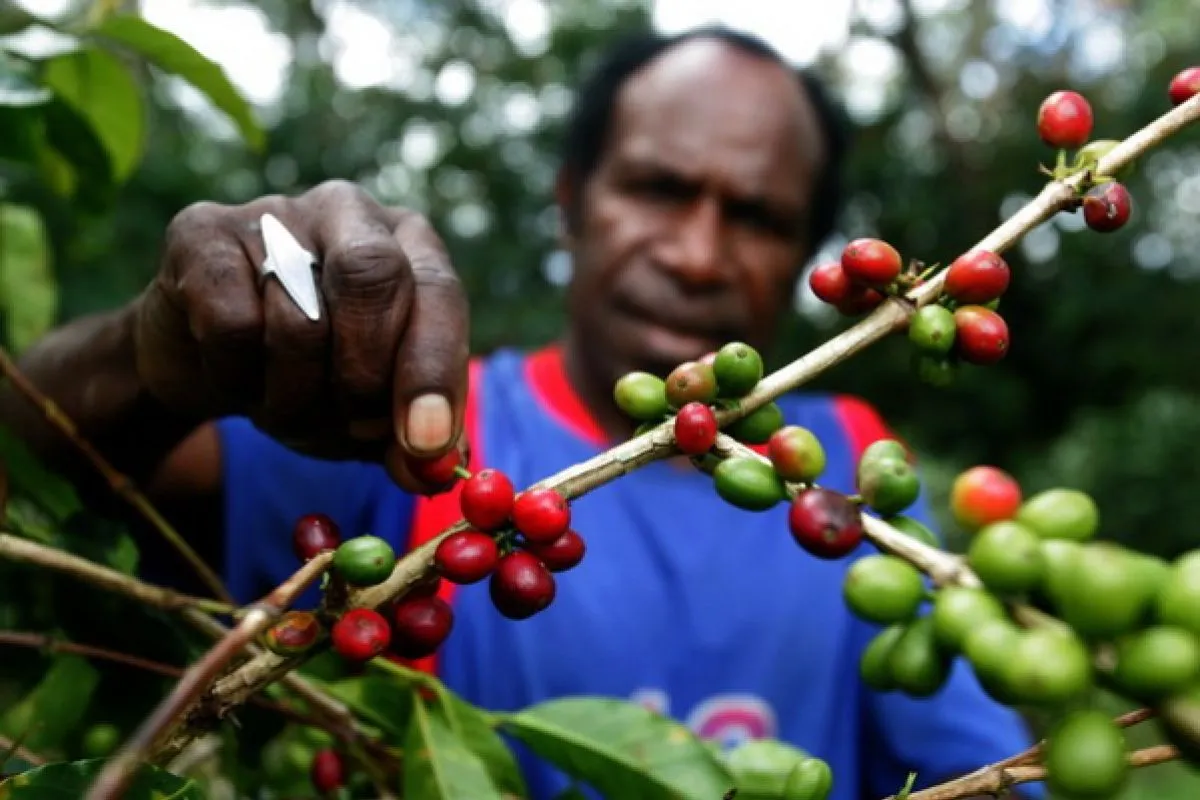
Early in the morning in Wamena, the air is still cool when farmers begin their work.
Coffee trees grow between other crops, not in large plantations but in small, scattered plots. The beans are picked by hand, often by families who have been doing this job for years. They do not always speak about markets or exports. They talk about the harvest, the weather, and whether this season will be good.
Yet from places like this, the story of Papua coffee in Indonesia is slowly reaching much further than it used to.
A Taste That Feels Different
People who try Papua coffee for the first time usually pause.
People pause not because the coffee is strong but because it is mild.
The taste is often described as smooth, sometimes with a mild sweetness, sometimes with a hint of chocolate or herbs. It does not hit sharply. It settles.
That character comes from where it is grown.
Highland areas, cooler temperatures, and minimally altered soil due to intensive farming all contribute to this.
Farmers here often grow coffee without relying much on chemical inputs. Some do not use them at all.
It is less about certification and more about habit.
Not Just One Kind of Coffee
Wamena and Other Highland Varieties
Wamena coffee is probably the most widely known.
It is often associated with a clean taste and a balanced profile. But even in Wamena, the flavor can vary by village or slope.
Other highland areas produce their own variations, sometimes slightly more floral, sometimes deeper, which can be attributed to differences in climate, soil composition, and local cultivation practices.
This is part of what attracts specialty buyers.
They are not looking for uniformity.
They are looking for character.
Robusta in Lower Areas
Arabica is all the rage, but it is not the only variety.
Robusta is grown in the lower areas where conditions are different.
It is generally stronger and less subtle than the other and is usually consumed locally rather than exported, so it is often preferred for its bold flavor in traditional beverages and local markets.
Still, it has a place in the greater coffee landscape of Papua.
Coffee as Part of Everyday Life
In many parts of Papua, coffee is not treated as a luxury product.
It is part of daily routines.
Beans are dried in front of houses.
Processing happens in simple ways, often without machines.
There is no clear line between farming and daily life.
That is part of what makes Papua’s coffee feel different.
It is not produced at scale.
It grows within communities.
Interest From Outside Is Growing
Buyers Looking for Something Distinct
Over the last few years, Papua coffee has been appearing more and more in conversations about specialty coffee.
Outside Indonesia, there has been interest from buyers, partly because of its taste and partly because of the way it is grown.
This is because it is often made by small-scale farmers who prefer traditional methods and sustainable practices, so it feels less industrial.
Easier.
More connected to its roots.
Still Finding Its Place in Export Markets
Despite that interest, Papua coffee is not yet widely available internationally.
Production volumes are limited.
Supply can be inconsistent.
Transporting beans from highland areas to ports is not simple.
These are practical challenges, not abstract ones.
They shape how far the coffee can travel.
What It Means for Local Economies
Small Farms, Real Impact
Most coffee farmers in Papua work on a small scale.
But even small harvests matter.
When prices are good and access to buyers improves, coffee can become a meaningful source of income.
It does not replace everything else.
But it helps.
Moving Beyond Raw Beans
There is also growing interest in processing coffee locally.
Roasting and packaging in Papua would allow more value to stay in the region.
Some programs have started to explore these options, although the process takes time.
Building skills.
Building markets.
Building trust.
The Challenges Behind the Opportunity
Papua’s coffee story has its challenges.
Sparse infrastructure.
Access by road may be restricted.
In some areas it takes longer to get coffee from the farm to market than it does to grow it.”
There are also challenges at the start of the supply chain.
Making sure quality is consistent
Support farmers.
Reasonable prices.
These are the kind of things that marketing stories don’t always reveal, but they do matter.
Efforts to Support the Sector
Government agencies and local groups are beginning to take a hard look.
There are programs to train farmers and improve post-harvest handling.
Direct connections between producers and buyers are also being pursued.
The aim is to increase production but also to improve quality and consistency.
“We are making slow headway.
But it is happening.
A Coffee Story That Is Still Unfolding
Papua’s coffee sits at an interesting point.
It has recognition, but not yet full access to global markets.
It has quality but still works through logistical challenges.
It has identity, which is perhaps its strongest asset.
Conclusion
The story of Papua coffee in Indonesia does not begin in a factory or a trading office.
It begins in places like Papua, where coffee grows alongside everyday life.
What makes it stand out is not only how it tastes but also how it is produced.
Slowly, that story is reaching further.
Whether it becomes a larger part of the global market will depend on what happens next.
But for now, the interest is real.
And it is growing.