It did not begin with a ceremony.
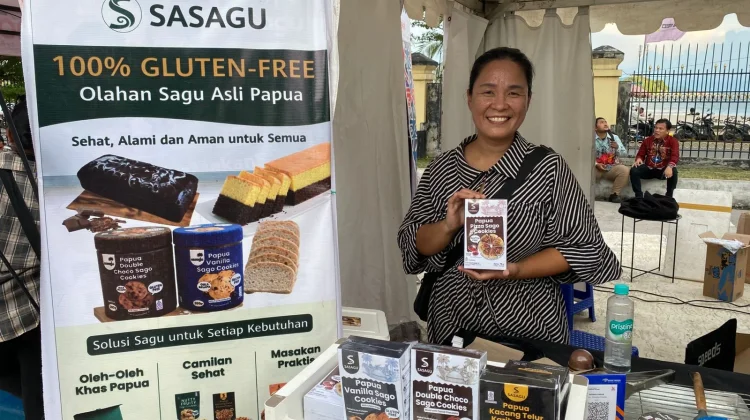
At least, it’s different from how people usually imagine. On the morning of April 24, the yard outside the governor’s office in Jayapura slowly filled up. Tables were set, products arranged, and the smell of sago started to carry in the air before anything officially opened.
The Papua Sago Festival ran for three days, but the feeling was immediate. It was familiar. It was not staged or distant; instead, it was just people bringing what they had made and seeing who would stop to try it.
Something People Already Understand
Sago does not need explaining in Papua.
It is already part of daily life. People grow up with it, cook it, and rely on it without thinking much about labels like “local commodity” or “traditional food.”
That is why, when officials call it the “tree of life,” it does not sound like a slogan.
It sounds like something people have known for a long time.
At the festival, that understanding showed up quietly. No one needed to introduce sago. They just served it.
Small Businesses, Real Conversations
If you stayed long enough near the stalls, you could hear the same kinds of conversations repeating.
People are asking where the sago came from.
How it was processed.
Whether it could be bought in larger quantities.
Some vendors answered easily. Others hesitated, especially when the questions turned to supply.
One of the more common concerns was simple.
Raw materials are not always simple to get.
Sago trees are not harvested quickly. Processing takes time. And when demand increases, the supply chain does not always keep up.
So while the festival showed potential, it also revealed limits.
Not Just Traditional Anymore
What was particularly striking was the distinct appearance of the products.
Some were exactly what people would expect. Simple, familiar, close to how sago is usually prepared at home.
Others were different.
Packaged snacks. Variations designed to appeal to younger buyers. Attempts at branding, even if still basic.
It felt like a transition.
Not a complete shift, but something in progress.
People are not leaving tradition behind. They are trying to carry it into something that can sell.
A Quiet Push About Ownership
At one point, officials spoke about intellectual property.
It was not the most visible part of the event. There were no large banners drawing attention to it. But the message came through in conversations.
Register your product.
Protect your name.
Make sure what you create stays yours.
For many small business owners, the process is still unfamiliar territory.
They are more focused on making and selling than on legal protection, which can leave them vulnerable to potential lawsuits and intellectual property issues.
But as products become more visible, the issue becomes harder to ignore, particularly regarding the potential for intellectual property theft and the need for proper legal safeguards.
Between Culture and Income
There is always a tension in events like these.
On one side, there is preservation. Keeping things as they are, maintaining the original form.
On the other, there is adaptation. Adapting slightly to cater to a larger audience is a viable option.
Neither side is wrong.
But balancing them is not simple.
At the festival, you could see both happening at the same time.
Traditional dishes served next to newly packaged products.
Old methods sitting beside new ideas.
What People Notice First
For visitors, the experience was straightforward.
They tasted food.
They moved from stall to stall.
Some stayed longer, asking questions. Others just passed through.
For participants, it was different.
It was a chance to be seen.
To see how people respond.
To think about what might come next.
What Is Not Immediately Visible
Behind the stalls, there are still questions that the festival itself cannot answer.
How to secure consistent raw materials.
How to scale production without losing quality.
How to reach markets beyond Papua.
Solving these problems will take more than three days.
But they are part of the conversation.
Conclusion
The Papua Sago Festival did not try to present a finished story.
In Jayapura, it felt more like a snapshot.
Something in motion.
Not fully formed, not fully resolved.
But moving.
Sometimes, this is sufficient to indicate the potential direction of events.