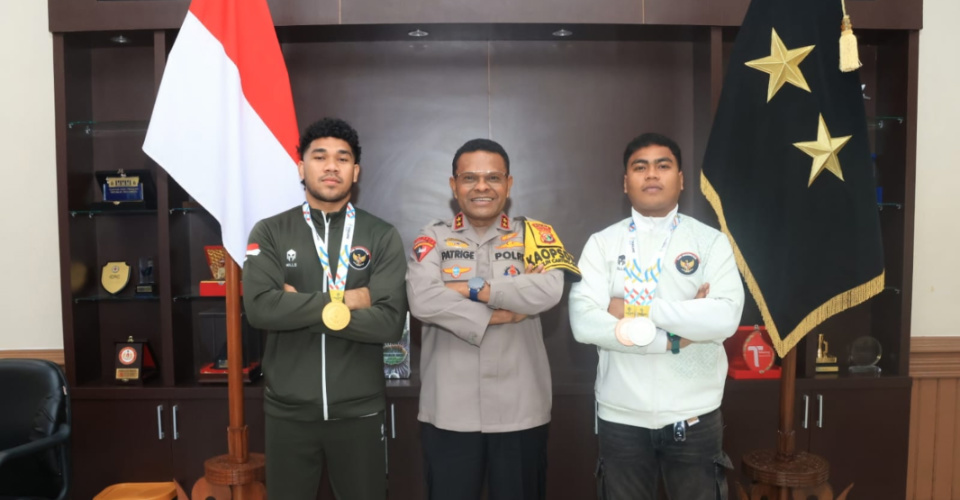
When two athletes from Papua stepped onto the podium at the 2025 Southeast Asian Games (SEA Games) in Bangkok, Thailand, they were not only celebrating personal victories. They were carrying the pride of an entire province and, in many ways, the hopes of a nation that sees sport as a powerful bridge between regions, identities, and generations. Their return to Papua was marked not simply by formal protocol, but by genuine emotion, applause, and a sense of shared achievement that resonated far beyond the walls of official buildings.
Both athletes are active members of the Papua Regional Police. Their dual roles as law enforcement officers and national athletes added a deeper meaning to their success. They represented discipline, commitment, and service, values that extend well beyond competition. When they arrived back in Papua after the SEA Games, they were welcomed warmly by the Chief of Papua Regional Police, known locally as the Kapolda, along with fellow officers, family members, and representatives of the local community.
The reception symbolized something larger than a sporting celebration. It was a recognition that excellence can emerge from Papua and stand confidently on the international stage.
SEA Games 2025: A Demanding Stage of Regional Excellence
The SEA Games is one of the most competitive sporting events in Southeast Asia. Athletes from eleven countries gather to compete at the highest level, often after years of intense preparation. For Indonesia, the 2025 edition in Bangkok was particularly significant, as it came amid renewed national efforts to strengthen sports development and highlight talent from across the archipelago.
For the two athletes from Papua, the road to Bangkok was long and demanding. Training required consistency, physical endurance, and mental strength. As police officers, they balanced professional duties with rigorous athletic preparation, a challenge that demanded discipline and careful time management. Their commitment paid off when they delivered outstanding performances that earned medals and placed Indonesia among the top competitors in their respective disciplines.
Their victories were celebrated not only by sports officials but also by ordinary citizens who followed the SEA Games closely. In Papua, news of their success spread quickly through local media and social networks, inspiring pride among communities that rarely see their own represented on such a prominent stage.
A Warm Welcome from the Kapolda Papua
Upon their return, the Kapolda Papua personally received the athletes in an official yet heartfelt gathering. In his remarks, he expressed deep appreciation for their dedication and achievements, emphasizing that their success was a source of pride not only for the Papua police institution but also for the entire Papuan people.
The Kapolda highlighted that winning medals at an international event such as the SEA Games is never the result of individual effort alone. It is built on years of training, sacrifice, and the support of families, coaches, and institutions. He acknowledged the athletes’ perseverance and reminded them that their achievements carried a responsibility to inspire others, particularly young people in Papua.
According to the Kapolda, the athletes had demonstrated that background and geography should never limit ambition. Their success, he said, showed that Papuan youth can compete and excel at the highest levels when given opportunity, guidance, and belief.
Messages of Character, Humility, and Responsibility
Beyond praise, the Kapolda delivered a message that reflected deeper values. He encouraged the athletes to remain humble, grounded, and committed to continuous improvement. Medals, he noted, are symbols of achievement, but character is what defines a lasting legacy.
He urged them to use their accomplishments as a platform to motivate others and to contribute positively to society. As police officers, they already served the public in their daily duties. As athletes, they now held an additional role as symbols of hope and discipline.
The Kapolda emphasized that success should strengthen unity rather than individual pride. He spoke about how sporting achievements can help foster a sense of togetherness in Papua, a region known for its cultural diversity and strong communal values. His words resonated with many attendees, who saw the athletes not as distant figures, but as relatable role models.
Papua’s Growing Presence in National and International Sports
Papua has long been recognized as a region with immense athletic potential. Over the years, Papuan athletes have contributed significantly to Indonesia’s success in various sports, from athletics to weightlifting and football. However, challenges such as limited infrastructure and access to high quality training facilities have often stood in the way.
The achievements at the 2025 SEA Games added to a growing narrative that Papua is increasingly asserting itself in the national sports landscape. The success of the two police athletes reinforced the idea that talent exists in abundance and that consistent support can transform potential into achievement.
Local sports observers noted that moments like this help change perceptions. They demonstrate that Papua is not merely a participant but a contributor to Indonesia’s sporting identity. The medals won in Bangkok were therefore seen as collective accomplishments, shared by communities across the province.
Community Pride and Youth Inspiration
Following the official reception, stories of the athletes’ journeys circulated widely. In schools, teachers spoke to students about discipline and perseverance, using the SEA Games success as a real and relatable example. In villages and urban neighborhoods alike, young people expressed renewed interest in sports, inspired by seeing individuals from their own region succeed internationally.
Parents spoke openly about their hopes that such achievements would lead to greater investment in youth sports programs. Coaches and local sports clubs began discussing ways to expand training opportunities and identify talent at earlier ages.
For many young Papuans, the athletes’ story carried a powerful message. It showed that success is possible without abandoning one’s identity. The athletes did not leave Papua behind when they competed abroad. Instead, they carried its name proudly, turning local roots into a source of strength rather than limitation.
The Role of Institutional Support
One of the key themes emphasized during the Kapolda’s remarks was the importance of institutional backing. The Papua Regional Police provided space and encouragement for officers who pursue excellence beyond their primary duties. This support, combined with cooperation from sports organizations and local government, created an environment where athletes could train and compete effectively.
Officials acknowledged that continued success requires sustained commitment. Investment in facilities, coaching, and athlete welfare is essential if Papua is to continue producing competitors capable of performing on international stages. The SEA Games achievements, therefore, were seen not as an endpoint, but as motivation to strengthen long term strategies for sports development.
The Kapolda expressed optimism that the achievements of 2025 would encourage broader collaboration between institutions, including educational bodies, sports federations, and community organizations.
Sport as a Bridge for Unity and National Identity
Sport has long played a unique role in Indonesia’s national life. It transcends ethnic, cultural, and geographic boundaries, offering moments where collective identity becomes visible and tangible. The success of Papuan athletes at the SEA Games reinforced this unifying function.
When the national anthem played in Bangkok and the Indonesian flag was raised, the victory belonged to the entire country. Yet for Papua, the moment held particular emotional weight. It was recognition that Papuan contributions matter and are valued on the national and international stage.
The Kapolda underscored this point by framing the athletes’ success as a shared achievement. He noted that unity is strengthened when every region sees itself reflected in national accomplishments. In this sense, sport becomes a language of inclusion, capable of bridging differences and building mutual respect.
Looking Toward the Future
As celebrations settled, attention began to turn toward what comes next. The athletes themselves expressed gratitude for the support they received and reaffirmed their commitment to continued training and service. They spoke about their desire to inspire younger athletes and to contribute to the development of sports in Papua.
Local officials echoed these sentiments, emphasizing the need to convert inspiration into concrete programs. Plans for talent scouting, youth competitions, and improved training facilities were discussed as part of broader efforts to build on the momentum created by the SEA Games success.
The Kapolda concluded the reception with a message of optimism. He reminded attendees that achievements like those seen in 2025 are the result of long journeys, not sudden breakthroughs. With patience, cooperation, and belief, he said, Papua can continue to produce athletes who bring honor to Indonesia.
Conclusion
The story of two police athletes from Papua winning medals at the 2025 SEA Games is not just a sports headline. It is a narrative about perseverance, institutional support, community pride, and national unity. Their journey from Papua to Bangkok and back again reflects the power of opportunity combined with determination.
Through the recognition given by the Kapolda Papua, their achievements were elevated beyond personal success. They became symbols of what is possible when talent is nurtured and when individuals remain connected to their roots while reaching for global stages.
As Papua continues to shape its future, stories like this will remain important. They remind communities that progress is built step by step and that every achievement, no matter where it originates, contributes to the shared story of Indonesia.