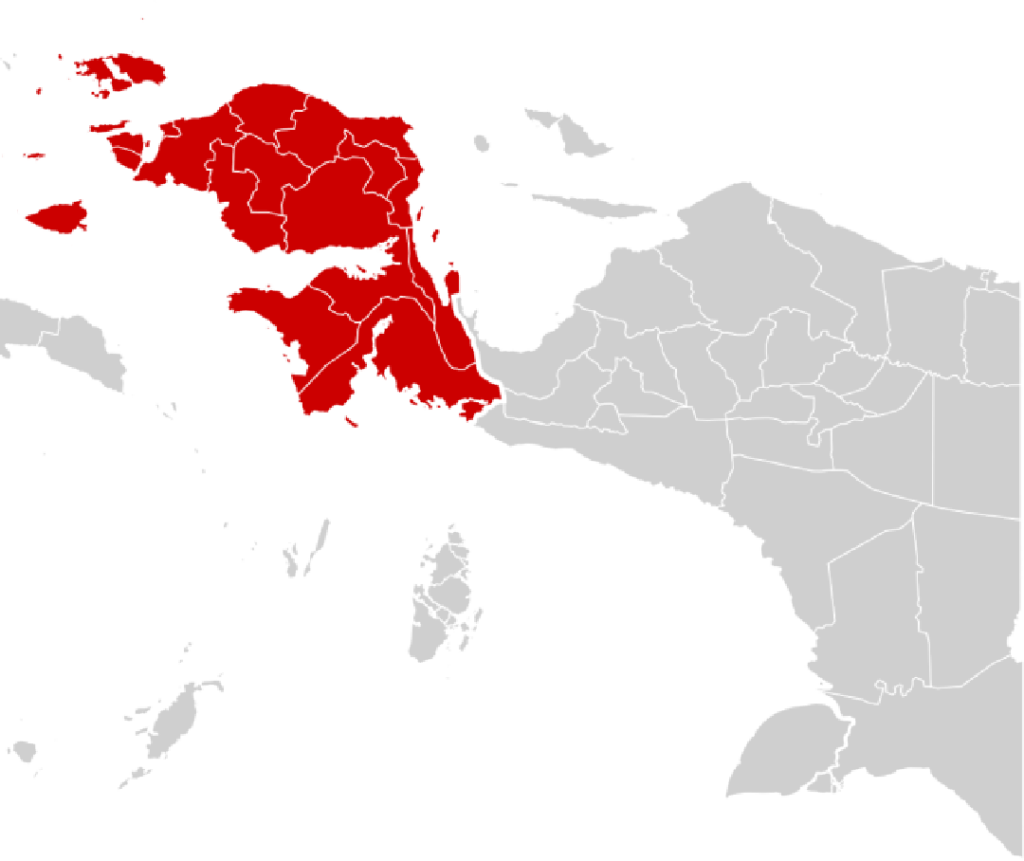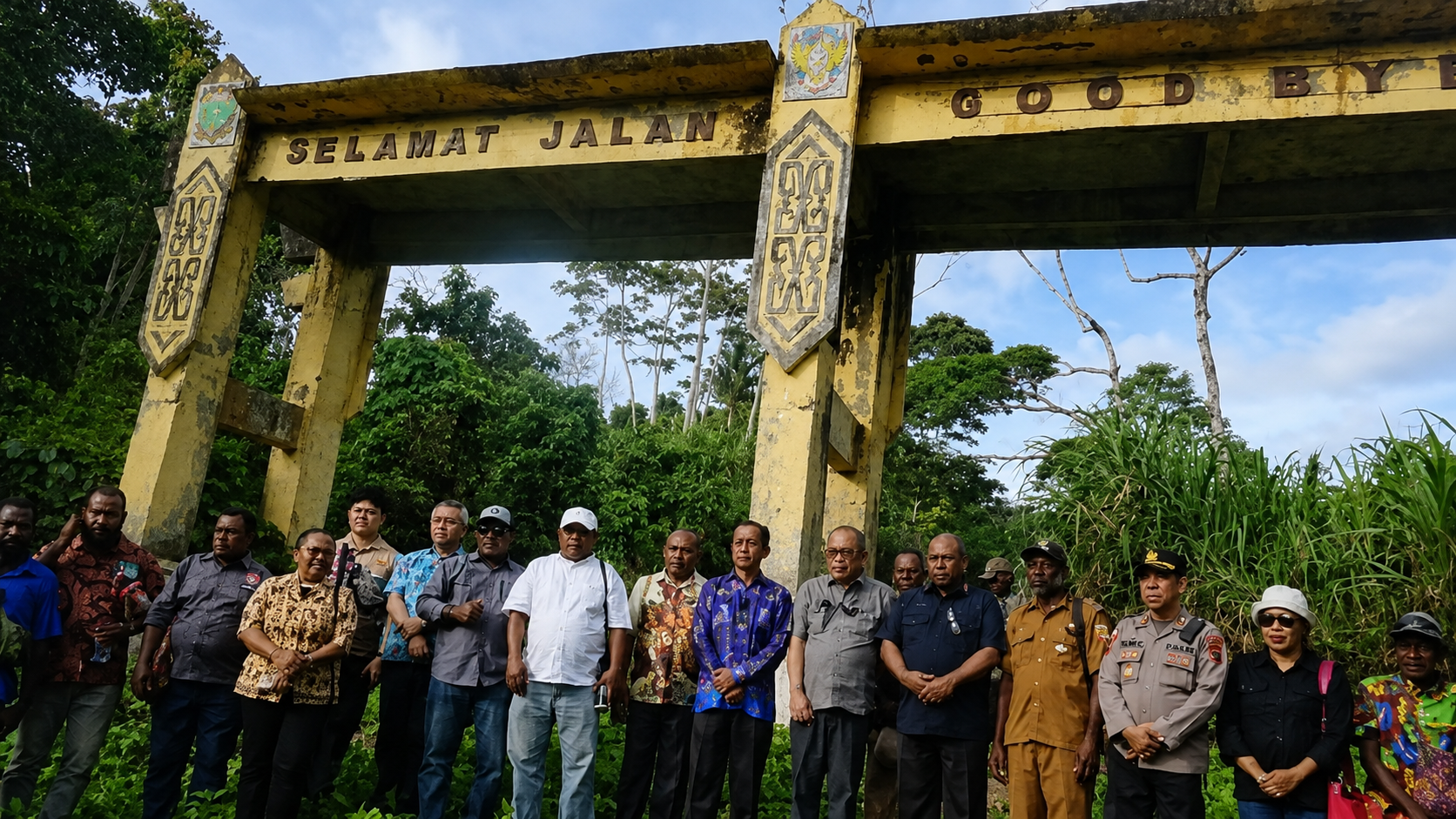
The visit by a group from West Sepik Province, Papua New Guinea, to the planned site of the Paitenda Integrated Border Post in Waris District, Keerom Regency, Papua Province, has boosted efforts to improve economic cooperation along the Indonesia-Papua New Guinea border. The delegation was accompanied by representatives from the Consulate General of the Republic of Indonesia (KJRI) in Vanimo and the Keerom Regency Government.
The visit was more than a routine check of the infrastructure. It signaled a common desire by local governments on either side of the international line to boost legal cross-border trade, enhance connectivity between neighboring communities, and foster sustainable economic development in one of the Pacific region’s most strategically critical border corridors.
The officials involved in the inspection emphasized that the proposed Paitenda Border Post is expected to align with Indonesia’s broader border development strategy by creating a modern gateway to facilitate the movement of people and goods, as well as to strengthen state services in the border areas.
The project holds the promise of greater commercial opportunities, enhanced institutional cooperation, and greater access to public services for communities living along the border of Indonesia and Papua New Guinea.
A Joint Inspection Highlights Growing Bilateral Cooperation
Representatives of the West Sepik Provincial Government, officials of the Indonesian Consulate General in Vanimo, and leaders of Keerom Regency were present at the inspection, which highlighted the increasing collaborative relationship between local governments divided by an international border.
The delegation visited the proposed site in Paitenda Village, Waris District, where officials assessed the site’s readiness and its long-term potential to facilitate economic activity between Indonesia and Papua New Guinea.
This project is the result of years of coordination between district governments, provincial authorities, and Indonesia’s central government, local officials said.
Keerom Regent Piter Gusbager has been a vocal advocate for the establishment of a new border crossing, arguing that better infrastructure would unlock the economic potential of border communities.
Meanwhile, Papua Governor Matius Fakhiri also reaffirms his support by confirming that proposals for Waris Integrated Border Post and another cross-border facility in Jayapura City have been submitted to the central government for further consideration.
Officials say the efforts are part of Indonesia’s broader strategy to accelerate development in Papua and strengthen ties with neighboring Papua New Guinea.
Paitenda Could Become a New Gateway for Legal Trade
The proposed Paitenda Border Post is anticipated to be an important gateway for regulated cross-border commerce between Indonesia and Papua New Guinea.
For generations, communities along the frontier have enjoyed close cultural and family ties, often crossing the international border.
Also important to many residents are local trades and agricultural products, fisheries, household goods, and small-scale commercial activities.
Officials say that modern border infrastructure can funnel these age-old interactions into a more efficient and regulated economic framework.
A fully operational border facility would combine customs, immigration, quarantine, and security services and reduce administrative burdens for travelers and traders.
This institutional framework aims to facilitate legal trade, curb informal business practices, and increase transparency in cross-border trade.
Easier market access could benefit farmers, fishermen, small businesses, transport operators, and local entrepreneurs who want to expand commercial activities across the border, economic planners say.
Improved connectivity can also spur investment in logistics, warehousing, hospitality, retail services, and supporting industries in Keerom Regency.
Border Communities Stand to Benefit
Better border infrastructure is not just a transport project for the people living in Waris District and the nearby communities of West Sepik Province.
It provides an opportunity to support local economies historically hindered by poor connectivity and bureaucratic hurdles.
There are often complementary economic strengths in border communities.
Agricultural commodities from Papua will be able to reach new markets, and commodities from Papua New Guinea may be able to more easily reach legal markets through regulated commercial channels.
Officials believe that increasing legitimate trade would provide more economic activity and create new job opportunities for local residents.
Falling transport expenses and better market access are also expected to benefit small- and medium-sized businesses.
Modern border facilities often attract restaurants, hotels, transport companies, repair services, and retail outlets that have a multiplier effect on the surrounding communities.
Investment in border infrastructure often has economic payoffs far beyond customs operations, development economists note.
With careful planning, border posts can become regional growth centers supporting commerce, public services, and private sector investment.
Supporting Indonesia’s Broader Border Development Strategy
The Paitenda project is part of Indonesia’s wider efforts to upgrade infrastructure in its border areas across the archipelago.
The government has heavily invested in integrated border posts in the past ten years, which are aimed at enhancing sovereignty, improving public services, and fostering local economic development.
The existing facilities, including the Skouw Integrated Border Post in Jayapura, have shown how modern border infrastructure can promote trade, tourism, immigration services, and people-to-people interaction while enhancing the quality of government services available in frontier regions.
Officials see Paitenda as a natural progression of this strategy.
Its location can add to existing border crossings and to increased economic opportunities for communities that currently have longer travel distances and more limited access to formal cross-border services.
“Hopefully the project will improve transportation networks and institutional coordination for more balanced regional development in the eastern frontier of Papua,” say the authorities.
Border Infrastructure Supports Regional Connectivity
Today’s border posts are increasingly multi-functional and not just for immigration and customs.
Integrated border facilities have evolved into nodes for trade, investment, tourism, logistics, and public administration in many parts of the world.
The officials behind the Paitenda initiative stressed that the project is expected to be taken in this integrated way, bringing together efficient border management and economic development goals.
Improved links between Indonesia and Papua New Guinea could lead to stronger business links, people-to-people exchanges, and greater opportunities for neighboring communities to work together.
As regional integration expands across the Indo-Pacific, experts increasingly regard border infrastructure as a crucial component of economic competitiveness and sustainable regional development.
Increasing border connectivity is another step for Papua to position the province as an important gateway connecting Indonesia with the Pacific region.
Economic Integration Creates New Opportunities
The proposed Paitenda Integrated Border Post is expected to play a role beyond immigration and customs procedures. The officials see the facility as an economic driver for regional integration, which could create new business opportunities for communities on both sides of the Indonesia-Papua New Guinea border.
Keerom Regency has a great deal of agricultural potential, such as food crops, cocoa, coffee, fisheries, and livestock. Improved border infrastructure may assist local producers to access larger markets via formal channels of trade and lower transportation expenses and administrative barriers.
Easier access to cross-border trade regulated by the West Sepik provincial government could also facilitate commercial exchanges related to agricultural commodities, consumer goods, and local products that have long circulated through traditional trading networks between neighboring communities.
Modern border crossings often attract more investment than just trade, say economic analysts. Supporting sectors such as warehousing, retail, hospitality, financial services, transport, and small-scale manufacturing tend to be more active with better transport and logistics.
A more efficient trading environment is expected to benefit local entrepreneurs, cooperatives, and micro, small, and medium enterprises (MSMEs). Border markets provide opportunities for Indigenous communities to sell agricultural products, handicrafts, and other locally made products and to bring more commercial activity to surrounding districts.
Officials see the expansion of legal economic activity as a way to boost household income, create additional employment opportunities, and generate strong local government revenues that can be reinvested into education, health care, and public infrastructure.
Modern Border Infrastructure Strengthens Security and Public Services
The Paitenda Border Post is anticipated to boost the economy and enhance border governance by offering essential government services from a single facility.
Modern integrated border posts (PLBNs) are normally integrated with immigration, customs, quarantine, security, and administrative services to ensure that the cross-border movement is conducted in an orderly, transparent, and lawful manner.
Officials have stressed that strengthening formal border infrastructure is an important part of improving oversight of cross-border activities while also allowing for legitimate travel and commerce.
Efficient border management also helps to prevent transnational crimes such as smuggling, illegal trafficking, document fraud, and other cross-border violations that may arise in remote frontier regions.
Authorities say that combined border facilities make travel safer and more reliable, ensuring that travelers and businesses receive clear services based on established laws, instead of limiting legitimate interactions between nearby communities.
Better public services may also reduce travel times to immigration and administrative facilities that were previously more remote for residents of border districts.
Thus, the project combines economic development objectives with better governance and service delivery to the public.
Papua’s Strategic Position in Indonesia’s Pacific Connectivity
Papua is Indonesia’s eastern gateway to the Pacific region with a unique geographic position.
Its direct land border with Papua New Guinea offers possibilities for greater cooperation in trade, transport, education, tourism, health care, and cultural exchange between adjoining communities.
The planned Paitenda Border Post is part of Indonesia’s larger vision to improve connectivity with Pacific nations via modern infrastructure and enhanced regional cooperation.
Over the past few years, the government has continued to invest in roads, bridges, ports, telecommunications, airports, and border facilities across Papua to improve connectivity between remote areas and national economic centers.
Projects like the Trans Papua Road, improved digital connectivity, border facilities, and logistics infrastructure are all part of a long-term strategy to reduce regional disparities and integrate Papua more closely into national and international economic networks.
Thus, border infrastructure is not only strategically and administratively relevant but also a driver of regional development.
Indonesia hopes that by improving relations with Papua New Guinea, it can promote greater people-to-people interaction, expand commercial partnerships, and strengthen diplomatic relations at the local and provincial levels.
Observers point out that sub-national cooperation between neighboring provinces often complements formal bilateral relations by addressing practical issues affecting border communities such as transportation, trade facilitation, public health, and environmental management.
Border Cooperation Reflects Shared Regional Interests
The joint inspection of the site by officials from Indonesia and Papua New Guinea is a clear illustration of the importance of local diplomacy in fostering practical cooperation between neighboring areas.
While the broad framework for bilateral relations is established by national governments, it is often provincial, district, or border communities that are essential in implementing initiatives that directly affect local populations.
The West Sepik Provincial Government, the Indonesian Consulate General in Vanimo, and the Keerom Regency Government demonstrated a mutual concern to promote development on both sides of the border for the benefit of all.
Officials on both sides emphasized that better infrastructure will help facilitate legal trade, promote investment, improve public services, and boost connectivity, without diminishing the long-standing cultural ties shared by many border communities.
Such cooperation also mirrors broader regional efforts to build stability and sustainable development through dialogue, institutional cooperation, and shared economic opportunities.
Looking Ahead
The proposed Paitenda Integrated Border Post is pending further planning and approval from the central government of Indonesia. However, the recent joint inspection has raised hopes that the project will continue to move forward as part of broader efforts to strengthen border development in eastern Indonesia. If realized, the facility is expected to boost legal trade, improve public services, strengthen border governance, and encourage investment across Keerom Regency while promoting closer economic ties between Indonesia and Papua New Guinea. For border communities, the project is more than new infrastructure, it is the hope of more prosperity through better regional connectivity.
Conclusion
The joint visit of the West Sepik Province delegation, the Indonesian Consulate General in Vanimo, and the Keerom Regency Government is another important step towards the proposed development of the Paitenda Integrated Border Post in Waris District. Beyond strengthening border administration, the project can be a new gateway for legal trade, investment, tourism, and people-to-people exchanges between Indonesia and Papua New Guinea. Supported by provincial leaders including Governor Matius Fakhiri and Keerom Regent Piter Gusbager, the project is part of a broader vision to transform Papua’s border regions into centers of economic growth, regional cooperation, and sustainable development. As Indonesia continues to build modern infrastructure across Papua, projects such as Paitenda show how smart investment along the border can simultaneously enhance connectivity, upgrade public services, and unlock new opportunities for communities on both sides of the international boundary.