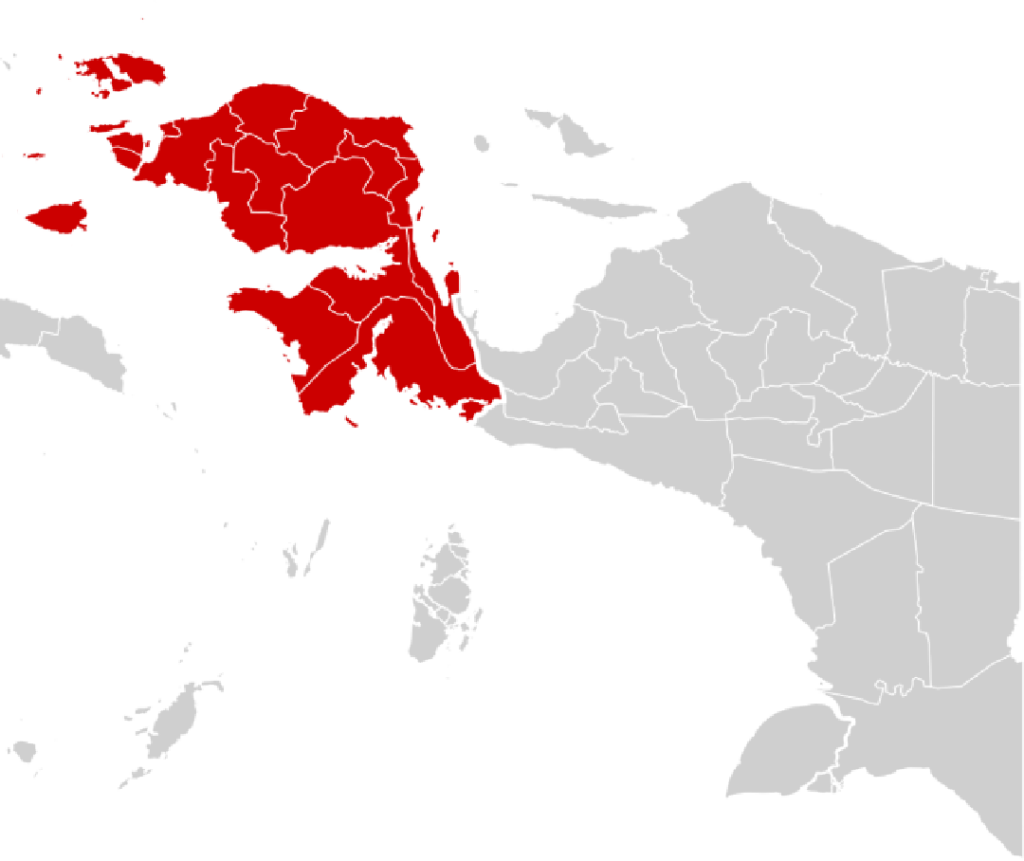
In Papua, optimism does not arrive as a slogan or a sudden declaration. It grows slowly, shaped by soil, water, and human effort. Over the past year, the Provincial Government of Papua has shown increasing confidence that food self-sufficiency is no longer a distant aspiration but an achievable goal. This belief is grounded in a careful assessment of land potential across four key areas: Jayapura City, Jayapura Regency, Sarmi Regency, and Keerom Regency.
For decades, Papua has relied heavily on food supplies transported from outside the region. Rice, in particular, has traveled long distances by sea and land before reaching local markets. This dependence has made food prices vulnerable to weather disruptions, transportation delays, and global economic shifts. Recognizing these risks, the provincial government has begun repositioning agriculture as a strategic pillar of regional resilience.
Officials now argue that Papua has enough fertile land, water resources, and human capacity to meet its own food needs. The challenge lies not in potential, but in coordination, commitment, and sustained policy support.
Four Regions at the Center of the Strategy
The decision to focus on Jayapura City, Jayapura Regency, Sarmi Regency, and Keerom Regency was not accidental. These areas were identified through land surveys, agricultural mapping, and consultations with local governments and farming communities. Each region offers distinct advantages that, when combined, form a strong foundation for food production.
Jayapura City, as the provincial capital, plays a unique role. While it is primarily an administrative and economic center, the city still has pockets of productive land on its outskirts. These peri-urban areas are increasingly being integrated into local food systems. Urban farming initiatives and small-scale rice cultivation are being encouraged to reduce dependence on external supplies and shorten distribution chains.
Jayapura Regency surrounds the capital and stretches across diverse landscapes, including fertile lowlands near Lake Sentani. This region has long been recognized for its agricultural promise, yet much of its land has remained underutilized. Through new programs, farmers are being supported to expand cultivation areas and adopt more efficient farming methods. The regency is expected to act as a buffer zone that supplies food not only to its own population but also to the growing urban center of Jayapura City.
Further west, Sarmi Regency has emerged as a symbol of Papua’s agricultural revival. With vast tracts of flat land and access to water, Sarmi is increasingly viewed as a future rice production hub. Keerom Regency, located near the border with Papua New Guinea, completes the quartet with its expansive plains and irrigation potential. Together, these four regions form a corridor of food production that could redefine Papua’s relationship with agriculture.
A Moment in Sarmi That Signals Change
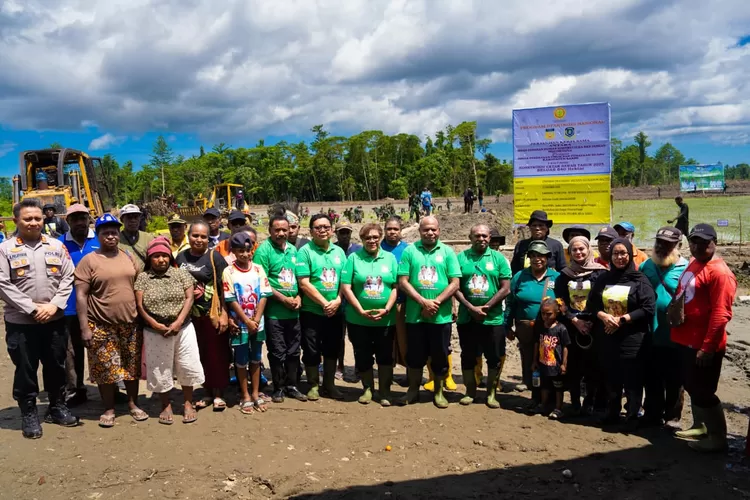
One of the most significant moments in Papua’s push toward food self-sufficiency took place in Sarmi Regency, when Governor Matius D. Fakhiri personally led the first rice planting in Tetom Jaya Village, Bonggo District. The event was modest in appearance, yet profound in meaning. Standing among farmers and local officials, the governor planted rice seedlings into newly prepared fields, marking the beginning of a long-term commitment rather than a one-time gesture.
For local farmers, the presence of provincial leadership carried weight. It signaled that agriculture was no longer treated as a secondary sector, but as a strategic priority. The initial planting covered hundreds of hectares, with plans to expand significantly in the coming planting seasons. Officials have estimated that Papua could achieve rice self-sufficiency if around 20,000 hectares of land are cultivated consistently.
This moment in Sarmi reflected a shift in mindset. Instead of viewing Papua solely as a consumer of food from other regions, the government began promoting the idea of Papua as a producer capable of sustaining itself.
Farmers as Partners, Not Beneficiaries
At the heart of this strategy are farmers, many of whom have long worked under challenging conditions. In villages across Sarmi and Keerom, agriculture has often been limited to subsistence farming, focused on immediate household needs rather than broader market supply. The new approach seeks to change that without undermining traditional practices.
Rather than positioning farmers as passive recipients of aid, the provincial government is encouraging a partnership model. Farmers are involved in planning discussions, land preparation decisions, and crop selection. Training programs are being introduced to help them improve productivity while respecting local knowledge and environmental conditions.
In conversations with farmers, a recurring theme emerges: dignity. The opportunity to contribute to regional food security gives them a renewed sense of purpose. For many, farming is no longer seen as a fallback option, but as meaningful work with social value.
Government Optimism Backed by Policy Direction
The confidence expressed by Papua’s provincial government aligns with broader national priorities. Under President Prabowo Subianto, food self-sufficiency has been emphasized as a cornerstone of national resilience. Regional governments are encouraged to identify their own strengths and reduce reliance on long supply chains that are vulnerable to disruption.
In Papua, this national directive has translated into concrete actions. The provincial administration is coordinating with the Ministry of Agriculture to support land development programs, commonly known as rice field creation initiatives. These programs provide technical assistance, seeds, and equipment to ensure that new farmland becomes productive quickly.
Officials stress that food self-sufficiency does not mean isolation. Instead, it is about building enough capacity to withstand shocks while remaining connected to national and regional markets. By producing its own staple foods, Papua can stabilize prices and improve food access for its population.
Infrastructure and Natural Challenges
Despite growing optimism, provincial leaders acknowledge that the road ahead is complex. Papua’s geography remains a formidable challenge. Remote locations, limited road networks, and unpredictable weather patterns all affect agricultural productivity. Irrigation systems need to be developed carefully to ensure sustainability and prevent environmental degradation.