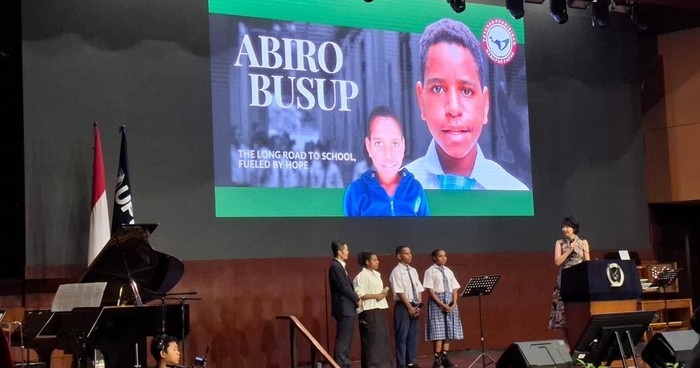
Abiro Busup, a little boy, is already awake before the sun rises over the misty mountains of Papua. The forest around his town is still dark and quiet, except for insects and birds that can be heard in the distance. Abiro gets ready for a trip that will test his strength and willpower every day, even though most kids his age are napping.
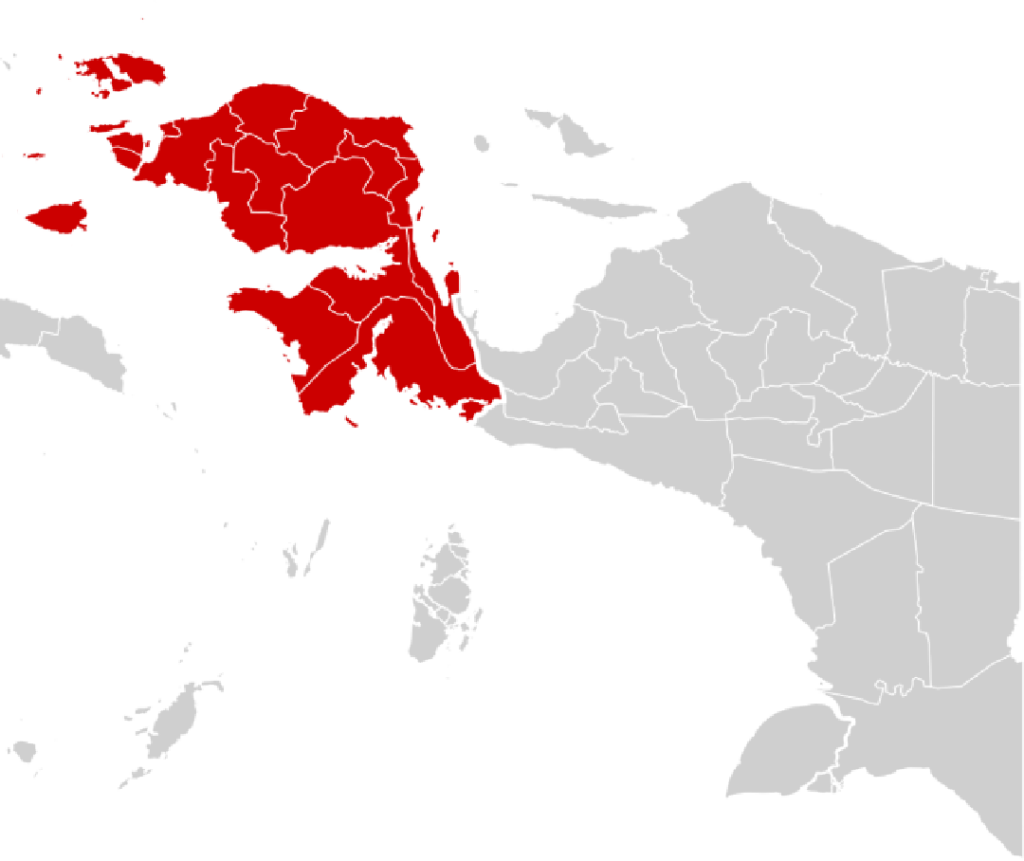
Abiro goes outside his house in the interior of Papua Pegunungan, Indonesia’s easternmost highland region, at about 3 a.m. He just has basic supplies and the perseverance of a child who knows that school is the way to get ahead. His school, Sekolah Lentera Harapan, is where he is going. It’s a place that gives him a chance, but it’s a few hours distant on foot.
Abiro is not the only one who is having a hard time. Ace, another student from Papua, starts her day at the same time. Her narrative is different, but just as strong. Their stories have gotten a lot of attention around the country and are a moral reminder of why Papua’s education infrastructure needs to develop faster and reach more people.
A School Day That Starts in the Middle of the Night
Abiro’s trip to school isn’t just a short walk down a paved road. There aren’t any school buses or public transportation nearby. Instead, there are small routes cut through the hills, land that is treacherous after it rains, and rivers that don’t have bridges.
Abiro leaves every morning before dawn so that he may be to school by 7 a.m. He walks for over three hours, and occasionally longer, depending on the weather. The path gets more dangerous during the rainy season because of mud and swelling creeks that slow him down.
Abiro has never been late for school, even with these problems.
Teachers say he is disciplined and always does what he says he would do. His attendance record is unusual not because he lives close by, but because he lives far away. Abiro says that he never complains because he wants to learn. He wants to be a pilot so he can help connect distant towns like his own to the outside world one day.
Even though they live far from the school, his parents do their best to help him. Abiro has lived with family members who live closer to school at different times during his schooling so he could keep learning. There were problems with each plan, but quitting school was never an option.
Ace and the Battle to Stay in School
Ace starts her adventure in a different village, but getting an education is just as hard for her. She walks for hours every day to get to school, much like Abiro. But her fight hasn’t only been physical.
Ace almost missed her chance to go to school when she was still in elementary school. People in her village almost married her off when she was young. Ode, her older brother, stepped in and made sure she stayed in school.
That help made a big difference in her life.
Later, Ace had to deal with another terrible loss. Her father died because he couldn’t get the medical attention he needed in time. The event made her more determined and defined her goals. Ace wants to be a doctor so that people in her neighborhood won’t have to go through what she did.
Her tale shows that school in Papua isn’t only about being in a classroom and reading books. It’s about survival, respect, and the freedom to determine your own future.
Stories That Went All Over the Country
On February 3, 2026, an education forum in University of Pelita Harapan Tangerang, Banten, talked about the trips that Abiro and Ace took. People from all throughout Indonesia, including teachers, students, and government officials, came to the event.
When Abiro talked about waking up at 3 a.m. and traveling for hours through the woods, everyone in the room went quiet. Many people were clearly impacted when Ace talked about how hard it was for her to continue in school and how she lost her father because he couldn’t get medical care.
These weren’t stories of people who were very lucky. They were stories of hard work.
For a lot of the authorities who were there, the message was plain. Papua kids are willing to go through a lot of trouble to get an education. The state is now responsible for making sure that this kind of hardship is no longer needed.
The Geography of Papua and the Cost of Distance
The land in Papua is some of the hardest in the world. Mountains, thick forests, and small communities make it hard and expensive to build infrastructure. But for decades, these problems have made it hard for some people to get an education.
In many places, schools are not close to settlements. There aren’t many roads, and there aren’t many bridges. Because of this, kids have to walk for hours or live away from their families to go to school.
Education specialists say that this condition makes more kids drop out of school, especially girls and younger kids. Students often have to choose between school and staying alive because they are tired, worried about their safety, or have family obligations.
Abiro and Ace are examples of people who keep going even when things get tough. But more and more authorities are realizing that resilience shouldn’t be a requirement for getting a basic education.
Special Autonomy and a Change in Policy
The Special Autonomy policy for Papua in Indonesia was created to fix these kinds of problems. Papua gets more money and more power to set development priorities, including as education and infrastructure, under this plan.
In the last several years, the government has put more effort into developing schools closer to communities that are hard to reach. In remote areas, new classrooms are being built, and boarding schools are being set up so that students don’t have to trek long distances every day.
Dorms let kids from faraway areas reside closer to their schools in safer conditions. Scholarship programs help pay for things like tuition, meals, uniforms, and transportation. These efforts are not charitable. They are bets on the future of people.
People in charge of organizing education argue that stories like Abiro’s and Ace’s have made these programs more important. They show what occurs when infrastructure can’t keep up with the needs of the people.
Infrastructure That Isn’t Buildings
Building schools is just one part of speeding up education in Papua. It also includes highways, bridges, homes, and places to get medical care.
The risk is not just a theory if a youngster has to cross a river to get to school without a bridge. Strong currents can hurt or sweep away kids during the wet season. Classes are canceled if a teacher can’t get to a community because the roads are bad.
Because everything is connected, education policy needs to be part of bigger plans for building infrastructure. Roads make it possible for instructors to get about. Dormitories lower the risks of traveling every day. Scholarships make guarantee that students don’t have to drop out of school because they can’t afford it.
Abiro and Ace’s long treks show these linkages in ways that numbers can’t.
Changing Culture Through Education
Ace’s experience also shows how education can help fight bad social habits. In some isolated areas, early marriage is still a problem. This is generally because of economic difficulties and custom.
Girls have more options when they stay in school longer. They can stand up for themselves and help their communities in new ways because of their education. Ace’s desire to be a doctor shows how much he has changed.
More and more, local officials are realizing that making it easier for people to get an education might help change long-standing social trends. This is one reason why scholarships for girls and dormitory programs are now a big part of Papua’s education plan.
A Message for Everyone
Abiro and Ace did not want to change national policy. They just wanted to go to school. But their experiences have become strong reminders of what education means in regions where it isn’t always available.
School is not a regular thing for kids in Papua. It is a journey that requires giving up something. Understanding this has helped change the public debate from blaming students for bad results to talking about the problems in the system.
Now, education authorities talk more openly about how important it is to have fairness instead of sameness. Papua doesn’t need the same answers as Java City. It needs answers that take into account its geography and culture.
The Road Ahead
Under Special Autonomy funds, the government has promised to build more schools, dorms, and scholarship programs all over Papua. There is progress, yet there are still problems.
It takes time to build infrastructure in places that are hard to reach. To make sure that teachers are good, they need help all the time. Long-term planning is needed to keep facilities in good shape.
But the path is obvious. The stories of Abiro Busup and Ace have helped put the real lives of children at the center of development strategy.
A Journey That Shouldn’t Be Required
Abiro still wakes up before sunrise. Ace still walks for hours. Even as policy talks move forward, their journeys go on.
Their drive is inspirational, but it also brings up an unsettling truth. No youngster should have to trek for hours in the dark to get an education.
If Papua’s infrastructural development goes well, kids in the future may start their days in a new way. They might wake up closer to school, get to class safely, and come home without being too tired.
The footsteps of Abiro and Ace are still a strong symbol till that day comes. They are not just marching toward their own futures, but also toward a better understanding of what it really means to have access to education in Papua.