
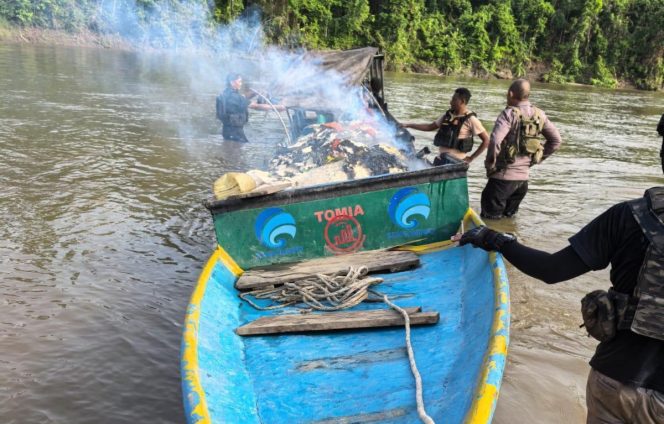
An armed attack on two motorised boats carrying 12 tonnes of rice has exposed the vulnerability of essential food distribution routes in Indonesia’s Papua region after suspected members of an armed criminal group, known as the West Papua National Liberation Army of the Free Papua Movement (TPNPB OPM), opened fire on the vessels travelling through Asmat waters towards Yahukimo. The November 24 incident left one rice transporter wounded, another person missing and both boats reportedly burnt, raising serious concerns about the security of civilian transportation and the delivery of essential commodities to communities in the region.
The attack occurred as the boats were transporting rice from Suator District in Asmat Regency, Papua Selatan (South Papua), to Logpon Port in Dekai District, Yahukimo Regency, in Papua Pegunungan. The shipment consisted of approximately seven tonnes of rice on the first boat and five tonnes on the second.
The incident has drawn attention to the wider consequences of armed violence against civilian logistics. In geographically challenging areas such as southern and mountainous Papua, river transportation remains an important means of moving food, fuel and other essential supplies. An attack on a commercial transport route can therefore create consequences extending beyond the immediate victims, potentially disrupting deliveries, increasing transportation risks and placing additional pressure on local supply chains.
Indonesia’s Damai Cartenz security operation, working alongside police personnel from Yahukimo and Asmat, has launched a search for the missing passenger and an investigation into the attack. Authorities have also identified a suspected TPNPB OPM member linked to Kodap XVI Yahukimo, known as Batalyon Kanibal, under the leadership of Peres Murup.
Attack on Two Rice Transport Boats in Asmat Waters
According to information released by the Damai Cartenz Operation Public Relations Task Force, the shooting occurred on Tuesday, November 24, 2026, at approximately 9 a.m. Eastern Indonesia Time.
The two motorised boats were travelling together through the waters near Wanjis Village, Kolf Braza District, Asmat Regency.
The first vessel was carrying approximately seven tonnes of rice and had two people aboard, identified by their initials as RR, aged 39, and MB, aged 16.
The second vessel was travelling approximately 100 metres behind the first. It carried another five tonnes of rice and was occupied by two individuals identified as NB and S.
The journey was part of an important transportation route connecting Suator in Asmat with Logpon Port in Dekai, Yahukimo. The shipment was expected to reach its destination through this waterway before continuing into the regional distribution network.
However, the journey was interrupted when gunfire suddenly erupted from the right-hand side of the boats.
According to the initial account provided by security authorities, the first shot was directed towards the leading vessel, followed by five additional gunshots.
The sudden attack forced the occupants to seek cover while attempting to protect themselves from further gunfire.
The incident quickly developed into an emergency involving both vessels, with one passenger suffering gunshot wounds and another subsequently reported missing.
Chronology: Six Gunshots and a Desperate Escape
The detailed chronology was explained by Commissioner Yusuf Sutejo, Head of Public Relations for the Damai Cartenz Operation 2026, in statements reported by ANTARA and detikcom on November 25 and 26.
First boat: Rice transporter wounded
When the first gunshot was heard, RR and MB immediately sought protection inside the boat.
The initial shot was followed by five additional gunshots directed at the vessel.
During the attack, RR sustained two gunshot wounds to the right side of his pelvic area. Despite his injuries, he and MB managed to take cover near the boat’s engine compartment.
The situation remained dangerous, but RR attempted to move the boat away from the shooting location.
He subsequently steered the vessel towards Patipi Village, where he could report the incident and seek immediate assistance.
After reaching the village, RR was collected by family members using a speedboat.
He was then evacuated through Logpon Port in Yahukimo before being transported to Dekai Regional General Hospital (RSUD Dekai) for further medical treatment.
MB survived the incident without the reported gunshot injuries.
Second boat: One passenger escapes, another disappears
The second boat, travelling approximately 100 metres behind the first, was also targeted by gunfire.
NB and S initially attempted to protect themselves behind the body of their vessel after hearing the gunshots.
However, the situation deteriorated when the boat’s engine stopped functioning.
With the vessel unable to continue its journey, NB urged S to jump into the river to escape the attack.
According to Yusuf, NB eventually jumped into the water and swam towards the riverbank, successfully reaching Wanjis Village.
S, however, did not follow the same course of action.
He reportedly remained aboard the disabled boat, and his whereabouts subsequently became unknown.
The disappearance prompted an immediate search operation involving personnel from the Damai Cartenz Task Force, Yahukimo Police and Asmat Police.
As of November 26, authorities had not confirmed whether S was alive or had died. His status remained unverified, and the search continued.
Both Boats Reportedly Shot and Burnt
Following the attack, investigators examined the two vessels to establish the extent of the damage and gather physical evidence.
According to Yusuf Sutejo, preliminary forensic inspections identified several suspected bullet holes across different sections of the boats.
On the first vessel, which carried RR and MB, investigators found damage to the front and rear sections of the right-hand side of the hull.
The second vessel, carrying NB and S, sustained more extensive damage. Investigators identified suspected bullet holes in the roof, hull, seating area and engine.
The rear section of the second boat was also found burnt.
ANTARA reported that both vessels had been shot at and burnt during the incident.
These physical findings are important to the investigation because they provide evidence that can be examined alongside witness statements and other information collected from the scene.
The authorities are continuing to investigate the circumstances surrounding the attack, including the identities of those responsible and the sequence of events that led to the disappearance of S.
Suspected Involvement of Kodap XVI Yahukimo
The Damai Cartenz Operation has attributed the suspected attack to members of TPNPB OPM, associated with Kodap XVI Yahukimo’s Batalyon Kanibal.
The group has been linked by security authorities to Peres Murup.
The suspected involvement was communicated by Yusuf Sutejo in his statements to journalists in Jayapura.
However, the attribution remains part of the ongoing investigation and should be distinguished from a final judicial determination of responsibility.
The incident has renewed attention to the security challenges facing civilians who depend on river transportation to move goods between isolated districts.
Civilian transport workers, traders and local suppliers operate in an environment where access to alternative transportation routes can be limited. When armed violence occurs along a major supply route, the consequences can extend to businesses, consumers and families relying on regular deliveries.
For this reason, the investigation is not only concerned with identifying those responsible for the shooting but also with preventing further attacks against civilian transportation.
A Serious Threat to Food Distribution in Papua
The most significant economic and humanitarian concern arising from the attack is its potential impact on the movement of essential commodities.
The 12 tonnes of rice aboard the two vessels represented a substantial shipment intended for transportation along the Suator to Logpon route.
Rice is a staple food for communities throughout Indonesia, including residents of Papua. In remote districts, the availability and affordability of rice can depend heavily on reliable transportation and distribution networks.
The geography of Papua creates particular logistical difficulties. Mountainous terrain, extensive river systems, dispersed settlements and limited road connections mean that goods frequently need to be transported through a combination of river, land and air routes.
In parts of southern Papua, rivers serve as important transportation corridors. Motorised boats connect settlements, trading centres and administrative areas that may otherwise be difficult to reach.
The route from Suator towards Logpon is therefore significant for the movement of commodities into Yahukimo.
An armed attack on vessels carrying food creates several immediate concerns.
First, the destruction of transport assets can reduce the capacity of local suppliers to deliver commodities.
Second, security risks may discourage boat operators and commercial transport workers from using affected waterways.
Third, delays in delivery can increase logistical expenses, potentially placing additional pressure on commodity prices and the purchasing power of households.
Fourth, uncertainty surrounding the safety of transportation routes can undermine the confidence of businesses involved in supplying remote communities.
Although the incident does not establish that the entire food supply system in Papua has been paralysed, it demonstrates how violence against civilian logistics can threaten the continuity of essential deliveries.
The loss or delay of a single shipment can be particularly significant in areas where alternative distribution options are limited.
Civilian Workers Should Never Become Targets of Armed Violence
The attack also raises important humanitarian concerns regarding the protection of civilians.
The people aboard the two boats were transporting food commodities rather than participating in armed operations.
RR, MB, NB and S were engaged in a civilian transportation activity when the shooting occurred.
The injury suffered by RR and the disappearance of S illustrate the human consequences of attacks on ordinary workers carrying out their livelihoods.
For many people in remote Papua, transporting goods is an important source of income. Boat operators, loaders, traders and other logistics workers help connect communities with essential supplies.
Their work is particularly important in locations where commercial transportation is closely connected to the availability of food and other basic necessities.
The protection of civilian workers must therefore remain a priority for security authorities.
Any investigation into the incident should establish responsibility through evidence, while ensuring that the victims and their families receive appropriate support.
Damai Cartenz Task Force Leads Search and Investigation
Following the attack, a joint security response was initiated involving personnel from the Damai Cartenz Operation 2026, Yahukimo Police and Asmat Police.
The response has focused on two main priorities: locating S and collecting evidence to establish the circumstances of the attack.
Yusuf Sutejo confirmed that personnel were continuing to search for the missing individual.
He also explained that the authorities were examining the two damaged vessels and following up on information obtained from witnesses.
The investigation includes the examination of suspected bullet holes, damage to the engines and other physical evidence recovered from the vessels.
The cooperation between police units in Asmat and Yahukimo is particularly important because the incident occurred in Asmat waters while the boats were travelling towards their destination in Yahukimo.
This cross-regional coordination is necessary to ensure that information, search operations and investigative activities are conducted effectively.
Authorities must also establish the precise circumstances surrounding the disappearance of S, rather than assuming his fate before sufficient evidence becomes available.
The search and investigation remained ongoing as of November 26.
Strengthening Security Along Papua’s Civilian Supply Routes
The incident highlights the importance of improving security arrangements along transportation corridors used by civilians and commercial operators.
For Papua, protecting logistics infrastructure is closely connected to maintaining regional economic activity and ensuring that communities can obtain essential goods.
The government and relevant security institutions face the challenge of balancing effective law enforcement with the need to maintain safe access for civilian transportation.
Several areas deserve particular attention.
First, security coordination should be strengthened along waterways connecting food-producing and distribution centres with remote settlements.
Second, local authorities should maintain communication with boat operators, traders and community representatives to identify potential security risks.
Third, emergency response capabilities should be improved so that injured passengers can receive medical assistance as quickly as possible.
Fourth, regional governments and relevant distribution agencies should assess whether alternative transportation arrangements are available when regular supply routes become temporarily unsafe.
These measures would help reduce the vulnerability of civilian logistics while supporting the continuity of essential services.
The attack also demonstrates why security policy in Papua must take account of the economic and humanitarian consequences of armed violence, not merely the immediate criminal incident.
Protecting Food Security and Public Confidence
Food security depends on more than agricultural production and the availability of commodities in warehouses.
It also requires transportation networks capable of moving supplies safely and consistently to consumers.
In Papua, where geographical challenges already increase the cost of logistics, security disruptions can make distribution more difficult.
The attack on the two rice boats therefore highlights the relationship between public security and economic stability.
If transportation workers face repeated threats, commercial operators may become reluctant to serve certain routes. Reduced competition and fewer transportation options can increase costs for traders and consumers.
The consequences could be particularly difficult for households in remote communities that depend on supplies transported from other districts.
Protecting civilian logistics is consequently part of a broader effort to safeguard the economic welfare of Papuan communities.
The government must ensure that law enforcement, emergency response, regional administration and food distribution agencies work together to prevent isolated security incidents from developing into wider supply problems.
Conclusion
The shooting of two rice transport boats in Asmat waters represents a serious incident with consequences extending beyond the immediate victims.
The vessels were carrying 12 tonnes of rice from Suator towards Logpon Port in Yahukimo when they were attacked on November 24. One transporter suffered gunshot wounds, another person remains missing, and both boats reportedly sustained gunfire damage and were burnt.
The continuing investigation by the Damai Cartenz Task Force, Yahukimo Police and Asmat Police is essential to establishing responsibility, locating the missing passenger and preventing similar incidents.
For Indonesia, the case reinforces the importance of protecting civilians, maintaining the security of essential transportation routes and ensuring that food distribution can continue without intimidation or violence.
For the communities of Asmat and Yahukimo, the immediate priority is the safe movement of essential commodities and the restoration of confidence among transportation workers.
Papua’s development depends not only on investment in roads, ports, schools and healthcare facilities but also on the security of the people and supply networks that keep these services functioning.
Ultimately, no civilian should have to risk being shot simply for transporting food. Protecting the people who keep Papua’s supply chains moving is an essential responsibility in building a safer, more stable and economically resilient region.
Read Also
TPNPB OPM’s Violence and TNI’s Humanitarian Approach in Papua
TNI Secures TPNPB OPM’s Firearms in Puncak Jaya, Papua

