
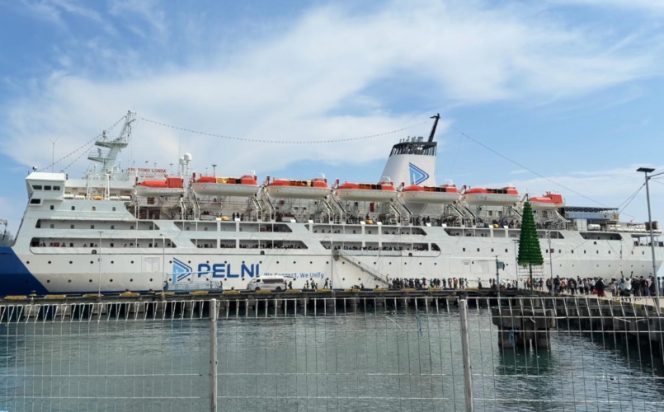
As Christmas approaches, thousands of Papuans are expected to travel by sea to reunite with relatives, attend church celebrations, and return to their hometowns. Anticipating the annual increase in passenger numbers, state-owned shipping company PT Pelayaran Nasional Indonesia (PELNI) is strengthening its services across Papua, combining additional vessel deployments, more frequent sailings, digital ticketing, and a government-backed 30 percent fare discount.
The preparations come at a particularly important time for Papua, where sea transport remains essential for connecting coastal communities and island regencies. For many residents, particularly those travelling between Jayapura, Biak, Serui, Nabire, Manokwari, and Sorong, passenger ships are not simply an alternative to air travel. They are a vital link to family, employment, education, and public services.
PELNI’s preparations were discussed during a working visit by Commission IV of the Papua Regional House of Representatives (DPR Papua) to the company’s Jayapura branch on November 13, 2026. The meeting was led by Commission IV Chairman Joni Y. Betaubun and attended by several legislators, who sought assurances that the shipping operator could accommodate the expected holiday rush.
PELNI Jayapura Branch Manager Daulad Apul Gervasius Naibaho outlined the company’s operational plans, including the deployment of four passenger vessels, increased sailing frequency, and the use of digital ticketing to manage passenger capacity.
The company also announced that a 30 percent discount on the basic passenger fare would apply to eligible journeys between December 17, 2026 and January 10, 2027. The program forms part of a national government stimulus intended to make holiday travel more affordable.
The preparations reflect a coordinated effort between a state-owned transport operator and regional lawmakers to improve mobility during one of Papua’s most important annual travel periods.
PELNI Prepares Additional Ships for the Christmas Rush
Four vessels to strengthen Papua’s main shipping routes
During the November 13 meeting, Daulad explained that PELNI Jayapura had prepared four passenger ships to support services across the region: KM Ciremai, KM Dobonsolo, KM Labobar, and KM Sinabung.
The vessels are expected to serve routes connecting Jayapura, Biak, Serui, Nabire, Manokwari, and Sorong before returning to Jayapura. KM Sinabung will also serve the Biak, Wasior and Nabire route as part of the company’s wider service arrangements.
The deployment is intended to provide additional capacity and improve connections between communities that rely heavily on maritime transport.
According to Daulad, the busiest period is expected to begin on 18 December 2026 and continue into early January 2027. A report by Teraspapua placed the expected peak movement between 18 December and January 8, while PELNI’s ticket discount program runs through January 10.
The distinction is important: the expected peak travel period and the official discount period are not necessarily identical.
PELNI is also adjusting its vessel schedules. Under normal operating conditions, the Jayapura branch handles approximately eight to 10 passenger-ship calls each month. During December, the company plans to increase its passenger-ship calls to around 15, adding approximately five to seven visits depending on the normal operating schedule used for comparison.
Daulad said the additional calls would help accommodate the increase in demand and give passengers more opportunities to travel.
The company is also maintaining pioneer shipping services for communities with limited transport access, including areas such as Depapre and Sarmi. These services are particularly important for residents who cannot easily reach larger transport hubs.
A broader fleet supports regional connectivity
In its wider operational preparation, PELNI Jayapura also reported the availability of different vessel categories, including 2,000-passenger-class ships, 1,000-passenger-class ships, and roll-on/roll-off vessels. Pioneer ships will continue to serve routes where regular commercial passenger services are limited.
The broader fleet arrangement is intended to support the transport needs of communities across Papua rather than concentrating all resources on the busiest urban ports.
The company’s challenge is to match vessel capacity and sailing frequency with the different needs of each route. A busy connection between major ports may require a different schedule compared to a pioneer service that serves smaller coastal settlements.
For passengers, the practical result should be more predictable travel options and better access to information about departures.
Serui to Receive Additional Ships in December
KM Labobar and KM Dobonsolo join KM Ciremai
One of the most significant local adjustments concerns Serui, the main town of Kepulauan Yapen Regency.
According to Kabar Papua, PELNI Serui Branch Head Whendy R. Imkotta said KM Ciremai would be the only passenger vessel serving Serui in November 2026.
Previously, the area had been served by KM Dorolonda and KM Ciremai. However, KM Dorolonda completed its final call to Serui in November. On its return journey, the vessel was scheduled to call at Waropen rather than Serui.
This temporarily left KM Ciremai as the principal passenger ship serving the town, operating along a route connecting Sorong and Jayapura.
Whendy said the situation would change in December, when PELNI planned to add KM Labobar and KM Dobonsolo to the Serui service. Together with KM Ciremai, the three vessels were expected to strengthen passenger transport during the Christmas and New Year period.
He said the additional ships were intended to anticipate increased demand and make it easier for residents to travel during the holidays.
The adjustment is particularly relevant for Kepulauan Yapen, whose island geography makes reliable sea connections essential. Residents depend on shipping services to reach other parts of Papua for family visits, business, and access to services.
Whendy also encouraged prospective passengers to monitor official arrival and departure schedules and purchase tickets through PELNI’s authorized channels.
The Serui arrangement illustrates how the company’s wider holiday preparations are being adapted to the needs of individual communities.
Parliament Calls for More Capacity and Wider Routes
Joni Betaubun stresses the importance of reliable public transport
The November 13 meeting was not limited to receiving an operational briefing. Members of Commission IV also raised concerns about the availability of ships, the distribution of passenger capacity, and the need for reliable services throughout the year.
Chairman Joni Y. Betaubun said the legislature had a responsibility to ensure that public transport services were accessible, orderly, and safe.
He emphasized that many Papuans travel by sea during Christmas to return to their hometowns, including destinations such as Biak and other coastal communities.
“We have a responsibility to remind our constituents. We represent the people, so they must also understand that the rules need to be followed. We do not want problems to arise at the port when passengers cannot obtain tickets,” Joni said, as reported by Teraspapua.
He also urged PELNI to maintain regular services along the Jayapura, Biak, Serui, Manokwari, and Sorong corridor.
In his view, a more consistent sailing pattern could reduce passenger congestion at ports and prevent situations in which travelers arrive but cannot secure an available seat.
Joni said ships departing from Jayapura should ideally serve the route through to Sorong before returning to the provincial capital. He also encouraged the Ministry of Transportation to consider additional vessels specifically supporting maritime connections in Papua.
For the legislature, the issue extends beyond the Christmas season. Reliable shipping is necessary throughout the year, particularly for communities that lack direct road connections to other districts.
Daulad responded that PELNI had prepared four passenger ships to strengthen the regional routes during the holiday period. Joni welcomed the explanation, saying the additional vessels addressed one of the concerns raised by Commission IV.
Biak and Supiori need special attention
The need for additional capacity was also highlighted by Martinus Pasang, a Commission IV member representing the Biak Numfor and Supiori electoral area.
He said the two island regencies faced limited transport options, particularly during the Christmas season when many residents living elsewhere in Papua wished to return home.
According to Martinus, only two passenger ships were currently serving Biak and Supiori. The limited number of vessels could create difficulties when demand increased in December and January.
He noted that the two regencies had no direct road connection to other regions. Residents therefore relied on sea and air transport for inter-regional travel.
Air connections were also limited. Martinus said Lion Air was the only airline serving Biak at the time, with approximately four flights each week.
This situation makes shipping capacity especially important for families planning their Christmas journeys.
Martinus asked PELNI to consider additional vessel calls and greater frequency on routes connecting Jayapura, Biak, Serui, Manokwari, and Sorong.
He also welcomed the company’s operational briefing and said the information would be communicated to residents in his constituency.
The discussion demonstrates why transport planning in Papua must take local geography into account. A schedule that may be sufficient for one port could leave another community with limited options.
Government Offers a 30 Percent Ticket Discount
Affordable travel during the holiday period
Alongside additional vessels, the government-backed ticket discount is another major part of PELNI’s preparations.
Under the program, eligible passenger tickets receive a 30 percent reduction from the basic fare for departures between December 17, 2026 and January 10, 2027.
PELNI Jayapura Branch Manager Daulad said the program was expected to reduce travel costs and make sea transport more accessible during the year-end holiday period.
He encouraged residents to make use of the discount and to follow official information regarding ticket purchases and sailing schedules.
The same program was promoted by PELNI Serui Branch Head Whendy R. Imkotta, who described the discount as a central government stimulus designed to support public mobility during Christmas and New Year.
I explained that the discount applies to economy-class tickets across all PELNI passenger routes. The reduction is calculated from the basic fare and does not include insurance charges or port entry fees.
Passengers must also purchase tickets using their identification documents. The discount does not apply to departures before December 17, 2026 or after January 10, 2027.
Another important condition concerns availability. If the allocated discounted-ticket quota is exhausted before the program ends, subsequent purchases will be charged at the normal fare.
When Dy said the program was expected to benefit a national target of 414,630 passengers.
The discount is therefore an opportunity for residents to reduce travel expenses, but it is not an unlimited fare reduction. Early planning remains important, particularly for popular routes and departure dates.
PELNI Mobile and Digital Ticketing Improve Passenger Management
Online bookings help control capacity
The company is also encouraging passengers to use digital services to purchase tickets.
Daulad said tickets could be purchased through the official PELNI Mobile application and selected banking channels, including BRI, Mandiri, and BCA services.
Digital ticketing is intended to make transactions easier while allowing PELNI to monitor the number of passengers booked on each vessel.
According to Daulad, ticket sales are controlled through an integrated system. Once the authorized passenger capacity has been reached, the system prevents additional tickets from being sold beyond the permitted limit.
This is particularly important during the holiday season, when demand can rise sharply and passengers may be tempted to purchase tickets at the port shortly before departure.
PELNI has nevertheless retained limited counter services for passengers who have difficulty using digital platforms. These include elderly travelers, people without smartphones, and groups requiring assistance.
The approach seeks to balance the efficiency of online booking with access for people who may not be comfortable using digital technology.
Commission IV Chairman Joni supported the company’s emphasis on advance booking. He urged residents not to wait until a ship arrived at the port before looking for tickets.
He also reminded travelers not to force their way onto a vessel once its passenger quota had been reached.
The message is straightforward: a confirmed ticket and compliance with the vessel’s capacity limit are essential parts of safe travel.
Safety and Passenger Comfort Remain Priorities
Vessel maintenance and updated safety equipment
Increasing the number of sailings is only one part of preparing for the holiday rush. Ships must also be technically ready to operate safely.
Daulad said PELNI had completed docking and maintenance work for its larger vessels at facilities in Surabaya, Jakarta, and Makassar. Pioneer vessels could undergo inspections through the Jayapura Class II Harbourmaster and Port Authority Office, known as KSOP.
The company also reported that safety equipment on board had been updated in accordance with applicable requirements.
The equipment includes lifeboats, rescue boats, and other safety facilities intended to protect passengers and crew during voyages.
Daulad stressed that safety remained the company’s highest priority. The passenger capacity limit, he said, was not intended to make travel more difficult but to ensure that ships operated within authorized standards.
This point is particularly relevant in Papua, where sea journeys can cover substantial distances and weather conditions can vary.
The combination of vessel maintenance, safety equipment, and controlled ticket sales is intended to reduce operational risks during the busiest period of the year.
Additional comfort for economy-class passengers
PELNI has also introduced optional services for passengers travelling on economy-class tickets who want additional comfort during longer journeys.
In a separate report published by ANTARA on October 19, 2026, Daulad explained that passengers on selected ships could purchase an add-on service providing access to beds and designated rooms.
The service is available on vessels without regular passenger cabins, including KM Dobonsolo, KM Ciremai, KM Dempo, and KM Dorolonda. Ships with existing cabin-class facilities, such as KM Sinabung, do not offer the same arrangement.
Passengers choosing the add-on can receive a bed, bed linen, pillowcases, slippers, soap, and access to a designated room, depending on the option purchased.
PELNI offers two arrangements: X Class 1A for two people and X Class 1B for up to four people. Prices vary according to the destination and voyage distance.
The additional service can be purchased through PELNI branch offices, although the available space on each ship is limited. Passengers are therefore encouraged to make reservations early.
For families travelling long distances, such options may provide greater comfort without requiring the purchase of a higher standard passenger ticket.
Legislators Seek Solutions for Emergency Travel Needs
Despite the company’s preparations, members of Commission IV have identified an issue that requires further consideration: passengers who need to travel unexpectedly.
Alberth Merauje proposed that PELNI consider setting aside a small allocation, estimated at one to two percent of available capacity, or establishing a special mechanism for urgent travel requests.
He cited situations involving family deaths, emergencies, and other circumstances that cannot always be planned in advance.
Alberth acknowledged that digital ticketing is important for controlling passenger numbers but argued that public transport services should also have a way to respond to exceptional needs.
His proposal was not a request to exceed a ship’s authorized capacity. Rather, he wanted PELNI to consider how urgent cases could be handled in an orderly manner without compromising safety.
He also encouraged residents to purchase tickets well in advance through official online channels.
Alberth said the program should be communicated effectively to Indigenous Papuans and other residents travelling home to Biak, Serui, Supiori, and other destinations.
He added that public funds used to support transport services should produce tangible benefits for communities.
The proposal highlights a broader challenge for public transport operators: digital systems can improve efficiency, but passenger services must remain responsive to genuine emergencies.
Maritime Connectivity and Papua’s Wider Development
The preparations for Christmas and New Year also underline the strategic importance of maritime transport in Papua.
The region’s geography includes islands and coastal settlements and communities separated by mountainous terrain. In many areas, direct road connections are limited or unavailable.
Reliable shipping therefore contributes to more than holiday travel. It supports the movement of workers, students, goods, and families while connecting smaller communities with larger commercial and administrative centers.
During the meeting, Commission IV member Jansen Monim also discussed plans by the Papua Provincial Government to strengthen maritime connectivity through the provision of rapid passenger vessels.
He said provincial representatives had previously accompanied the governor and the provincial transportation agency on a visit to Tanjungpinang in the Riau Islands to inspect rapid vessels being considered for the region.
The proposed vessels are expected to complement PELNI services and potentially reduce pressure on selected routes, including connections involving Yapen, Serui, and Biak.
The plan will require careful consideration of operating expenses, funding arrangements, and the long-term benefits for communities. Alberth Merauje specifically stressed that any use of Special Autonomy funds for transport infrastructure should be accountable and deliver practical benefits to residents.
Taken together, these discussions show that the Nataru preparations are part of a larger conversation about improving transport access across Papua.
Conclusion
PELNI’s preparations for Christmas 2026 and New Year 2027 combine additional passenger vessels, more frequent sailings, a 30 percent government-backed ticket discount, and digital booking arrangements.
The planned deployment of KM Ciremai, KM Dobonsolo, KM Labobar, and KM Sinabung, alongside additional services for Serui, is intended to strengthen connections between key destinations across Papua. Meanwhile, Commission IV DPR Papua is pressing for more capacity on routes serving Biak, Supiori, and other island communities.
The company’s preparations also include vessel maintenance, safety equipment checks, and optional comfort services for economy-class passengers.
For residents, the most immediate opportunity is the discounted fare program, which applies to eligible departures from December 17, 2026 to January 10, 2027. Buying tickets early through official channels will help passengers secure available seats and avoid last-minute difficulties.
The coming holiday period will test how effectively these plans translate into reliable services at the ports and on board the ships. Continued coordination between PELNI, the Ministry of Transportation, regional governments, and the legislature will remain important.
Ultimately, the success of the program will be measured not simply by the number of vessels deployed, but by whether people can travel safely, affordably, and on schedule to reunite with their families.
For many Papuans, that journey is an essential part of celebrating Christmas. Ensuring that it is accessible and well managed is therefore both a transport priority and a meaningful contribution to community life across the region.
Read Also
Ship Ticket Discount Boosts Connectivity in Papua
Belibis 9 Express Ship to Boost Papua’s Island Connectivity

