
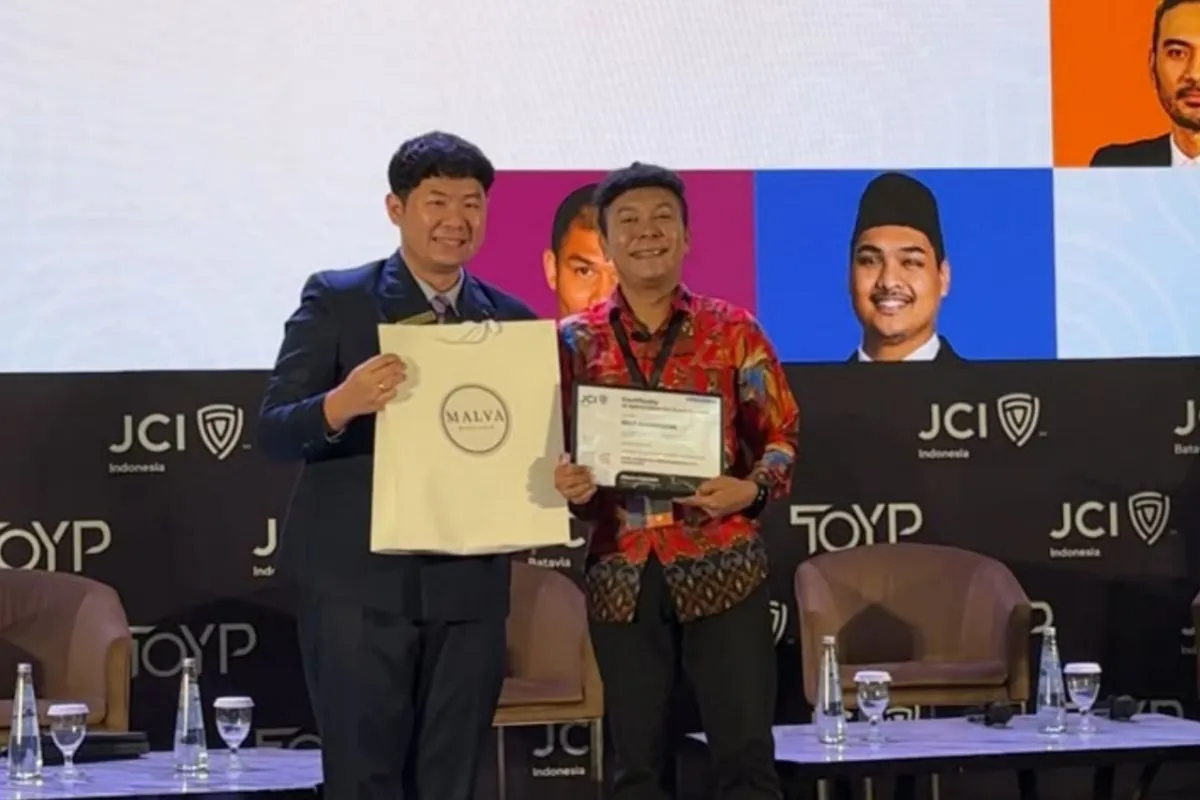
Billy Mambrasar, an educator and social development advocate from Papua, has become the first indigenous Papuan to receive the 2026 Ten Outstanding Young Persons of Indonesia award, marking an important recognition of his work to expand educational opportunities and strengthen community empowerment.
The award, formally known as The Outstanding Young Persons (TOYP) Indonesia 2026, was presented by Junior Chamber International (JCI) in Jakarta on October 29. Billy, whose full name is Gracia Josaphat Jobel Mambrasar, was selected as one of 10 national recipients in the Personal Improvement and Accomplishment category.
His achievement has attracted attention not just for the award but for the journey behind it. Born into a modest family in the Yapen Islands of Papua, Billy has built an academic and professional career that has taken him from Indonesia to universities in the United Kingdom, Australia and the United States. He has subsequently channelled that experience into educational programmes, economic empowerment initiatives and public service.
For Billy, however, the recognition is not simply a personal milestone. He has dedicated the award to children in Papua and across Indonesia who continue to pursue their ambitions despite economic and geographical constraints.
“The award is dedicated to the children of Papua and all Indonesian children who are struggling amid limitations,” he said, expressing hope that young people would understand that their birthplace and family economic circumstances should not determine how far they can learn, contribute and develop their potential.
The recognition offers a wider perspective on the contribution of Papuan professionals to Indonesia’s education and development agenda. It also highlights the importance of investing in human capital, particularly in regions where access to quality education and opportunities remains a major development priority.
A National Recognition with International Connections
Understanding the TOYP Indonesia 2026 Award
The TOYP programme is an international recognition initiative organised by Junior Chamber International, a global organisation that promotes leadership, entrepreneurship, community engagement and youth development.
JCI has a history of cooperation with the United Nations system, including relationships with UNICEF and consultative status with the UN Economic and Social Council (ECOSOC). This institutional connection provides the TOYP programme with an international dimension, although the Indonesian award itself is a national-level recognition administered by JCI rather than an award directly issued by the United Nations.
The programme recognises young individuals whose achievements and contributions have generated positive impacts in their respective fields.
Billy was selected in the Personal Improvement and Accomplishment category, alongside nine other national recipients. Among the other recognised individuals were Ferry Irwandi, Jerhemi Owen, Carina Joe and Johan Nurlela.
The distinction is particularly meaningful because Billy is reported to be the first indigenous Papuan to receive the Indonesian TOYP award.
The wider TOYP and Jaycees recognition network has previously included internationally known personalities such as former United States presidents John F. Kennedy and Bill Clinton, actress Michelle Yeoh, Nobel Peace Prize recipient Henry Kissinger and actor Jackie Chan.
While the backgrounds and achievements of these individuals differ considerably, their inclusion in the wider award tradition illustrates the programme’s international reach and its emphasis on recognising individuals whose contributions extend beyond personal success.
For Billy, the Indonesian recognition represents an opportunity to bring greater attention to educational development and the potential of young people from eastern Indonesia.
An achievement dedicated to the next generation
In his statement following the award, Billy emphasised that the recognition should serve as encouragement for young Papuans who aspire to pursue higher education, professional careers and community leadership.
“I want children in Papua to have the opportunity to become scientists, educators, entrepreneurs and leaders,” he said.
He added that the award had strengthened his determination to continue working with others so that more talent from Papua could develop and contribute to Indonesia.
His message reflects a philosophy that places collective progress above individual achievement. For Billy, receiving an award is meaningful only when it encourages other people to pursue opportunities that might otherwise appear beyond their reach.
This perspective is particularly relevant to young people in remote communities, where geographical distance, household income and limited educational facilities can influence access to learning opportunities.
From the Yapen Islands to International Universities
A journey shaped by determination
Billy’s story began in the Yapen Islands of Papua, where he grew up in a modest family.
His early experiences shaped his understanding of the relationship between education, economic opportunity and social mobility. Access to quality education was not simply an academic issue. It represented a pathway through which individuals could improve their circumstances and contribute to their communities.
His determination to pursue education eventually brought him to the Bandung Institute of Technology (ITB), one of Indonesia’s leading universities, where he studied engineering.
He subsequently continued his academic journey through international institutions, including the University of London, the Australian National University and Harvard University.
These educational experiences exposed him to different approaches to public policy, economic development, entrepreneurship and human development.
However, his academic achievements were not the only defining feature of his journey. His decision to use the opportunities he had received to support other young people became an increasingly important part of his professional direction.
He left the oil and gas industry to build an education movement
One of the defining decisions in Billy’s career was his move away from a conventional professional pathway in the oil and gas industry.
After completing his engineering education, he worked as an engineer in the energy sector, including involvement in Indonesia’s oil and gas industry.
He later decided to leave that career and devote more attention to social entrepreneurship and education.
In a public lecture at Gadjah Mada University in March 2020, Billy explained that his personal experience of overcoming educational and financial limitations had influenced his decision to establish a foundation that could provide learning opportunities for children in Papua.
He recognised that the challenges experienced by young people in remote communities could not be addressed through individual success alone.
Instead, he sought to establish an organisation capable of providing educational support, skills development and opportunities for future generations.
That ambition eventually became the foundation of Kitong Bisa Foundation Indonesia.
The name reflects a message of confidence and collective ability. Its programmes focus particularly on children, young people and Indigenous communities who require greater access to education and economic opportunities.
For Billy, the transition from engineering to social development was therefore not simply a change of profession. It represented a decision to redirect his professional knowledge and experience towards a broader social purpose.
Kitong Bisa Foundation: Expanding Opportunities for Papuan Children
Reaching more than 50,000 Indigenous students
One of the most significant contributions associated with Billy’s work is the development of Kitong Bisa Foundation Indonesia.
The organisation focuses on improving access to education and empowering communities, particularly Indigenous populations in Papua and other underserved areas of Indonesia.
According to the profile published by the Obama Foundation, Kitong Bisa has helped provide educational access to more than 50,000 Indigenous students under Billy’s leadership.
The figure reflects the scale of the organisation’s outreach and the importance of community-based initiatives in addressing educational disparities.
Its approach extends beyond conventional classroom learning. The foundation has developed training curricula and skills programmes designed to help young people improve their capabilities and prepare for future employment.
The programmes also seek to strengthen the capacity of community leaders, including in efforts to protect the natural environment.
Such an approach recognises that education should not be separated from the social and economic realities experienced by local communities.
In Papua, for example, education initiatives can be more effective when they take into account geographical conditions, local cultural identities and the economic activities available to residents.
Providing learning opportunities is only one part of the process. Equipping young people with practical skills, confidence and access to professional networks is equally important.
Supporting more than 1,000 entrepreneurs
Billy’s community empowerment initiatives also extend into the economic sector.
The Obama Foundation profile records that he has supported more than 1,000 entrepreneurs through assistance with business capital.
This work reflects the understanding that education and economic empowerment are closely connected.
Young people who receive appropriate training and entrepreneurial support can become job creators rather than relying exclusively on formal employment opportunities.
In regions such as Papua, strengthening small businesses and community-based enterprises can contribute to local economic activity, improve household incomes and encourage the development of locally driven solutions.
The foundation’s programmes therefore combine educational access with efforts to improve economic independence.
Billy has also established CONTAINDER, a social enterprise addressing waste management challenges in Indonesia.
The initiative complements his broader interest in sustainable development by connecting entrepreneurship with environmental responsibility.
Together, these activities illustrate a development approach that combines human capital, economic participation and environmental awareness.
From Social Entrepreneurship to National Public Service
Contributing to Indonesia’s development agenda
Billy’s work has also extended into national policymaking.
From 2019 to 2024, he served as a special staff member to Indonesian President Joko Widodo.
According to the Obama Foundation, during this period he contributed to the development of 33 national policies and programmes aimed at broadening educational access and employment opportunities for young people from under-represented communities.
The experience provided an opportunity to connect grassroots development initiatives with national policy discussions.
It also demonstrated how professionals with experience in social entrepreneurship can contribute to public institutions and development programmes.
For Papua, the participation of Papuan professionals in national policymaking is particularly important. Local perspectives and knowledge can help ensure that development strategies take account of the different circumstances experienced by communities across the region.
Billy’s subsequent involvement in academic research and economic policy has continued this trajectory.
He currently works as a lecturer and economic policy researcher at the ASEAN Competitiveness Study Center, Politeknik Negeri Batam.
His professional activities also include engagement with investment and business development in Batam, providing a link between regional economic competitiveness and broader development objectives.
International leadership and professional recognition
In addition to receiving TOYP Indonesia 2026, Billy was selected for the Obama Foundation Leaders Asia-Pacific 2025–2026 programme.
The programme brings together emerging leaders from across the Asia-Pacific region and provides opportunities for leadership development, professional networking and collaboration.
His selection reflects the international dimension of his work in education, entrepreneurship and community development.
The combination of academic experience, public service and social entrepreneurship has enabled him to engage with development issues from several perspectives.
The TOYP recognition now adds another milestone to that professional journey while creating an opportunity to promote the contribution of young Indonesian leaders to international discussions on education and inclusive development.
According to AlurNews, Billy is also targeting participation in the international-level TOYP recognition programme in 2027.
What His Achievement Means for Papua’s Future
Investing in people as a foundation for development
Billy’s achievement comes at a time when improving the quality of human resources remains central to Papua’s long-term development.
Infrastructure, transportation, healthcare and investment are important components of regional progress. However, their benefits depend significantly on the availability of capable people who can manage, maintain and expand these opportunities.
Education therefore remains one of the most important investments in Papua’s future.
The development of qualified teachers, scientists, entrepreneurs, healthcare professionals and public administrators can strengthen the region’s capacity to participate in Indonesia’s national economy.
This requires cooperation between central government institutions, regional administrations, universities, private companies and community organisations.
Government development programmes and social initiatives can complement each other when they share clear objectives and focus on measurable outcomes.
In this context, the experience of Kitong Bisa Foundation offers an example of how community-based organisations can contribute to wider development objectives.
Its reported educational outreach and entrepreneurship support demonstrate the potential of partnerships that combine local knowledge, professional expertise and access to resources.
Nevertheless, lasting improvements in education require more than the achievements of individual organisations. They also depend on sustained investment in schools, teacher development, learning facilities, digital connectivity and the welfare of students.
The challenge is to ensure that opportunities reach children not only in urban centres but also in remote villages and island communities.
A message that reaches beyond Papua
Billy’s story carries significance beyond the geographical boundaries of Papua.
Across Indonesia, many young people face similar questions about access to education, economic opportunities and the ability to pursue their ambitions.
His message that birthplace and family economic circumstances should not determine a person’s future speaks to a wider national aspiration: ensuring that every Indonesian child has the opportunity to develop their potential.
For Papua in particular, the recognition also demonstrates that individuals originating from the region can contribute to national development and gain recognition through professional achievement, academic excellence and community service.
It provides an encouraging example for younger generations who may aspire to pursue careers in science, education, business, public administration and international development.
More importantly, it reinforces the importance of creating pathways through which personal success can generate wider benefits for society.
Conclusion
Billy Mambrasar’s achievement as the first indigenous Papuan recipient of TOYP Indonesia 2026 represents more than a personal award. It highlights the contribution of education, social entrepreneurship and public service to the broader development of Papua and Indonesia.
His journey from a modest family in the Yapen Islands to international academic institutions, followed by his decision to establish Kitong Bisa Foundation, illustrates how educational opportunities can become a foundation for community empowerment.
The reported achievement of providing educational access to more than 50,000 Indigenous students and supporting over 1,000 entrepreneurs demonstrates the scale of the initiatives associated with his work.
His experience in national public service and participation in international leadership programmes further illustrates how local development experience can contribute to wider policy and professional networks.
For Papua, the central lesson is that sustainable progress must be built around people. Roads, infrastructure and investment are essential, but educated, skilled and empowered communities ultimately determine how effectively those resources can be transformed into long-term prosperity.
The recognition also provides an opportunity to strengthen cooperation between government, educational institutions, businesses and civil society in expanding access to learning and entrepreneurship.
As Billy looks towards further international recognition in 2027, his message remains focused on the next generation.
The greatest achievement, as his own words suggest, is not simply reaching the highest level of personal success but ensuring that more children have the opportunity to follow a similar path. For Papua and Indonesia, that ambition represents an important investment in a more educated, productive and inclusive future.
Read Also
Papua Plans Special Schools to Expand Inclusive Education
Mimika People’s School Expands Education Access in Papua

