
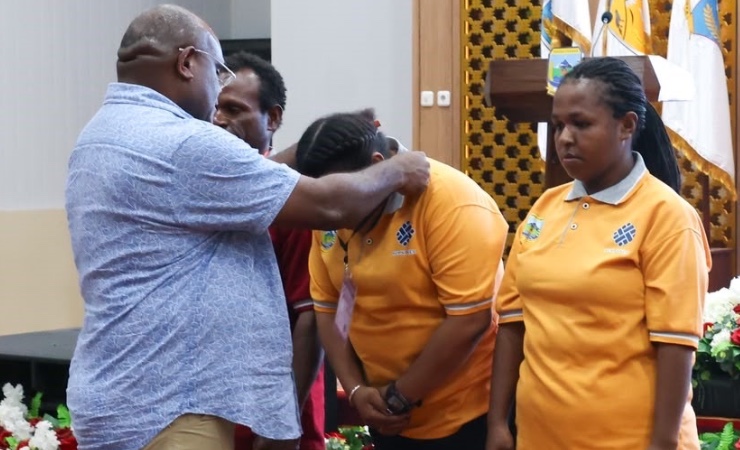
The Papua Tengah (Central Papua) provincial government has allocated Rp6.3 billion (approximately US$380,000, depending on the exchange rate) for vocational training aimed at 74 Indigenous Papuans, known locally as Orang Asli Papua (OAP). The Papua Tengah vocational training programme is designed to strengthen practical skills, improve access to employment, and help participants establish independent businesses.
The initiative brings together technical training in mobile phone repair, sewing, barista skills, outboard motor repair and computer operation. Fifty-six participants are undertaking training in Makassar, Sulawesi Selatan (South Sulawesi), while another 18 are receiving computer training in Nabire, the capital of Papua Tengah.
Announced during a participant send-off at the governor’s office in Nabire on Friday, October 9, 2026, the programme reflects the provincial administration’s efforts to connect workforce development with economic opportunities. Rather than focusing exclusively on formal employment, the initiative also seeks to equip young Papuans with skills they can use to build businesses and provide services in their communities.
The programme’s long-term value will depend on what happens after the training ends. Participants will need opportunities to apply their skills, reach customers, obtain business permits where required and access the tools or resources needed to begin working. Provincial Governor Meki Nawipa has highlighted the importance of linking vocational instruction with practical support for establishing businesses.
A Rp6.3 Billion Investment in Local Skills
The Papua Tengah Provincial Government is implementing the programme through its Department of Manpower, Transmigration, and Energy and Mineral Resources. Department head Frets James Boray said the initiative was intended to address unemployment by improving participants’ competencies through training organised around specific skill areas.
“The programme is directed at improving skills and competencies, particularly for Indigenous Papuans, so they can enter the workforce or establish independent businesses and gradually help reduce unemployment,” Boray said, according to a report by Indonesia’s national news agency, ANTARA.
The funding package totals Rp6.3 billion. According to the department, Rp4.8 billion is allocated for OAP training, while Rp1.5 billion is provided as a grant. The investment is intended to provide participants access to practical instruction that can translate into employment or income-generating activities.
The allocation is significant not simply because of its monetary value but because it targets a fundamental part of economic development: the ability of local residents to participate in the labour market. Infrastructure, investment and public spending can create economic opportunities, but communities also need workers and entrepreneurs equipped to take advantage of them.
Vocational training offers one route to narrowing that gap. A person trained to repair mobile phones, for example, may be able to seek employment at a repair shop or establish a small service business. Sewing skills can support work with garment producers or the creation of a tailoring enterprise. Computer skills can be applied in office administration and other services, while barista training may open opportunities in cafés, hotels and the wider food and beverage industry.
These are potential pathways rather than guaranteed outcomes. Their success will depend on the quality of instruction, the participants’ commitment, local demand and access to equipment, finance and customers. Nevertheless, the programme provides participants with several different routes into productive work rather than preparing everyone for the same occupation.
From Makassar to Nabire: Five Training Areas
The 74 participants have been divided between two training locations, with the distribution reflecting the programme’s selected areas of competence.
Fifty Six Participants Train in Makassar
Fifty six participants have been sent to Makassar to undertake four types of vocational training. Nine are learning mobile phone repair, 19 are enrolled in sewing, 13 are studying barista skills, and 15 are receiving instruction in outboard motor repair.
The training is being conducted in cooperation with the Centre for Vocational Training and Productivity (BBPVP) Makassar. The institution provides a vocational training environment for participants who are developing practical skills that can be used in employment or self-employment.
The selection of these occupations offers different possibilities for economic participation. Mobile phone repair addresses demand for maintaining devices used for communication, education and business. Sewing can serve households, local clothing markets and businesses requiring tailoring services. Barista training connects hospitality skills with the growing potential of coffee-based businesses, while outboard motor repair may be useful in communities where boats support transportation, fishing and other livelihoods.
The programme’s design, therefore, encompasses multiple industries. It introduces participants to several service-oriented occupations that could be developed into small enterprises, depending on market conditions in their home communities.
Eighteen Participants Study Computers in Nabire
The remaining 18 participants are undertaking computer training in Nabire through cooperation with the Community Vocational Training Centre (BLKK) operated by the Pesat Foundation.
Computer skills can support a range of activities, including administrative work, document preparation, data entry and basic digital services. For aspiring entrepreneurs, digital literacy can also be useful in managing records, communicating with customers and promoting products.
Holding this part of the programme in Nabire means that these participants don’t have to travel to Makassar for instruction. The arrangement combines training outside the province with a local component, while drawing on the expertise of two training partners.
The partnership model is important because vocational programmes require more than just budget allocations. Training institutions must provide relevant instruction, and participants must have opportunities to practice what they learn. Cooperation between the provincial government and specialised training providers can help establish that foundation.
Governor Meki Nawipa Emphasises the Next Step: Business Development
For Governor Meki Nawipa, the programme should not end when participants complete their courses and return home. He argues that training should be accompanied by support that enables participants to apply their newly acquired skills.
“If we only provide training and then they return, it will not be enough. After the training, we also prepare the licensing documents so they can subsequently establish businesses,” Nawipa said, as quoted by ANTARA.
His remarks point to a practical challenge facing vocational initiatives: technical competence alone does not automatically create a sustainable livelihood. A participant may learn how to repair a phone or prepare coffee professionally, but turning that ability into a business can require additional steps, including securing suitable equipment, identifying a location, understanding customer demand and meeting relevant administrative requirements.
Support with business licensing can help participants navigate one part of that process. However, the wider objective will require attention to other factors as well, such as access to working capital, mentoring, market connections and follow-up assistance after training.
The governor has also called on participants to approach the programme seriously, stressing that the government can facilitate opportunities but that individuals must work to develop their capabilities.
“This training must be used properly. Do not underestimate its importance. Your future is determined by your own process. We are only facilitating,” he said.
The message places responsibility on both sides of the development process. Public institutions can provide training and create enabling conditions, while participants need to practise their skills, maintain professional standards and seek opportunities to apply what they have learned.
For the programme to achieve lasting results, these two elements will need to reinforce each other. A well-trained participant who cannot access tools or customers may struggle to establish a business. Equally, access to support will have limited value if the skills acquired during training are not maintained and improved.
Fredi Bunai Sees Potential in Papua Tengah’s Coffee
Among the participants, barista trainee Fredi Bunai sees an opportunity to connect vocational skills with a product that already has a local identity: Papua’s coffee.
Bunai has expressed appreciation for the provincial government’s support and hopes the training will help young Papuans improve the quality and presentation of locally produced coffee. He has highlighted Arabica coffee from Paniai and Moanemani as products with potential for further development.
His perspective illustrates how vocational training can extend beyond the immediate goal of securing a job. Barista skills may allow participants to work in cafés and hospitality businesses, but they can also help them understand how coffee is prepared and presented to customers. When combined with knowledge of sourcing, quality control, pricing and business management, these skills could contribute to a broader local coffee enterprise.
Coffee production and coffee services are different parts of the same value chain. Farmers cultivate and harvest the beans, processors prepare them for market, and cafés and baristas introduce the finished product to consumers. Improvements at several stages can help strengthen the identity and commercial appeal of a local product.
For Papua Tengah, the potential lies in connecting the region’s coffee-growing areas with better processing, preparation and marketing. Paniai and Moanemani are already associated with Arabica coffee, and Bunai hopes that young people can help improve its quality and introduce it to wider markets.
He has also expressed the hope that participants will use their new competencies not only to find jobs but also to develop businesses capable of competing nationally and internationally. That ambition will require time and sustained effort. International competitiveness depends on consistent product quality, reliable supply, professional service, effective branding and the ability to meet buyers’ expectations.
Even so, Bunai’s emphasis on local coffee reflects an important economic principle: vocational skills can become more valuable when they are connected to resources and products already present in the region. Instead of treating training as an isolated activity, participants can seek ways to apply it within the local economy.
The same principle can apply to the other training fields. Computer skills can support local businesses, sewing can serve community demand, mobile phone repair can provide an essential service, and outboard motor maintenance can support people whose livelihoods depend on boats. The potential economic benefits will vary from one location to another, but each skill offers a possible starting point.
Why Vocational Training Matters for Papua’s Economy
Papua Tengah’s training initiative comes amid a wider development challenge: ensuring that local residents can benefit from economic activity and that young people have practical routes into employment or entrepreneurship.
For provincial authorities, workforce development is one way to connect public spending with household-level economic opportunities. Training programmes can help people acquire skills that employers need, while entrepreneurship can create self-employment and, over time, potentially generate work for others.
However, the number of participants enrolled is only the first measure of progress. The more important indicators will emerge after the training: how many participants complete their courses, how many find jobs, how many establish businesses and whether those businesses remain viable.
A strong monitoring system could record these outcomes over the months following graduation. It could also identify the most common barriers faced by participants, allowing the government and training partners to adjust future programmes. If equipment is too expensive, for example, targeted assistance or partnerships may be needed. If demand is limited in one location, participants may need help identifying other customers or connecting with employers.
Such follow-up would also help determine whether the selected training fields match the needs of Papua Tengah’s economy. The current programme covers several occupations, but local demand may differ between urban centres, coastal communities and more remote areas. Future training cycles could use lessons from participants’ experiences to refine course selection and delivery.
Another consideration is the relationship between technical skills and business management. People starting small enterprises need to understand costs, pricing, savings, customer service and basic record-keeping. These competencies can influence whether a business survives beyond its first months. Combining technical training with entrepreneurship guidance would strengthen the programme’s practical value.
For Indigenous Papuans, locally accessible opportunities can be particularly important in enabling communities to participate in economic development. A programme that helps participants become employable or establish businesses can contribute to household income and expand the pool of skilled workers available to local employers. Its overall impact, however, must be assessed through actual outcomes rather than intentions alone.
Turning Public Investment into Lasting Results
The Papua Tengah Provincial Government has established a clear objective for its Rp6.3 billion initiative to improve the skills of 74 Indigenous Papuans and help them move towards employment or independent enterprise.
The programme has several elements in its favour. It offers multiple vocational pathways, works with established training partners in Makassar and Nabire, and includes a stated commitment from the governor to help participants prepare the administrative requirements for setting up businesses. The focus on coffee through trainees such as Fredi Bunai also demonstrates how individual skills may connect with local products and wider market ambitions.
However, the most critical phase is yet to come. The training will need to translate into measurable improvements in employment, business creation and income. Participants will need to apply what they learn, while government agencies and training providers will need to make sure that promised support continues after the courses conclude.
For Papua Tengah, the programme is an investment in people as much as in training. Its success will be determined not by the budget alone, but by whether participants can turn new competencies into productive work and sustainable livelihoods.
If that transition is supported with practical follow-up, the initiative could offer a useful model for linking vocational education with local economic development. For the 74 participants, the immediate task is to master their chosen skills. The longer-term opportunity is to use those skills to build careers, serve their communities and contribute to a more diverse regional economy.
Read Also
Nabire Empowers Indigenous Papuan Farmers Through Special Autonomy Training
Vocational Training Empowers Indigenous Papuan Women

