
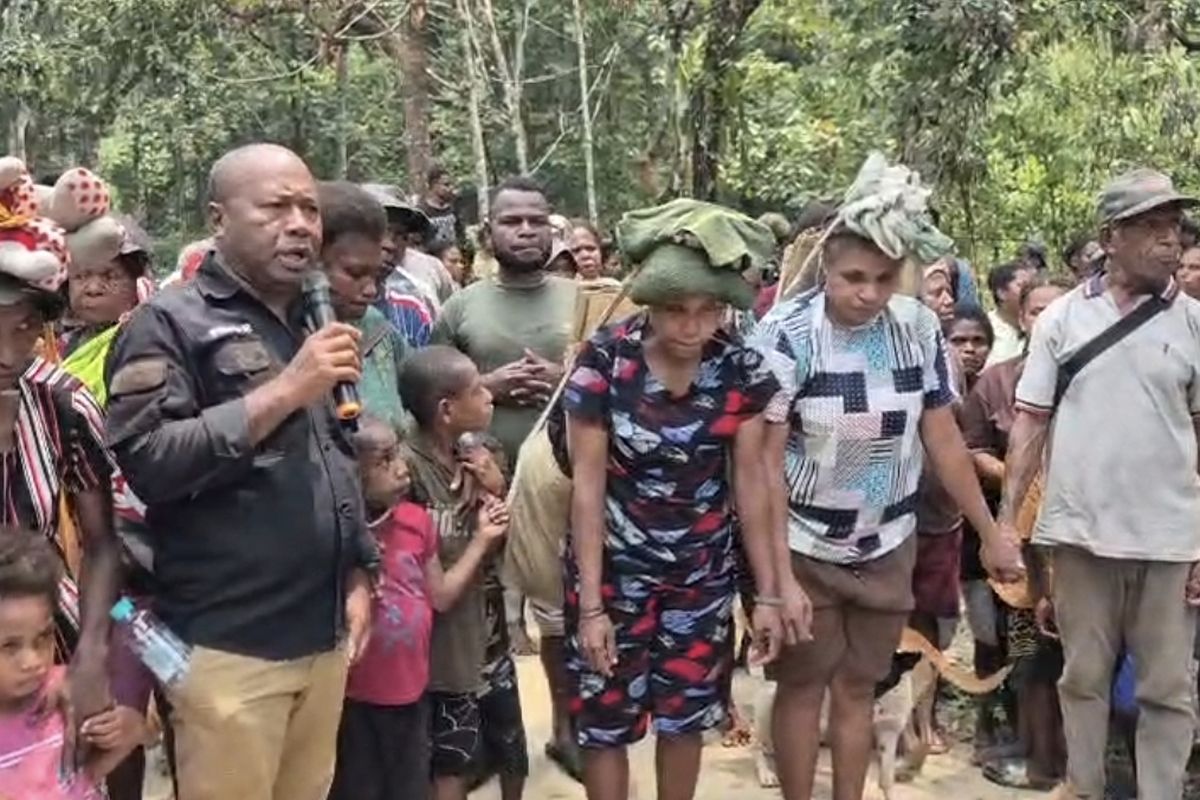
For some of the Maybrat displaced families, returning home has taken roughly five years.
Women and children who fled their communities following the West Papua National Liberation Army from the Free Papua Movement, or TPNPB OPM’s deadly attack on the Kisor military post in September 2021, have begun another stage of their long-awaited return, following negotiations facilitated by Indonesia’s National Commission on Human Rights, or Komnas HAM.
The latest group was formally handed over to the Maybrat Regency Government on September 30, 2026, with representatives of the Indonesian military and police witnessing the process. The exact number of women and children in this latest group has not been publicly disclosed.
For the families themselves, however, the significance cannot be measured simply by numbers.
Their return represents another step toward rebuilding lives disrupted by years of insecurity, separation from home, and uncertainty over whether it was safe to go back.
For the Indonesian government, Komnas HAM, and local authorities, it also marks the beginning of a more difficult phase. Getting people home is one task. Ensuring that they can stay there safely, sending their children back to school, receiving healthcare, repairing damaged houses, and rebuilding livelihoods is another.
The September 2021 Attack That Changed Maybrat
The story of the displacement begins before dawn on September 2, 2021.
At around 3 a.m. local time, attackers from the TPNPB OPM struck the Military Rayon Command Post, or Posramil Kisor, in South Aifat District, Maybrat. Four Indonesian National Armed Forces (TNI) personnel were killed.
They were identified as Second Sergeant Amrosius, Chief Private Dirham, First Private Zul Ansari, and First Lieutenant Chb Dirman, who commanded the post. Three were found dead inside the military post, while Dirman’s body was discovered in bushes nearby. Another soldier was initially reported missing.
The attack was followed by a security operation to locate those responsible.
Komnas HAM Papua subsequently conducted its investigation. Its team visited the site, interviewed witnesses, met suspects, and spoke with military personnel who survived the attack.
Frits Ramandey, head of the Papua representative office of Komnas HAM, said at the time that the commission’s investigation found that the assault had been carried out in a planned and organized manner by the TPNPB OPM.
The attack and the security situation that followed had consequences far beyond the military post.
Fear spread through surrounding communities.
Families left their homes, some moving into forests and others seeking safety elsewhere. What began as displacement around the immediate area eventually expanded across several districts.
Thousands Leave Their Communities
Initial records cited in the latest Komnas HAM reporting put the number of displaced people at about 3,121.
As the displacement expanded across South Aifat, Central East Aifat, East Aifat, Far East Aifat, and Southeast Aifat districts, reports put the number at as many as 6,000 people. Later records from 2022 documented around 1,220 households affected by displacement.
These figures changed over time as people moved between locations and gradually returned, making a single permanent displacement count difficult.
What remained clear was the scale of disruption.
People who had lived in their villages suddenly found themselves away from farms, homes, schools, and familiar community networks.
Women and children faced particular vulnerabilities.
Children risked interruptions to education, while families living away from established settlements faced difficulties obtaining food, healthcare, and other basic services.
Simply declaring an area secure could not resolve the humanitarian problem.
People had to believe they could safely return.
Government Urged Residents to Home from the Beginning
Security Guarantees in September 2021
Efforts to persuade residents to return began within days of the Kisor attack.
On September 4, 2021, then West Papua Governor Dominggus Mandacan visited the area and urged residents who had fled into the forest to return to their villages.
“The community does not need to panic or flee into the forest, because the government, together with the TNI and Polri, guarantees public security,” Mandacan said at the time.
He said the presence of security personnel in villages was intended to find those responsible for killing the four soldiers rather than intimidate civilians.
Then commander of Kodam XVIII/Kasuari, Maj. Gen. I Nyoman Cantiasa, and West Papua Police Chief Inspector General Tornagogo Sihombing also gave security assurances to civilians.
A week after the attack, military and local government officials were visiting displaced communities directly.
On September 9, Maybrat military commander Lt. Col. Harry Ismail and then Maybrat Regent Bernard Sagrim met residents and encouraged them to return home. The local administration also arranged healthcare assistance for displaced people who needed treatment.
Yet, reversing the fear accumulated during conflict is not an easy task.
For many families, returning required more than an official assurance. It required time, dialogue, and confidence that conditions in their villages had genuinely improved.
Returns Begin Gradually
The process therefore unfolded in stages rather than through one mass return.
According to the latest information reported by Komnas HAM Papua, around 1,400 displaced residents, representing 172 households from South Aifat District, returned during earlier phases.
Another important step came in December 2024.
On December 23 that year, 64 displaced people, including elderly residents, teenagers, and children, returned to Imsun village in South Aifat after spending more than three years away.
During that process, five individuals on a police wanted list also surrendered.
One institution alone did not arrange the return.
An official Komnas HAM statement from December 2024 records coordination involving the Maybrat regional government, police, TNI, church figures, and the families themselves. Komnas HAM monitored and accompanied both the return of internally displaced residents and the surrender of the five wanted individuals.
That process illustrates the complexity of resolving displacement in a conflict-affected area.
Security agencies can secure territory. Local governments can restore services. But community leaders, churches, families, and human rights institutions can also play an important role in rebuilding confidence.
Government Promises Security and Basic Needs
The December 2024 process also produced concrete government commitments.
According to Komnas HAM, the regional government guaranteed security and basic necessities for returning residents, including assistance with damaged homes.
Then acting Southwest Papua Governor Mohammad Musa’ad and acting Maybrat Regent Vincente Campana Baay welcomed the planned return to Imsun and encouraged other displaced residents to consider returning to their villages.
The government said basic necessities would be provided periodically, particularly during the first three months after the families returned. Damaged houses and household equipment would also be restored gradually.
Police separately guaranteed security for the returning residents and said legal proceedings involving the five people who surrendered would be handled professionally.
Those commitments are significant because displacement does not end the moment someone crosses back into their village.
A family may technically have returned while still lacking a habitable home, income, or access to school or medical treatment.
A sustainable return requires those conditions to recover as well.
Women and Children Finally Make the Journey Home
The latest return came on September 30, 2026.
Komnas HAM Papua facilitated the repatriation of another group of women and children who had remained displaced following the Maybrat conflict.
TNI and Polri representatives witnessed the formal handover of the families to the Maybrat Regency Government.
Frits Ramandey said the process was built around negotiations with the families themselves.
“We conducted good negotiations together with the families to facilitate the return of women and children in Maybrat Regency,” he said.
That sentence captures an important element of the process.
Return was negotiated, not merely ordered.
For people who had spent years away from their homes because they were afraid of insecurity, confidence had to be rebuilt.
A Catholic foundation school in Aimas, Sorong Regency, had previously accommodated some of the children affected by the Maybrat displacement.
Komnas HAM had visited displaced children there and stressed the importance of psychological recovery, continued education, and eventual return to their places of origin.
Returning Home Is Only the Beginning
Trauma Cannot Be Repaired Like a House
The physical signs of displacement can sometimes be straightforward to identify.
A damaged house can be repaired. A road can be reopened. A classroom can be restored.
Psychological trauma is different.
Women and children who have lived with insecurity for years may need sustained assistance after returning.
Komnas HAM has therefore called on the Maybrat government and related institutions to ensure not only security but also food, healthcare, education, housing, and psychosocial services.
It has specifically called for special attention to women and children, along with repairs to homes and equal access to public services.
The commission has said it will continue monitoring the situation of the recently returned families.
This turns the September 30 handover into a starting point rather than an endpoint.
A Human Rights Test for the Recovery Process
The return also carries wider significance for Indonesia’s approach to conflict-related displacement in Papua.
Security is essential. Families are unlikely to return if they fear renewed violence.
But security alone is insufficient.
Children need functioning schools. Pregnant women and elderly residents need healthcare. Families need food and shelter while they rebuild livelihoods. Farmers need access to land. Communities need confidence that public services will continue after the attention surrounding their return has faded.
That is why Komnas HAM’s involvement matters.
As Indonesia’s national human rights institution, its role allows the return process to be viewed not merely as a security achievement but as a question of restoring citizens’ rights.
Its recommendations place civilian welfare at the center of the next phase.
The Importance of Community Trust
Maybrat’s experience also demonstrates why resolving internal displacement requires trust between institutions and communities.
The 2024 return involved government officials, security agencies, Komnas HAM, church leaders, and families.
That broad participation matters in Papua, where churches, customary leaders, and extended family networks can carry considerable influence at the community level.
A government program may provide resources, but local acceptance determines whether people feel confident enough to use them.
The gradual return of Maybrat residents suggests that dialogue has been necessary alongside security guarantees.
This does not erase what happened.
Four soldiers were killed at Kisor. Thousands of civilians subsequently experienced displacement. Families spent years separated from normal community life.
The task now is preventing another generation from inheriting those consequences.
From Emergency Response to Long-Term Recovery
The trajectory of Maybrat since September 2021 can be divided into several stages.
The first was emergency displacement following the Kisor attack and subsequent insecurity.
The second involved security operations and attempts by authorities to convince residents that they could safely return.
The third has been the gradual repatriation of families, including the return of 64 people to Imsun in December 2024.
The September 2026 return signals a further transition toward longer-term recovery.
Most of the roughly 1,220 households recorded as displaced after the conflict have now returned gradually, according to recent reporting.
But numbers alone cannot determine whether recovery has succeeded.
The stronger measure will be whether those families remain home.
What Must Happen Next
The immediate priority is ensuring that the latest return is sustainable.
Komnas HAM has already identified the essential elements: security, adequate food, healthcare, education, housing, psychosocial support, and restoration of public services.
For the Indonesian government and Maybrat authorities, delivering those commitments would demonstrate that security policy and civilian recovery can operate together.
It could also help restore confidence among any families who remain hesitant to return.
For children, the stakes are particularly high.
Five years is a substantial part of a childhood. A child who left home in primary school in 2021 may now be approaching adolescence.
Restoring education therefore means more than reopening classrooms. Schools and local authorities may need to identify learning gaps and help children readjust socially after years of disruption.
For adults, the challenge will include rebuilding livelihoods.
Returning to a village without a functioning source of income risks replacing one form of insecurity with another.
Agriculture, local commerce, transportation, and public services therefore become part of the peace and recovery process.
Conclusion
The return of women and children to Maybrat is one of the clearest signs yet that communities affected by the violence surrounding the September 2021 Kisor attack are moving toward a different chapter.
The journey has been long.
Fear and insecurity, following the deaths of four Indonesian soldiers at the Kisor military post on September 2, 2021, led to civilian displacement across several districts. Initial figures recorded 3,121 displaced people, while later estimates reached as many as 6,000.
Government officials and security authorities began encouraging residents to return within days, offering security guarantees. Yet rebuilding trust took far longer.
Returns subsequently proceeded in stages.
Around 1,400 people from South Aifat returned during earlier phases. Another 64 people went back to Imsun in December 2024 following coordination involving Komnas HAM, government authorities, TNI, police, church representatives, families, and other parties.
Now another group of women and children has come home.
Their September 30 return demonstrates what sustained dialogue can achieve. But it should not be treated as the end of the story.
Komnas HAM’s emphasis on housing, healthcare, food, education, psychosocial assistance, and security points to the real measure of progress.
The goal is not simply to move people out of displacement sites.
It is to make the home liveable again.
If children can return to school, families can rebuild houses and livelihoods, healthcare becomes accessible, and communities regain confidence in their safety, the latest homecoming could become something more durable: a transition from displacement to recovery.
For Maybrat, after years shaped by fear and separation, that is the outcome that matters most.
Read Also
Indonesia Steps Up Humanitarian Response in Papua Tengah
Indonesia Steps Up Aid for Papua Tengah Refugees
Central Papua Governor Meki Nawipa: Delivering Aid, Reuniting Families, and Advocating Peace in Puncak’s Gome and Sinak

