The Biak cannabis seizure began with what appeared to be routine monitoring at a busy port but quickly developed into a case highlighting a wider security challenge facing Papua.
Indonesian police arrested two men after they arrived at Biak Port from Jayapura carrying a total of 71 packages of dried cannabis weighing about 1 kilogram. The arrests, made on September 6 and 7, 2026, followed intelligence gathering and surveillance by the Biak Numfor Police Narcotics Unit in cooperation with port security personnel.
The case is significant for more than the quantity seized.
Police say the cannabis was intended for sale, while one suspect initially told investigators that some of the drug was intended for personal use. The movement of cannabis from Jayapura to Biak nevertheless illustrates how narcotics can travel between Papua’s urban centers and island communities through established transportation routes.
It also comes against the backdrop of a separate and more troubling development in Papua’s interior: the discovery of large illegal cannabis cultivation sites in remote mountainous areas.
In September, Indonesian security forces found 1,347 cannabis plants in two locations in Siminbuk, Serambakon District, Pegunungan Bintang, Papua Pegunungan. Earlier in the year, security personnel reported discovering around 5,000 plants in Yahukimo. Authorities have alleged links between some plantations and members or affiliates of the West Papua National Liberation Army from the Free Papua Movement (TPNPB OPM), although those allegations remain subject to investigation.
Together, the cases raise an important question for Papua: is the region facing not only isolated drug offenses but also the emergence of a wider supply chain linking cultivation, transportation, and distribution?
The available evidence does not yet establish such a single integrated network. But the pattern is serious enough to warrant sustained attention.
How the Biak Operation Unfolded
Police Watch the Port
The first arrest took place on Sunday, September 6, at Biak Port.
According to Biak Numfor Police Chief AKBP Arjuna Wijaya, officers from the police Narcotics Unit were monitoring passengers arriving by ship when they became suspicious of RU, a 30-year-old man, as he walked toward the port exit.
Officers stopped him and took him to the Biak Marine Port Security Implementation Unit, known as KP3 Laut Biak, for further questioning and a search.
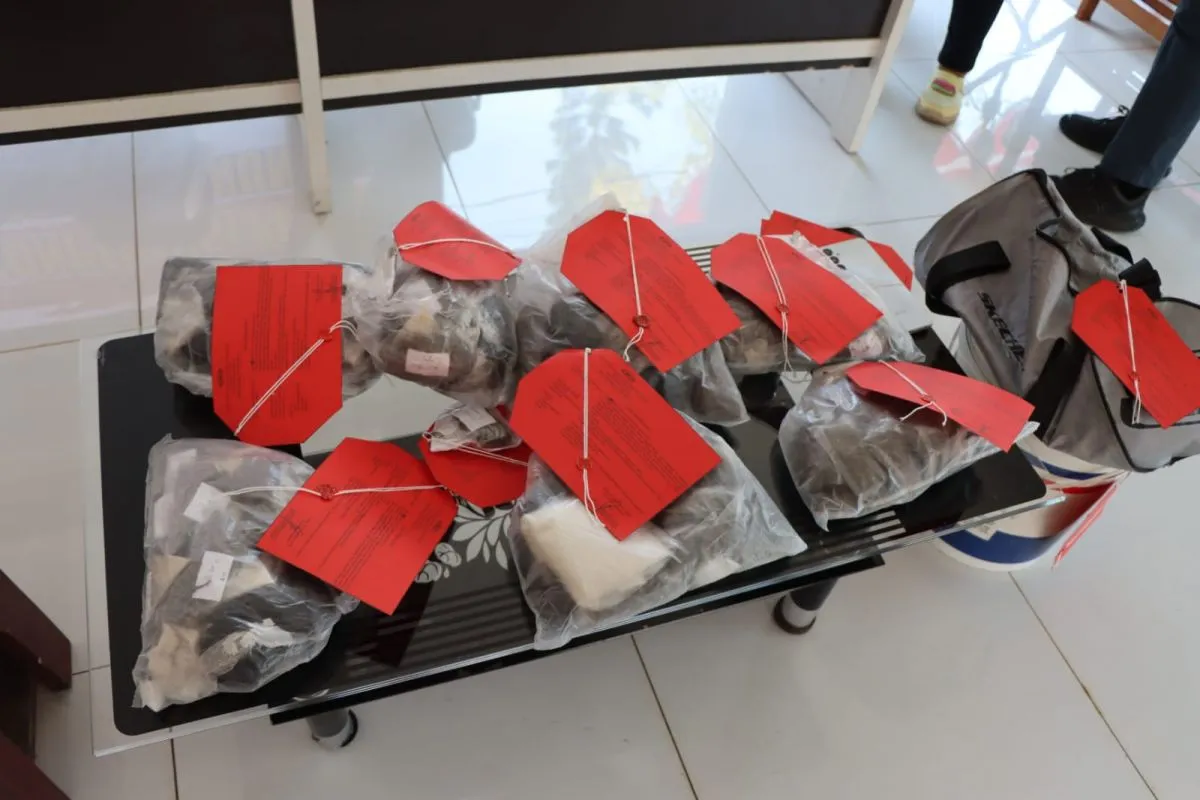
The initial inspection reportedly uncovered a large transparent plastic sachet containing 4.67 grams of suspected cannabis.
Police then continued examining the clothing and belongings carried by RU.
A blue carrying bag was found concealed near his groin. Inside were three additional transparent plastic packages containing 39.62 grams of suspected cannabis.
The total amount seized from RU was therefore 44.29 grams. Police also confiscated a sling bag, plastic packaging, and the carrying bag used to conceal the drugs.
The search was witnessed by a terminal employee who was on duty near the port exit, after which RU and the evidence were taken to the Biak Numfor Police Narcotics Unit for further examination.
A Second Arrest Follows
The investigation did not end with RU.
The following day, Monday, September 7, police arrested GKY, 22, at the same port.
This time, the quantity was substantially larger.
Police seized 68 packages of cannabis with a combined weight of 970.9 grams. ANTARA reported that the two suspects had transported a total of 71 packages weighing approximately 1 kilogram.
The two arrests were therefore made on consecutive days, both involving cannabis arriving in Biak from Jayapura.
That geographical detail matters.
Jayapura is Papua’s major urban and transportation center, while Biak Numfor is an important island district with maritime and air connections to other parts of eastern Indonesia.
A seizure at a port does not automatically prove the existence of an organized regional drug network. But it demonstrates that narcotics can move through ordinary transportation infrastructure and that law enforcement must monitor several points along the supply chain.
What Police Say About the Intended Market
Police said the 71 packages were intended to be sold.
According to Kapolres Biak Numfor AKBP Arjuna Wijaya, the suspects told investigators that the cannabis had been purchased in Jayapura.
The case therefore differs from a simple discovery of cannabis possession in a remote location.
The drugs had crossed from one Papuan urban area to another and arrived in dozens of separately packaged units.
For investigators, packaging and movement are important pieces of evidence because they can help establish whether a case involves personal possession, distribution, or a wider trafficking arrangement.
In RU’s case, police said he initially claimed the cannabis was for personal consumption on his birthday. Authorities nevertheless processed him as a suspect in an alleged narcotics distribution case because of the circumstances surrounding the possession and transportation.
The second suspect, GKY, was carrying almost one kilogram.
The two cases are now moving through the criminal justice process.
Police Warn of Wider Social and Economic Effects
Arjuna has urged residents of Biak Numfor to help authorities identify narcotics activity.
He said the effects of drug abuse are not limited to individual users. According to the police chief, narcotics can damage the psychological condition of young people and affect the local economy.
He encouraged residents who know about suspected drug activity to report it through the police emergency number or other official channels.
He also urged families whose relatives may already be experiencing drug dependence to seek assistance from police or relevant institutions so that they can receive appropriate treatment and rehabilitation.
The message is significant because narcotics enforcement cannot rely solely on arrests.
Biak is a relatively close-knit island community, where information can travel quickly. Community cooperation can therefore become an important component of early detection.
At the same time, law enforcement needs to maintain a clear distinction between suspicion and proof.
Residents should not be treated as criminals simply because they live near a suspected drug-related location. Evidence-based investigation remains essential if public confidence is to be maintained.
Four Narcotics Cases in Biak During 2026
The two arrests also fit into a broader local law enforcement picture.
According to Biak Numfor Police Narcotics Unit Chief Iptu Ruslan Umagapi, police had handled four narcotics cases between January and September 2026, with total seized evidence reaching approximately 1.4 kilograms.
The figure provides useful context.
The Biak case cannot by itself establish that the island has become a major narcotics market. Four cases over nine months represent evidence of a problem, but they do not provide enough information to measure the total scale of drug consumption or trafficking in the district.
However, the repeated seizures show why authorities remain concerned.
The challenge is particularly important for young people. If narcotics become increasingly available through local distribution networks, the consequences can reach schools, families, workplaces, and community institutions.
For this reason, prevention and rehabilitation need to complement enforcement.
From Urban Distribution to Remote Cultivation
The Biak arrests become more concerning when considered alongside developments in Papua’s mountainous interior.
The most recent major discovery occurred on September 7 in Kampung Siminbuk, Serambakon District, Pegunungan Bintang.
A joint TNI and Polri operation found two cannabis cultivation sites containing 1,347 plants. The first site contained 345 plants, while the second contained 1,002. Of the total, authorities described 976 as large plants, 339 as smaller plants, and 32 as plants without leaves.
The operation began with aerial surveillance.
A drone operated by Satgas Ketapang Bais TNI detected indications of suspicious cultivation in a remote mountainous area. Ground personnel from the RI PNG Static Border Security Task Force Yonif 734/SNS subsequently conducted reconnaissance and entered the area.
Around 70 personnel from multiple TNI, Polri, and related agencies were involved.
The operation was led by Lieutenant Colonel Inf. Pono Darmadi, the commander of the task force for border security.
The cannabis plants were secured and handed over to the Pegunungan Bintang Police Narcotics Unit for further legal processing.
The case demonstrates a different side of Papua’s narcotics challenge.
In Biak, police were dealing with packaged cannabis moving through a port.
In Pegunungan Bintang, security forces were confronting cultivation hidden in difficult mountainous terrain.
The two problems are connected by the same basic commodity, but the available sources do not yet establish that they belong to one trafficking organization.
That distinction is important.
Why Remote Cannabis Farms Are Difficult to Detect
Papua’s geography gives illegal cultivation a natural advantage.
Large areas of the interior consist of steep mountains, dense forests, and settlements separated by considerable distances. Some locations remain difficult to reach by road, while transportation may depend on aircraft, footpaths, or limited local routes.
These conditions make continuous surveillance extremely difficult.
The Siminbuk operation demonstrated why aerial technology is increasingly important.
A drone can cover terrain that would take ground personnel considerably longer to search. But aerial detection alone cannot establish that a particular patch of vegetation is an illegal plantation. Ground teams must verify the detected information before taking enforcement action.
The operation therefore combined technology with human verification.
That model may become increasingly important as authorities attempt to locate other cultivation sites.
The TPNPB OPM Allegation
The most politically sensitive element of Papua’s illegal cannabis problem concerns alleged links to armed groups.
Following the discovery in Pegunungan Bintang, Kogabwilhan III Commander Lieutenant General Lucky Avianto said there was strong suspicion that the cannabis had been cultivated by members or affiliates of Kodap XXV Bintang Timur, an OPM-associated armed group identified by authorities with Ananias Ati Mimin.
Authorities have also previously alleged that some remote cannabis plantations in Papua were connected to TPNPB OPM networks.
In May, Indonesian military officials said around 2,000 cannabis plants had been found in Pegunungan Bintang and alleged that local residents had been pressured to cultivate cannabis in remote areas. Officials further argued that profits from illegal cultivation could potentially be used to finance logistics and other activities of armed groups.
A separate West Papua Voice report on a plantation in Yahukimo documented the discovery of around 5,000 cannabis plants and reported military allegations of links to TPNPB members. The same report stressed that ownership and criminal networks connected to the site remained under investigation.
These allegations are significant, but they require careful handling.
The discovery of an illegal plantation proves that illegal cultivation existed at the site.
It does not, by itself, prove who established the farm, financed it, controlled it, or intended to receive its profits.
Those questions require evidence.
No public court finding establishing that TPNPB OPM as an organization controls the Biak trafficking case has been cited in the sources reviewed for this article.
That means the connection between the Biak arrests and alleged OPM-linked cannabis cultivation should be treated as a security concern and investigative hypothesis, not as an established fact.
Could Papua Be Developing a Wider Cannabis Supply Chain?
The question is now becoming increasingly relevant.
There are at least three different stages to consider.
First is cultivation in remote highland areas.
Second is the movement of cannabis through transportation corridors.
Third is local distribution in urban and island communities.
The recent Biak arrests demonstrate the second and third elements in one case. The discoveries at the highland plantations illustrate the first element.
But evidence currently available does not establish that these cases form one coordinated network.
That is precisely why further investigation matters.
If investigators can trace the origin of seized cannabis, identify suppliers, and establish connections between growers, couriers, and distributors, authorities would have a clearer picture of Papua’s narcotics supply chain.
The opposite is also possible.
Some cultivation sites may be independent operations, while individual shipments may originate from unrelated sources.
Either way, the cases justify continued surveillance.
Narcotics and Papua’s Border Security
The location of the largest plantations is also important.
Pegunungan Bintang lies along Indonesia’s border with Papua New Guinea, an area where security agencies already monitor cross-border movement, armed activity, and illicit trade.
Authorities have not established that the Siminbuk plantation was part of a cross-border trafficking network. The available evidence does not support such a conclusion.
Nevertheless, illegal cultivation in a border district creates an additional law enforcement challenge.
Remote terrain can be exploited by criminal networks because conventional monitoring is difficult.
That makes cooperation between local communities, TNI, Polri, intelligence agencies, and local governments particularly important.
It also explains why narcotics enforcement in Papua cannot be separated entirely from broader border management.
Security and Development Are Closely Connected
The narcotics issue is not only about policing.
Illegal drug economies can affect development because they place additional pressure on families, schools, health services, and local government institutions.
West Papua Voice’s earlier reporting on illegal cannabis plantations has highlighted this relationship. Remote communities need legitimate economic opportunities, access to markets, education, and public services if illicit activities are to be prevented from becoming an attractive source of income.
This issue is especially relevant in Papua Pegunungan.
Agriculture remains an important part of rural livelihoods. If illegal crops take root where legitimate agricultural markets are weak, authorities face a more complicated problem than simply removing plants.
They must also ensure that communities have viable alternatives.
Law enforcement can destroy a plantation.
Sustainable development must reduce the conditions that allow another plantation to emerge.
That is why security, economic development, and community engagement need to operate together.
Protecting Young Papuans
One of the clearest concerns expressed by Indonesian security officials is the effect of narcotics on younger generations.
Lieutenant General Lucky Avianto said the discovery of cannabis plantations should be understood partly through the need to protect Papua’s youth from drug exposure.
The concern extends beyond cannabis itself.
A growing illegal drug market can create secondary problems involving crime, school attendance, family welfare, and public health.
For Papua, where governments are investing in education, connectivity, health, and youth development, preventing the expansion of narcotics markets is therefore part of protecting those investments.
Young people need opportunities to study, work, and build businesses.
They should not be drawn into illegal economies because legitimate opportunities remain inaccessible.
What Happens Next?
The immediate task for Biak police is to complete the investigation into the two suspects.
Authorities need to establish the full chain of possession, determine the intended recipients, and identify whether other individuals were involved.
The suspects are being processed under Indonesia’s narcotics law. ANTARA reported that the charges cited Article 114, paragraph 1, in conjunction with Article 111 of Law No. 35 of 2009 on Narcotics, together with Law No. 1 of 2026 on Criminal Adjustment, with a maximum sentence of 20 years according to the police statement.
Meanwhile, the cannabis plants found in Pegunungan Bintang have been transferred to police investigators.
That creates an opportunity for law enforcement to move beyond simply destroying the crops.
Investigators can examine evidence, identify possible organizers, and determine whether the plantations were connected to broader criminal networks.
If links to armed groups are established through admissible evidence, that information could significantly strengthen the understanding of how illegal economies intersect with Papua’s security environment.
If no such links are established, the findings should be reported accordingly.
That distinction is essential for credible law enforcement.
Conclusion
The Biak cannabis seizure involved two suspects and approximately one kilogram of dried cannabis. On its own, it is a local narcotics case.
But viewed alongside the discovery of large illegal plantations in Papua’s mountainous interior, it becomes part of a larger warning.
Papua faces a difficult combination of geography, limited access in remote areas, evolving transportation networks, and the presence of illegal economic activity.
The four narcotics cases recorded by Biak Numfor Police between January and September 2026, with total evidence of about 1.4 kilograms, indicate that the district is not immune from the problem.
At the same time, the discovery of 1,347 cannabis plants in Pegunungan Bintang and around 5,000 plants previously reported in Yahukimo shows that illegal cultivation can exist on a substantially larger scale in remote areas.
The allegations of TPNPB OPM involvement make the issue more sensitive. Indonesian authorities have repeatedly raised concerns about possible connections between some plantations and armed groups, including claims that illegal cannabis profits could support logistics or other activities. Those claims remain subject to investigation and should not be treated as established organizational responsibility without supporting evidence.
For Indonesia, the policy challenge is therefore broader than arresting couriers.
Authorities must disrupt cultivation, investigate distribution networks, protect young people, strengthen community awareness, and ensure that remote communities have legitimate economic opportunities.
The Biak arrests show that narcotics can move across Papua’s transportation corridors.
The highland plantations show where the supply may begin.
What happens next will determine whether these remain separate criminal cases or reveal a more organized narcotics economy emerging across parts of Papua.
For Papua’s long-term development, preventing that economy from taking root may be just as important as building roads, schools, health facilities, and legitimate markets.
A safer Papua requires all of those efforts to move forward together.
Read Also
TNI-Polri Find 1,347 Cannabis Plants in Papua
Papua Cannabis Farms Raise Concern Over OPM Funding
Security Forces Discover Large Illegal Cannabis Plantation in Papua