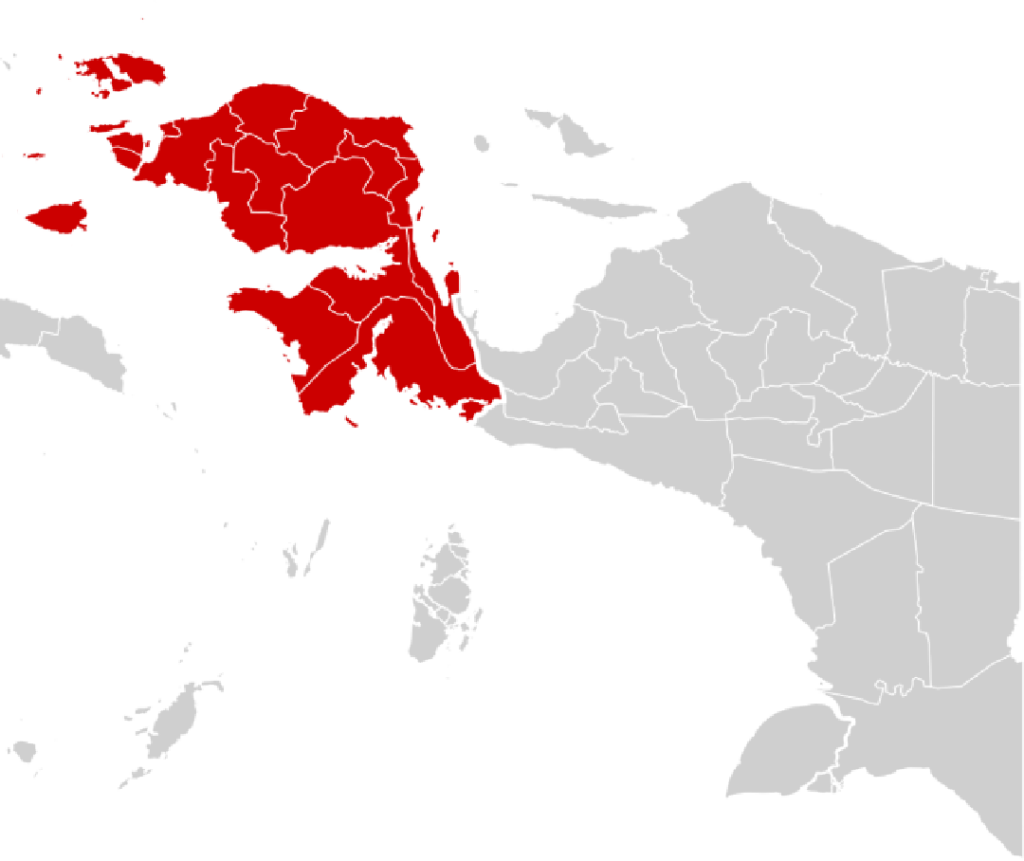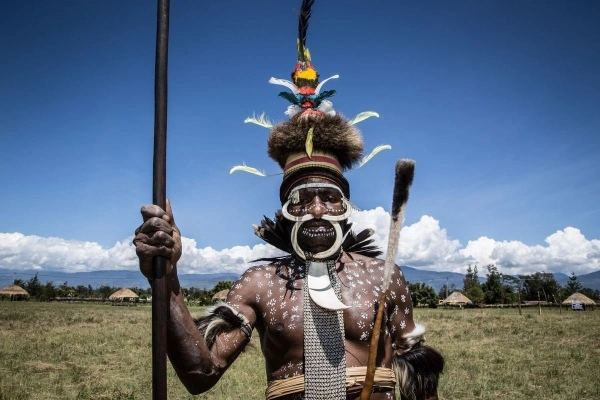
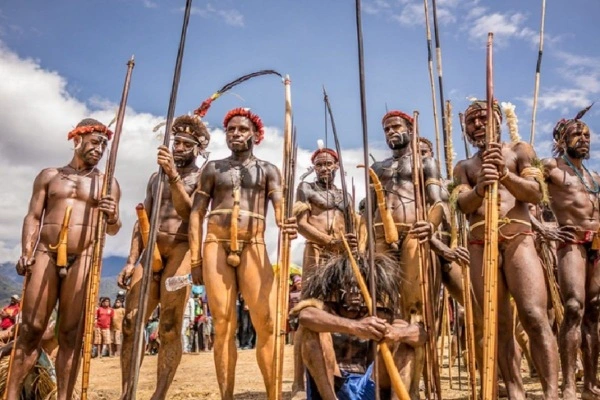
Papuan traditional clothing is not simply a collection of distinctive garments. Across Papua, clothing has historically reflected people’s relationship with nature, social position, gender, marital status, and customary life.
For international visitors, the image of Papua’s traditional dress is often immediately associated with the koteka. Yet that is only one part of a much broader cultural picture. There are different forms of traditional clothing, made from materials ranging from dried water gourds and tree bark to sago leaves and grass. Each has its function and, in some communities, its own rules governing who may wear it and on what occasion.
Two Indonesian cultural references, Finansialku and IDN Times, describe six forms of traditional Papuan clothing and five important rules surrounding their use. Together, they show how clothing can function almost like a visual language.
A garment can indicate whether someone is unmarried or married. Another can distinguish ordinary daily use from an important customary ceremony. Accessories can complete the appearance while carrying their own symbolic meanings.
Understanding those distinctions is increasingly important as Papua’s culture becomes more visible through tourism, education, cultural festivals, and national events.
For Indonesia, preserving knowledge about traditional clothing is also part of safeguarding the country’s wider cultural diversity. Papua is home to hundreds of ethnic communities and languages, meaning that cultural expressions should not be treated as a single uniform tradition. Finansialku itself notes the diversity of Papua’s peoples and the distinctive roles associated with traditional clothing.
Six Traditional Papuan Clothes to Know
1. Koteka: A Distinctive Men’s Garment
Perhaps no item is more immediately associated with traditional Papuan clothing than the koteka.
The Finansialku reference describes koteka as a traditional garment worn by men to cover the reproductive organs, leaving much of the rest of the body uncovered. It is also known by other names, including bobbe and horim.
Traditionally, koteka is made from a dried water gourd. The preparation process is itself an example of how closely traditional clothing is connected to the natural environment.
The gourd is first processed so that its inner flesh and seeds can be removed. It is then dried, including through exposure to heat, until the material becomes sufficiently solid and durable for use. The finished object generally has an elongated, tapered shape. In some examples, feathers from birds may be attached to the tip.
But the koteka is not necessarily identical everywhere.
Finansialku notes that its shape can vary between communities. The source also describes differences associated with social standing. A young unmarried man may wear the koteka pointing upward, while a person regarded as having a higher social position may wear it pointing upward and slightly to the right.
IDN Times adds another distinction. It describes simpler koteka without decoration as suitable for everyday use, while koteka intended for important customary ceremonies may be longer and feature traditional carvings. The source also states that size can be associated with the wearer’s social position within the customary structure.
The lesson for outsiders is important: a koteka should not be viewed merely as an unusual item of clothing. In the cultural context described by these sources, its design and manner of wearing can communicate information about the person using it.
2. Baju Kurung: A Women’s Garment with Outside Influence
The baju kurung represents another stage in the development of Papuan traditional clothing.
According to Finansialku, baju kurung is traditionally associated with women and has been influenced by outside cultural contact. It is commonly made from velvet and is particularly associated with women in Manokwari, although women in other areas have also adopted the garment.
Unlike the koteka, baju kurung is a more conventional upper-body garment. It is often combined with a rumbai skirt and accessories such as feathers, beads, or stones.
This combination illustrates how cultural traditions can change without necessarily disappearing.
Papuan clothing has not developed in isolation. Contact with other communities, regions, and cultural traditions has introduced new materials and forms. Yet those elements can become incorporated into local styles and take on new meanings.
For modern Papua, that adaptability is part of the story of cultural continuity.
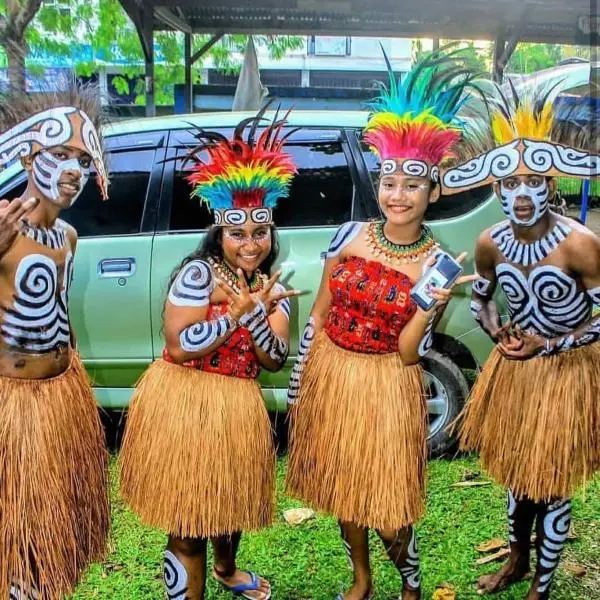
3. Rok Rumbai: Sago Leaves Become Clothing
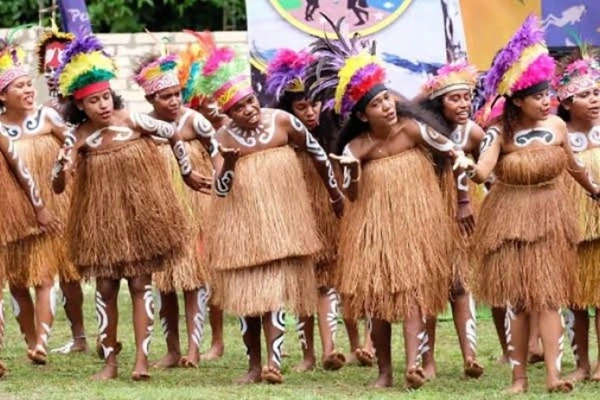
The rok rumbai, or rumbai skirt, is one of the most visually recognizable traditional garments described in the sources.
It is made from dried sago leaves that are processed and woven into a skirt. Finansialku says the garment has traditionally been used by communities in both coastal areas and the central highlands, including people associated with Tobati, Biak Numfor, Yapen, Sentani, Enggros, and Nafri.
The garment is generally described as women’s lower-body clothing, but the source notes that men may also wear rumbai skirts on certain occasions. In those cases, the upper body may remain uncovered.
IDN Times describes the rumbai skirt as being accompanied, in particular contexts, by head decorations made from cassowary feathers and dried sago leaves. It also describes the use of body decoration or traditional tattoos in connection with the appearance.
The material itself tells a larger story.
Sago has long been important in many Papuan communities. Turning parts of the sago plant into clothing demonstrates the practical relationship between traditional life and the surrounding environment.
The skirt is therefore not simply decorative. Its material connects clothing to local ecology and traditional knowledge.
4. Sali: Clothing Associated with Unmarried Women
The Sali is described in the sources as traditional clothing for unmarried women.
Finansialku states that Sali can be used in everyday activities and is traditionally made from tree bark or sago leaves. The source particularly notes the use of brown-colored tree bark, producing a garment that can resemble a simple piece of cloth when viewed from a distance.
IDN Times places greater emphasis on its social meaning.
According to the publication, Sali is specifically associated with unmarried women. Once a woman marries, she is no longer considered to wear Sali under the customary distinction described by the source.
That makes Sali more than a practical garment.
It can function as a visual marker of social status.
In traditional societies, clothing has often served this purpose. Rather than relying on a written record, community members can recognize social roles through appearance. In this context, clothing becomes part of a system through which cultural information is communicated.
5. Yokal or Yokai: Clothing for Married Women
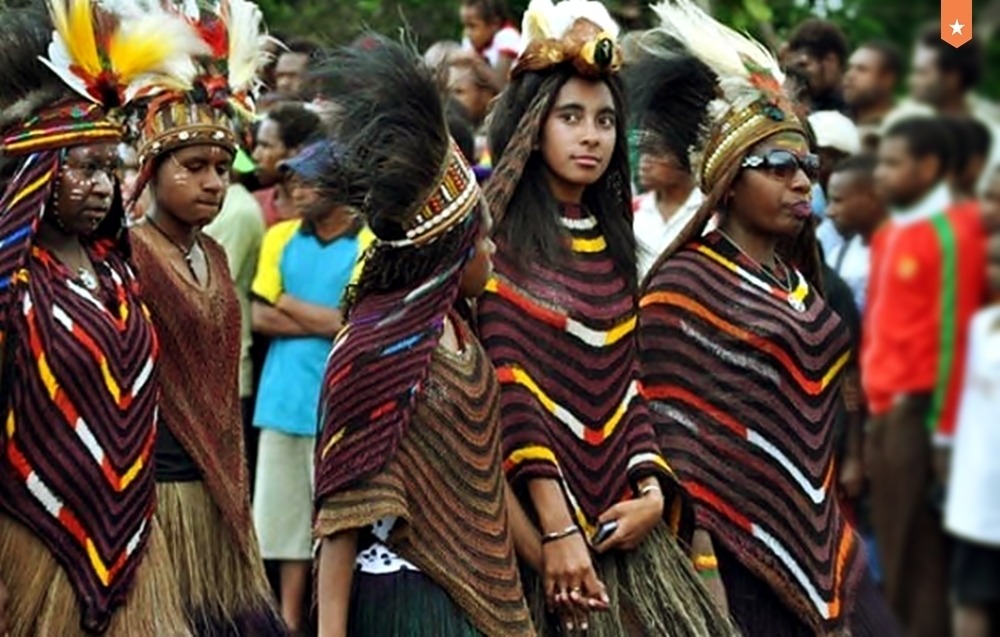
The fifth garment is known as “Yokal” in the Finansialku article and “Yokai” in the IDN Times article.
Finansialku describes Yokal as clothing associated with married women. It is made from tree bark, particularly material with brown or reddish tones, and is worn by wrapping it around the body.
IDN Times uses the spelling “Yokai” and similarly associates the garment with married women. Its article says the material is also derived from tree bark but distinguishes it from Sali through its reddish-brown color. It describes Yokai as associated particularly with communities in inland areas of Papua.
The difference in spelling is worth noting for international readers.
Traditional cultural terminology can be transliterated or written differently across Indonesian publications. Readers should therefore avoid assuming that Yokal and Yokai necessarily refer to two entirely different garments solely because of the spelling used by different sources.
More important is the cultural distinction presented by the sources: Sali is associated with unmarried women, while Yokal or Yokai is associated with married women.
IDN Times also emphasizes that this clothing is connected to a relationship with nature and should not simply be treated as an ordinary commercial product.
6. Grass Cloth: A Garment Made from Local Plant Material
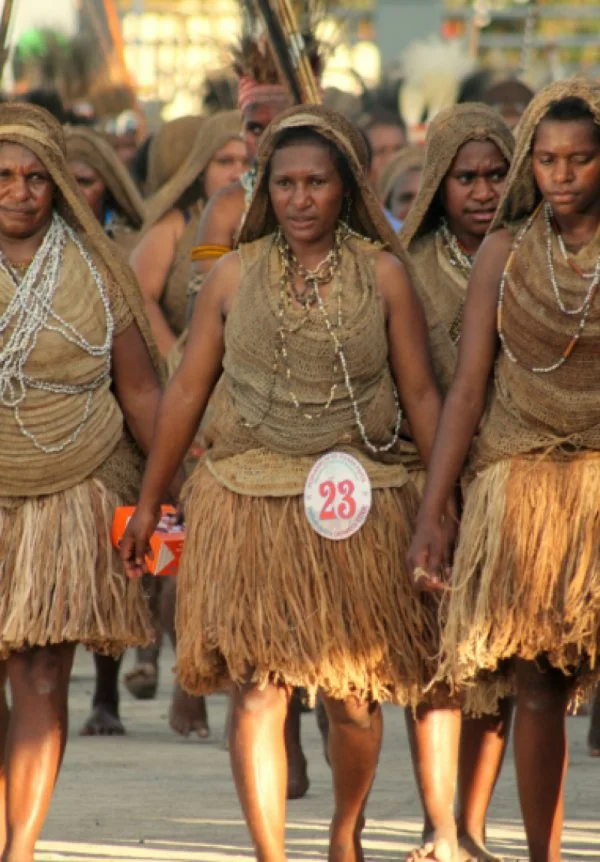
The sixth garment is baju kain rumput, or grass-cloth clothing.
Unlike some of the other garments described above, the grass-cloth garment can be worn by both men and women.
Finansialku explains that it is made using the young tips of sago leaves collected at high tide. The material is then dried and soaked before being woven. The weaving process uses wooden supports to help organize the strands, while the cords are made from dried and twisted grass.
The production process is labor-intensive and demonstrates traditional knowledge about local materials.
What may look simple to an outside observer therefore represents a series of skills: selecting the right plant material, harvesting it at the appropriate time, drying it, soaking it, preparing fibers, and finally weaving them into a wearable form.
That knowledge is part of Papua’s intangible cultural heritage.
Five Rules for Wearing Traditional Papuan Clothing
Knowing the names of the garments is only the beginning.
The sources also describe five important principles or rules surrounding traditional Papuan dress. They show that clothing cannot always be separated from customary status and ceremonial context.
1. Koteka Can Differ According to Occasion and Status
The first rule concerns the koteka.
IDN Times explains that koteka intended for ordinary daily use can be relatively simple, while koteka for important customary ceremonies can be longer and decorated with traditional carvings. The size can also reflect the social position of the wearer within the customary community.
This means that selecting a koteka is not necessarily just a question of appearance.
The occasion matters.
The status of the wearer can matter.
And the design itself can communicate information.
For international audiences, this is an important reminder that traditional clothing should not automatically be interpreted through modern fashion conventions.
2. Rumbai Skirts Can Be Accompanied by Head Decorations
The second rule concerns the rok rumbai.
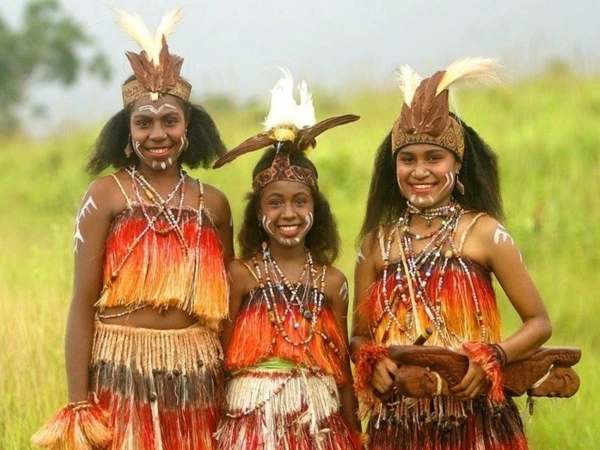
IDN Times describes head decorations as an important complement to the traditional appearance. These decorations can use cassowary feathers, rabbit fur, and dried sago leaves.
Finansialku similarly identifies head fringes as an accessory associated with traditional Papuan clothing and notes the use of cassowary feathers or alternative natural materials.
The headpiece is not merely an ornament.
In the explanation provided by IDN Times, it functions symbolically like a crown.
This transforms a collection of natural materials into an element of identity and presentation.
3. Sali and Yokal/Yokai Follow Marital Status
Perhaps the clearest customary distinction concerns women’s clothing.
The sources describe Sali as clothing for unmarried women, while Yokal/Yokai is associated with married women. IDN Times specifically states that women who marry are no longer expected to wear Sali under the customary distinction described in its article.
The rule demonstrates how clothing can communicate a person’s position within the social structure.
For outsiders, however, the distinction should not be interpreted as a universal rule applying identically to every Papuan community. Papua is culturally diverse, and customary practices can differ between communities.
The safest approach is to understand these descriptions as cultural references tied to particular traditions, rather than imposing one clothing system across the whole of Papua.
4. Traditional Accessories Complete the Cultural Appearance
The fourth principle involves accessories.
IDN Times highlights three important accessories associated with traditional Papuan clothing: animal teeth and tusks, head decorations, and the noken.
Animal teeth can be worn as necklaces or other ornaments. The source describes dog teeth as jewelry and pig tusks as another traditional accessory.
Head decorations may use cassowary feathers, rabbit fur, and dried sago leaves.
The noken, meanwhile, is an important woven bag made from natural fiber. It can be carried in different ways, including over the shoulder or like a backpack.
Finansialku describes noken as a woven bag used in everyday activities, including carrying crops such as tubers, beans, and vegetables.
The noken, therefore, demonstrates that traditional objects can have both cultural and practical functions.
5. Traditional Clothing Should Be Treated as Cultural Heritage
The fifth principle is perhaps the most important for visitors and outsiders: traditional clothing should be approached with respect for its customary meaning.
The sources repeatedly connect Papuan clothing with nature, social status, gender, marital status, and customary ceremonies. Some garments are intended for specific groups or contexts rather than unrestricted everyday use.
This is especially relevant as Papua becomes increasingly visible to domestic and international visitors.
Cultural tourism can create economic opportunities for communities, artisans, and local businesses. But tourism also brings responsibility.
Visitors should learn the meaning of an item before wearing it, ask local communities or cultural custodians when uncertain, and avoid treating sacred or customary objects as costumes without context.
Respect can turn cultural tourism into a form of education rather than simple consumption.
Clothing, Nature, and Papua’s Cultural Economy
One of the strongest themes running through the two sources is the relationship between clothing and the natural environment.
Water gourds become koteka.
Sago leaves become skirts.
Tree bark becomes clothing.
Grass becomes woven material.
Natural feathers become head decorations.
The materials demonstrate a traditional economy in which local communities made practical use of resources available around them.
That knowledge has contemporary relevance.
As Papua develops its tourism and creative economy, traditional clothing could provide opportunities for artisans, cultural educators, designers, and community-based tourism initiatives. The value is not only in selling finished products. It can also lie in preserving the knowledge of how materials are selected, prepared, and transformed.
For policymakers and cultural institutions, this creates a wider development question: how can traditional knowledge be preserved while communities gain fair economic benefits from cultural tourism?
The answer requires community participation.
Cultural heritage is strongest when the people who inherit it remain active participants in determining how it is presented, taught, and commercialized.
Traditional Dress in Modern Indonesia
Traditional Papuan clothing also has a place in contemporary Indonesian public life.
It can appear at cultural festivals, educational events, official ceremonies, exhibitions, and tourism programs. Its presence allows people from outside Papua to learn about the country’s extraordinary cultural diversity.
At the same time, modern use requires sensitivity.
A garment originally associated with a particular community or social status may be presented differently in a national cultural event. That does not necessarily mean the tradition has disappeared. Rather, it shows how cultural symbols can move between customary settings and modern public spaces.
The important task is to preserve context.
A koteka may carry different meanings when displayed in a museum, worn during a cultural presentation, or used in a customary ceremony. The same principle applies to rumbai skirts, Sali, Yokal, and grass cloth.
Understanding that difference helps prevent Papua’s culture from being reduced to stereotypes.
Papua’s Cultural Identity in a Changing Era
Papua is changing rapidly.
Infrastructure development, education, tourism, digital media, and growing connections between Papua and other parts of Indonesia are reshaping everyday life. Young Papuans increasingly move between traditional communities, schools, universities, cities, and national institutions.
That does not automatically mean traditional culture will disappear.
In many cases, greater connectivity can provide new opportunities to document and promote cultural heritage.
Digital platforms can introduce Papuan traditions to international audiences. Schools can teach children about local heritage. Museums and cultural centers can preserve traditional objects. Tourism programs can introduce visitors to local craftsmanship.
Traditional clothing can become part of that process, provided its cultural meaning remains visible.
The challenge is not simply to keep old garments physically intact.
The goal is to preserve their meaning, who wears them, how they are made, and why they exist.
Conclusion
The six forms of Papuan traditional clothing described by Finansialku provide an entry point into a much larger cultural landscape.
The koteka represents a distinctive men’s garment whose form and use can vary according to community, occasion, and social position. Baju kurung reflects cultural interaction and has become particularly associated with women in Manokwari. Rok Rumbai demonstrates the use of sago materials in traditional clothing. Sali is associated with unmarried women, while Yokal or Yokai is associated with married women. Grass-cloth clothing demonstrates another traditional method of transforming local plant materials into garments.
The five rules described by IDN Times add another layer of meaning. They cover differences in koteka according to occasion and status, the use of head decorations with rumbai skirts, distinctions between Sali and Yokal/Yokai, traditional accessories, and the broader customary meaning attached to Papuan clothing.
Taken together, these traditions show that clothing in Papua can function as a form of cultural language.
It can communicate identity, status, gender, marital position, connection with nature, and participation in customary life.
For Indonesia, preserving this heritage is part of protecting the country’s cultural diversity. For international audiences, it offers a more nuanced way to understand Papua beyond its geography and contemporary political narratives.
The future of Papuan traditional clothing will ultimately depend on whether the next generation can carry both the garments and the knowledge behind them.
That means preservation should not stop at museums or photographs.
It should live in communities, schools, cultural events, responsible tourism, and the hands of artisans who still know how to transform local materials into objects that carry meaning.
Papua’s traditional clothes are therefore not simply pieces of the past.
They remain part of a living cultural heritage that can continue to evolve while retaining the stories that gave each garment its meaning.
Read Also
Getting to Know the Asmat Tribe Funeral Ritual Ceremony
Papua’s Korowai Treehouses: A Living Legacy of Culture, Architecture, and Living in Harmony with Nature
The Bauzi Tribe in Papua Has a Forest Telephone Method, No Secrets Among Us
Getting to Know the Amungme Tribe’s Culture in Mimika