
For many small business owners, a government tender can represent a significant opportunity. Yet before competing for a project, entrepreneurs often have to navigate a maze of registration requirements, certificates, and administrative procedures that can be particularly difficult for smaller firms.
In Nabire, the local government is trying to lower one of those barriers.
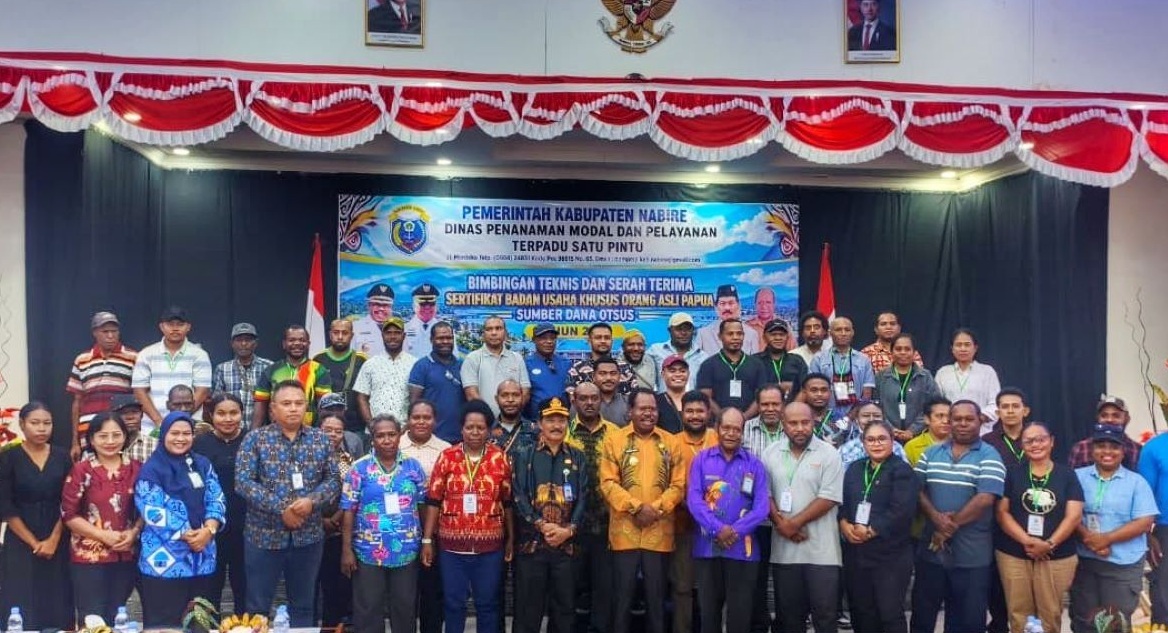
The Nabire Regency Government has provided free Business Entity Certificates, or Sertifikat Badan Usaha (SBU), to 51 Indigenous Papuan entrepreneurs, known locally as Orang Asli Papua (OAP). The program is intended to help local businesses obtain formal recognition, compete for government contracts, and participate more actively in the economic development of Central Papua.
The initiative, carried out through the Nabire Investment and One Stop Integrated Services Agency, or DPMPTSP, is more than an administrative exercise. For the recipients, obtaining formal business certification can provide access to previously inaccessible projects.
The policy also reflects a wider development challenge in Papua: ensuring that local communities are not simply consumers of economic growth but have the legal status, skills, and institutional capacity to become active participants in it.
Making Formal Business Access Easier
The certificates were handed to 51 OAP entrepreneurs on August 27, 2026. According to DPMPTSP Head Engelbertus Magai, the recipients had already established business entities in the form of limited partnerships, or CVs.
The SBU formally recognizes the classification and qualifications of a business, particularly in the construction sector. With the certificate in hand, eligible contractors can participate in government tenders for larger projects because their business capabilities have received formal recognition.
For a small contractor, that distinction can be decisive.
A company may have workers, equipment, and local experience, but without the necessary documentation, it can struggle to compete in a formal procurement system. Certification therefore serves as a bridge between informal economic activity and participation in the regulated market.
The Nabire government has also removed a financial obstacle. ANTARA reported that obtaining an SBU would normally cost approximately Rp18 million to Rp20 million. Providing the certificates free of charge means that the participating entrepreneurs can avoid a substantial upfront administrative cost.
The decision is therefore both a legalization measure and an economic access policy.
From Paperwork to Economic Opportunity
The importance of the program goes beyond the certificate itself.
According to DPMPTSP, the entrepreneurs also received training and assistance in managing their businesses professionally. The objective is to help them develop from small CVs into stronger business entities, with the possibility of eventually establishing limited liability companies, or PTs.
That progression matters because formalization can influence a company’s ability to obtain financing, establish partnerships, participate in procurement, and expand its operations.
Bupati Nabire Mesak Magai said the government has a responsibility to create broad opportunities for OAP entrepreneurs to grow and take part in the local economy. He argued that local businesspeople should not remain merely consumers of development but should become economic actors and partners for government.
The approach places local entrepreneurship at the center of development rather than treating government spending as an end in itself.
Connecting OAP Businesses to Government Projects
One of the clearest opportunities created by the SBU program is access to public procurement.
DPMPTSP said the certified entrepreneurs could seek opportunities with local government agencies that require construction and related services, including the public works, health, and education offices.
This is particularly relevant because public infrastructure remains an important component of development in Papua.
Roads, schools, health facilities, and other public infrastructure require contractors and service providers. When local businesses are capable of participating in those projects, part of the economic value generated by public investment can circulate within the local economy.
That can have a multiplier effect.
A local contractor winning a project may employ local workers, purchase materials from local suppliers, and use services from other small businesses. Revenue generated through the project can consequently move through several layers of the local economy.
However, certification alone cannot guarantee that outcome.
Businesses still need to demonstrate technical competence, financial discipline, good management, and the ability to complete projects according to procurement rules. That is why the training and mentoring component of the program is as important as the certificate itself.
The Challenge of Building Competitive Local Businesses
Bupati Mesak Magai has acknowledged that some young Papuan entrepreneurs face challenges in developing business skills and adapting to the requirements of a modern economy.
Speaking after a DPMPTSP-facilitated program at the RRI hall in Nabire on August 27, he highlighted limitations in business skills, communication, and the ability to identify and negotiate opportunities.
His comments point to an issue that cannot be solved simply by issuing business documents.
Formalization creates an opportunity, but entrepreneurs must also know how to use it.
A contractor needs to understand procurement procedures. A small retailer needs basic financial management. A food business needs consistent quality and customer service. A growing company needs bookkeeping, planning, and the ability to separate household finances from business finances.
These skills become increasingly important as local businesses move from small-scale operations into larger markets.
Adapting Without Losing Local Values
The Nabire government has framed this transition as a process of economic adaptation.
Mesak noted that Papua has its social and cultural traditions, including strong family relationships and communal approaches to household life. He said these values remain important, while also encouraging young Papuans to gradually adapt to the demands of the modern economy.
That balance is significant.
Economic development does not necessarily require communities to abandon their cultural identity. Instead, the challenge is to combine local values with the skills needed to operate successfully in a formal and increasingly competitive economy.
In practical terms, that could mean helping entrepreneurs understand accounting while maintaining community-based business models. It could mean encouraging young people to establish shops, food businesses, livestock operations, or construction companies while remaining connected to their families and communities.
DPMPTSP officials have also encouraged recipients to explore opportunities beyond government tenders. Engelbertus Magai pointed to livestock and other income-generating activities as examples of businesses that could be developed.
That broader approach reduces the risk of making government procurement the only pathway for local entrepreneurs.
Why Business Formalisation Matters for Papua
Papua’s economic development is closely linked to the ability of local communities to participate in formal markets.
For years, development programs have often focused heavily on physical infrastructure. Roads, buildings, telecommunications, and public facilities are essential, but infrastructure alone does not automatically create local economic capacity.
Businesses need to be ready to use the opportunities created by that infrastructure.
This is where formalization becomes important.
A registered and certified business has a clearer legal identity. It can compete for contracts, establish partnerships, and potentially gain access to formal financing. It can also build a track record that helps demonstrate its capacity to prospective clients.
In the long term, a stronger base of local enterprises can contribute to economic resilience.
Instead of relying predominantly on government employment or informal trading, communities can develop a wider range of private sector activities. Construction, agriculture, livestock, food services, retail, logistics, and other sectors can provide employment and generate income.
For Central Papua, where Nabire plays an important administrative and economic role, strengthening local enterprises could therefore complement wider regional development efforts.
A Policy Rooted in Special Autonomy
The initiative can also be viewed within the broader context of Indonesia’s Special Autonomy policy for Papua, which seeks to accelerate development and increase opportunities for Indigenous Papuans.
At the local level, however, the effectiveness of such policies ultimately depends on practical implementation.
A policy framework has limited impact if entrepreneurs cannot access licensing, financing, procurement opportunities, or professional training. The Nabire program attempts to address several of those practical barriers at once.
The government is not simply providing financial assistance. It is helping businesses obtain formal recognition and encouraging them to build the capacity required to operate within the formal economy.
That distinction is important for sustainability.
Direct financial assistance can help a business survive in the short term. Legal recognition and managerial capacity can potentially help it compete for years.
The Next Test: What Happens After Certification?
The 51 SBU recipients now face the more demanding part of the process.
The certificates provide access, but they do not guarantee contracts.
Their success will depend on whether they can convert formal recognition into viable businesses. That means maintaining professional standards, competing fairly, managing finances carefully, and delivering projects on time.
Government agencies also have a role.
DPMPTSP has said it will continue to assist OAP entrepreneurs because the certification process can involve several institutions and can be complicated.
Continued mentoring could be especially important for first-time participants in government procurement.
The government can also improve the wider business environment by ensuring that licensing services remain fast, transparent, and accountable. Mesak has specifically asked DPMPTSP to make licensing easier and to prevent entrepreneurs from seeing business administration as an unnecessarily difficult process.
That institutional reform may ultimately be as important as the free certificates.
If entrepreneurs can obtain documents efficiently, understand procurement rules and receive reliable guidance, more local businesses may be able to enter the formal economy.
From CVs to Stronger Companies
The long-term ambition is clearly larger than the 51 businesses receiving certificates.
DPMPTSP hopes that the supported businesses will eventually develop from CVs into PTs.
That transition would represent more than a change in legal status. It could signal the emergence of companies with greater organizational capacity, stronger financial management, and the ability to undertake larger projects.
The process will take time.
Businesses need experience, capital, skilled workers, and consistent market opportunities. Yet creating the first step toward formal participation can be critical.
In that sense, the Nabire initiative is best understood not as a one-off distribution program but as an attempt to build an entrepreneurial pipeline.
A Broader Opportunity for Local Economic Growth
The policy also carries a social dimension.
When Indigenous Papuan entrepreneurs become more active in the formal economy, the benefits can extend beyond individual business owners. Successful businesses can employ local residents, train younger workers, and create demand for suppliers.
Over time, these developments can strengthen household incomes and broaden the local tax and economic base.
There is also a potential confidence effect.
For young Papuans considering entrepreneurship, seeing local businesses successfully participate in formal procurement may demonstrate that business ownership is a realistic career option.
This is particularly relevant as the government encourages young people to adapt to changing economic conditions.
The goal should not be to make every young person a contractor. Rather, the broader objective is to create a business environment in which those who want to become entrepreneurs have a fair opportunity to do so.
Conclusion
Nabire’s decision to provide free SBU certification to 51 OAP entrepreneurs represents a practical step toward strengthening Indigenous Papuan participation in the formal economy. By removing certification costs, providing training, and connecting businesses with potential government procurement opportunities, the local government is attempting to address some of the barriers that small enterprises face.
The next stage will determine whether the policy delivers its full economic value.
Certificates must lead to contracts, contracts must lead to sustainable businesses, and sustainable businesses must create employment and wider economic opportunities. Achieving that will require continued mentoring, transparent procurement, access to finance, and a business environment that rewards competence and compliance.
For Nabire, the significance of the program is therefore not measured simply by the number of certificates handed over on August 27.
Its real measure will be whether those 51 entrepreneurs can use their new legal status to build stronger companies, employ more people, and become lasting contributors to Central Papua’s economy.
That would turn a government administrative service into something much more consequential: a pathway for local enterprise to become a stronger engine of Papua’s development.

