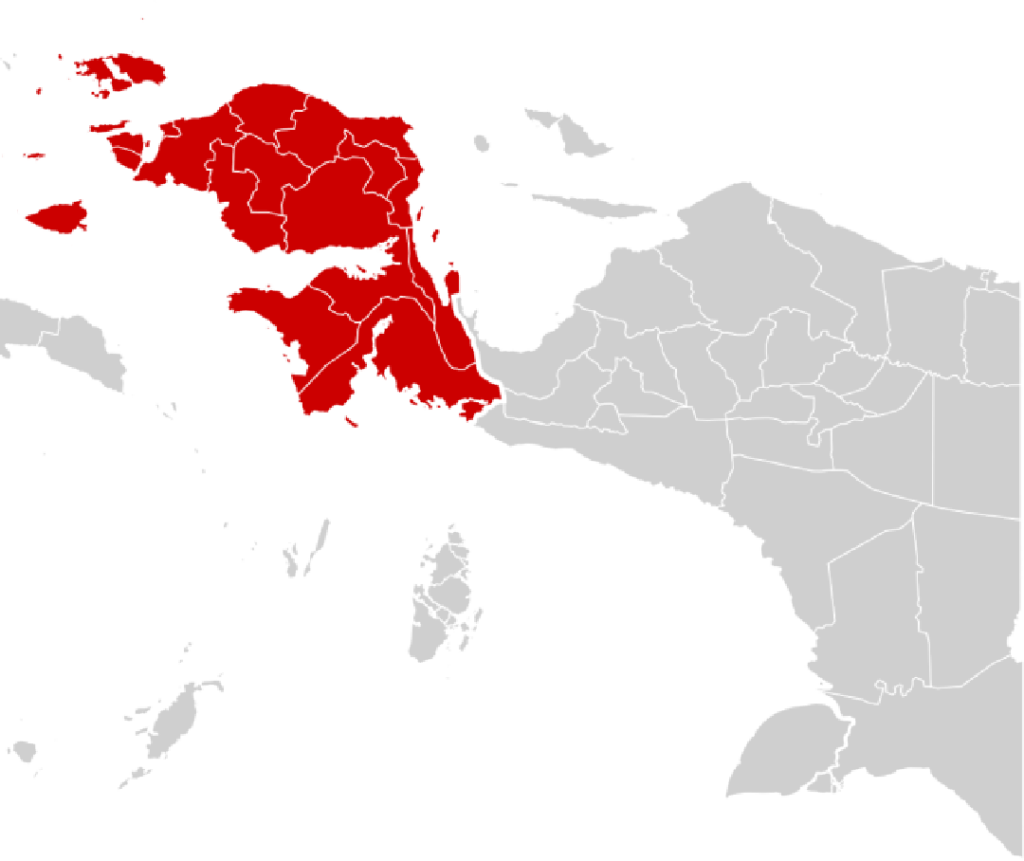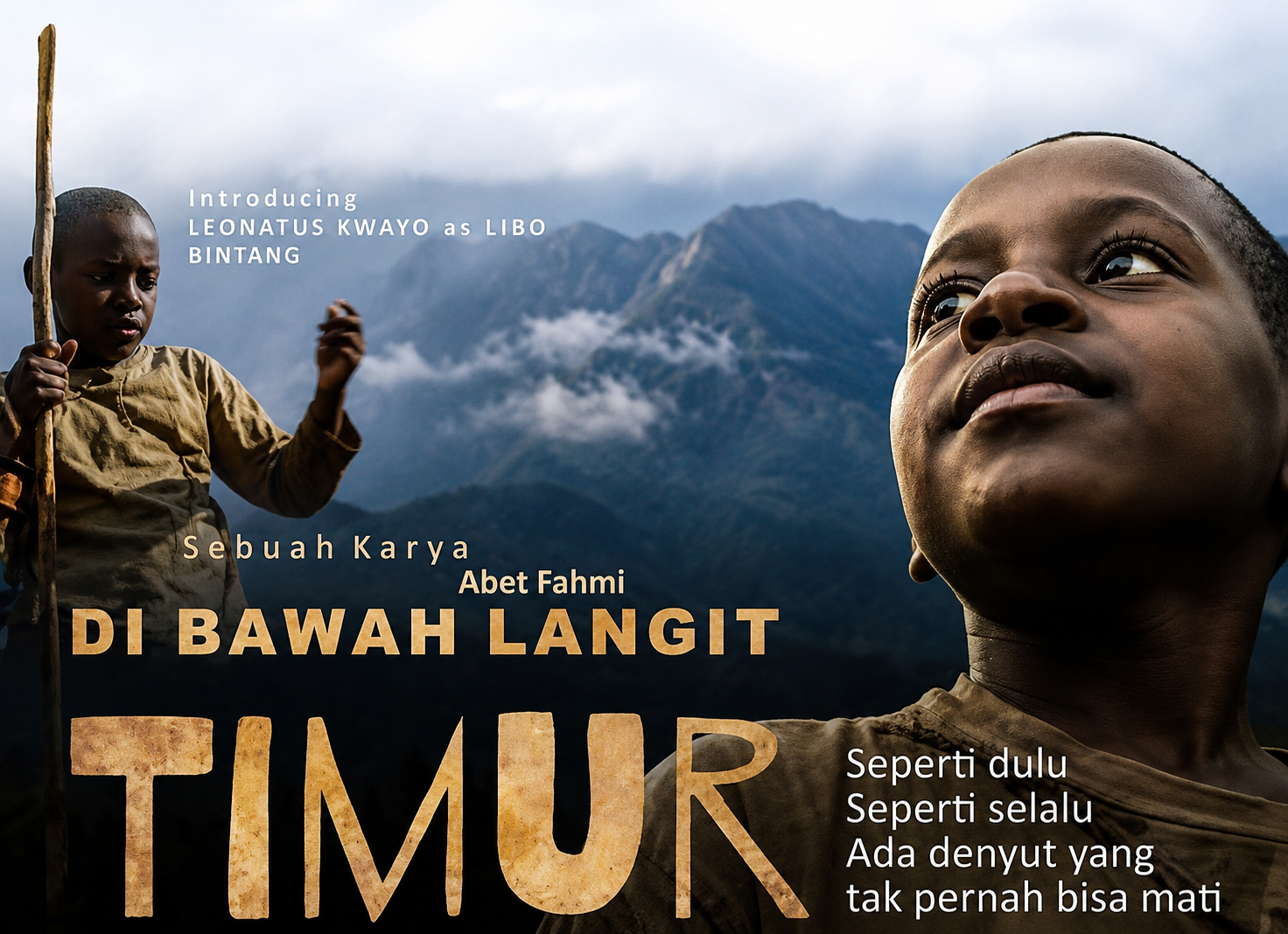
A child walking from the interior of Papua toward a flag-raising ceremony may appear to be a simple cinematic premise. In Di Bawah Langit Timur (Under the Eastern Sky), however, that journey becomes a broader reflection on how Indonesia is experienced from places far beyond its major cities.
Released ahead of Indonesia’s 81st Independence Day on August 17, 2026, the musical short film follows Libo, a Papuan child who travels from the interior toward a flag ceremony. Directed by Abet Fahmi, the film uses Papua not simply as a backdrop but as the setting for a story about hope, struggle, unity, and love of country.
That choice gives the production a distinctive place in this year’s Independence Day cultural landscape. Rather than presenting national identity solely through familiar urban images, Di Bawah Langit Timur puts a child from Papua at the center of the story.
For an international audience, the film offers a glimpse into one way Indonesian filmmakers are using popular culture to discuss national identity: not by erasing regional differences, but by placing those differences within a larger national story.
Papua Becomes More Than A Cinematic Backdrop
A Journey Toward the Flag
The film’s central character, Libo, begins his journey in the interior of Papua before making his way toward a flag-raising ceremony. According to the director, the journey is intended to open a conversation about what independence, hope, and belonging can mean from an Eastern Indonesian perspective.
That perspective is significant.
Indonesia is an archipelagic country stretching thousands of kilometers from west to east. Its national identity has consequently developed through a combination of different languages, cultures, traditions, and local histories.
The film’s creators deliberately place Papua within that wider picture.
Abet Fahmi explained that he selected Papua because he wanted to demonstrate the breadth of Indonesian stories. In his view, Papua should not be seen merely through its natural scenery but also through the people and stories that emerge from the region. He described independence as something that should be experienced as belonging to everyone, from Sabang to Merauke.
The statement captures the film’s central proposition. Its nationalism is presented through an individual journey rather than through political speeches.
Libo simply wants to reach the ceremony.
That personal journey becomes the vehicle through which the film discusses a much larger idea.
Local People at the Center of the Story
The production also sought to maintain a strong connection with Papua by selecting local talent.
Abet said he wanted the principal actor to be a Papuan child who actually lives in Papua. Social media popularity was not the primary consideration. Instead, the filmmakers focused on whether the child had the character and qualities required for the role.
That decision matters from a storytelling perspective.
A film about Papua made entirely through an outside lens can risk creating a distance between the story and the community it portrays. By involving local children and people familiar with the environment, the production attempted to preserve what the director described as an organic quality.
There were challenges. Some of the young performers were accustomed to creating digital content rather than acting as fictional characters. Moving from simply being themselves to portraying a character required adaptation. Yet the director regarded their natural qualities and spontaneity as strengths worth protecting.
The result is an approach that places authenticity above celebrity.
For a short film, that can be an important creative decision.
Nationalism without Erasing Identity
One of the more interesting elements of Di Bawah Langit Timur is its treatment of national unity.
The film does not frame unity as requiring every region to look or behave in the same way. Instead, the director describes Indonesia as a shared home built from different cultures, languages, traditions, and experiences.
That idea gives the film a cultural dimension beyond the immediate Independence Day celebration.
National identity is often discussed through symbols such as flags, ceremonies, and national anthems. Those symbols remain important in the film, particularly because Libo’s journey leads toward a flag-raising ceremony. But the filmmakers also suggest that national belonging can coexist with strong regional identities.
Papua therefore remains recognizably Papua within the story.
The landscape, people, and local setting are not treated as obstacles that must disappear before the national narrative can emerge. Instead, they become part of the narrative itself.
This approach also reflects Indonesia’s broader cultural complexity, where local and national identities often coexist.
For international readers unfamiliar with Indonesia, that is perhaps one of the most useful aspects of the film. It presents nationalism not simply as a centralized concept but as something that can be expressed through local experiences.
Music Turns the Message Into a Shared Language
The Role of “Fajar Indonesia”
The musical dimension gives Di Bawah Langit Timur another layer.
Its original soundtrack, “Fajar Indonesia,” was arranged by Sastro Adi and developed from the Mantra Mukaddimah Fajar Indonesia. The song carries a message of love for the homeland, commitment, and perseverance.
The soundtrack is important because the film does not rely solely on dialogue to communicate its message.
Music allows the story to move from the specific experience of one child toward a broader emotional idea.
The opening imagery of a new day and the repeated references to devotion to the homeland connect the personal journey of Libo with the wider theme of independence. The song essentially provides an emotional bridge between the character’s physical journey and the film’s national message.
A Musical Map of Indonesia
Perhaps more strikingly, “Fajar Indonesia” incorporates philosophical expressions from different parts of the archipelago.
The lyrics draw on values associated with Bugis and Makassar, Mandar, Dayak, Banjar, Javanese, Sundanese, Minangkabau, and Batak traditions. Among those referenced are Sipakatau, Sipakalebbi, Sipakainge, Sipamandar, Siamasei, Adil Ka’ Talino, Baiman, Baadab, Bauntung, Batuah, Memayu Hayuning Bawana, Silih Asih, Silih Asah, Silih Asuh, Dima bumi dipijak, di siko langik dijunjuang, and Dalihan Na Tolu.
The decision to bring those different traditions together is deliberate.
Rather than suggesting that one cultural tradition represents Indonesia by itself, the soundtrack creates a musical collection of values from across the country.
That makes the title Di Bawah Langit Timur especially relevant. The film begins in Papua, but its musical message travels across the Indonesian archipelago.
The concept is simple: regional diversity does not necessarily have to compete with national identity.
It can help to construct it.
From Papua’s Interior to the National Screen
Why Representation Matters
The film arrives at a time when stories about Papua continue to attract significant attention in Indonesia’s political, economic, and social conversations.
Much of the international coverage of Papua focuses on development, security, infrastructure, and political debates. Those issues are important, but they represent only part of the region’s social reality.
There are also children going to school, families building their livelihoods, communities maintaining traditions, and young people participating in Indonesia’s cultural and creative life.
Di Bawah Langit Timur enters that space through entertainment.
Its story does not attempt to provide a comprehensive picture of Papua. It is a short musical film, not a documentary or policy report. But its creative choice to put a Papuan child at the center of an Independence Day story provides a different kind of representation.
It allows Papua to appear as a place where national stories are also lived.
The director has emphasized that the region should not be used only for its visual beauty. The people and their stories are equally important.
That distinction is particularly relevant for international audiences, who often encounter Papua primarily through news reports.
Cinema can introduce another dimension.
Creative Industries and Regional Voices
There is also a broader implication for Indonesia’s creative economy.
The decision to use local performers and a Papua-based storyline demonstrates how regional communities can contribute to national cultural production. Digital distribution makes it possible for a short film produced around a regional story to reach viewers far beyond its original setting.
That potentially creates space for more stories from Indonesia’s eastern regions.
The issue is not simply whether one film becomes popular. It is whether productions such as this can encourage filmmakers, producers, and digital platforms to look beyond established cultural centers when developing new stories.
Abet said he hoped more stories from areas that have historically received less attention would find room in the creative industry.
That aspiration has significance beyond this particular production.
Indonesia’s cultural diversity is enormous. A national creative industry that can incorporate more regional voices is better positioned to reflect that diversity to domestic and international audiences.
Independence Through a Child’s Perspective
There is an emotional simplicity to the film’s premise.
Libo is not portrayed as a politician, soldier, or public official. He is a child making a journey toward a national ceremony.
That perspective strips the idea of patriotism down to something personal.
The filmmakers connect nationalism with awareness, responsibility, and service rather than merely with slogans. Sastro Adi, the composer and arranger of “Fajar Indonesia,” described love for Indonesia as something that begins with personal consciousness and a willingness to serve.
That interpretation is consistent with the film’s overall tone.
The story does not present national identity as an abstract concept detached from ordinary life. Instead, it places the idea within the experience of a child.
The flag ceremony becomes the destination, but the journey is the story.
That distinction is important because national celebrations can sometimes become dominated by ceremony itself. A musical film can instead ask what the symbols of independence mean to people living in very different circumstances.
From the filmmakers’ perspective, the answer is that independence should be understood as belonging to everyone.
A Cultural Message for Indonesia’s Independence Day
The timing of the release is central to its meaning.
Indonesia will celebrate its 81st Independence Day on 17 August 2026. Di Bawah Langit Timur was created specifically as a creative contribution to that national moment. Executive Producer Ulta Levenia described the film as a creative offering that combines story, Papua’s visual environment, and music to demonstrate that Indonesian stories also grow from the country’s interior regions.
The timing also gives the film an opportunity to reach audiences who may be thinking about independence through more traditional celebrations.
Flag ceremonies, public performances, and national decorations remain familiar features of the anniversary. A short musical film adds another form of participation.
It tells a story.
And the story comes from Papua.
That is perhaps the film’s strongest symbolic element.
The national Independence Day narrative does not begin and end in Jakarta. It can also emerge from an interior community in Papua, represented through the journey of a child.
A Broader Conversation about Indonesia’s Diversity
For an international audience, Di Bawah Langit Timur can be read as a small cultural window into Indonesia’s approach to diversity.
The country contains hundreds of ethnic communities and numerous regional traditions. Maintaining a sense of national cohesion within that diversity is an ongoing social process.
The film’s creative answer is not uniformity.
It is coexistence.
Abet’s message is that Indonesians can maintain different cultures and traditions while sharing a common national home.
That framing also provides a more nuanced way of discussing nationalism.
Patriotism does not necessarily require regional identities to disappear. Instead, regional identity can become one of the foundations from which national identity is expressed.
In the film, Papua is therefore both the beginning of Libo’s journey and part of the larger Indonesian story.
Looking Beyond the Independence Day Moment
The film’s release may be tied to one specific date, but its broader cultural implications could extend beyond August 17.
Indonesia’s creative industry has an opportunity to tell more stories from regions that remain underrepresented in mainstream media. Papua, with its diverse communities, landscapes, and cultural traditions, offers considerable storytelling potential.
The challenge will be ensuring that these stories remain authentic and do not reduce local communities to scenery or symbols.
Di Bawah Langit Timur attempts to address that challenge through its casting and its emphasis on local experience. The production chose a Papuan child living in Papua for the central role and sought to preserve the natural qualities of the performers.
That approach can become a useful model for future productions, particularly when stories involve communities that are frequently portrayed from outside perspectives.
The film itself is modest in scale, but the principle behind it is larger: regional stories can be national stories too.
Conclusion
Di Bawah Langit Timur arrives ahead of Indonesia’s 81st Independence Day with a simple but carefully constructed message. From the interior of Papua, a child named Libo makes his way toward a flag ceremony, turning a personal journey into a reflection on hope, unity, and love for Indonesia.
Its significance lies not only in its patriotic theme but also in who tells the story and how.
Papua is presented through local people, a local child, and a setting that forms part of the character’s world rather than merely serving as scenery. At the same time, the soundtrack “Fajar Indonesia” connects the Papua-based narrative with philosophical traditions from across the Indonesian archipelago.
For Indonesia’s Independence Day, that combination offers a timely cultural message: national identity can be strengthened by recognizing the diversity that already exists within the country.
For international viewers, the film offers another way to understand Papua and Indonesia through a child’s journey rather than through the familiar language of politics and headlines.
The film can be accessed through the YouTube channels of Ulta Ultimatum and Bintang, according to the reports.
In the end, the journey of Libo is deliberately uncomplicated. He walks toward a ceremony. But behind that journey is a larger idea about belonging, representation, and the many places from which an Indonesian story can begin.
From beneath the eastern sky, this one begins in Papua.