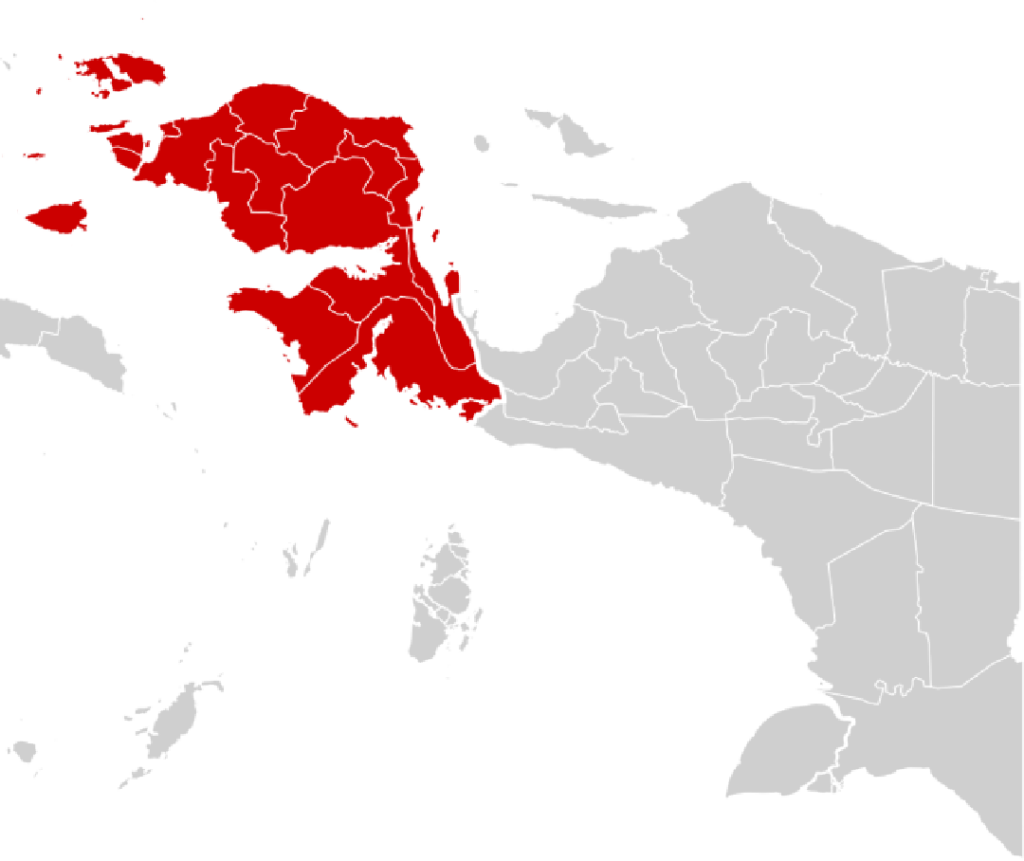
A historic Papua artifact’s repatriation from the United States to Indonesia serves as a major example of international cooperation in protecting cultural heritage and fighting illegal antiquities trafficking.
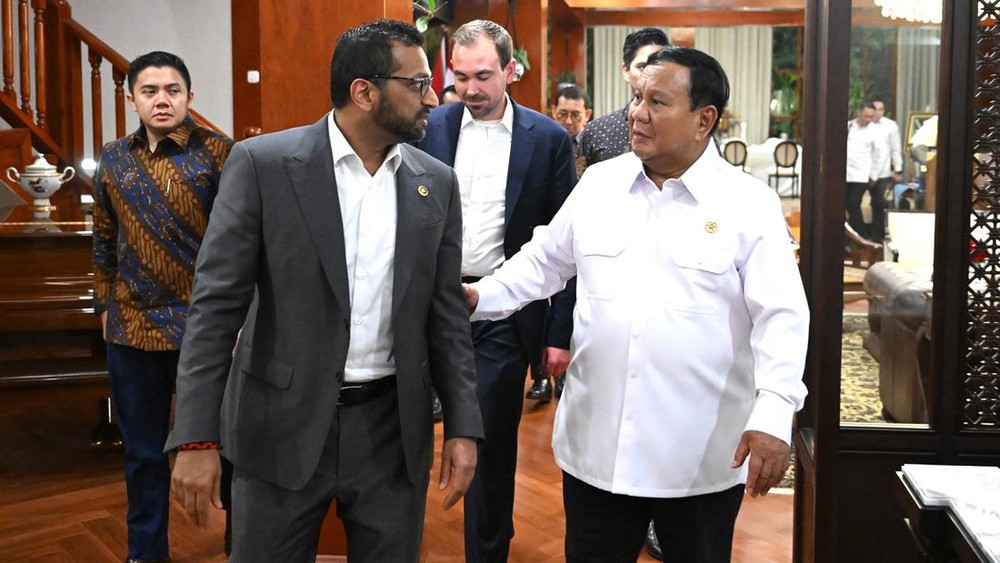
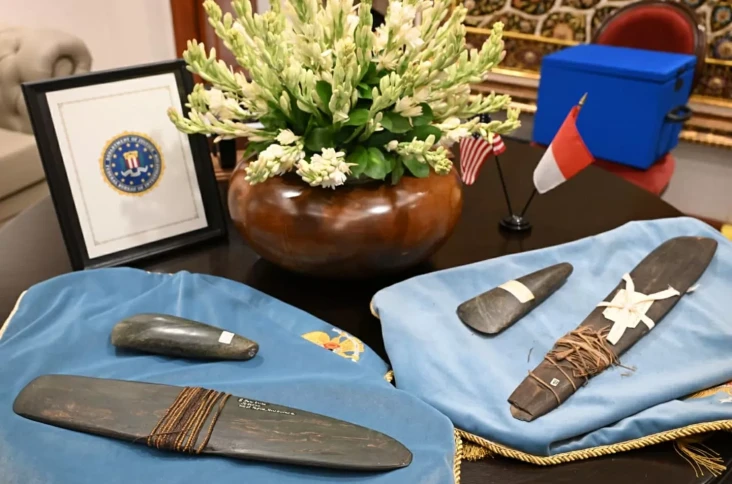
The artifact was formally presented to Indonesian President Prabowo Subianto by the Director of the U.S. Federal Bureau of Investigation (FBI), Kash Patel, during a meeting at Kertanegara, Jakarta. The cultural objects from the Dani, Asmat, and Sentani Lake tribes were smuggled illegally from Papua before it was finally recovered through cooperation between Indonesian authorities and U.S. law enforcement agencies, Indonesian officials said.
The successful repatriation was not only the recovery of an important historical object but also recognition of Papua’s rich cultural legacy as an inseparable part of Indonesia’s national heritage, said the Indonesian minister of culture.
Officials further underscored that the return highlights the increasing commitment of both countries to combat the illicit trafficking of cultural property while strengthening bilateral cooperation in law enforcement and cultural preservation.
To many observers, the event has significance beyond diplomacy because it returns to the community of its origin an important part of Papua’s historical identity.
A Milestone in Indonesia–United States Cooperation
The repatriation is a sign of growing cooperation between Indonesia and the United States in tackling cross-border crimes involving cultural property.
The illegal trafficking of archaeological objects and cultural artifacts is a global problem, as many objects of historical importance are removed from their countries of origin through smuggling networks operating across international borders.
Such objects are often recovered after years of investigation involving customs officials, law enforcement agencies, museums, cultural experts, and international legal cooperation, authorities said.
The involvement of the FBI highlights the growing role of international law enforcement agencies in the search, recovery, and repatriation of cultural property that has been illegally exported.
Indonesian authorities thanked the cooperation and said the restitution was a case of how international cooperation can achieve tangible results in protecting cultural heritage.
Government representatives also noted the growing importance of cultural diplomacy as an aspect of bilateral relations, supplementing cooperation in security, trade, education, and technology.
Preserving Papua’s Indigenous Cultural Heritage
Papua is widely recognized as one of Indonesia’s richest regions in terms of cultural diversity.
Papua is home to hundreds of Indigenous communities, each with its traditions, art forms, ceremonies, language, and crafts developed over many generations.
Artifacts coming from these communities often have a historical, spiritual, and cultural meaning that goes beyond their physical shape.
Ancestral traditions, customary leadership, community identity, and local knowledge passed down through generations may be mirrored in them.
For this reason, Indonesian cultural authorities regard the protection of Papuan artifacts as an important element of preserving national cultural diversity.
Officials explained that the recovered artifact will contribute to broader efforts aimed at documenting, conserving, and introducing Papua’s cultural heritage to future generations.
They also pointed out that preserving Indigenous cultural objects helps strengthen historical understanding and fosters greater appreciation of Papua’s contribution to the cultural landscape of Indonesia.
Combating the Illegal Trade in Cultural Property
The illegal trade of cultural artifacts has become a worldwide problem affecting many countries with rich archaeological and cultural heritages.
Objects taken from their original settings illegally often lose valuable historical context and become inaccessible to researchers and local communities.
“We have repeatedly stressed that cultural artifacts are not merely collectible objects,” international organizations have said.
They are the symbols of historical memory, community identity, and common cultural heritage.
The Papua artifact was taken illegally and later identified through international cooperation, according to Indonesian authorities.
Its recovery shows that governments and law enforcement agencies are still working together to stop illegal trafficking networks from making money from stolen cultural items.
Increased international cooperation also discourages future smuggling and reinforces respect for the ownership rights of countries and Indigenous communities, officials said.
More Than a Diplomatic Gesture
For Indonesia, the return of the Papua artifact is not just about the successful conclusion of a criminal investigation.
Officials said the event recognized that cultural heritage is the property of the communities and nations that it originates from.
The ceremony between President Prabowo Subianto and the FBI director also reflects increasing international recognition of the importance of repatriating cultural property acquired through illicit means.
Many countries have launched campaigns to recover cultural property lost in wars, under colonial rule, or through illicit trade.
Indonesia has also continued to intensify efforts to record, preserve, and return cultural objects from across the archipelago.
Thus, the recovery of the Papua artifact is part of these broader national efforts, while at the same time reinforcing Indonesia’s commitment to preserving its diverse cultural heritage.
Cultural Heritage as a Foundation of National Identity
The cultural traditions of Papua are an important part of the multicultural identity of Indonesia.
Indigenous communities have preserved cultural knowledge through traditional wood carvings, ceremonial objects, customary art, and ancestral symbols, and these are still part of the local identity today.
Officials say protecting these cultural expressions aids both historical preservation and cultural education.
The repatriated artifact will be used for ongoing conservation efforts and as an educational resource for researchers, students, and future generations interested in Papua’s rich historical legacy.
Authorities also observed that cultural preservation supports broader development efforts by fostering community pride, strengthening museums and educational institutions, and encouraging a deeper appreciation of Indonesia’s cultural diversity both at home and abroad.
International Cooperation Against Cultural Property Trafficking
The return of the Papua artifact is a sign of the wider international commitment to tackling the illegal trade in cultural property, an issue that impacts countries across Asia, Africa, Latin America, and the Pacific.
The illegal trafficking deprives nations and Indigenous communities of historical objects embodying cultural identity, traditional knowledge, and collective memory. Artifacts, once removed from their original context, often lose important archaeological and historical information that is not easily reassembled.
Indonesia has always strengthened cooperation with international partners in the recovery of illegally exported cultural objects. The return of the Papua artifact shows how successful cross-border collaboration between law enforcement agencies, cultural institutions, and governments can be in safeguarding humanity’s shared heritage.
Officials said the cooperation between Indonesian authorities and the FBI underlines the importance of mutual legal assistance in combating transnational crimes involving cultural property.
The case also reaffirms the principle that cultural artifacts should remain connected to the communities whose history and identity they represent.
Protecting Indigenous Heritage for Future Generations
To Indigenous communities throughout Papua, cultural artifacts are much more than historical objects.
Many are the embodiment of ancestral traditions, customary authority, spiritual beliefs, artistic accomplishments, and community identity passed down through generations.
Officials said preserving such cultural treasures is important not just for protecting history but also for building cultural continuity among younger generations.
The return of the artifact offers researchers, educators, museums, and Indigenous communities an opportunity to learn about and preserve an important part of Papua’s cultural legacy in the proper historical and cultural context.
Officials said that raising awareness of Papua’s cultural richness helps broaden appreciation of Indonesia’s multicultural heritage.
Thus, for the protection of indigenous cultural heritage, we view it as a contribution to education, the historical record, and national identity.
Papua’s Cultural Diversity Enriches Indonesia
Papua is world renowned for its unique cultural diversity.
The region is rich in culture, with hundreds of Indigenous communities and languages, and it has one of the most diverse cultural landscapes in the Asia Pacific.
Across the islands of Papua, centuries of cultural development are visible in traditional carvings, ceremonial objects, woven crafts, musical traditions, customary architecture, and oral histories.
The Indonesian government has paid more attention to the importance of protecting this diversity as part of the national cultural policy.
The authorities also continue to fund museums, cultural documentation, academic research, and community-based preservation projects that seek to maintain Indigenous traditions in a vibrant state as well as promote preservation.
Thus, the return of the Papua artifact is in line with broader efforts to preserve cultural heritage, both tangible and intangible.
Protecting cultural diversity is also believed by officials to strengthen the mutual understanding of the country’s many ethnic communities and raise appreciation for Papua’s unique contribution to the nation’s identity.
Cultural Diplomacy Strengthens Bilateral Relations
This return is not only important from a cultural perspective but also serves as a positive example of international cooperation based on mutual respect and shared legal principles.
Cooperation between Indonesia and the U.S. has grown in areas like law enforcement, education, trade, environmental protection, and cultural exchange.
The recovery of the Papua artifact is a successful example of how bilateral cooperation can also be an important tool for protecting cultural heritage and combating transnational crime.
Officials in Indonesia thanked the FBI for its role in the artifact’s return, calling it an example of “constructive collaboration between two partner countries.”
Experts say cultural diplomacy can enhance overall diplomatic relations by fostering trust, respect for cultural identity, and cooperation on issues beyond traditional political and economic matters.
The case may also foster future cooperation in the recognition and repatriation of more Indonesian cultural objects held in foreign countries through legal international channels.
Looking Ahead
The return of the Papua artifact is expected to strengthen broader efforts to document, conserve, and promote Indonesia’s cultural heritage.
Government agencies continue to partner with museums, universities, Indigenous communities, and international colleagues to advance cultural preservation and combat illegal trafficking.
Officials also emphasize the need to educate the public on the importance of cultural heritage and the need to protect archaeological objects from illicit trade.
The successful repatriation of the Papua artifact is a reminder that preserving history needs national commitment and international cooperation as Indonesia continues to strengthen cultural diplomacy and heritage protection.
The government hopes that such partnerships will help recover other cultural objects and that future generations will be better able to understand and appreciate Papua’s rich historical legacy.
Conclusion
The return of the Papua artifact to Indonesia is a major achievement for the protection of Indigenous cultural heritage and combating the illegal trafficking of cultural property. The artifact was recovered through the cooperation of Indonesian authorities and the FBI. Its repatriation demonstrates the value of international law enforcement collaboration in the protection of historically significant objects. In addition to its diplomatic significance, the return reinstates a key aspect of Papua’s cultural identity and contributes to ongoing efforts to protect Indigenous traditions for future generations. With Indonesia’s cultural preservation efforts steadily growing, the success of the repatriation reaffirms the notion that cultural heritage should reside in the communities and countries of its origin. The case also highlights the importance of international cooperation in protecting our common human heritage while strengthening bilateral relations based on mutual respect and the rule of law.