
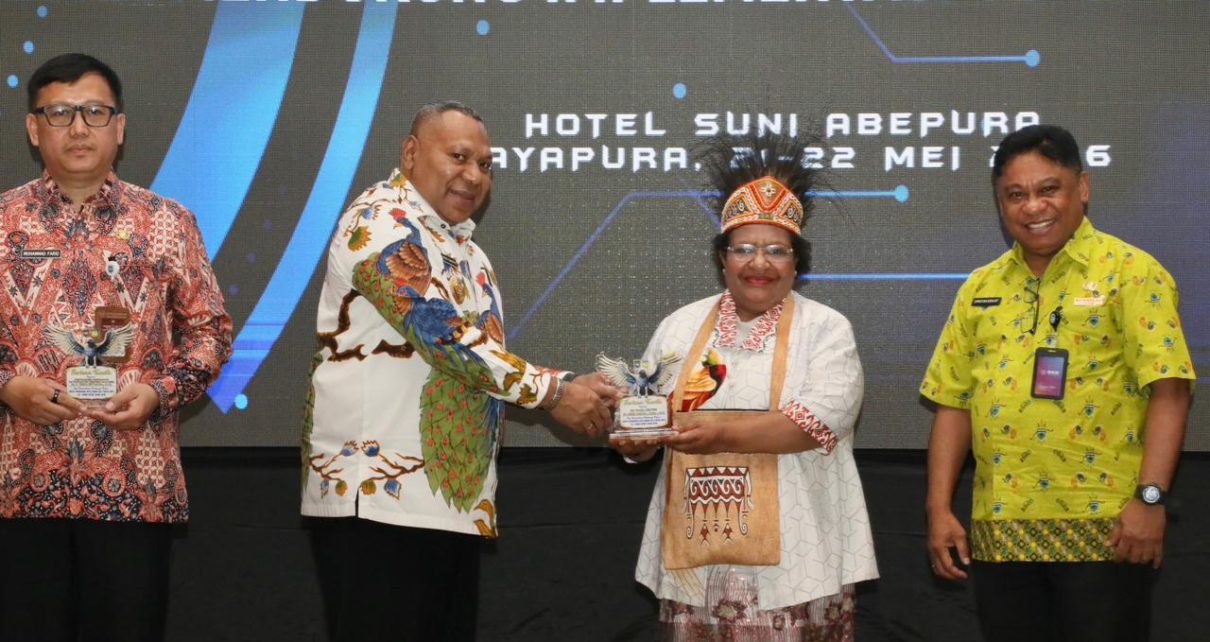
Officials from across Papua filled the meeting hall at Hotel Suni in Abepura, Jayapura, on May 21 carrying demographic reports, laptops, and regional data records that many admitted still do not match one another.
The issue discussed that day was highly sensitive in Papua because it touched directly on welfare distribution, affirmative policies, and the future management of Papua’s Special Autonomy (Otsus) funds.
Speaking during the Coordination Meeting on Orang Asli Papua Data Across Papua, Indonesia’s Deputy Home Affairs Minister Ribka Haluk called on governors, regents, and mayors throughout Papua to immediately accelerate the collection and synchronization of indigenous Papuan data.
According to Ribka, accurate demographic mapping of Orang Asli Papua (Indigenous Papuan), commonly known as OAP, is now essential if welfare programs and special autonomy funds are expected to reach communities more effectively.
“We are pushing for the census process to be accelerated because this data will become the basis for development programs,” Ribka said during the May 21 coordination forum in Jayapura.
Government Says Accurate OAP Data Is Essential
Throughout the coordination meeting, officials from the Home Affairs Ministry repeatedly emphasized that Papua’s development policies cannot rely on fragmented demographic information.
For years, population data involving Indigenous Papuans has differed between regional governments and central institutions.
Those discrepancies, according to officials, have complicated policy planning involving education, healthcare, social assistance, and affirmative development programs linked to Papua’s Special Autonomy framework.
Ribka Haluk stated that the government now wants all Papuan provinces to move toward a unified database system.
“This data is important because it will become the basis for welfare policy and special autonomy fund distribution,” she said during the meeting, according to reports published on May 21.
The coordination forum involved representatives from provinces across Papua, including Papua, Papua Pegunungan (Papua Highlands), Papua Tengah (Central Papua), Papua Selatan (South Papua), Papua Barat Daya (Southwest Papua), and Papua Barat (West Papua).
Otsus Fund Distribution Becomes the Main Concern
Welfare Programs Need Better Targeting
Indonesia continues allocating large Special Autonomy funds to Papua every year through the Otsus framework introduced in the early 2000s.
The government intends to allocate the funds to sectors such as education, healthcare, infrastructure, economic empowerment, and Indigenous welfare programs.
But government officials acknowledged during the May 21 meeting that implementation often becomes less effective when demographic data remains inconsistent.
Ribka Haluk emphasized the importance of valid information about Indigenous Papuan communities for effectively targeting development programs.
“Programs will be right on target only if the data itself is accurate,” she said during the forum in Abepura.
According to officials from the Home Affairs Ministry, the census effort is expected to help create a clearer welfare map for Indigenous Papuans across the region.
“One Data” System Proposed
Vice Governor of Papua Aryoko Rumaropen also highlighted the importance of creating what officials described as “one data” for OAP communities.
Speaking during discussions surrounding the coordination meeting, Giyai said fair development planning in Papua would be difficult without unified demographic information shared between local governments and Jakarta.
According to statements released through Papua provincial government channels on May 21, Giyai emphasized that accurate data would support more equitable development policies for Indigenous Papuans.
Several regional officials attending the meeting agreed that the absence of synchronized data has affected program evaluation for years.
Regional Leaders Admit Data Differences Remain Serious
Deputy Governor of Papua Selatan Raises Concerns
One of the more direct comments during the coordination process came from Deputy Governor of Papua Selatan Paskalis Imadawa.
According to reports published on May 22, Paskalis acknowledged that demographic data between regional administrations and the central government still differs significantly in several areas.
“Data between local governments and the central government is still different,” he said after attending the coordination meeting.
The statement reflected broader administrative challenges that have emerged following Papua’s regional expansion into several new provinces.
Officials admitted that synchronizing demographic records across multiple provincial and district governments remains complicated.
Papua’s Geography Creates Administrative Challenges
Collecting demographic data in Papua is more difficult than in many other Indonesian provinces because of geography and infrastructure limitations.
Some Indigenous communities remain located in mountainous regions or remote coastal areas that are difficult to access regularly.
Officials involved in the May 21 discussions acknowledged that civil registration systems remain uneven in several districts.
Digital infrastructure also varies significantly between regions.
Because of those conditions, demographic records are sometimes incomplete or updated at different times between institutions.
The government now hopes the accelerated census effort can gradually reduce those gaps.
Census Linked to Long-Term Development Planning
Government Wants Welfare Mapping
Officials from the Home Affairs Ministry explained that the census process will involve more than population counting alone.
The broader objective includes mapping social and economic conditions among OAP communities.
That includes education access, healthcare conditions, welfare levels, and economic vulnerability in different districts across Papua.
According to reports from the coordination forum, the government wants future special autonomy policies to rely more heavily on measurable demographic indicators.
Officials said the data could later influence scholarship programs, healthcare assistance, village funding priorities, and Indigenous economic empowerment initiatives.
Administrative Reform Gains Momentum
The push for more accurate OAP data also reflects broader reforms currently taking place across Papua following the creation of several new provinces.
Administrative restructuring has increased the need for stronger coordination between local governments and national institutions.
Several participants at the May 21 meeting said integrated demographic systems would help reduce overlapping programs and improve budget efficiency.
Officials also argued that more accurate data would improve accountability regarding how Special Autonomy funds are spent.
OAP Status Remains Politically Sensitive
Indigenous Identity Closely Connected to Policy
The issue of who qualifies administratively as Orang Asli Papua remains highly important because special autonomy policies provide affirmative support specifically intended for Indigenous Papuans.
OAP status affects access to several government programs tied to education, political representation, social welfare, and regional empowerment initiatives.
Officials repeatedly emphasized during the meeting the need for careful and transparent data collection.
Several regional representatives warned that inaccurate demographic classification could later create public distrust or social tension.
Government Emphasizes Inclusive Development
Despite the sensitivity surrounding Indigenous demographic mapping, officials insisted the objective of the accelerated census is improving governance rather than creating division.
Ribka Haluk said the government wants future development policies in Papua to become more precise, transparent, and accountable.
According to statements from the coordination meeting, local governments were encouraged to work together rather than maintaining separate demographic systems.
The Home Affairs Ministry also emphasized that accurate welfare targeting remains one of the most important goals behind the initiative.
Papua’s Otsus Policy Faces Growing Evaluation
Special autonomy remains one of Indonesia’s main policy frameworks for Papua.
Over the years, Otsus funds have financed infrastructure projects, education programs, healthcare services, and local governance initiatives across the region.
But questions about effectiveness and targeting have continued emerging in public discussions.
That partly explains why the government now views demographic accuracy as increasingly urgent.
Several officials attending the May 21 meeting stated that policy evaluation becomes difficult if population data itself remains inconsistent.
The census effort is, therefore, expected to become one of the foundations for future Otsus governance reform.
Conclusion
The Coordination Meeting on OAP Data held at Hotel Suni in Jayapura on May 21 highlighted growing urgency within Indonesia’s government to improve demographic accuracy and welfare planning across Papua.
Deputy Home Affairs Minister Ribka Haluk urged all regional leaders to speed up the collection of Indigenous Papuan data, saying that accurate OAP data is now crucial for making sure Special Autonomy funds and development programs go to the right communities.
For officials in both Jakarta and Papua, the issue is no longer viewed as purely administrative.
It has become closely connected to accountability, fair development planning, and the long-term effectiveness of Papua’s special autonomy framework itself.

