
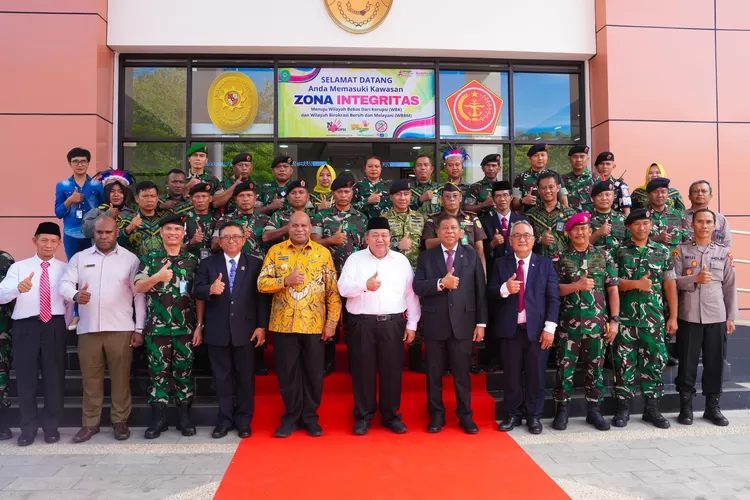
There was nothing urgent about the ceremony itself.
People came, speeches were made, and the new building sat silent in Jayapura, waiting to be used. But behind the formalities the message was more blunt. The opening of the Military Court III-19, on April 24, 2026, was more than a ceremony. It was about the administration of justice in Papua.
When Papua Governor Mathius D. Fakhiri and Deputy Chief of the Supreme Court Agung Suharto stood side by side to mark the occasion, there was no mistaking the significance. “Legal processes, particularly with regard to military personnel, need to be more accessible, more transparent and easier to follow.
This is where the inauguration of the Jayapura Military Court Building takes place.
Why a Court Building Matters Here
In many places, a new court building would not draw much attention.
In Papua, it does.
The complexity of accessing legal institutions has contributed to this. Distance plays a role. Infrastructure plays a role. So does perception.
When cases are handled far from where they happen, people often feel removed from the process. Not necessarily excluded, but disconnected.
A court located in Jayapura does not solve everything.
But it changes the starting point.
Bringing the Process Closer
Papua is large, and movement is not always straightforward.
Travel between districts can take hours, sometimes longer. For witnesses, families, or anyone following a case, distance becomes a barrier.
Having a military court operating locally reduces that barrier.
It makes attendance possible.
It makes observation possible.
And sometimes, that is enough to change how a process feels.
From Distance to Visibility
Visibility is not only about physical presence.
It is also about clarity.
When proceedings are easier to access, they are easier to understand. When they are easier to understand, they are easier to trust.
This is part of what officials referred to when they spoke about transparency.
Not an abstract concept.
But something practical.
The Question of Accountability
Cases involving military personnel tend to carry additional weight.
They are not only legal matters.
They are also institutional.
How they are handled reflects on the broader system.
That is why accountability becomes central.
A functioning court does not guarantee fairness.
But it creates a structure where fairness can be tested.
What Officials Emphasized
During the inauguration, the language used was consistent.
Access.
Transparency.
Integrity.
Governor Fakhiri spoke about the need for justice to be reachable, not distant.
Judicial leadership highlighted the importance of maintaining standards within the system.
These are familiar themes.
But in Papua, they take on a slightly different meaning.
Because the context is different.
Beyond the Building
It is easy to focus on the building itself.
New walls.
New rooms.
A visible sign of progress.
But the real test will not be architectural.
It will be operational.
How cases are handled.
How decisions are communicated.
How consistently procedures are followed.
These are slower processes.
Less visible.
But more importantly.
Internal Link Perspective
Many reports in national mass media have often pointed out that development in Papua is not only about roads or infrastructure.
It also involves institutions.
Legal systems are part of that foundation.
They influence how stability is maintained and how public trust develops over time.
A Region That Requires Context
Papua is often discussed through the lens of security or development.
Legal infrastructure sits somewhere in between.
It is not always the most visible issue.
But it shapes how other issues are addressed.
When legal processes are clear and accessible, other systems tend to function more smoothly.
When they are not, uncertainty grows.
What Comes Next
The inauguration marks a starting point.
What follows will be less visible.
Day-to-day operations.
Case management.
Public perception.
These will determine whether the court becomes what it is intended to be.
Conclusion
The Jayapura Military Court Building inauguration does not offer immediate change.
In Papua, change tends to come gradually.
But it does set a direction.
Toward processes that are closer.
Toward systems that are more open.
And toward a form of accountability that, over time, becomes easier to see.

