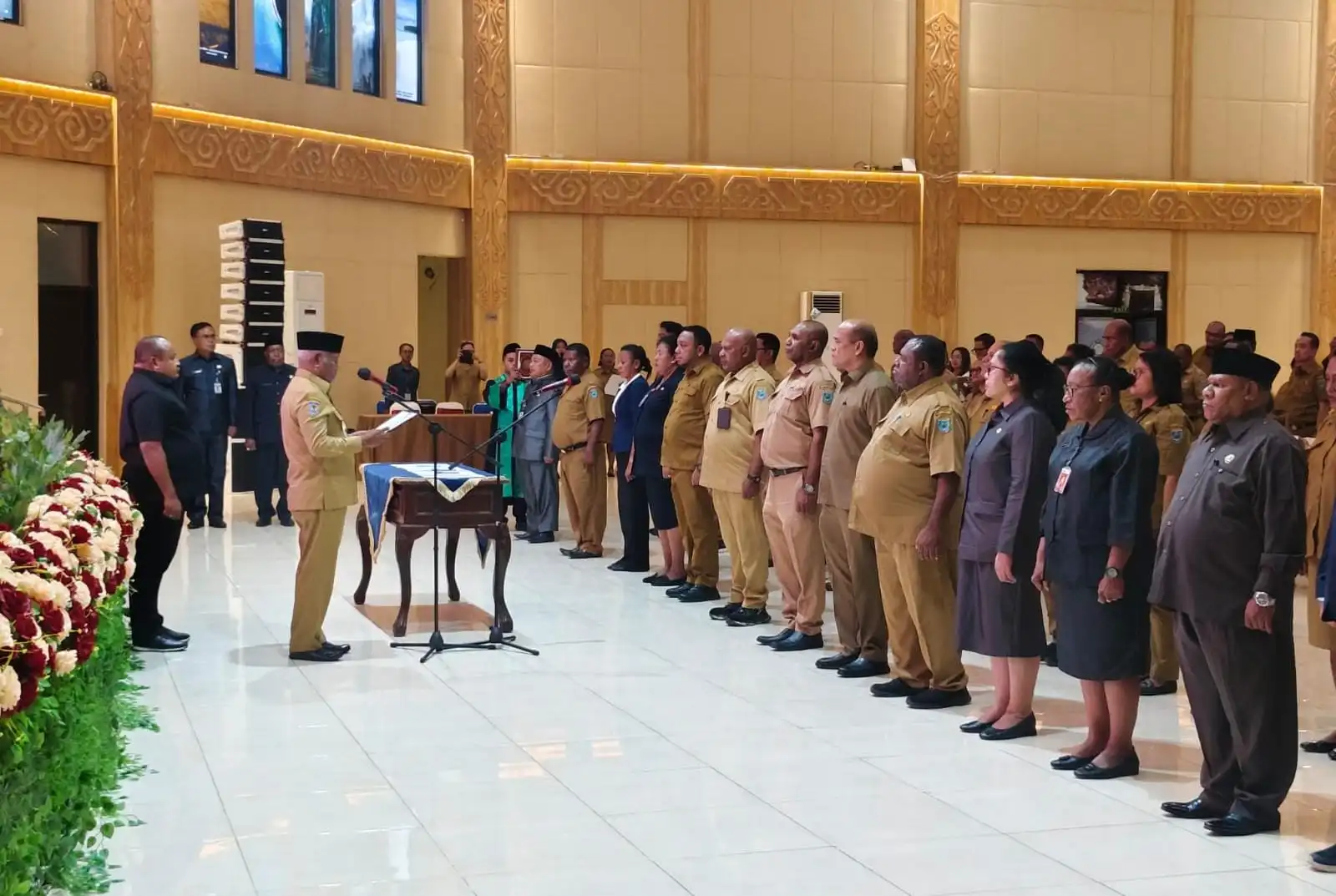
On March 16, 2026, the morning air in Manokwari carried a quiet sense of formality as government officials, civil servants, and invited guests gathered inside the provincial hall. The room was arranged with careful attention. Chairs were aligned in rows, nameplates set in place, and the provincial emblem stood prominently at the front.
Moments like this type are not unusual in government life. Ceremonies come and go, often marked by speeches and formalities. But for the individuals standing at the front of the room that day, the occasion felt different.
One by one, they stepped forward.
A total of 33 officials were officially sworn into new positions within the Papua Barat (West Papua) Provincial Government, a move that Governor Dominggus Mandacan described as part of a broader effort to strengthen professionalism, integrity, and public service delivery.
For those taking the oath, the moment was not only about career progression. It was about responsibility.
More Than Just a Promotion
From the outside, appointments like this can look routine.
A list of names. A reshuffle of positions. Another administrative update.
But inside the room, it felt different.
For the officials being sworn in, the moment carried a mix of pride and pressure.
Some smiled when their names were called. Others kept their expressions neutral, as if trying to absorb what the new role would demand.
One official, after stepping down from the front, paused briefly before returning to his seat. He adjusted his jacket, took a breath, and glanced toward his colleagues.
It was a small gesture, but it said a lot.
These positions are not symbolic. They come with expectations that begin immediately.
“This Is Not Just a Title”
In his remarks, Governor Mandacan did not speak for long, but his message was direct.
He reminded the newly appointed officials that their roles were not simply positions to hold.
“This is not just a title,” he said. “It is a trust.”
The words were simple, but they lingered in the room.
In many parts of Indonesia, including Papua Barat, public trust in institutions is shaped not by policies written on paper but by how officials behave in their daily work.
Do they show up? Do they listen? Do they respond?
Those are the questions people remember.
Faces Behind the System
The 33 officials came from different departments.
Some would oversee administrative functions. Others would manage specific programs in health, education, or regional development.
Their work might not always be visible to the public, but its effects are.
A delay in paperwork. A decision made quickly or slowly. A program that reaches a village or stops halfway.
All of it depends on people like them.
In places where infrastructure is still developing and distances between communities can be far, the role of local officials becomes even more important, as they facilitate communication, resource allocation, and the implementation of programs that directly impact the community’s access to essential services.
They are often the link between policy and reality.
Working in a Place Like Papua Barat
Papua Barat is not an effortless place to govern.
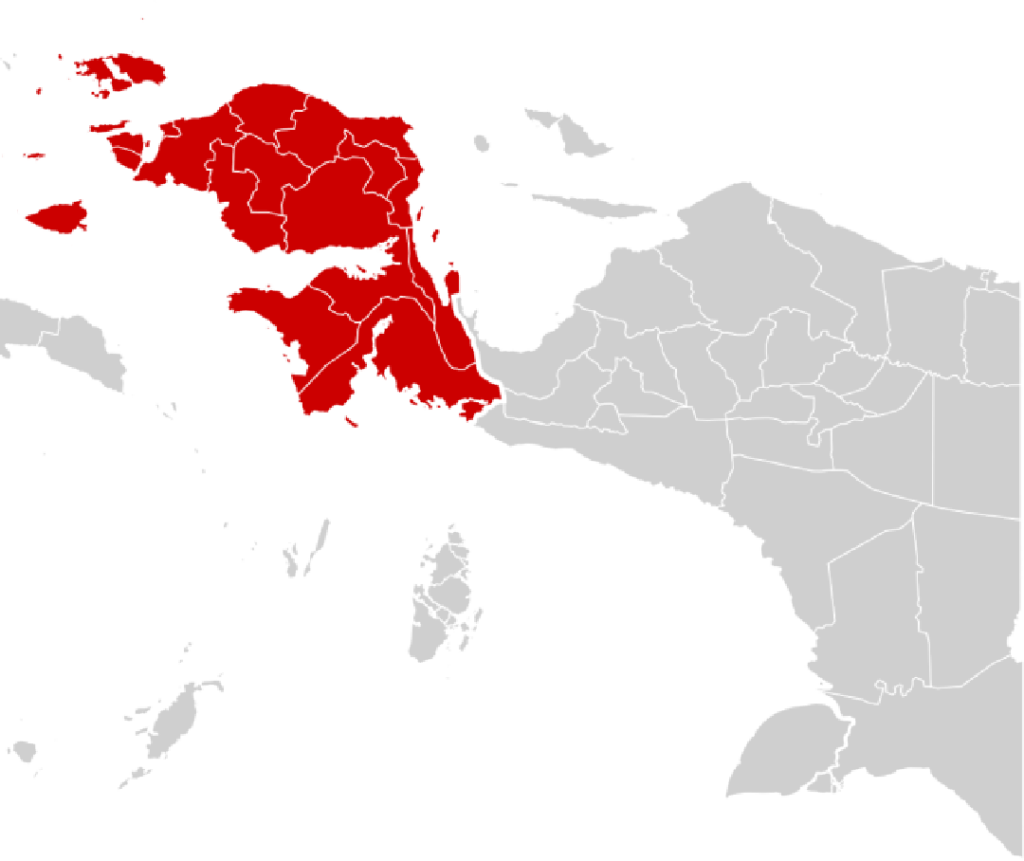
The province spans across coastal areas, islands, and inland regions, providing limited access. Reaching some communities requires hours of travel.
In those conditions, even simple administrative tasks can become complicated.
A document that needs approval might take days to move from one office to another. A program designed in Manokwari might face unexpected challenges when implemented in a remote district, such as logistical issues, lack of infrastructure, or resistance from local stakeholders.
This step is where professionalism becomes more than just a word.
It becomes a daily practice.
The Quiet Importance of Integrity
Governor Mandacan also spoke about integrity, though not in abstract terms.
He described integrity as something that is reflected in small decisions.
Choosing not to misuse authority. Being transparent about how resources are used. It is crucial to treat people fairly, even when no one is observing.
These are not dramatic actions.
But over time, they shape how people see their government.
In a region where development is ongoing and expectations are growing, that perception matters because it influences public trust and engagement with governmental initiatives.
After the Oath
Once the formal ceremony ended, the room slowly relaxed.
Officials stepped away from their positions, greeting colleagues and exchanging short conversations.
Some laughed quietly. Others remained thoughtful, as if already thinking about the work ahead.
A few gathered in small groups, discussing their new assignments.
“What’s your first task?” one asked another.
“Still figuring it out,” came the reply, followed by a brief smile.
It was a reminder that behind the structure of government, there are individuals adjusting to new responsibilities in real time.
What the Public Hopes For
For people outside the government, moments like this often come with simple expectations.
Those services will improve.
Those offices will respond more quickly.
Those programs will reach those who need them.
These expectations are not always easy to meet, especially in a region with complex challenges, such as socioeconomic disparities and limited access to resources. But they remain.
But they remain.
Because for most people, government is not an abstract concept.
It is something they encounter in everyday life.
When they visit a clinic. When they send their children to school. They apply for documents.
A Process That Never Really Stops
Appointments like this are part of a larger process.
Governments adjust, rotate, and evaluate their officials regularly.
Each change is meant to improve how the system works, particularly by enhancing efficiency, accountability, and responsiveness to public needs.
Whether it succeeds depends on what happens afterward.
Regarding the decisions made in offices, On the way, officials interact with the public. On how seriously they take the responsibilities given to them, which can significantly impact public trust and the effectiveness of governance.
Looking Ahead
As the sun moved higher over Manokwari, the ceremony became just another event in the city’s daily rhythm.
Outside, traffic continued. Shops opened. People went about their routines.
Inside government offices, however, something had shifted.
Thirty-three officials now carried new roles.
Their names may not be widely known, but their work will influence how policies are carried out and how services are delivered, particularly in areas such as public health, education, and infrastructure development.
In the end, that will define the significance of the day.
Not the ceremony itself.
But what comes after it?