
For decades, the towering mountains of Papua Tengah (Central Papua) have held one of the world’s richest mineral deposits. From these lands, copper and gold have flowed to global markets, generating vast wealth and strengthening Indonesia’s national economy. Yet for many Papuans living near the mining sites, prosperity has often felt distant. Roads remain limited, access to quality education and healthcare is uneven, and poverty continues to shape daily life in many communities.
This long-standing imbalance has fueled demands for a more just distribution of resource wealth. On December 16, 2025, that demand reached a decisive moment. President Prabowo Subianto signaled a clear commitment to improving welfare in Papua Tengah by agreeing to allocate 10 percent of PT Freeport Indonesia’s shares for the benefit of Papuan people. The decision was widely interpreted as a shift in how the state views resource ownership and regional justice in Papua.
Rather than being framed as a political concession, the move was presented as part of a broader national vision that places welfare, dignity, and inclusion at the center of development. For many Papuans, it was the first time that shared ownership in such a strategic national asset was openly discussed as a right tied to their land and identity.
The Meeting That Changed the Conversation
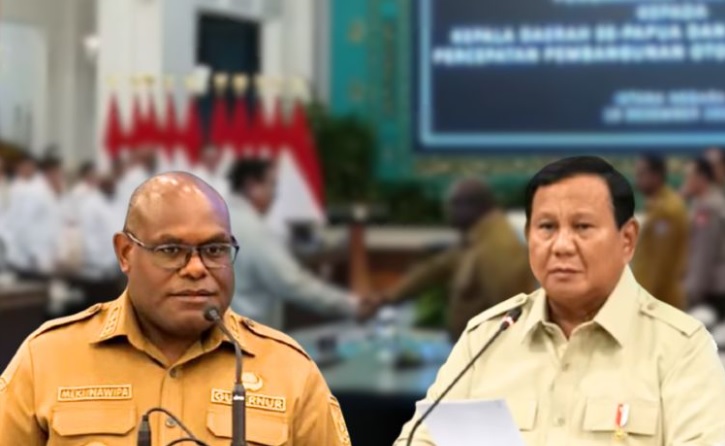
The announcement followed a high-level meeting at the Presidential Palace in Jakarta, attended by governors from across Papua. Among them was the Governor of Papua Tengah, Meki Fritz Nawipa, who formally raised the issue of releasing funds derived from the divestment of 10 percent of PT Freeport Indonesia’s shares.
Governor Nawipa emphasized that Papua Tengah has carried the social and environmental burden of mining for decades. While acknowledging the national importance of Freeport, he argued that local communities must see tangible, long-term benefits from the resources extracted from their ancestral lands. President Prabowo responded positively, agreeing in principle to move forward with the release of the divestment funds and instructing relevant ministries to begin the necessary processes.
This moment marked more than a policy discussion. It was a recognition that economic justice in Papua cannot be achieved solely through infrastructure projects or budget allocations. Ownership and participation in strategic industries are equally essential.
From Divestment Policy to People’s Welfare
The idea of divesting Freeport shares is not new. Indonesia has previously negotiated ownership changes to increase national control over the mining giant. What makes this proposal different is its explicit focus on indigenous Papuans as beneficiaries.
Under the proposed framework, the 10 percent stake would be managed through a regional entity representing Papuan interests. This mechanism is intended to ensure that the shares are not symbolic but actively generate income through dividends. Those funds could then be directed toward public services, economic empowerment programs, and long-term development initiatives.
President Prabowo stressed that this approach reflects his administration’s belief that welfare must be built from sustainable sources of income, not short-term assistance. By turning natural resource wealth into recurring revenue, the government hopes to create a financial foundation that supports future generations in Papua Tengah.
A National Vision with Local Roots
The Freeport share allocation is part of a wider strategy under President Prabowo to accelerate development in Papua. His administration has consistently emphasized that Papua requires special attention, not as a region to be managed from afar, but as a partner in national progress.
In national briefings, Prabowo has underlined that Papua’s development challenges are not rooted in a lack of resources but in unequal access to opportunity. Addressing this gap, he argues, requires structural solutions that allow local governments and communities to take greater control of their economic destiny.
By agreeing to the 10 percent share allocation, Prabowo has tied his welfare agenda to a concrete economic instrument. The move sends a signal that Papua’s future is not limited to being a site of extraction but can evolve into a region with financial leverage and decision-making power.
Why Papua Tengah Matters
Papua Tengah occupies a unique position in Indonesia’s political and economic landscape. It is home to the Grasberg mine, one of the largest contributors to state revenue in the mining sector. At the same time, it faces persistent challenges in human development indicators.
This contrast has long shaped local perceptions of injustice. Many residents see wealth leaving their region while basic services lag behind. The promise of share ownership directly addresses this imbalance by linking local welfare to the success of the mining operation itself.
Local leaders believe that when communities feel included in economic outcomes, social stability improves. Trust between the state and society grows, reducing tensions that have historically surrounded resource management in Papua.
Managing Expectations and Responsibilities
While optimism is growing, officials are careful to manage expectations. The release of shares and funds requires regulatory steps, shareholder approvals, and detailed governance arrangements. President Prabowo has emphasized the importance of transparency and accountability to prevent misuse and ensure that benefits reach the grassroots.
Governors across Papua have agreed that the management of these shares must involve strong oversight mechanisms. Discussions are ongoing about how dividends should be allocated, which sectors should be prioritized, and how indigenous communities can be meaningfully represented in decision-making.
The government has also stressed that this initiative must complement, not replace, existing development programs. Education, healthcare, infrastructure, and economic empowerment remain central pillars of Papua’s future.
Voices from Papua: Hope and Caution
In Papua Tengah, news of the decision has sparked a mix of hope and cautious optimism. Community leaders, church figures, and youth representatives have welcomed the recognition of Papuan rights while emphasizing the need for inclusive governance.
Many recall past promises that failed to deliver lasting change. For them, the success of the Freeport share allocation will depend on how transparently it is implemented and how directly it improves daily life.
Farmers hope for better access to markets and agricultural support. Parents want improved schools and healthcare facilities. Young people are looking for job opportunities that allow them to stay and build futures in their homeland.
A New Model for Resource Governance
If implemented effectively, the 10 percent Freeport share allocation could become a model for resource governance in Indonesia. It demonstrates how national interests and regional rights can be balanced without undermining economic stability.
For President Prabowo, the initiative aligns with his broader philosophy that national strength comes from inclusive growth. Regions that feel valued and empowered are more likely to contribute positively to national unity.
The policy also reflects a shift in how development is measured. Success is no longer defined solely by output or revenue, but by how equitably benefits are distributed.
Challenges That Still Lie Ahead
Despite its promise, the initiative faces challenges. Commodity prices fluctuate, and dividend income can vary from year to year. Effective financial planning will be essential to avoid overreliance on mining revenue.
There is also the challenge of ensuring that indigenous Papuans, rather than political or corporate elites, remain the primary beneficiaries. This requires continuous monitoring, strong institutions, and public participation.
President Prabowo has acknowledged these risks, stating that policy success depends not only on intention but also on discipline and integrity in execution.
Conclusion
The decision by President Prabowo Subianto to support the allocation of 10 percent of PT Freeport Indonesia’s shares to the people of Papua represents a significant moment in Indonesia’s approach to regional welfare and resource justice.
For Papua Tengah, it offers a pathway toward greater economic inclusion and dignity. For the nation, it tests whether long-standing inequalities can be addressed through structural reform rather than temporary solutions.
Whether this commitment transforms lives will depend on what follows. Clear rules, transparent management, and genuine community involvement will determine if this initiative becomes a turning point or another missed opportunity.
What is certain is that expectations are high. For the people of Papua Tengah, this decision has reopened a conversation about fairness, ownership, and the meaning of development. The coming years will reveal whether that conversation leads to lasting change.

