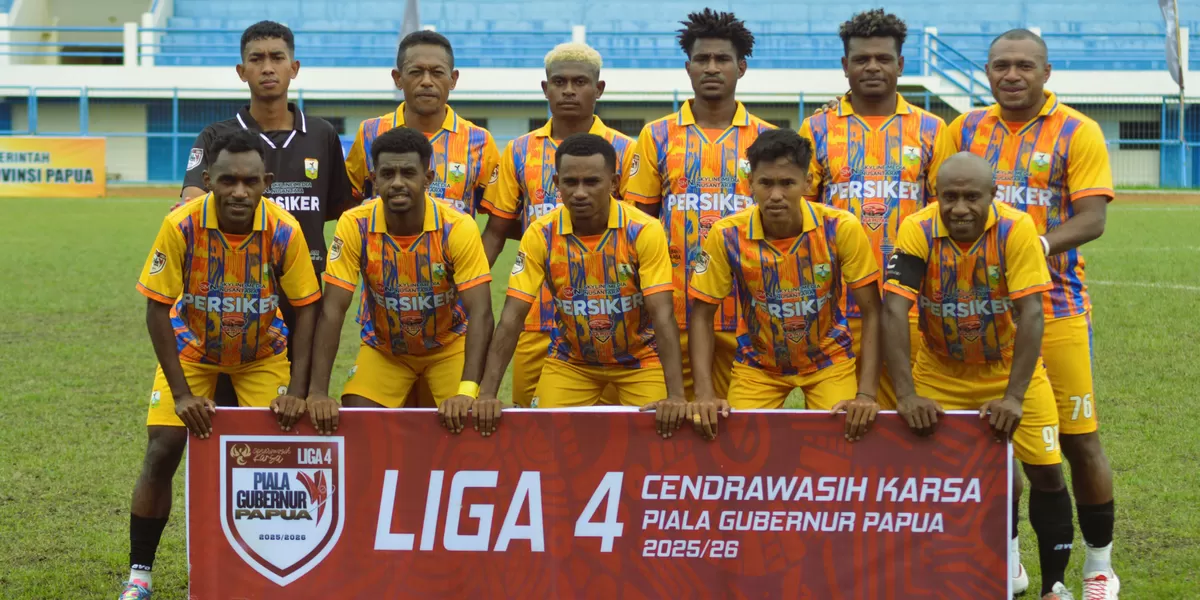
The 2025–2026 Papua League 4 season ended with a moment that felt bigger than football. In Papua, where sport often carries social meaning beyond competition, Persiker Keerom’s championship victory marked not only sporting success but also a growing commitment to youth development and community engagement. The tournament, supported by regional authorities and closely followed by local communities, has become part of a broader effort to channel energy, talent, and identity into constructive pathways.
For many observers, Papua League 4 is no longer just a regional competition. It is increasingly seen as a platform where sport, governance, and social cohesion intersect.
Persiker Keerom’s Victory Reflects Local Strength
On April 8, 2026, at Stadium of Barnabas Youwe, Sentani, Jayapura regency, the final whistle that confirmed Persiker Keerom as champions was met with celebration, but also recognition.
This was not an easy journey.
The team navigated a competitive field of clubs across Papua, demonstrating consistency and resilience throughout the tournament. Their performance reflected a level of preparation and discipline that is not always associated with lower-tier leagues.
For local supporters, the victory carried emotional weight.
“It shows what we can achieve,” one fan said after the final. “Not just as a team, but as a region.”
Persiker’s win also secured their place in the national stage, giving players the opportunity to compete beyond Papua. For young athletes, this transition is significant. It represents exposure, experience, and the possibility of a professional career.
Papua League 4 as a Development Platform
Papua League 4 has grown into more than a competition.
It is a system.
Organizers initially targeted participation from more than a dozen teams, reflecting growing interest in structured football development across the province. Over time, the league has become a consistent platform for identifying and nurturing talent.
This matters in Papua, where raw athletic ability is abundant but pathways to professional development have historically been limited.
By creating a structured competition, the league provides continuity.
Players train with purpose. Coaches develop strategies. Clubs build identity.
These elements form the foundation of long-term growth.
A Stage for Young Talent
For many players, League 4 is their first real exposure to organized competition at a provincial level.
The matches are not just about results.
They are about learning.
How to play under pressure. How to work as a team. How to adapt to different styles of play.
A local coach described the experience simply.
“This is where players begin to understand the game seriously.”
That understanding is critical.
It transforms football from a pastime into a pathway.
Government Support Strengthens Football Ecosystem
The success of the league is closely tied to institutional support.
Mathius Fakhiri has consistently emphasized the importance of sports as part of youth development in Papua. During the closing of the tournament, his message focused not only on congratulating the winners but also on recognizing the broader value of the league.
Football, in this context, is not isolated from development policy.
It is part of it.
Regional officials, including those representing the provincial government, highlighted that competitions like League 4 create space for young people to express themselves in positive ways.
This approach reflects a wider understanding.
Youth engagement reduces risk.
Opportunity creates direction.
Building Talent from the Ground Up
The involvement of the provincial government signals a shift toward more structured talent development.
Rather than relying solely on elite programs, the focus is expanding to grassroots levels.
League 4 plays a key role in this process.
It connects local clubs with broader systems. It creates visibility for players who might otherwise remain unnoticed. It also encourages communities to support sports as part of daily life.
A regional official noted that such initiatives are essential for long-term progress.
“Development starts from below,” he said. “If we want strong players, we must build strong foundations.”
Football, Identity, and Social Cohesion in Papua
In Papua, football carries cultural significance.
It brings people together.
Matches are not only attended by fans of specific teams. They become community events. Families gather. Local vendors participate. Conversations extend beyond the field.
In regions where social and economic challenges exist, sport can serve as a stabilizing force.
It provides structure.
It creates shared experiences.
It offers alternatives.
League 4, in this sense, contributes to social cohesion.
Youth Engagement Beyond the Field
One of the key benefits of structured competitions is engagement.
Young people who participate in sports are often less exposed to negative influences. They develop discipline, teamwork, and a sense of responsibility.
These qualities extend beyond football.
They influence education, employment, and community involvement.
Officials involved in the league have noted that keeping youth engaged in positive activities is part of a broader strategy for regional stability.
It is not always visible.
But it is impactful.
Linking Local Success to National Opportunity
Persiker Keerom’s qualification for the national stage represents more than a sporting milestone.
It is a connection.
Between local talent and national recognition.
For players, this transition provides exposure to higher levels of competition. It also opens doors for scouting and professional opportunities.
For Papua, it reinforces the idea that talent developed locally can compete nationally.
This is important for perception.
It shifts narratives.
From isolation to participation.
Challenges in Sustaining Development
Despite the positive momentum, challenges remain.
Infrastructure is one of them.
Access to quality training facilities varies across regions. Travel between districts can be difficult. Funding for local clubs is often limited.
There is also the question of continuity.
Programs like League 4 need to be sustained over time. Consistency is key to long-term development.
Without it, progress can slow.
However, the growing support from government and local stakeholders suggests that these challenges are being recognized.
And addressed.
A Broader Perspective on Development in Papua
Football may seem like a narrow focus.
But in Papua, it connects to broader themes.
Youth development.
Social cohesion.
Regional identity.
Government support for sports reflects an understanding that development is not only about infrastructure or economics.
It is also about people.
And how they engage with their environment.
Looking Ahead
The conclusion of the 2025–2026 season is not an endpoint.
It is part of a cycle.
Preparation for future competitions will begin soon. Clubs will regroup. Players will continue training.
For Persiker Keerom, the focus shifts to national competition.
For others, the goal is improvement.
Across Papua, the impact of the league will continue to unfold.
Conclusion: Football as a Pathway Forward
In Papua, the success of Papua League 4 and Persiker Keerom’s championship victory represent more than a sporting achievement.
They reflect a process.
One that combines community participation, government support, and individual ambition.
Through initiatives like this, football becomes more than a game.
It becomes a pathway.
For talent.
For opportunity.
And for a future where young people in Papua can see possibilities that extend beyond their immediate surroundings.