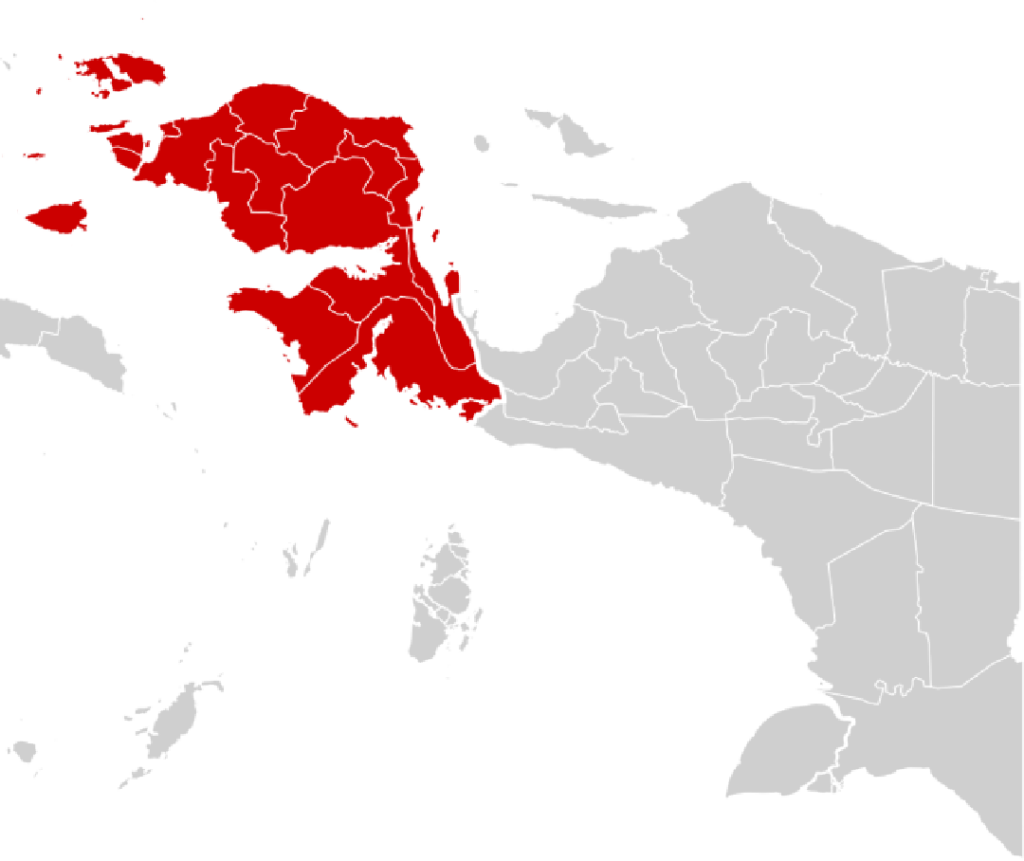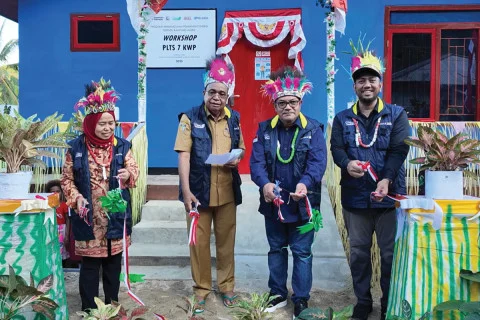
For decades, the people of Kampung Ausem, a remote village in the mountainous region of Papua, lived without access to reliable electricity. When the sun sank behind the dense border of tropical rainforest, darkness fell over the village, leaving homes lit only by kerosene lamps and small solar cells with limited power storage. Productivity stopped when night came. Children studied using dim, flickering lights, and families could not refrigerate food or store fish—their main economic product. The absence of electricity was more than just inconvenience; it was a barrier to equal opportunity.
Today, that story is changing. Through the initiative of PT Pelabuhan Indonesia (Pelindo), in collaboration with Institut Bisnis dan Ekonomi Kerakyatan (IBEKA) and various local stakeholders, Kampung Ausem is now illuminated by renewable and clean electricity. The introduction of a hybrid Micro-Hydropower Plant (PLTMH) and Solar Power Plant (PLTS) system has brought 24-hour electricity access, transforming the social and economic capabilities of residents.
Pelindo’s contribution is not simply a corporate social responsibility (CSR) gesture—it is a strategic effort to support inclusive development, bridge disparity between western and eastern Indonesia, and empower indigenous Papuan communities through sustainable infrastructure.
A Breakthrough for Equal Access: Why Electricity Matters in Remote Papua
Papua is home to vast natural beauty and cultural wealth, but its geographical challenges—mountain ranges, deep valleys, and limited transportation networks—often isolate villages like Ausem. Government infrastructure programs continue to expand, yet many rural areas remain outside the national power grid.
Electricity is foundational for meeting modern needs: education, healthcare, industry, communication, and food security. Without power, communities struggle to advance.
Before Pelindo’s involvement, villagers relied on small diesel generators that operated only a few hours a week due to expensive fuel supplies. Many families could not afford it, and noise and smoke polluted the environment. Limited energy meant limited productivity: fishermen and farmers were unable to preserve their harvest, and school activities were heavily restricted.
The arrival of clean, uninterrupted electricity marks the beginning of a new era. Electricity has become the gateway for development, enabling digital access, economic growth, and improved wellbeing.
Pelindo’s Commitment: Supporting Papua through Renewable Energy
As a state-owned enterprise operating as a national port operator, Pelindo plays a major role in strengthening maritime logistics to support the government’s mission of developing Indonesia from the periphery. However, Pelindo’s responsibility stretches beyond ports and shipping lanes.
Through its community development framework, Pelindo initiated the program to bring electricity to Kampung Ausem using a renewable energy-based hybrid scheme. The system combines:
- Micro-Hydropower (PLTMH) utilizing local river flows
- Solar Power Plant (PLTS) capturing abundant sunlight
- Battery storage system to ensure 24-hour reliability
- Distribution network powering homes, public facilities, and economic centers
This project is environmentally friendly, produces zero emissions during operation, and allows communities to maintain energy independence—vital in remote areas where fossil fuel logistics are complex and expensive.
According to public reporting, Pelindo designed the program with a long-term empowerment model, not merely infrastructure donation. The project includes training on power system maintenance, establishing local operators from villagers, and integrating sustainability education to build local ownership.
Empowering the Blue Economy: Economic Opportunities Begin to Grow
The arrival of electricity has rapidly opened new possibilities for community-based economic development. Most residents of Kampung Ausem rely on fisheries and river products—key potential resources within the regional blue economy framework.
With electricity available around the clock, villagers are now able to:
- Operate cold storage for fish and agricultural produce
- Extend business hours for small shops and micro-enterprises
- Utilize equipment such as ice-making machines and digital scales
- Increase productivity in food processing for value-added export
Before electricity, fish had to be sold immediately after catching or consumed the same day. Losses were frequent. Now, families can store products for several days, monitor market prices, and reduce waste.
Electricity has also increased digital access. Residents now charge mobile devices daily, communicate with buyers and relatives outside the village, and access government services online. Local students study at night, preparing for a competitive future previously inaccessible to them.
The empowerment of Kampung Ausem demonstrates Pelindo’s vision: infrastructure must not only be built but must also transform lives and ignite economic resilience.
Environmental Sustainability: Reducing Carbon Emissions in Rural Energy
Pelindo’s renewable system does more than provide power—it replaces polluting generators and reduces greenhouse gas emissions. Diesel use was previously the only realistic option, and transporting fuel to the village required costly manual logistics over great distances.
Through hydropower and solar integration:
- Pollution and noise have been eliminated
- Operational costs have decreased drastically
- Papua’s forests and rivers remain protected
The program aligns with Indonesia’s national commitment to climate action and transition to low-carbon energy. It also aligns with global Sustainable Development Goals (SDGs), including:
- SDG 7 – Affordable and Clean Energy
- SDG 8 – Decent Work and Economic Growth
- SDG 10 – Reduced Inequalities
- SDG 13 – Climate Action
This environmentally sensitive approach is critical in Papua, a region rich in biodiversity and indigenous knowledge.
Building Social Impact: From Light to Hope
The arrival of electricity has had profound social effects. At night, community activities continue—church services, cultural gatherings, and community meetings now take place after sunset. Schools can operate computer learning, and healthcare facilities are better equipped to store medicine and operate medical devices.
Women and youth have gained new opportunity: home industries such as weaving, food processing, and retail trade expand with longer productive hours. Local micro-entrepreneurs are emerging.
Children now dream differently. Where darkness once limited their world, light now expands their imagination.
Ausem’s transformation illustrates that infrastructure is deeply human: when basic needs are met, dignity and hope evolve naturally.
Collaboration as the Foundation of Success
This program is a successful model of multi-stakeholder cooperation, combining Pelindo’s resources, IBEKA’s technical expertise, and local government and community support. Villagers were involved throughout the design process—strengthening community ownership that ensures long-term sustainability.
Rather than imposing a system from outside, Pelindo’s approach was participatory, respectful, and empowering, honoring local cultural values and decision-making traditions.
Conclusion
The electrification of Kampung Ausem is more than an infrastructure project. It is a symbol of national commitment to bridge inequality and enable prosperity for all Indonesians—regardless of geography.
Pelindo’s initiative proves that development is strongest when it integrates sustainability, equity, and empowerment. With one village illuminated, a larger transformation is already under way. Kampung Ausem is becoming a model that can be replicated across remote Papua and other isolated regions in the archipelago.
Light has arrived—and with it, opportunity.